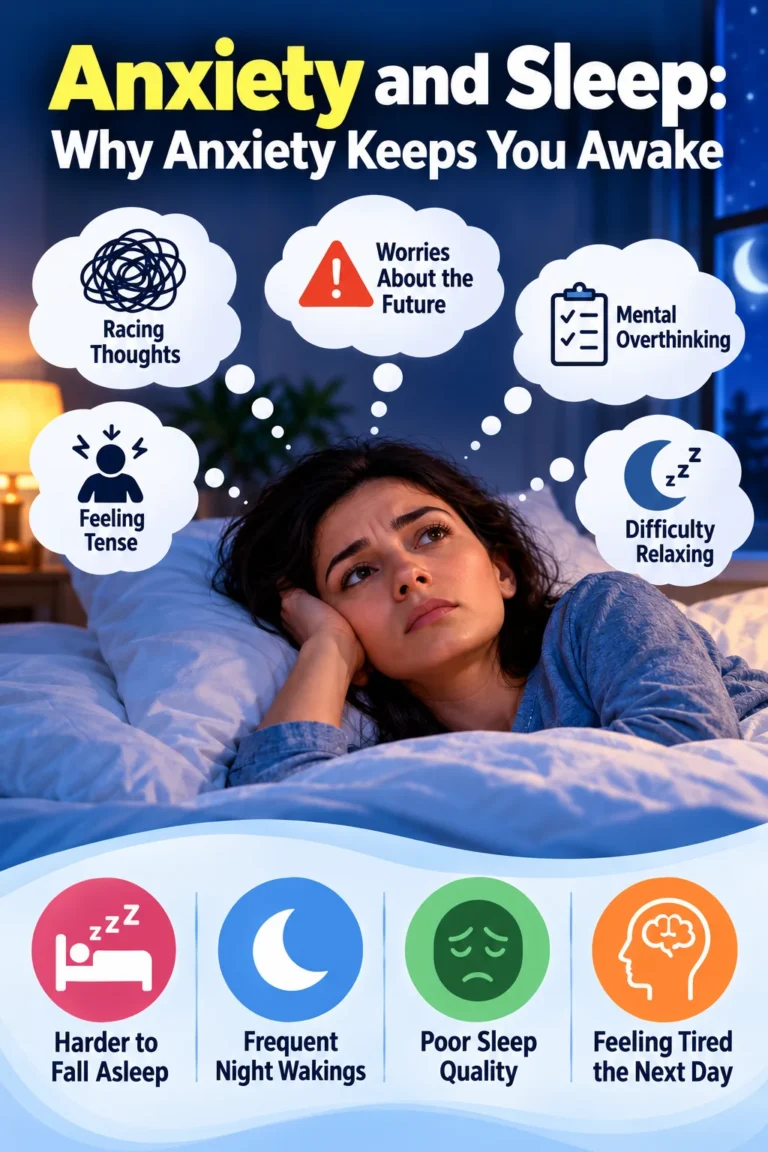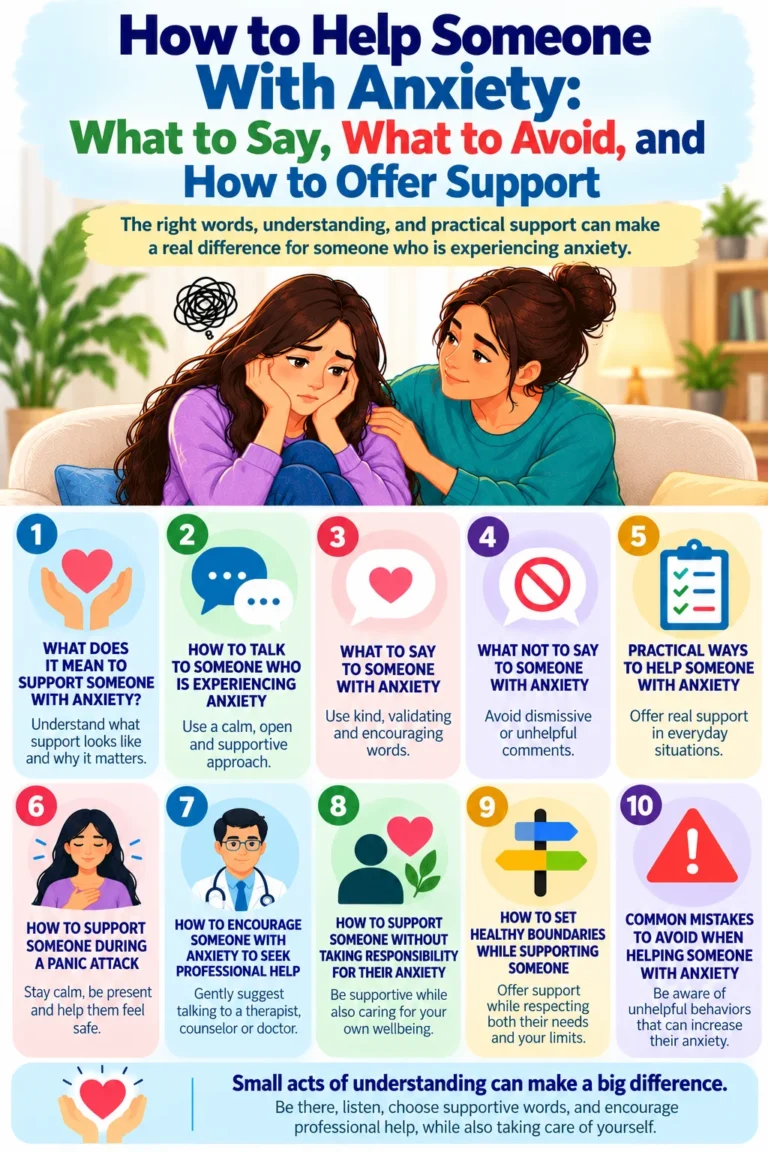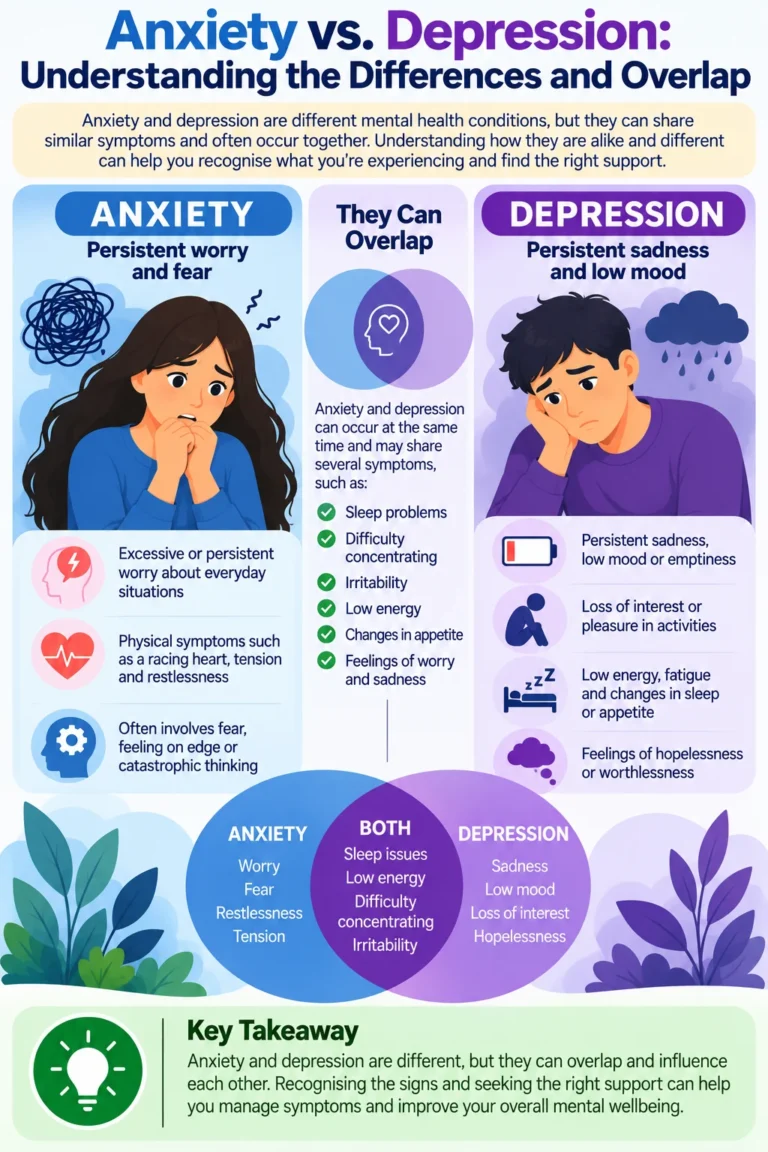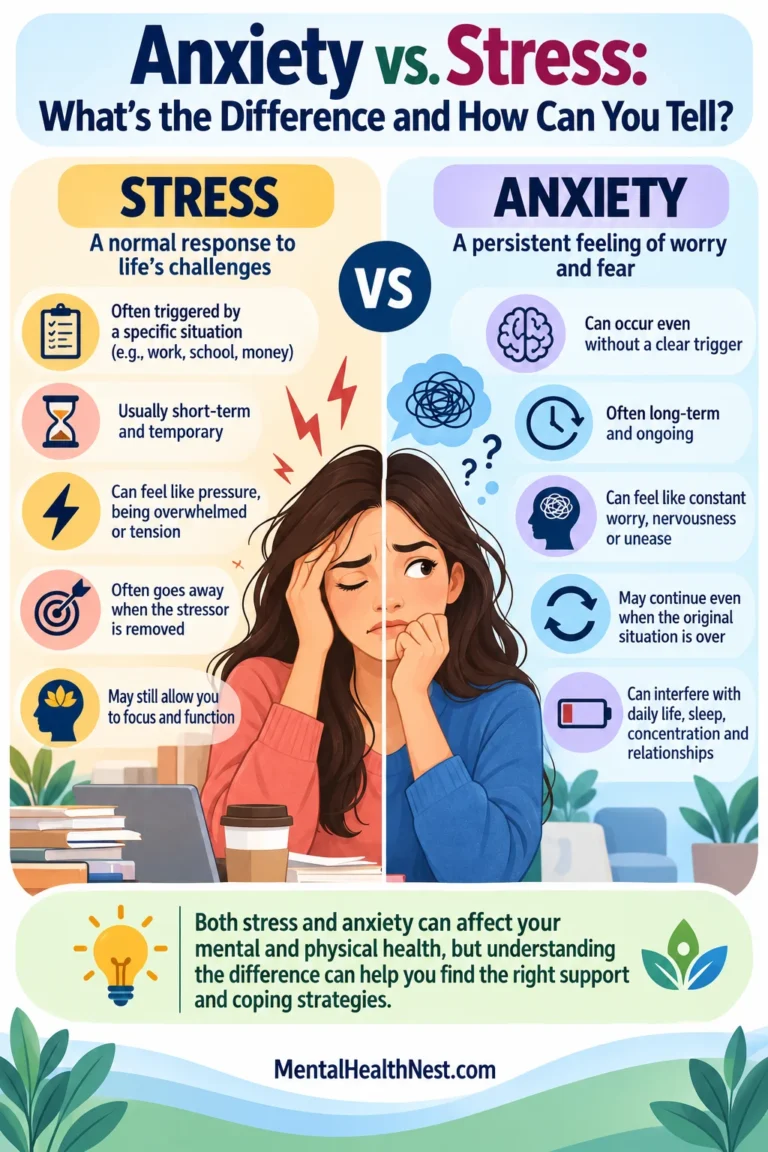
Introduction
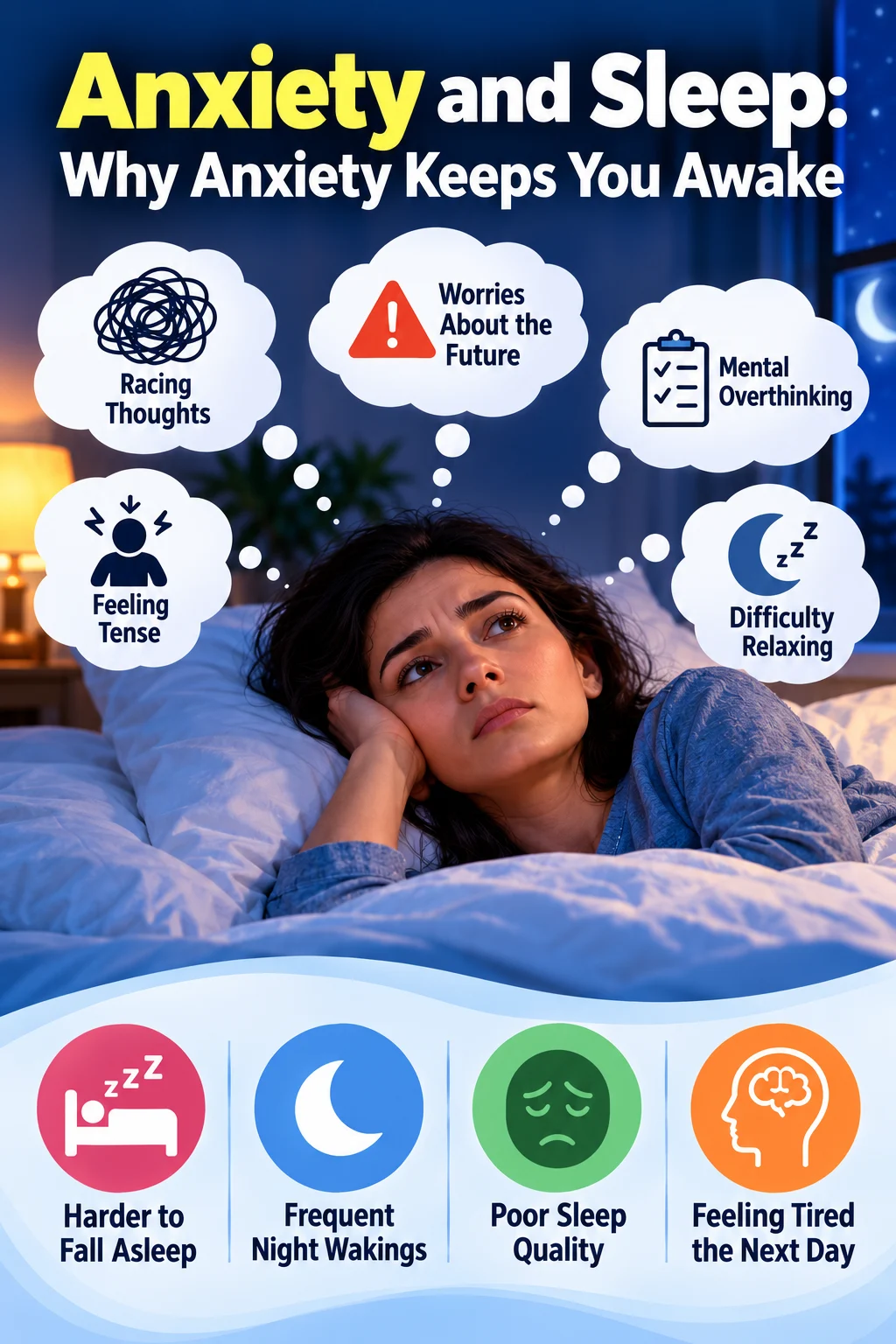
Have you ever felt exhausted at the end of the day, looked forward to going to bed, and then found that your mind seemed unwilling to slow down? Perhaps you begin thinking about tomorrow’s responsibilities, replaying a difficult conversation, worrying about someone you care about, or wondering whether everything will work out. The room is quiet, but your thoughts keep moving. For some people, this is where anxiety and sleep begin to affect each other. The more you worry, the harder it may become to settle down. When sleep does not come easily, you might start worrying about how tired you will feel the next morning, whether you will manage your responsibilities, or whether another difficult night lies ahead. This experience can be frustrating, especially when you are doing everything you can to rest. You may even feel pressure to fall asleep quickly, only to become more aware of the passing minutes. If this sounds familiar, it does not mean that you are failing at sleep or that something is necessarily wrong with you. Anxiety can contribute to sleep difficulties because worry and heightened alertness can make it harder to relax. At the same time, insufficient or disrupted sleep may make it more difficult to manage emotions and everyday stress. The relationship can work in both directions, although the reasons for sleep difficulties vary from person to person. It is also important to remember that not every restless night is caused by anxiety. Work pressures, changes in routine, physical discomfort, medications, other health conditions, and sleep disorders can all contribute to difficulty sleeping. Understanding the possible causes is more helpful than assuming that one explanation fits everyone. In this guide, we will explore why anxious thoughts may become more noticeable at bedtime, how worry about sleep can develop into a frustrating cycle, and what practical approaches may help. We will also look at the difference between occasional sleep difficulties and persistent problems that deserve professional attention. Whether you are encountering this experience for the first time or have been struggling with it for a while, the aim is to help you understand what may be happening without adding more pressure to an already difficult night. Better understanding can be a useful starting point for finding an approach that fits your circumstances.
Quick Answer
Anxiety can make it harder to fall asleep or return to sleep because worry and heightened alertness may keep the mind active when the body needs rest. Concerns about daily responsibilities, future events, or sleep itself can contribute to this pattern. Addressing anxious thoughts, developing a supportive sleep routine, and seeking professional help when difficulties persist may help improve sleep.
KEY TAKEAWAYS
- Anxiety can interfere with sleep. Worry and heightened alertness may make it difficult to settle down at bedtime or return to sleep after waking.
- Nighttime worry can feel particularly noticeable. When daily activities quiet down, unresolved concerns and thoughts about the future may become more prominent.
- Sleep difficulties and anxiety can reinforce each other. Anxiety may disrupt sleep, while insufficient sleep can make managing emotions and everyday stress more difficult.
- Worrying about sleep can add another layer of pressure. Becoming preoccupied with how quickly you fall asleep or how tired you will feel tomorrow may make bedtime more stressful.
- There is no single explanation for every restless night. Stress, health conditions, medications, changes in routine, and sleep disorders can also affect sleep.
- Practical approaches may help. Relaxation exercises, a consistent sleep schedule, and strategies for responding to anxious thoughts may support healthier sleep habits.
- Persistent difficulties deserve attention. If anxiety or sleep problems regularly affect daily life, a qualified healthcare professional can help assess possible causes and discuss appropriate options.
- Professional support is available. Evidence-based psychological treatments can help address anxiety and persistent insomnia, depending on the individual’s needs.
1. Why Anxiety Can Make It Difficult to Fall Asleep
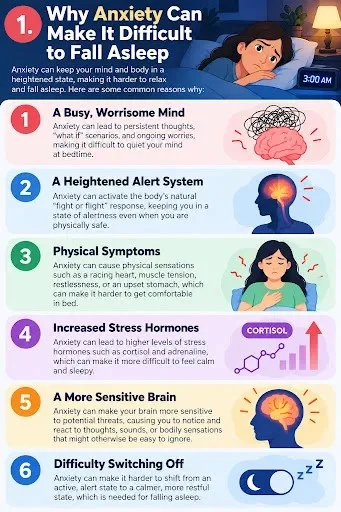
Infographic explaining how anxious thoughts, mental tension, and physical alertness can make it difficult to fall asleep at night.
Anxiety can make it difficult to fall asleep because worry, mental tension, and heightened alertness may keep the mind active when the body needs rest. Instead of gradually settling down, a person may continue thinking about problems, anticipating future difficulties, or feeling unable to relax. These experiences can delay sleep, although anxiety is only one of several possible reasons someone may struggle to fall asleep.
WHY WORRY CAN KEEP THE MIND ACTIVE
During the day, work, conversations, household responsibilities, and other activities give your attention somewhere to go. When you finally lie down, those distractions become less prominent. Thoughts that received little attention earlier may suddenly seem more noticeable.
You might start reviewing something you said, thinking about an unfinished task, or anticipating a conversation you need to have tomorrow. One thought can lead to another, making it difficult to shift your attention away from concerns and toward rest.
The problem is not necessarily the presence of thoughts themselves. Everyone experiences thoughts at bedtime. The difficulty arises when worrying becomes persistent, emotionally demanding, or hard to disengage from.
For someone already feeling anxious, the quiet of the bedroom may leave more room for these concerns to occupy their attention.
HOW HEIGHTENED ALERTNESS AFFECTS SLEEP
Anxiety can involve a state of increased alertness in which the mind and body remain prepared to respond to possible problems. A person may feel tense, restless, or unable to relax even when there is no immediate danger.
This state can make the transition to sleep more difficult. You may feel physically tired but mentally alert, notice tension in your muscles, or find yourself repeatedly checking whether you are becoming sleepy.
The National Institute of Mental Health identifies restlessness, difficulty relaxing, and trouble falling or staying asleep among symptoms that may occur in generalized anxiety disorder. However, these experiences alone do not establish that someone has an anxiety disorder.
WHY TRYING HARDER TO SLEEP MAY NOT HELP
When sleep does not come quickly, it is understandable to want to make it happen. You might repeatedly check the time, calculate how many hours remain before morning, or tell yourself that you must fall asleep immediately.
Although these reactions are understandable, worrying about whether you will get enough sleep can add another source of stress. The National Heart, Lung, and Blood Institute notes that worry about sleep and clock-watching can increase the risk of insomnia or make it worse.
This does not mean that you are deliberately keeping yourself awake. It means that concern about sleep can sometimes become part of the difficulty itself.
For example, someone who needs to get up early may begin the night feeling concerned about an important meeting. After lying awake for a while, the concern may shift from the meeting to the consequences of being tired the next day. Sleep then becomes another problem to solve rather than a natural process that the person can allow to unfold.
ANXIETY IS NOT THE ONLY POSSIBLE CAUSE
Difficulty falling asleep can also be associated with irregular schedules, caffeine, medications, physical discomfort, other health conditions, and sleep disorders. Sometimes several factors contribute at once.
A difficult night does not automatically mean that you have insomnia or an anxiety disorder. What matters is the broader pattern, including how frequently the problem occurs, how long it has continued, and whether it affects your daily life.
If sleep difficulties persist or interfere with everyday functioning, a healthcare professional can help assess possible causes and discuss appropriate support.
Understanding why anxiety may interfere with sleep provides a useful starting point. The next question is why these difficulties can sometimes feel more noticeable after the day has ended.
2. Why Anxiety May Feel Stronger at Night
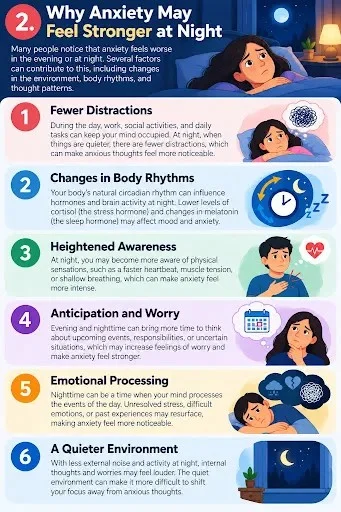
Infographic illustrating why nighttime quiet, fewer distractions, accumulated daily stress, and worry may make anxiety feel more intense before sleep.
Anxiety may feel stronger at night because daytime distractions become less prominent, leaving more room for worries, unresolved concerns, and thoughts about the future. For some people, the quiet of bedtime makes these thoughts easier to notice. This does not necessarily mean anxiety is medically worse at night; the experience can vary depending on a person’s circumstances, stress levels, and sleep patterns.
WHEN THE DAY BECOMES QUIET, WORRIES CAN BECOME MORE NOTICEABLE
During the day, conversations, work, family responsibilities, and everyday activities compete for your attention. You may still feel anxious, but you have other things to concentrate on.
At night, those distractions often fade. Your attention may turn toward concerns that were pushed aside earlier, such as an unfinished responsibility, a difficult interaction, a health concern, or an uncertain situation awaiting an answer.
For example, someone who spent the day managing work responsibilities may begin thinking about an upcoming deadline as soon as they lie down. Another person may replay a conversation and wonder whether they said something wrong. These thoughts can feel more prominent when there is little else demanding attention.
The quiet itself is not necessarily the cause of anxiety. Rather, it may make existing concerns more noticeable.
WHY UNCERTAINTY CAN FEEL DIFFICULT AT BEDTIME
Anxiety often involves concern about what might happen rather than what is happening at that moment. At bedtime, there may be little opportunity to resolve tomorrow’s problems immediately, obtain reassurance, or take practical action.
Your mind might keep returning to questions such as, “What if things go wrong tomorrow?” or “What happens if I cannot manage everything?” Repeatedly thinking through possible outcomes may feel like preparation, but it does not always produce a useful answer.
This is particularly frustrating when you recognise that worrying is not helping but still find it difficult to redirect your attention.
You do not need to solve every uncertainty before you are allowed to rest. Some concerns can be addressed the following day, when you have more information, energy, or practical options available.
HOW STRESS DURING THE DAY CAN CARRY INTO THE NIGHT
A demanding day does not automatically end when you leave work, finish studying, or complete household responsibilities. Emotional strain can remain with you after the immediate situation has passed.
The National Institute of Mental Health explains that anxiety symptoms can fluctuate and may become worse during periods of stress. For some people, this can include difficulty relaxing or sleeping.
Consider someone who has spent the day dealing with family disagreements. Even after the conversation ends, they may continue thinking about what happened, what it means, or what they should say next. The body may be ready for rest while the person’s attention remains focused on the stressful experience.
This response is not a personal failure. It can reflect the difficulty of mentally disengaging from something that still feels unresolved.
WHY A DIFFICULT NIGHT CAN AFFECT THE NEXT BEDTIME
Anxiety about sleep can sometimes become an additional source of worry. After a night of poor rest, you may begin the following evening hoping that sleep will come easily. If it does not, concern about the next day’s responsibilities can return.
The National Heart, Lung, and Blood Institute notes that worrying about getting enough sleep and watching the clock can increase the risk of insomnia or make existing difficulties worse.
This does not happen to everyone, and one restless night does not mean that a lasting problem is developing. However, when concern about sleep becomes persistent, it can make bedtime feel increasingly pressured.
We will examine this pattern in greater detail in the section on the cycle of nighttime worry and sleep-related anxiety.
NIGHTTIME ANXIETY DOES NOT HAVE THE SAME CAUSE FOR EVERYONE
Some people notice more worry at bedtime, while others experience anxiety during the day, wake during the night feeling unsettled, or have no clear pattern at all.
Sleep timing, ongoing stress, health conditions, medications, and other sleep-related difficulties may all influence what someone experiences. It is therefore important not to assume that nighttime anxiety always has one explanation.
If anxiety regularly interferes with sleep or affects your ability to function during the day, a qualified healthcare professional can help you explore possible causes and appropriate support.
Recognising why worries may become more noticeable at night can help explain the experience without making it seem inevitable. The next section looks more closely at the mental and physical responses that may occur when anxiety and sleep difficulties overlap.
3. What Happens in the Mind and Body When Anxiety Keeps You Awake?
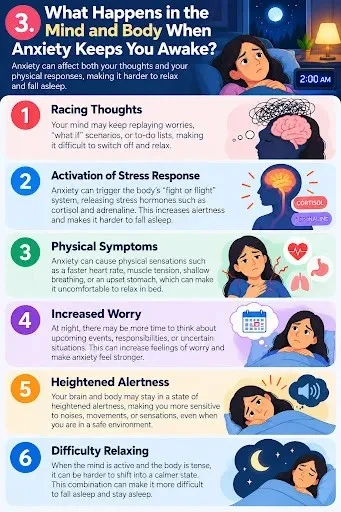
Infographic showing how anxious thoughts, heightened alertness, muscle tension, and physical arousal can interfere with relaxation and sleep.
When anxiety keeps you awake, the mind may remain focused on possible problems while the body experiences increased alertness, muscle tension, or other stress-related responses. These reactions can make it harder to relax and settle into sleep. The intensity varies from person to person, and physical symptoms during a restless night do not automatically indicate an anxiety disorder.
HOW THE BRAIN RESPONDS TO WORRY
Anxiety often involves anticipating what might happen next. You may mentally rehearse a difficult conversation, imagine several possible outcomes, or repeatedly review something you cannot resolve immediately.
When these thoughts feel important or threatening, your attention may keep returning to them. Even when you recognise that you need sleep, part of your mind may continue looking for answers or trying to prepare for tomorrow.
This can be mentally tiring. You may feel physically exhausted but still find it difficult to disengage from your concerns.
Anxiety does not mean that the brain is deliberately working against you. It reflects a response to perceived uncertainty or threat that can become difficult to switch off when worries persist.
WHY THE BODY MAY REMAIN ON ALERT
Anxiety can activate the body’s stress response. This response helps prepare you to respond to challenges by increasing alertness and producing physical changes.
MedlinePlus explains that the stress response can increase heart rate, blood pressure, and blood glucose while making the body more alert and ready to act.
At bedtime, some people may notice:
- Muscle tension or difficulty getting physically comfortable.
- A faster heartbeat or a heightened awareness of their heartbeat.
- Restlessness or a feeling of being unable to relax.
- Changes in breathing or a sense of physical tension.
- Stomach discomfort or other stress-related physical sensations.
Not everyone experiences these symptoms, and they can have causes other than anxiety. New, severe, persistent, or concerning physical symptoms should not automatically be attributed to stress; a healthcare professional can help determine what may be causing them.
WHY FEELING TIRED DOES NOT ALWAYS MEAN FEELING READY FOR SLEEP
Physical tiredness and mental alertness can occur together. You may have had a demanding day and genuinely need rest, yet your thoughts remain occupied with concerns or your body still feels tense.
For example, imagine finishing a stressful day at work. You turn off the lights and settle into bed, but your mind returns to an unfinished task. You begin thinking about how you will complete it tomorrow, then worry about whether you will have enough time. Although you are tired, your attention remains focused on the problem.
This mismatch between tiredness and alertness can feel confusing. However, it does not mean that you have lost the ability to sleep. It means that several processes influencing rest may not be working together comfortably at that moment.
HOW SLEEP LOSS MAY AFFECT THE FOLLOWING DAY
Sleep supports attention, memory, emotional functioning, and everyday decision-making. When sleep is insufficient or repeatedly interrupted, you may find it harder to concentrate, manage frustration, or respond calmly to ordinary challenges.
For someone already dealing with anxiety, these difficulties may add to concerns about work, relationships, studies, or other responsibilities. Feeling tired can also make the next night seem more important, especially if you are worried about repeating the experience.
However, the relationship is not identical for everyone. Anxiety can contribute to poor sleep, and poor sleep can make emotional difficulties harder to manage, but other factors may also be involved.
UNDERSTANDING YOUR EXPERIENCE WITHOUT JUMPING TO CONCLUSIONS
A restless night, racing thoughts, or occasional physical tension cannot establish a diagnosis. Similar experiences may occur during temporary stress, illness, medication changes, or other sleep and health conditions.
If these difficulties happen frequently, persist over time, or interfere with daily activities, consider discussing them with a qualified healthcare professional. They can assess your symptoms, consider other possible explanations, and help identify appropriate next steps.
Understanding the mind–body connection can make nighttime experiences less confusing. The next section examines how worry about sleep itself can sometimes become part of a repeating pattern.
4. The Cycle of Nighttime Worry and Sleep-Related Anxiety
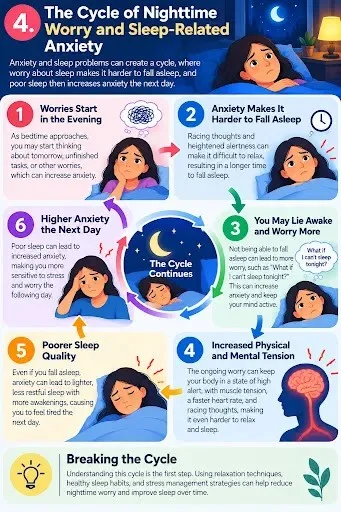
Infographic illustrating the cycle of nighttime worry, difficulty falling asleep, frustration about lost sleep, and increased anxiety the following night.
The cycle of nighttime worry and sleep-related anxiety occurs when difficulty sleeping leads to worry about sleep, and that worry makes it harder to relax and fall asleep. A person may begin the night concerned about an everyday problem and later become anxious about being awake. Over time, bedtime itself can become associated with pressure and frustration, potentially making sleep more difficult.
HOW THE WORRY–SLEEP CYCLE DEVELOPS
Imagine that you have an important responsibility the next morning. You go to bed hoping to get enough rest, but your mind remains active. As the minutes pass, you start thinking about how tired you will feel if you do not fall asleep soon.
Now there are two concerns competing for your attention: the original responsibility and the fear of not sleeping well enough to manage it.
This can create a repeating pattern:
- An initial worry: You go to bed thinking about something stressful or uncertain.
- Difficulty falling asleep: Your thoughts continue, and you remain awake longer than expected.
- Concern about sleep: You begin calculating how much rest you may lose or how you will feel tomorrow.
- Increased pressure: You try harder to make yourself fall asleep, becoming more focused on whether sleep is happening.
- Further difficulty relaxing: The added worry keeps your attention on the problem, making it harder to settle down.
Not everyone experiences all these stages, and the pattern does not explain every sleep difficulty. However, research and guidance from the National Heart, Lung, and Blood Institute recognise that worrying about sleep and watching the clock can worsen insomnia.
WHY WORRYING ABOUT TOMORROW’S TIREDNESS CAN ADD PRESSURE
After a poor night’s sleep, it is understandable to worry about the next day. You may have work to complete, responsibilities to manage, or plans that require concentration.
The difficulty arises when concern about tomorrow becomes a constant assessment of whether you are sleeping quickly enough tonight.
Thoughts such as “I must fall asleep immediately” or “Tomorrow will be terrible if I do not get enough sleep” can make bedtime feel like a test you must pass. That pressure may increase frustration rather than help you rest.
A more balanced perspective is to recognise that a difficult night can affect how you feel without determining exactly how the entire next day will unfold. You do not have to predict every consequence of being tired while you are lying in bed.
HOW THE BEDROOM CAN BECOME ASSOCIATED WITH FRUSTRATION
When sleepless nights happen repeatedly, some people begin anticipating difficulty as bedtime approaches. They may enter the bedroom already wondering whether they will sleep, remember previous frustrating nights, or become alert to every sign that they are still awake.
As a result, going to bed may begin to feel less like an opportunity to rest and more like an experience to worry about.
This is one reason persistent insomnia may require more than simply trying harder to sleep. The National Heart, Lung, and Blood Institute describes cognitive behavioral therapy for insomnia (CBT-I) as a treatment that can help address thoughts and behaviors that contribute to ongoing sleep difficulties.
This does not mean that you have created the problem yourself. The pattern can develop gradually, and it may be influenced by stress, health circumstances, and other factors.
WHY RECOGNISING THE CYCLE MATTERS
Recognising the pattern can help separate two different concerns: the original worry and the additional pressure created by not sleeping.
For example, if you are concerned about an upcoming meeting, the meeting may be the issue that needs attention. Worrying repeatedly about the number of hours remaining before morning is a separate concern that may not help you prepare.
Understanding this distinction can make it easier to consider appropriate responses without blaming yourself for being awake.
If the pattern continues, affects your daily functioning, or causes substantial distress, a healthcare professional can help assess whether anxiety, insomnia, another health concern, or several factors are contributing.
The next section explores the kinds of thought patterns that may keep the mind occupied at bedtime, including anticipating problems, replaying past events, and feeling a need to resolve uncertainty before resting.
5. Common Thought Patterns That Can Keep You Awake
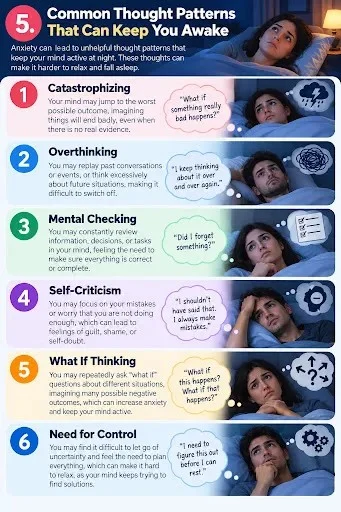
Infographic highlighting common nighttime thought patterns, including overthinking, anticipating problems, worst-case scenarios, and worrying about the consequences of poor sleep.
Certain thought patterns can make it harder to settle down at bedtime by keeping attention focused on worries, uncertainty, or unresolved experiences. These may include imagining worst-case outcomes, replaying conversations, mentally rehearsing tomorrow’s responsibilities, or feeling that every problem must be solved before sleep. Such thoughts can occur during ordinary stress as well as anxiety, and they do not automatically indicate a mental-health condition.
1. ANTICIPATING EVERYTHING THAT COULD GO WRONG
When you are anxious, your mind may focus on possible future problems. You might imagine making a mistake at work, receiving disappointing news, or being unable to manage an upcoming responsibility.
Thinking ahead can sometimes help with preparation. However, repeatedly imagining negative outcomes without reaching a useful decision can leave you mentally occupied long after the situation can be addressed.
For example, you may have a presentation the following morning. Instead of reviewing your preparation once and allowing yourself to rest, you repeatedly imagine forgetting important information or answering a question incorrectly.
The difficulty is not that you are thinking about the future. It is that the same concern may keep returning without producing anything new or useful.
2. REPLAYING CONVERSATIONS AND PAST EVENTS
Some people find themselves reviewing conversations after the day has ended. You might wonder whether you sounded rude, whether someone misunderstood you, or whether you should have responded differently.
This kind of repeated thinking is sometimes called rumination. It involves dwelling on experiences or concerns, often without reaching a clear resolution.
A conversation that lasted only a few minutes may occupy your attention for much longer as you reconsider different interpretations of what happened.
It is reasonable to reflect on important interactions. However, repeatedly revisiting the same details at bedtime may increase distress without providing additional information about what the other person actually thought or intended.
3. FEELING THAT EVERY PROBLEM MUST BE SOLVED BEFORE RESTING
When something feels unresolved, you may find it difficult to set it aside. Your mind might keep searching for the right answer, the perfect response, or a way to guarantee that tomorrow will go smoothly.
This can be especially frustrating when the situation depends on another person, incomplete information, or circumstances beyond your control.
For instance, you may be waiting for an important decision and repeatedly consider every possible outcome. Because you cannot obtain the answer immediately, the thinking continues without bringing you closer to a resolution.
Some problems genuinely require attention. Others can be addressed only when circumstances change. Recognising that distinction may help you understand why continued thinking does not always bring relief.
4. WORRYING ABOUT NOT GETTING ENOUGH SLEEP
After experiencing a restless night, you may begin monitoring your sleep more closely. You might repeatedly check the time, calculate how many hours remain before morning, or compare the current night with previous nights.
These reactions are understandable, particularly when you have important responsibilities the next day. However, focusing intensely on whether you are falling asleep can add pressure to an already difficult situation.
The National Heart, Lung, and Blood Institute identifies worry about sleep and clock-watching as factors that can contribute to or worsen insomnia.
Sleep is not something you can reliably force by monitoring it more closely. Becoming preoccupied with the process may make bedtime feel increasingly stressful.
5. ASSUMING THAT A DIFFICULT NIGHT MEANS TOMORROW WILL GO BADLY
Anxiety can encourage predictions that treat a possible difficulty as though it were certain.
After lying awake, you might think, “I will not be able to concentrate tomorrow,” or “Everything will go wrong because I am tired.”
You may indeed feel tired after insufficient sleep, and that can affect concentration, mood, and daily functioning. But the exact effect varies, and a difficult night does not determine every part of the following day.
Recognising the difference between a possibility and a certainty can help you respond to the situation more realistically without dismissing the importance of getting adequate rest.
6. SEEKING COMPLETE CERTAINTY BEFORE SWITCHING OFF
Some worries persist because there is no immediate way to know what will happen. You may want reassurance that a relationship is secure, that a health concern is harmless, or that an upcoming decision will turn out well.
Seeking information or support can be appropriate. The difficulty arises when you feel unable to rest until every uncertainty has been eliminated.
Life rarely provides complete certainty about future events. Continuing to analyse every possibility may therefore leave you with more questions rather than a definite answer.
You do not need to resolve every uncertainty at bedtime to recognise that a concern matters. Sometimes, the most useful next step is to identify what can be addressed later rather than continuing to search for certainty in the middle of the night.
RECOGNISING A THOUGHT PATTERN WITHOUT JUDGING YOURSELF
Noticing one or more of these patterns does not mean you have an anxiety disorder or that your thoughts are abnormal. People can experience repetitive worry during stressful periods without having a diagnosable condition.
The purpose of recognising these patterns is to understand what may be keeping your attention occupied, not to label yourself or force every thought to disappear.
If recurring worries interfere with sleep regularly or affect your everyday life, a qualified mental-health professional can help you explore them and discuss appropriate support.
Understanding these thought patterns also helps clarify an important distinction: difficulty sleeping because of temporary worry is not necessarily the same as a persistent insomnia problem. The next section explains how anxiety-related sleep difficulties and insomnia differ.
6. Anxiety-Related Sleep Problems vs. Insomnia: Understanding the Difference
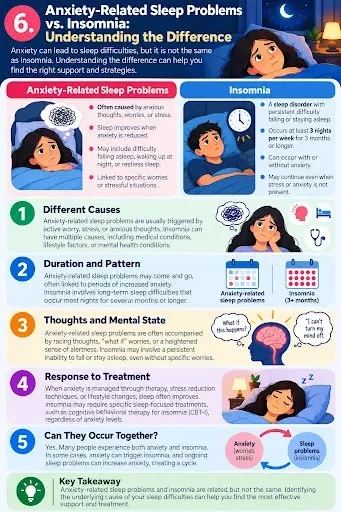
Infographic comparing anxiety-related sleep difficulties with insomnia, highlighting anxious thoughts, persistent sleep problems, and their potential overlap.
Anxiety-related sleep problems are difficulties with sleep that occur alongside worry, stress, or anxious feelings, while insomnia is a sleep disorder involving persistent difficulty falling asleep, staying asleep, or returning to sleep despite having an adequate opportunity to rest. The two can overlap, but experiencing anxiety and sleeping poorly does not automatically mean someone has insomnia.
WHAT ARE ANXIETY-RELATED SLEEP PROBLEMS?
Anxiety-related sleep problems occur when anxious thoughts, emotional tension, or heightened alertness interfere with rest. These difficulties may appear during a stressful period, before an important event, or when ongoing worries become difficult to manage.
For example, someone awaiting an important decision may spend several nights thinking about possible outcomes. Once the uncertainty passes, their sleep may improve. Another person may continue experiencing sleep difficulties because the underlying anxiety or other contributing factors remain.
Anxiety can also occur alongside other sleep problems, so the relationship is not always straightforward.
The important point is that sleep difficulties can accompany anxiety without necessarily meeting the criteria for a sleep disorder.
WHAT IS INSOMNIA?
Insomnia is a sleep disorder in which a person has persistent difficulty falling asleep, staying asleep, or obtaining restorative sleep despite having sufficient opportunity to sleep. The problem may also affect daytime functioning, including concentration, energy, mood, and daily activities.
Insomnia can be short-term, sometimes occurring during stressful life events or changes in routine. Chronic insomnia generally involves sleep difficulties at least three nights a week for three months or longer. A healthcare professional considers the person’s symptoms, duration, circumstances, and daytime effects when assessing the problem.
These time frames are useful clinical context, not a self-diagnosis checklist. You do not need to wait three months to seek help if sleep problems are causing substantial distress or interfering with daily life.
HOW ANXIETY AND INSOMNIA CAN OVERLAP
Anxiety and insomnia are not mutually exclusive. Anxiety may contribute to insomnia, and persistent sleep difficulties may increase worry, frustration, or emotional strain.
Consider someone who initially has trouble sleeping because of work-related concerns. After several difficult nights, they begin worrying about whether they will sleep at all. Eventually, they may feel tense before bedtime even when the original work problem is less pressing.
In this situation, both anxiety and a persistent sleep problem may deserve attention. Treating only one aspect may not address every factor contributing to the person’s difficulties. However, not everyone who experiences anxiety-related sleep problems develops insomnia, and insomnia does not always arise from anxiety.
HOW CAN YOU TELL WHEN SLEEP DIFFICULTIES NEED ATTENTION?
Rather than trying to label your experience, consider its overall pattern and impact.
- Duration: Has the problem occurred occasionally, or has it continued over an extended period?
- Frequency: Are sleep difficulties happening repeatedly throughout the week?
- Daytime effects: Are tiredness, concentration difficulties, or changes in mood interfering with your usual activities?
- Possible contributing factors: Have stress, medication changes, physical symptoms, or changes in your schedule affected your sleep?
- Overall wellbeing: Are anxiety or sleep difficulties making everyday responsibilities increasingly difficult to manage?
These questions can help you describe your experience to a healthcare professional, but they cannot establish a diagnosis.
WHEN PROFESSIONAL ASSESSMENT MAY HELP
Consider speaking with a healthcare professional if sleep difficulties persist, repeatedly disrupt your nights, or interfere with your daily life. A clinician can assess anxiety symptoms, sleep patterns, medical history, medications, and other possible causes.
Treatment depends on what is contributing to the problem. For chronic insomnia, cognitive behavioral therapy for insomnia (CBT-I) is generally recommended as the initial treatment option. Anxiety may also benefit from appropriate psychological treatment or other clinician-guided care.
You do not have to determine whether anxiety or insomnia is the primary problem before asking for help. Understanding the pattern is part of the assessment, not a responsibility you must manage alone.
With this distinction in mind, we can turn to practical approaches that may help when anxious thoughts interfere with sleep.
7. What May Help When Anxious Thoughts Keep You Awake?
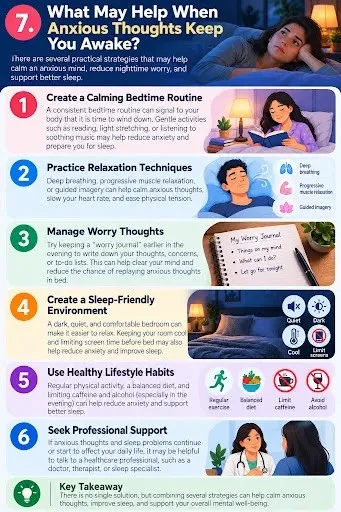
Infographic presenting practical approaches to nighttime anxiety, including calming routines, slow breathing, writing down worries, and maintaining consistent sleep habits.
When anxious thoughts keep you awake, it may help to reduce the pressure to fall asleep, give worries a more manageable place in your day, and create conditions that support relaxation. Strategies such as writing down concerns, practising gentle relaxation, and maintaining a consistent sleep schedule may help, although their usefulness varies from person to person.
1. SET ASIDE TIME FOR WORRIES BEFORE BEDTIME
If concerns repeatedly return when you lie down, consider setting aside a short period earlier in the evening to think through them.
Write down what is worrying you, what you can do about it, and whether anything needs attention the following day. If a concern cannot be resolved yet, acknowledge that rather than continuing to search for an immediate answer.
For example, if you are worried about an unfinished work assignment, you might write down the first step you will take tomorrow. This gives the concern a practical next step without requiring you to solve the entire problem at bedtime.
Writing down worries does not make them disappear automatically. The aim is to organise your thoughts so that you do not have to keep mentally reviewing every concern.
2. USE GENTLE RELAXATION RATHER THAN FORCING YOURSELF TO SLEEP
Relaxation techniques may help some people settle down when they feel tense or mentally overstimulated.
You could try slow, comfortable breathing, gently relaxing different muscle groups, listening to quiet music, or following a guided relaxation exercise. Choose something that feels comfortable rather than turning relaxation into another task you must perform perfectly.
The National Institute of Mental Health identifies relaxation and mindfulness practices as possible ways to manage anxiety symptoms. These techniques can support wellbeing, but they are not guaranteed to resolve persistent anxiety or insomnia.
If focusing on your breathing or body makes you feel more uncomfortable, you can stop and try a different activity, such as listening to calming audio or reading something undemanding.
3. CREATE A CONSISTENT WIND-DOWN ROUTINE
A predictable evening routine can provide a transition between the day’s responsibilities and bedtime.
You might dim the lights, put away work materials, read a book, listen to relaxing music, or take a comfortably warm bath. The specific activity matters less than finding something that helps you shift away from demanding tasks.
Try to avoid turning your routine into a strict checklist that creates additional pressure. If one evening does not go as planned, you have not failed. A routine is intended to support rest, not become another source of worry.
The National Heart, Lung, and Blood Institute recommends a relaxing bedtime routine as part of healthy sleep habits.
4. KEEP YOUR SLEEP SCHEDULE AS REGULAR AS PRACTICAL
Going to bed and waking up at reasonably consistent times can help support your body’s sleep-wake rhythm.
Where possible, allow enough time for sleep and get up at a consistent time, including after a difficult night. If your work schedule, caregiving responsibilities, or other circumstances make a regular schedule difficult, aim for an approach that fits your situation rather than pursuing perfection.
Also consider whether caffeine later in the day, long or late naps, or activities that keep you highly alert near bedtime may be contributing to your difficulties. You do not need to change every habit at once; identifying relevant factors can be a more manageable starting point.
5. REDUCE THE PRESSURE TO MONITOR YOUR SLEEP
Repeatedly checking the time can make you more aware of how long you have been awake. You might calculate how much sleep remains possible and become increasingly concerned about the following day.
If clock-watching tends to increase your anxiety, consider turning the clock away from view or keeping your phone out of immediate reach.
You can also remind yourself that being awake longer than expected is frustrating, but it does not require you to predict exactly how tomorrow will go. You cannot force sleep by checking whether it has arrived.
The National Heart, Lung, and Blood Institute notes that worrying about sleep and watching the clock can worsen insomnia.
6. IF YOU CANNOT SLEEP, GIVE YOURSELF A CHANGE OF SETTING
If you remain awake and become increasingly frustrated in bed, consider getting up and doing something quiet and relaxing in dim light. Return to bed when you feel sleepy.
For example, you might sit somewhere comfortable and read a few pages of a book. Avoid turning the time into an opportunity to work, tackle stressful tasks, or repeatedly check your phone.
This approach is part of stimulus control, a behavioural strategy used in cognitive behavioral therapy for insomnia (CBT-I). The goal is to reduce the association between being in bed and prolonged wakefulness or frustration.
If sleep difficulties persist, a clinician trained in CBT-I can explain how to apply the approach appropriately. Avoid imposing a rigid sleep schedule or restricting your time in bed without suitable professional guidance.
7. KNOW WHEN SELF-HELP MAY NOT BE ENOUGH
Practical strategies can be useful, but they may not fully address persistent anxiety, chronic insomnia, or another underlying health concern.
Consider speaking with a healthcare professional if sleep difficulties continue, regularly affect your concentration or daily activities, or leave you feeling increasingly distressed. A clinician can assess possible causes and discuss suitable options.
For ongoing anxiety, psychotherapy such as cognitive behavioral therapy may be helpful. For chronic insomnia, CBT-I is generally recommended as the first treatment option. Depending on your circumstances, a professional may recommend addressing anxiety, sleep difficulties, or both.
You do not need to master every strategy before seeking support. The most useful approach is one that fits your needs and helps you move toward better rest without creating more pressure.
The next section addresses a related but distinct experience: what you can do when you wake during the night already feeling anxious.
8. How to Respond When You Wake Up Feeling Anxious at Night
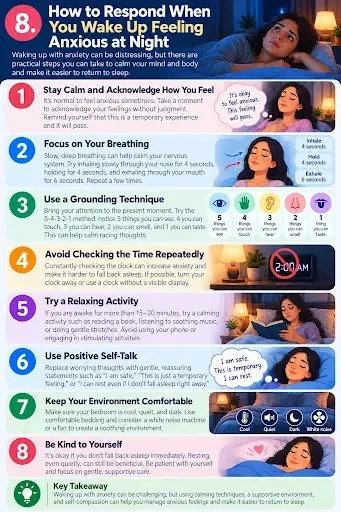
Infographic illustrating helpful responses to nighttime anxiety, including gentle breathing, grounding techniques, reducing sleep pressure, and returning to bed when ready.
Waking up feeling anxious at night can be unsettling, particularly when your mind immediately turns to worries or your body feels unusually alert. It may help to pause, acknowledge what you are experiencing, and choose a calm response rather than trying to solve every concern immediately. The most appropriate approach depends on what you are feeling, how often it happens, and whether another health or sleep issue may be involved.
1. PAUSE BEFORE TRYING TO EXPLAIN THE FEELING
When you wake suddenly, you may immediately wonder why you are awake, whether something is wrong, or how you will manage the next day if you cannot return to sleep.
Before following those thoughts, give yourself a moment to become oriented. Notice that you are awake, recognise how you feel, and remind yourself that you do not have to understand the entire experience immediately.
You might quietly tell yourself, “I am awake, and I am feeling anxious right now. I can take this one step at a time.”
This is not an attempt to dismiss your concerns. It is a way of responding to the present moment without immediately adding more questions or predictions.
2. NOTICE YOUR THOUGHTS WITHOUT FOLLOWING EVERY ONE
Nighttime worry can move quickly from one subject to another. A concern about tomorrow’s responsibilities may lead to thoughts about past mistakes, future uncertainty, or the consequences of being tired.
When you notice this happening, try identifying the thought without treating it as a problem that must be solved immediately.
For example, you might recognise, “I am worrying about tomorrow’s meeting,” rather than mentally rehearsing every possible outcome.
You do not have to force the thought away. If it requires action, you can consider it when you are better placed to respond. If it is an uncertain prediction, you may be able to let it remain unresolved for the moment.
3. USE A COMFORTABLE, GENTLE RELAXATION PRACTICE
If you feel physically tense, a simple relaxation activity may help you become more comfortable.
You could try breathing gently at a natural pace, relaxing your shoulders, or noticing the support of the mattress beneath you. Some people prefer quiet music or a familiar, calming audio recording.
Avoid forcing deep breaths or treating a particular breathing pattern as necessary for sleep. If focusing on breathing makes you feel more uncomfortable, stop and choose another activity.
The aim is to offer yourself a less demanding experience, not to guarantee that you will fall asleep within a certain amount of time.
4. AVOID TURNING THE REST OF THE NIGHT INTO A COUNTDOWN
After waking, it can be tempting to check the time repeatedly and calculate how many hours remain before morning.
Although this may feel like a way to assess the situation, it can also increase pressure about getting enough sleep. If checking the clock tends to make you more anxious, consider keeping it out of view.
Remind yourself that you cannot predict exactly how you will feel tomorrow based on a single moment during the night. You can acknowledge that rest matters without repeatedly calculating what you may have lost.
5. IF YOU REMAIN AWAKE, CONSIDER A QUIET ACTIVITY
If you remain awake and begin feeling frustrated, consider getting out of bed for a while and doing something quiet in dim light. Reading a few pages of a book or listening to calm audio may be more comfortable than lying in bed feeling increasingly pressured.
Return to bed when you feel sleepy. This approach is consistent with stimulus-control strategies used in cognitive behavioral therapy for insomnia (CBT-I).
Try to avoid activities that are likely to make you more alert, such as starting work, engaging with upsetting content, or checking notifications repeatedly.
If getting out of bed is difficult or unsafe because of mobility concerns or another health condition, choose an appropriate alternative that allows you to remain comfortable and safe.
6. RECOGNISE WHEN THE EXPERIENCE MAY NEED MEDICAL ATTENTION
Not every episode of nighttime anxiety has the same cause. Stress, sleep disturbances, medications, physical health conditions, and other factors may contribute to waking during the night.
If you repeatedly wake feeling anxious, experience significant daytime impairment, or find that your sleep is becoming increasingly disrupted, consider speaking with a healthcare professional. They can help assess the pattern and discuss appropriate next steps.
Seek urgent medical attention for severe or concerning symptoms rather than automatically assuming they are caused by anxiety.
If you experience a sudden episode of intense fear accompanied by physical symptoms, a panic attack is one possible explanation, but other conditions can produce similar symptoms. The experience alone cannot establish the cause.
REMEMBER: YOU DO NOT HAVE TO SOLVE EVERYTHING BEFORE MORNING
Waking up anxious can make concerns feel urgent, especially when the rest of the world is quiet and you are tired. But not every thought requires an immediate answer, and not every restless night signals a lasting problem.
If this experience happens repeatedly, you deserve support rather than pressure to manage it perfectly on your own.
Understanding what happens after you wake is one part of improving your relationship with sleep. The next section explores how to reduce the pressure surrounding bedtime more generally.
9. Building a Less Pressured Relationship With Sleep
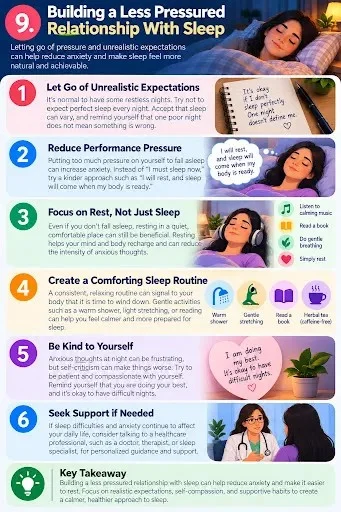
Infographic showing how flexible sleep expectations, consistent routines, reduced clock-watching, and a calmer bedtime mindset may support a healthier relationship with sleep.
Building a less pressured relationship with sleep means reducing the fear, frustration, and rigid expectations that can develop around bedtime. Instead of treating sleep as something you must force or achieve perfectly, you can focus on creating supportive conditions for rest and responding to difficult nights with greater flexibility. This approach does not guarantee better sleep, but it may help reduce the additional stress that sometimes accompanies sleep difficulties.
UNDERSTAND THAT SLEEP IS NOT A PERFORMANCE
When sleep becomes difficult, bedtime can begin to feel like a task you must complete successfully. You may monitor how quickly you fall asleep, compare each night with the previous one, or judge yourself for being awake.
This can make an ordinary part of life feel like a test.
Sleep is influenced by several factors, including your sleep-wake rhythm, level of alertness, health, environment, and daily circumstances. It is not entirely under voluntary control.
You can support sleep through your habits and environment, but you cannot guarantee exactly when it will happen. Recognising this distinction may help you approach bedtime with less pressure.
LET GO OF THE IDEA THAT EVERY NIGHT MUST BE PERFECT
A difficult night can be frustrating, particularly when you have important responsibilities the next day. It is understandable to want reassurance that you will sleep well every night.
However, sleep can vary from night to night. An occasional restless night does not necessarily indicate a lasting sleep problem, just as one good night does not resolve persistent difficulties.
Try to evaluate your sleep over time rather than treating each night as a final verdict on your health or ability to function.
If poor sleep becomes frequent or affects your daily life, take it seriously without assuming that every difficult night means the situation is getting worse.
RECOGNISE THE DIFFERENCE BETWEEN REST AND FORCING SLEEP
You may not be able to make yourself fall asleep on demand, but you can choose activities that make the evening more comfortable and less demanding.
For example, you might put away work materials, reduce unnecessary stimulation, or spend a little time reading before bed. If you are awake and increasingly frustrated, you can consider a quiet activity rather than continuing to struggle in bed.
The purpose is not to replace sleep with relaxation or to convince yourself that being awake is just as restorative as sleeping. Sleep remains important. The aim is to avoid adding unnecessary pressure while allowing yourself an opportunity to become sleepy.
RESPOND TO YOURSELF WITH UNDERSTANDING, NOT CRITICISM
After a difficult night, you may find yourself thinking, “Why can’t I sleep like everyone else?” or “I should be able to control this.”
Such thoughts can add disappointment to an already tiring experience.
A more balanced response might be, “Sleep has been difficult lately, and I am going to take the problem seriously without blaming myself.”
This does not mean ignoring habits or circumstances that may need attention. It means recognising that sleep difficulties can have multiple causes and are not necessarily a reflection of personal weakness.
If anxiety is contributing to your sleep problems, approaching yourself with patience may make it easier to consider practical changes or seek help when needed.
FOCUS ON CONSISTENCY RATHER THAN PERFECTION
A supportive sleep routine can provide structure without requiring every evening to follow an identical pattern.
Where practical, aim for reasonably consistent sleep and wake times, make room for a relaxing wind-down period, and notice whether caffeine, daytime naps, or late-night activities affect your sleep.
You do not need to change everything at once. A small adjustment that fits your circumstances may be more sustainable than a long list of rules that becomes another source of stress.
If you have persistent insomnia, general sleep habits alone may not be enough. Cognitive behavioral therapy for insomnia (CBT-I) addresses the thoughts and behaviors associated with ongoing sleep difficulties and is recommended as a first-line treatment for chronic insomnia.
WHEN ACCEPTANCE DOES NOT MEAN PUTTING UP WITH ONGOING PROBLEMS
Accepting that sleep cannot always be controlled does not mean you should ignore persistent difficulties or simply tolerate their effects.
If sleep problems continue, cause substantial distress, or interfere with your work, relationships, concentration, or daily functioning, a healthcare professional can help assess the causes and discuss appropriate treatment.
You can be patient with yourself while still taking action to improve your sleep. Those approaches are not contradictory.
A less pressured relationship with sleep is not about caring less about your wellbeing. It is about responding to difficulties without turning every bedtime into a struggle.
The next section explains when anxiety-related sleep difficulties may warrant professional assessment and why getting help can be a practical step rather than a last resort.
10. When Anxiety-Related Sleep Problems Deserve Professional Attention
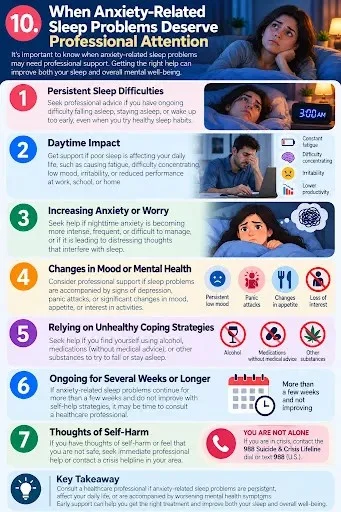
Infographic outlining signs that professional support may be helpful, including persistent sleep difficulties, daytime fatigue, ongoing anxiety, and disruption to everyday activities.
Anxiety-related sleep problems deserve professional attention when difficulty sleeping or persistent worry causes significant distress, continues over time, or interferes with daily activities. You do not need to wait until the problem becomes overwhelming to ask for help. A healthcare professional can assess possible causes, consider whether anxiety or a sleep disorder may be involved, and discuss appropriate support.
WHEN SLEEP DIFFICULTIES BEGIN AFFECTING DAILY LIFE
An occasional restless night can happen to anyone. However, repeated sleep difficulties may become more concerning when their effects extend into the following day and begin interfering with your usual activities.
You may notice that you:
- Struggle to concentrate on work, studies, or everyday responsibilities.
- Feel persistently tired or unrefreshed despite making time for sleep.
- Find it increasingly difficult to manage ordinary stress.
- Experience irritability or changes in mood associated with poor sleep.
- Begin avoiding activities because you are worried about how tired you will feel.
These experiences do not establish a particular diagnosis. They are reasons to consider whether your sleep and wellbeing would benefit from professional assessment.
The National Institute of Mental Health advises seeking professional help when mental-health symptoms are severe or distressing and persist for two weeks or longer. You can seek help sooner if symptoms are worsening or substantially affecting your daily functioning.
WHEN ANXIETY BECOMES DIFFICULT TO MANAGE
Consider speaking with a healthcare professional if worry feels difficult to control, repeatedly interferes with sleep, or affects your relationships, concentration, work, or other responsibilities.
You do not have to experience anxiety throughout the day to deserve support. Some people notice their difficulties most strongly at bedtime, while others experience worry across several parts of their lives.
A professional can help you explore when the symptoms began, what circumstances may contribute to them, and whether anxiety, sleep difficulties, or another issue may need attention. Symptoms alone cannot establish a diagnosis.
WHEN TO CONSIDER AN ASSESSMENT FOR INSOMNIA OR ANOTHER SLEEP PROBLEM
If you regularly have difficulty falling asleep, staying asleep, or returning to sleep after waking, a healthcare professional can help determine whether insomnia or another sleep disorder may be involved.
Chronic insomnia generally involves difficulty sleeping at least three nights a week for three months or longer. However, you do not need to meet this duration to discuss sleep problems with a clinician, particularly when they are already affecting your daily life.
It is also important not to assume that anxiety explains every sleep problem. Physical health conditions, medications, changes in routine, and other sleep disorders can contribute to disrupted rest. A proper assessment can help identify which factors are relevant to your circumstances.
WHAT HAPPENS WHEN YOU SEEK PROFESSIONAL HELP?
A useful first step is to speak with a primary care provider or another qualified healthcare professional. Depending on your circumstances, they may recommend a mental-health professional or a clinician with expertise in sleep disorders.
You can prepare for the conversation by noting:
- When your sleep difficulties began and how often they occur.
- Whether you have trouble falling asleep, staying asleep, or both.
- How you feel during the day.
- Any recurring worries or stressful circumstances.
- Medications, supplements, or other health factors that may be relevant.
A sleep diary covering one to two weeks may help a clinician understand your sleep patterns. The National Heart, Lung, and Blood Institute recommends recording sleep and wake times, naps, daytime sleepiness, and relevant habits before an assessment.
You do not need to have every detail worked out before making an appointment. Describing what you have noticed is a reasonable starting point.
WHY SEEKING HELP IS NOT A SIGN OF FAILURE
When sleep becomes difficult, people sometimes feel that they should be able to resolve the problem through willpower or better habits alone. If those efforts do not work, they may become frustrated with themselves.
Persistent sleep problems can involve several interacting factors, and finding an appropriate response may require professional guidance. Seeking help is a practical way to understand what is happening rather than a sign that you have failed to manage your own wellbeing.
With appropriate assessment, you can explore options that address your particular difficulties instead of trying to follow every piece of sleep advice you encounter.
If you experience new or severe physical symptoms, do not automatically attribute them to anxiety. Seek appropriate medical assessment, including urgent care when symptoms may indicate an emergency.
Recognising when professional support may be useful is an important step. The next section explains the treatment options that may help when anxiety and persistent sleep difficulties occur together.
11. Treatment Options for Anxiety and Persistent Sleep Difficulties
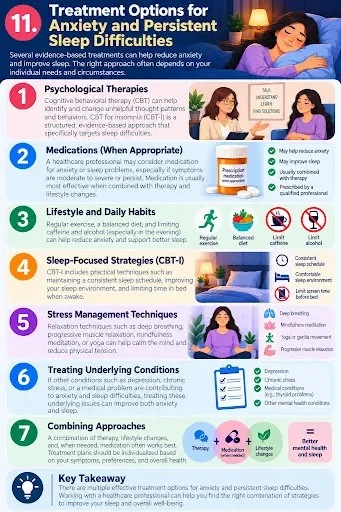
Treatment options for anxiety and persistent sleep difficulties, including therapy, medication, and sleep improvement strategies.
Treatment for anxiety and persistent sleep difficulties depends on the symptoms, their underlying causes, and how much they affect daily life. Psychotherapy, including cognitive behavioral therapy (CBT), may help manage anxiety, while cognitive behavioral therapy for insomnia (CBT-I) is a recommended first-line treatment for chronic insomnia. A healthcare professional can help determine which approach, or combination of approaches, may be appropriate.
TREATING ANXIETY THROUGH PSYCHOTHERAPY
When anxiety repeatedly interferes with sleep, addressing the underlying worry may be an important part of treatment. Cognitive behavioral therapy (CBT) helps people recognize unhelpful thinking patterns, examine anxious predictions, and develop more balanced ways of responding to uncertainty.
For example, someone who repeatedly worries about making mistakes the next day may learn to recognize the difference between a possible problem and an outcome they are treating as inevitable. Therapy can also help people respond differently to anxious feelings instead of spending long periods trying to eliminate every uncertainty before bedtime.
Other therapeutic approaches may be appropriate depending on the person’s symptoms and preferences. Treatment can take place in person or, when available and suitable, through telehealth. The goal is not to eliminate every worry but to help a person manage anxiety in ways that support everyday functioning and well-being.
WHEN COGNITIVE BEHAVIORAL THERAPY FOR INSOMNIA MAY HELP
Cognitive behavioral therapy for insomnia (CBT-I) is a structured treatment designed specifically for persistent difficulty falling asleep, staying asleep, or returning to sleep. It is generally recommended as the first treatment for chronic insomnia in adults.
CBT-I differs from general anxiety treatment because it directly addresses the thoughts and behaviors that may maintain sleep difficulties. Depending on the treatment plan, it may include strategies to reduce worry about sleep, adjust habits that interfere with sleep, strengthen the association between bed and sleep, and establish a more consistent sleep-wake pattern.
CBT-I commonly takes around six to eight weeks, although the duration varies. It can be delivered by a suitably trained healthcare professional in person, by telephone, or online. A qualified provider can help determine whether it is appropriate for a person’s circumstances.
WHEN ANXIETY TREATMENT AND SLEEP TREATMENT NEED TO WORK TOGETHER
Anxiety and insomnia can occur together, but treating one does not always resolve the other completely. Someone may experience less anxiety yet continue to worry about sleep, while another person may sleep better after treatment but still need support for persistent anxiety.
When both problems are present, a healthcare professional may recommend addressing them together or in a planned sequence. The approach depends on the person’s symptoms, medical history, preferences, and response to treatment. Assessment may also identify other contributors to sleep difficulties, such as medication effects, physical health conditions, or another sleep disorder.
This combined approach recognizes that sleep problems and anxiety can influence each other without assuming that anxiety explains every restless night.
THE ROLE OF MEDICATION IN TREATMENT
Depending on the assessment, a healthcare professional may discuss medication for an anxiety disorder, persistent insomnia, or another identified condition. The appropriate choice depends on the diagnosis, potential benefits and risks, other health conditions, and any medicines already being taken.
Medication is not necessary for everyone, and the options used for anxiety are not identical to those used for insomnia. Some medicines may cause side effects, interact with other treatments, or affect sleep differently from person to person. Some anxiety medications can also cause dependence and therefore require particular caution and professional supervision.
Medication should be selected and monitored by a qualified healthcare professional. Do not start, stop, or change a prescribed medicine without discussing it with the prescriber. Sleep aids and supplements should not automatically be assumed to be safe or effective simply because they are available without a prescription.
HOW TO PREPARE FOR A PROFESSIONAL APPOINTMENT
A brief record of sleep patterns and anxiety symptoms may help a healthcare professional understand what is happening. Consider noting when the difficulties began, how often they occur, whether anxiety is present at bedtime or during the day, and how sleep problems affect concentration, mood, school, work, or everyday responsibilities.
It can also be useful to list current medicines and supplements, relevant health conditions, and any strategies already tried. You do not need to identify the cause yourself before seeking help; explaining your experience is a useful starting point.
Treatment may require adjustments, and improvement can take time. If one approach does not help enough, a healthcare professional can reassess the situation and discuss other suitable options.
The central point is that persistent anxiety and sleep difficulties are treatable concerns, and support can be tailored to the individual. Understanding the available options can make the next step feel more manageable, without placing pressure on anyone to solve every sleep difficulty alone.
12. Frequently Asked Questions
CONCLUSION
Anxiety and sleep can influence each other in ways that make restful nights feel difficult to achieve. Worry, mental tension, and heightened alertness may keep the mind active when the body needs rest. When sleep becomes a source of concern itself, frustration and fear about another difficult night can add to the pressure.
Understanding this connection is an important first step. Recognizing night time thought patterns, developing a supportive sleep routine, and responding to anxious moments with patience may help make bedtime feel less overwhelming. These approaches do not guarantee immediate improvement, and persistent sleep difficulties should not automatically be attributed to anxiety alone.
If anxiety or sleep problems continue to affect daily life, professional support can help identify possible causes and appropriate treatment options. Cognitive behavioral therapy may help with anxiety, while cognitive behavioral therapy for insomnia (CBT-I) is a recommended treatment for chronic insomnia. A qualified healthcare professional can help determine which approach best fits an individual’s needs.
Most importantly, a difficult night does not mean you have failed at sleeping, and you do not have to resolve every worry before allowing yourself to rest. Progress may take time, but understanding the anxiety-sleep connection can help you approach your nights with greater awareness, realistic expectations, and compassion for yourself.
Final Notes
Anxiety and sleep difficulties can be challenging, particularly when tiredness and nighttime worry begin to reinforce each other. Understanding this connection can help you recognize what may be contributing to restless nights without assuming that every sleep problem has the same cause.
Be patient with yourself as you explore what may help. There is no single routine that works for everyone, and one difficult night does not determine how the next night will go. If sleep problems or anxiety persist, worsen, or interfere with daily activities, consider speaking with a qualified healthcare professional.
You deserve support for both your emotional well-being and your sleep. You do not have to manage persistent difficulties alone, and seeking help is a constructive step toward understanding your needs and finding appropriate care.
A NOTE FOR RETURNING READERS
Welcome back to MentalHealthNest. If you are continuing your journey toward understanding anxiety and emotional well-being, this guide is one part of our growing collection of mental-health resources. You can revisit the sections most relevant to you and explore related articles below to develop a broader understanding of anxiety, stress, overthinking, and sleep.
Everyone’s experience is different. These educational resources can help you understand common patterns, but they do not replace an individual assessment or advice from a qualified healthcare professional.
Explore More On Mental Health Resources
ANXIETY SERIES: RELATED ARTICLES
Continue exploring our anxiety-related guides to understand how anxiety may connect with everyday stress, repetitive thinking, and sleep difficulties.
- Anxiety Disorders: Understanding Symptoms, Types, and Treatment
Learn about the different types of anxiety disorders, their common symptoms, how they may affect everyday life, and the assessment and treatment options available. - Overthinking and Anxiety: Why Your Mind Won’t Slow Down
Learn how persistent overthinking can be connected with anxiety and explore practical approaches that may help you manage repetitive worries. - Anxiety vs. Stress: What’s the Difference and How Can You Tell?
Understand how anxiety and everyday stress differ, where they overlap, and when ongoing symptoms may deserve additional attention. - Anxiety and Physical Symptoms: How Anxiety Can Affect the Body
Learn about physical experiences that may accompany anxiety, why symptoms can vary, and when it is important to seek medical advice. - Panic Attacks vs. Anxiety Attacks: What Is the Difference?
Understand the distinction between panic attacks and the informal term “anxiety attack,” including differences in how symptoms may develop. - Health Anxiety: When Worry About Your Health Becomes Overwhelming
Explore health-related worry, how it can affect everyday life, and when professional support may be beneficial. - Social Anxiety in Adults: Symptoms, Causes, and What May Help
Learn how fear of judgement or embarrassment can affect social situations and discover support options that may help. - Anxiety at Work: How Workplace Stress Can Affect Mental Health
Explore the relationship between workplace pressures and anxiety, including how ongoing difficulties may affect concentration, performance, and wellbeing. - Anxiety and Relationships: Why Anxiety Can Affect Connection and Communication
Understand how anxiety may influence communication, trust, and connection, and explore ways to approach relationship challenges constructively. - How to Calm an Anxious Mind: Practical Strategies for Managing Anxiety
Discover practical approaches to coping with anxious thoughts, managing everyday stressors, and supporting emotional wellbeing. - When Does Anxiety Become a Problem?
Learn when anxiety may be more than a temporary response to stress and when professional assessment may be worth considering. - How to Help Someone With Anxiety: What to Say, What to Avoid, and How to Offer Support
Learn how to support someone experiencing anxiety through empathetic communication, practical ways to help, and guidance on what to say and avoid while respecting their feelings and encouraging professional support when needed. - Sleep and Mental Health: How Better Sleep Improves Emotional Wellbeing
Explore the broader relationship between sleep and emotional well-being, including why healthy sleep matters for mental health.
TRUSTED MENTAL HEALTH RESOURCE
The following trusted U.S. health organizations provide reliable information about anxiety, sleep difficulties, mental health treatment, and when to seek professional support.
- National Institute of Mental Health (NIMH)
Learn about anxiety disorders, their symptoms, diagnosis, and available treatment options.
https://www.nimh.nih.gov/health/topics/anxiety-disorders - National Heart, Lung, and Blood Institute (NHLBI)
Explore information about insomnia, sleep health, diagnosis, and treatment options for persistent sleep difficulties.
https://www.nhlbi.nih.gov/health/insomnia - MedlinePlus — U.S. National Library of Medicine
Find accessible, medically reviewed information about anxiety, insomnia, mental health, and related health conditions.
https://medlineplus.gov/ - Centers for Disease Control and Prevention (CDC)
Learn about sleep and health, recommended sleep duration, and the importance of healthy sleep habits.
https://www.cdc.gov/sleep/
These resources offer general educational information. They do not replace an individualized assessment or advice from a qualified healthcare professional.
REFERENCES
The following authoritative health resources support the information presented in this article about anxiety, nighttime worry, sleep difficulties, and treatment options.
- National Institute of Mental Health (NIMH). Anxiety Disorders.
Information about anxiety disorders, symptoms, diagnosis, and treatment.
https://www.nimh.nih.gov/health/topics/anxiety-disorders - National Institute of Mental Health (NIMH). Generalized Anxiety Disorder: What You Need to Know.
Information about persistent worry, symptoms, psychotherapy, and medication treatment options.
https://www.nimh.nih.gov/health/publications/generalized-anxiety-disorder-gad - National Heart, Lung, and Blood Institute (NHLBI). Insomnia: What Is Insomnia?
Information about insomnia, its effects on daily functioning, and when assessment may be appropriate.
https://www.nhlbi.nih.gov/health/insomnia - National Heart, Lung, and Blood Institute (NHLBI). Insomnia Treatment.
Information about cognitive behavioral therapy for insomnia (CBT-I), sleep habits, and medical treatment options.
https://www.nhlbi.nih.gov/health/insomnia/treatment - National Heart, Lung, and Blood Institute (NHLBI). Insomnia Diagnosis.
Information about evaluating sleep difficulties, chronic insomnia criteria, and keeping a sleep diary.
https://www.nhlbi.nih.gov/health/insomnia/diagnosis - Centers for Disease Control and Prevention (CDC). About Sleep.
Information about sleep, health, emotional well-being, and recommended sleep duration.
https://www.cdc.gov/sleep/about/index.html.
These sources provide general health information and support the educational purpose of this article. They are not a substitute for individualized medical advice, diagnosis, or treatment.
MEDICAL DISCLAIMER
The information provided in this article on MentalHealthNest is intended for general educational and informational purposes only. It is designed to help readers understand the relationship between anxiety and sleep, recognize common patterns, and learn about potential approaches to improving sleep and managing anxiety.
This article is not intended to replace professional medical advice, diagnosis, or treatment. Anxiety and sleep difficulties can have different causes, and symptoms may vary from person to person. Only a qualified healthcare professional can assess an individual’s circumstances and recommend appropriate care.
Do not use the information in this article to diagnose yourself or another person, change prescribed medication, or delay seeking professional advice. Consult a qualified healthcare professional if anxiety or sleep difficulties persist, worsen, or interfere with daily activities.
MentalHealthNest is a mental health education and awareness platform. Its content is not a substitute for an individual consultation with a licensed healthcare professional.
By reading this article, you acknowledge that the information is provided for educational purposes and does not establish a professional healthcare relationship.
About MentalHealthNest: Editorial Policy and Content Standards
OUR MISSION
MentalHealthNest is a mental health education and awareness platform dedicated to helping readers better understand mental health, emotional well-being, common mental health conditions, and available support options. Our content is designed primarily for readers in the United States and aims to make reliable mental health information accessible, understandable, and useful.
EVIDENCE-INFORMED CONTENT
We aim to develop articles using credible health information, established research, and authoritative sources, including relevant U.S. government health agencies and recognized medical organizations. When discussing symptoms, mental health conditions, or treatment options, we seek to distinguish established information from emerging evidence and general educational guidance.
ACCURACY AND SOURCE TRANSPARENCY
Our editorial approach prioritizes factual accuracy, clear explanations, and appropriate references. Where relevant, articles link to trusted external resources so readers can explore the subject further. We aim to avoid unsupported medical claims, exaggerated promises, misleading headlines, and statements suggesting that one approach works for everyone.
CONTENT CREATION AND EDITORIAL REVIEW
Articles are prepared according to MentalHealthNest’s editorial standards, which emphasize reader needs, clear organization, responsible language, relevant internal linking, and evidence-informed explanations. Content is reviewed for clarity, consistency, factual accuracy, and the suitability of its cited sources before publication.
We aim to correct material errors and update articles when important information changes or a review identifies a need for improvement.
MEDICAL REVIEW AND PROFESSIONAL LIMITATIONS
MentalHealthNest provides mental health education and awareness; it does not provide clinical diagnosis, individualized treatment, or emergency medical services. The platform’s founder is a mental health advocate, not a licensed healthcare professional. Unless an article explicitly identifies a qualified professional reviewer, readers should not assume that the content has undergone clinical review.
Readers should consult appropriately qualified healthcare professionals for individual concerns, diagnosis, and treatment decisions.
RESPONSIBLE USE OF MENTAL HEALTH INFORMATION
Mental health experiences differ from person to person. Our content aims to communicate respectfully, avoid unnecessary stigma, acknowledge individual differences, and encourage appropriate professional support when needed. Educational information should not be used as a substitute for individualized healthcare advice.
OUR COMMITMENT TO READERS
Our goal is to provide accessible, transparent, and responsible mental health information that helps readers make better-informed decisions about their well-being. We recognize the importance of maintaining reader trust and aim to improve our content and editorial practices over time.
For questions, corrections, or editorial feedback, readers can contact MentalHealthNest through the website’s Contact page.
• Mental Health Directory
• Psychologist Registration
• Psychiatrist Registration
Every article is designed to help you make informed decisions, strengthen your mental wellbeing, and connect with trusted professional support when needed.
ABOUT THE AUTHOR
Sujit Shetty — Founder of MentalHealthNest and Mental Health Advocate
Sujit Shetty is the founder of MentalHealthNest.com, a mental health education and awareness platform dedicated to helping readers better understand mental health conditions, emotional well-being, and available support options.
As a mental health advocate, Sujit focuses on making mental health information accessible, understandable, and relevant to everyday life. Through MentalHealthNest, he aims to raise awareness, reduce stigma, and help readers explore evidence-informed information about anxiety, stress, sleep, emotional resilience, and other mental health topics.
His editorial approach emphasizes reader-focused explanations, credible health resources, responsible communication, and appropriate references to established health organizations. The goal is to help readers become better informed while recognizing when guidance from a qualified healthcare professional may be needed.
Sujit is not a licensed healthcare professional. MentalHealthNest provides educational information and does not replace professional assessment, diagnosis, or treatment.
Learn more: Visit MentalHealthNest.com to explore additional mental health guides and resources.
Respect for therapists, psychologists, psychiatrists, and other healthcare professionals
MentalHealthNest.com aims to become one of the web’s most trusted educational resources for mental health while connecting readers with qualified mental health professionals through its growing therapist directory.