Introduction
Many people know the experience of getting stuck in their own thoughts.
You may replay a conversation from earlier in the day, worry about something that has not happened yet, imagine everything that could go wrong, or keep searching for an answer even after you have already thought about the situation many times.
Sometimes this kind of thinking is simply part of being human. People naturally think through problems, consider consequences, prepare for difficult situations, and reflect on experiences.
But when thinking becomes repetitive, difficult to control, and closely tied to fear or uncertainty, it can become exhausting. For some people, anxiety and overthinking can reinforce one another: anxious feelings can lead to more worrying, while repeated worrying can keep attention focused on possible problems.
Research has described worry and rumination as forms of repetitive negative thinking that are relevant across anxiety and other emotional difficulties. At the same time, overthinking itself is not a medical diagnosis, and experiencing it does not automatically mean that someone has an anxiety disorder.
Understanding that distinction matters.
The goal is not to eliminate every unwanted thought. A healthy mind will sometimes notice problems, uncertainty, mistakes, and possible risks. The more useful question is whether repetitive thinking is helping you understand or solve something, or whether it is keeping you trapped in the same cycle without moving you toward a meaningful next step.
This guide explains the connection between overthinking and anxiety, the difference between ordinary reflection, worry, and rumination, signs that repetitive thinking may be affecting daily life, and practical approaches that may help you respond differently.
Quick Answer
Overthinking and anxiety can be closely connected. Anxiety may increase repetitive worrying about possible problems, uncertainty, mistakes, or future events, while prolonged worrying can keep attention focused on threats and maintain anxious feelings. However, overthinking is not itself a diagnosis. It becomes more concerning when repetitive thoughts are difficult to control, cause significant distress, interfere with sleep or daily functioning, or contribute to avoidance.
KEY TAKEAWAYS
• Overthinking is a common experience and does not automatically mean that someone has an anxiety disorder.
• Anxiety can make the mind repeatedly focus on possible threats, uncertainty, mistakes, or future problems.
• Worry often focuses on what might happen, while rumination may repeatedly revisit something that has already happened.
• Repetitive negative thinking can occur across different mental-health difficulties, so the content of thoughts alone cannot establish a diagnosis.
• The important question is not simply how much a person thinks, but whether the thinking is useful, controllable, and compatible with everyday life.
• When anxiety or repetitive worrying begins interfering with sleep, work, relationships, school, or other daily activities, talking with a qualified health professional may be appropriate.
EXPLORE RELATED ANXIETY TOPICS
If you’re exploring anxiety, you may also find it helpful to read a related topic:
Anxiety Disorders: Symptoms, Causes, Treatments, and When to Seek Help — Explore the core guide to understanding anxiety disorders and the different ways anxiety can affect thoughts, emotions, behavior, and daily life.
Anxiety vs. Stress: What’s the Difference and How Can You Tell? — Understand how anxiety and stress differ, where they overlap, and how they may affect everyday wellbeing.
Anxiety vs. Depression: Understanding the Differences and Overlap — Explore how anxiety and depression differ, where symptoms may overlap, and why understanding the distinction can be helpful.
Explore the MentalHealthNest Anxiety Guide to discover the complete collection of related anxiety topics.
1. What Is Overthinking?
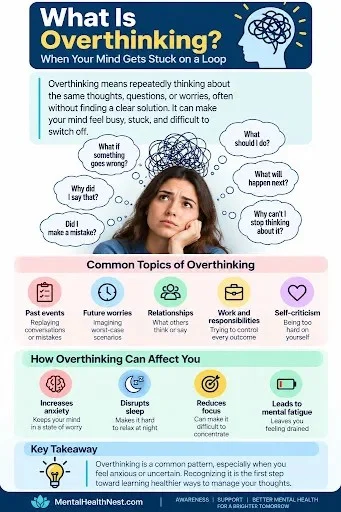
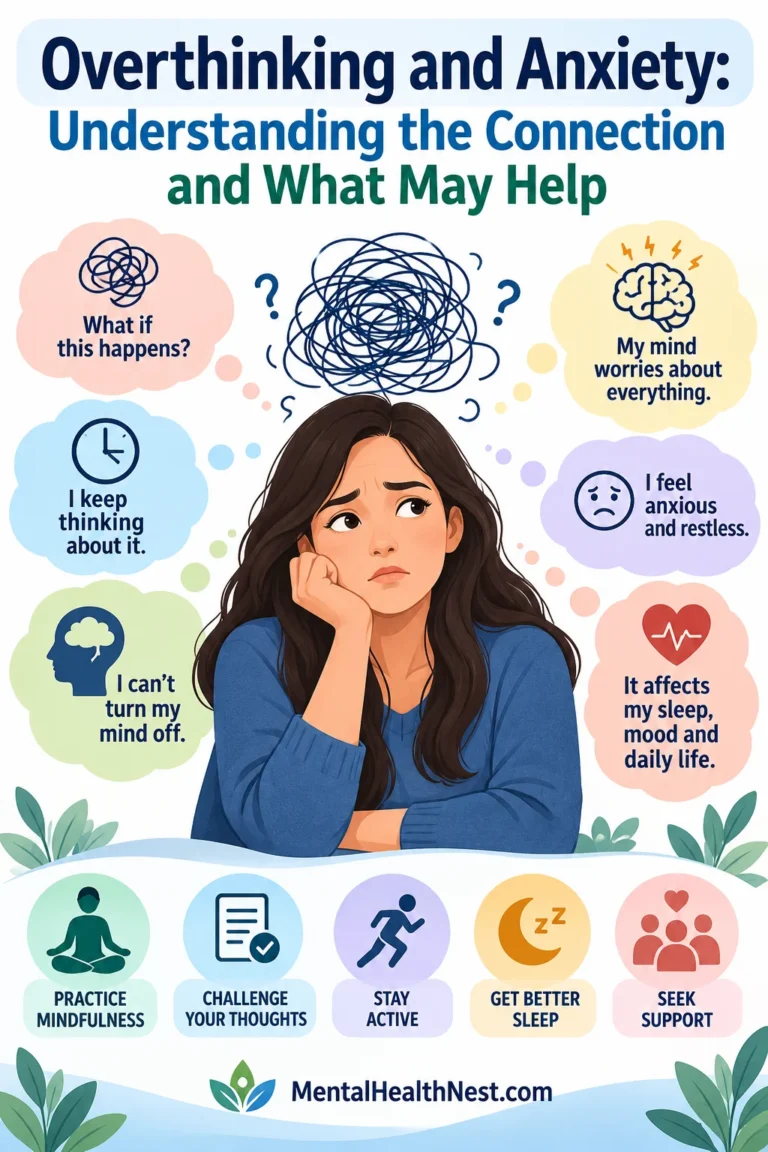
Infographic explaining overthinking, common thought patterns, and how repetitive thinking can affect anxiety and focus.
Overthinking generally refers to getting caught in repeated, often unproductive thinking about a situation, decision, problem, mistake, or possible future event. It is not a formal mental-health diagnosis. Thinking carefully can be useful, but repetitive thinking may become unhelpful when it is difficult to control and does not lead to meaningful understanding or action.
Everyone thinks about problems from time to time. You might reconsider a decision before making it, reflect on something that happened during the day, or think through how to handle a difficult conversation. This type of reflection can help people learn, plan, and make decisions.
Overthinking is different when the same thoughts keep returning without providing much new information or helping you move forward.
For example, someone might spend hours wondering whether they said the wrong thing during a conversation. They may repeatedly examine the other person’s facial expression, tone of voice, or choice of words, looking for evidence that something went wrong.
Another person might repeatedly imagine possible problems at work. Instead of identifying a specific action they can take, their mind may continue generating new possibilities about what could go wrong.
These patterns can feel mentally exhausting because the thinking may create the impression that a solution is just one more round of analysis away.
Overthinking can involve both past and future events.
When the mind repeatedly revisits something that has already happened, the pattern may resemble rumination. When it repeatedly focuses on what might happen in the future, it may resemble worry. These processes can overlap, and researchers often study them within the broader concept of repetitive negative thinking.
WHY DOES OVERTHINKING HAPPEN?
There is no single reason why someone may become caught in repetitive thinking.
People may overthink when they are facing uncertainty, making an important decision, dealing with conflict, experiencing stress, or trying to understand an emotionally difficult experience.
For some people, anxiety may contribute to this pattern. Anxiety can increase attention toward possible threats and uncertainty, which may make the mind repeatedly examine what could go wrong.
Overthinking can also become a learned mental habit. If repeatedly analyzing a situation feels as though it might prevent mistakes or provide certainty, a person may continue doing it even when the process is no longer helping.
This does not mean that someone is choosing to overthink or simply needs to “think positively.” Repetitive thinking can be difficult to interrupt, particularly when it is connected with strong emotions or ongoing uncertainty.
WHEN IS THINKING USEFUL AND WHEN CAN IT BECOME UNHELPFUL?
A useful question is whether the thinking is helping you understand something, make a decision, solve a problem, or identify a reasonable next step.
Useful reflection may lead to something concrete.
For example:
“I made a mistake during the presentation. What can I learn from it, and what can I do differently next time?”
Unproductive repetitive thinking may keep returning to the same issue without producing a new understanding or practical action.
For example:
“Why did I say that? What did everyone think? Did they notice? What if they think I am incompetent? What if I ruined everything?”
The difference is not simply the number of thoughts a person has. Someone can think deeply about a difficult situation without being stuck in an unhelpful cycle.
The more important issue is what the thinking is doing.
If reflection helps you understand a situation and decide what to do, it may be useful. If repeated thinking increases distress while leaving you feeling no closer to a solution, it may be worth examining the pattern.
OVERTHINKING IS NOT THE SAME AS HAVING AN ANXIETY DISORDER
Overthinking by itself does not establish that someone has an anxiety disorder.
Anxiety disorders involve more than occasional worry or repetitive thoughts. Depending on the specific disorder, they can involve persistent anxiety or fear, difficulty controlling worry, avoidance, physical or emotional symptoms, and meaningful interference with everyday functioning.
For example, the National Institute of Mental Health notes that generalized anxiety disorder involves excessive anxiety and worry about a number of areas of life, with difficulty controlling the worry and associated symptoms that can interfere with daily life.
Because many experiences can contribute to repetitive thinking, it is not possible to determine a diagnosis simply by reading a list of symptoms or recognizing yourself in an article.
If overthinking is persistent, distressing, or interfering with sleep, work, school, relationships, or other areas of life, a qualified mental-health or healthcare professional can help assess what may be contributing to it.
A useful starting point is not to ask, “What disorder do I have?”
Instead, consider:
“Is this pattern of thinking causing distress or interfering with my life, and would additional support be helpful?”
That question keeps the focus on your wellbeing rather than on trying to diagnose yourself.
EXPERT TIP
When you notice repetitive thinking, try identifying whether your mind is working toward a specific solution or simply revisiting the same uncertainty. If there is a practical next step, focus on that step. If there is no immediate solution, recognizing that uncertainty cannot always be completely eliminated may be more useful than continuing the same mental analysis.
TRANSITION
Understanding overthinking becomes easier when we look at its connection with anxiety. The two experiences can overlap, but they are not identical. The next section examines how anxiety can influence repetitive thinking and why the two may reinforce one another.
2. How are Overthinking and Anxiety Connected?
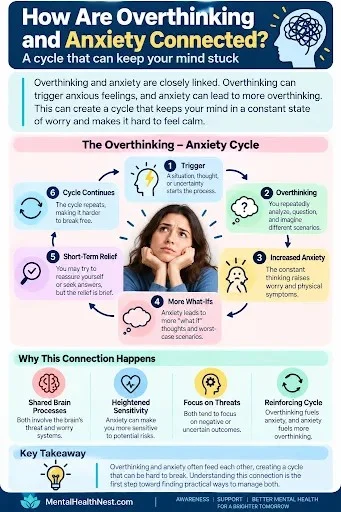
Overthinking and anxiety connection and common patterns
Overthinking and anxiety can reinforce one another. Anxiety can increase attention to uncertainty, possible threats, mistakes, and negative outcomes, which may lead to repeated worrying or mental reviewing. In turn, prolonged overthinking can keep attention focused on possible problems and make anxious feelings harder to settle. The relationship is not the same for everyone, and overthinking does not by itself indicate an anxiety disorder.
When anxiety is present, the mind may become especially focused on questions that do not have an immediate or certain answer.
What if something goes wrong?
What if I made a mistake?
What if they are upset with me?
What if I cannot handle what happens next?
These questions can arise during ordinary periods of stress. Having them does not necessarily mean that something is wrong with a person’s mental health.
The difficulty can develop when the mind repeatedly returns to the same uncertainty without reaching a useful conclusion.
ANXIETY CAN KEEP THE MIND FOCUSED ON POSSIBLE THREATS
Anxiety is closely connected with anticipation of possible danger, difficulty, or uncertainty. Sometimes the perceived threat is obvious. At other times, it may be vague or difficult to define.
For example, someone who is worried about an upcoming work presentation may repeatedly imagine making a mistake, being judged by coworkers, or forgetting important information.
The person may respond by mentally rehearsing the presentation again and again.
Some preparation may be useful. It could help the person identify what they need to practice.
But after reasonable preparation has been completed, continuing to mentally review every possible problem may provide little additional benefit.
The mind can remain focused on what might go wrong even when there is no further action available at that moment.
This is one reason anxiety can make overthinking feel difficult to stop.
UNCERTAINTY CAN FEED REPETITIVE THINKING
Uncertainty is an important part of everyday life. Many questions cannot be answered immediately, and some cannot be answered with complete certainty.
For a person experiencing anxiety, uncertainty may feel particularly uncomfortable.
The mind may respond by repeatedly analyzing possibilities in an attempt to reach certainty.
For example:
“Did I make the right decision?”
“What if I overlooked something?”
“What if the situation changes?”
“What if I regret this later?”
Each question may produce another question.
The person may believe that continuing to think will eventually create complete certainty. However, some situations do not offer that level of certainty, no matter how much they are analyzed.
Recognizing this distinction can be important. Problem-solving aims to identify what can reasonably be done. Repetitive worry may continue searching for certainty that is not available.
OVERTHINKING CAN MAINTAIN ATTENTION ON ANXIETY-PROVOKING INFORMATION
What we repeatedly focus on can influence what feels most noticeable.
If someone spends a long time examining possible problems, mistakes, or threats, those possibilities can remain highly active in their attention.
This does not mean that thoughts create danger or that a person is responsible for feeling anxious.
It means that repeated mental attention can keep a particular concern at the center of awareness.
For example, someone who is worried about their health may repeatedly check how they feel, search for explanations, and reconsider minor physical sensations. Each new observation may generate another question, keeping attention focused on the concern.
Health-related worry can become especially complicated because physical sensations can have many possible explanations, and anxiety itself can be associated with physical symptoms.
The presence of a thought or sensation does not establish that the feared outcome is occurring.
THE CYCLE BETWEEN ANXIETY AND OVERTHINKING
For some people, anxietyand repetitive thinking can form a cycle.
A situation creates uncertainty.
The person becomes anxious.
The anxious feeling draws attention toward possible problems.
The person begins repeatedly analyzing the situation.
The analysis increases attention to additional possibilities.
More uncertainty appears.
Anxiety continues.
This cycle can feel convincing because the mind is actively trying to protect the person from something going wrong.
However, thinking more does not always produce greater certainty or better decisions.
Sometimes the most useful response is to identify what can actually be addressed and recognize what remains uncertain.
A SIMPLE EXAMPLE
Imagine that you send an important message to a friend and do not receive a response.
An ordinary thought might be:
“They may be busy. I will give them some time.”
Anxious overthinking might look more like:
“Why haven’t they responded?”
“Did I say something wrong?”
“Are they angry with me?”
“Maybe I should send another message.”
“What if they do not want to talk to me anymore?”
“What did I say that could have caused this?”
The situation itself has not necessarily changed.
What has changed is the amount of mental attention being given to uncertain possibilities.
This example does not mean that every repeated thought is anxiety-related. People may think repeatedly about relationships for many different reasons. The point is that anxiety can make uncertainty feel urgent and can encourage continued mental analysis.
OVERTHINKING DOES NOT ALWAYS COME FROM ANXIETY
It is also important not to assume that anxiety is always the cause.
People may become caught in repetitive thinking because of stress, sadness, unresolved conflict, difficult decisions, perfectionistic tendencies, habits of self-criticism, or other experiences.
Some people may also experience repetitive negative thinking in connection with depression or other mental-health difficulties.
This is why the pattern needs to be considered in context.
The goal of this article is not to label a person’s thoughts. It is to help readers recognize how repetitive thinking and anxiety can interact and understand when additional support may be useful.
WHEN THE CYCLE STARTS AFFECTING DAILY LIFE
Occasional worry is part of normal life. Concern becomes more important to address when it is persistent, difficult to control, causes significant distress, or begins interfering with everyday functioning.
Possible areas of impact include:
Sleep
Concentration
Work or school
Relationships
Decision-making
Daily responsibilities
Enjoyment of ordinary activities
Avoidance of situations that create anxiety
The National Institute of Mental Health notes that anxiety becomes clinically significant when symptoms persist and interfere with daily life. The specific signs and diagnostic criteria vary among anxiety disorders, so persistent overthinking alone should not be used to identify a disorder.
A qualified healthcare or mental-health professional can help determine whether anxiety, another concern, or several factors may be contributing to persistent distress.
EXPERT TIP
When your mind is repeatedly analyzing the same problem, separate the situation into two questions: “What can I do about this?” and “What am I trying to make certain that cannot be known yet?” Taking a reasonable action can be useful when one is available. When no further action is possible, continuing to analyze the uncertainty may not provide additional control.
TRANSITION
The connection between anxiety and overthinking becomes clearer when we distinguish different forms of repetitive thinking. Worry, rumination, and ordinary reflection can look similar from the outside, but they often involve different patterns of thought and different concerns.
3. Overthinking vs. Worry vs. Rumination
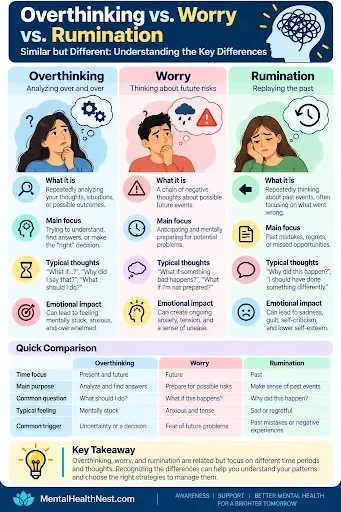
Infographic comparing overthinking, worry, and rumination by their focus, thought patterns, and emotional effects.
Overthinking, worry, and rumination are related terms, but they are not interchangeable. Overthinking is a broad everyday term for becoming stuck in repeated thinking. Worry usually focuses on possible future problems, while rumination often involves repeatedly thinking about past events, negative experiences, or distressing feelings. These patterns can overlap, particularly when anxiety is present.
Understanding the differences can help readers describe what they are experiencing more accurately without turning a common thinking pattern into a diagnosis.
HOW OVERTHINKING DIFFERS FROM WORRY AND RUMINATION
Although these terms can overlap, they describe somewhat different patterns of repetitive thinking. Overthinking is a broad everyday term, while worry and rumination are more specific ways of describing the content or direction of repetitive thought.
Worry generally focuses on possible future problems, uncertainty, or threats. A person may repeatedly think about what could go wrong, what might happen next, or how to prevent an unwanted outcome.
Rumination generally involves repeatedly thinking about past events, negative experiences, mistakes, or distressing feelings. A person may revisit what happened, why it happened, or what they could have done differently.
Overthinking can include either future-focused worry or past-focused rumination, but it does not necessarily fit neatly into either category. The terms can also overlap, particularly when a person is experiencing anxiety or ongoing stress.
Understanding these differences can help readers describe their experiences more accurately without assuming that repetitive thinking automatically indicates a mental-health disorder.
WHAT IS WORRY?
Worry generally involves repeated thoughts about possible future problems or negative outcomes.
A person who is worried may think about what could happen and try to anticipate or prevent difficulties.
For example:
“What if I make a mistake at work?”
“What if something happens to my family?”
“What if I cannot handle the situation?”
“What if the decision I made turns out to be wrong?”
Worry is a normal human experience. It can sometimes help people prepare for challenges.
For example, worrying about an upcoming presentation may encourage someone to prepare their notes or practice beforehand.
The difficulty arises when worry becomes excessive, persistent, difficult to control, or disruptive to everyday life.
In generalized anxiety disorder, for example, excessive worry occurs across multiple areas of life and is difficult to control, along with other symptoms and functional effects. However, occasional worry does not mean that someone has generalized anxiety disorder.
WHAT IS RUMINATION?
Rumination generally refers to repetitive thinking about distressing experiences, negative events, emotions, or their possible meaning.
Rather than primarily asking what might happen in the future, rumination may repeatedly return to something that has already happened or to feelings about that experience.
For example:
“Why did I let that happen?”
“Why did they treat me that way?”
“What did I do wrong?”
“Why can’t I get over this?”
“What does this say about me?”
Rumination can sometimes involve trying to understand an experience. Reflection can be useful when it leads to learning, perspective, or constructive action.
But repeatedly revisiting the same negative material without reaching a useful conclusion can become emotionally exhausting.
HOW THESE PATTERNS CAN OVERLAP
The boundaries between overthinking, worry, and rumination are not always clear.
Someone may worry about the future and then ruminate about a past experience.
For example, a person may think:
“I should not have said that yesterday.”
Then:
“What did my coworker think about me?”
Then:
“What if they tell other people?”
Then:
“What if this affects my job?”
The thinking has moved between the past and the future.
This illustrates why these terms should not be treated as completely separate categories. Researchers often study worry and rumination as related forms of repetitive negative thinking, and these processes can occur across different emotional difficulties.
A SIMPLE COMPARISON
Overthinking
Usually refers to repeated or excessive thinking about a situation, decision, problem, mistake, or possibility.
Typical direction of thought:
Past, present, or future.
Example:
“Am I making the right decision?”
Worry
Usually focuses on possible future problems, threats, or negative outcomes.
Typical direction of thought:
Future.
Example:
“What if something goes wrong?”
Rumination
Often involves repeatedly revisiting past events, negative experiences, emotions, or their meaning.
Typical direction of thought:
Past or present emotional experience.
Example:
“Why did that happen, and why can’t I stop thinking about it?”
The categories can overlap, and everyday language does not always use these terms consistently.
THE IMPORTANT QUESTION IS WHETHER THE THINKING IS HELPING
It can be tempting to focus on whether a particular thought pattern has a specific name.
For everyday mental-health understanding, another question may be more useful:
“Is this thinking helping me understand the situation or take a useful next step?”
Consider someone who is preparing for a difficult conversation.
They might think through what they want to say, consider how the other person might respond, and decide how they would like to handle the conversation.
That is thoughtful preparation.
If the person continues imagining every possible reaction for hours, repeatedly changes what they plan to say, and becomes increasingly distressed without gaining anything useful from the process, the thinking may have become less productive.
The difference is not simply how long someone thinks.
It is also the function and effect of the thinking.
WHEN REPETITIVE THINKING MAY DESERVE ATTENTION
Repetitive thinking may be worth discussing with a healthcare or mental-health professional when it becomes persistent, difficult to control, significantly distressing, or disruptive to everyday life.
For example, someone may notice that repetitive thoughts are regularly interfering with:
Sleep
Concentration
Work or school
Relationships
Decision-making
Daily responsibilities
Enjoyment of activities
The presence of these experiences does not establish a particular diagnosis. Several factors can contribute to repetitive thinking, and different anxiety or mood conditions have different diagnostic criteria.
Professional assessment can help place the experience in its broader context.
EXPERT TIP
Instead of trying to force every thought to stop, notice what direction the thinking is taking. If it is helping you identify a practical action, take that action when reasonable. If it is repeatedly returning to the same question without producing new information, pausing the analysis may be more useful than continuing to search for complete certainty.
TRANSITION
Once worry and rumination become repetitive, it can be difficult to understand why the mind keeps returning to the same concerns. The next section looks more closely at why anxiety can make thoughts feel difficult to stop.
4. Why Anxiety Can Make Thoughts Feel Difficult to Stop
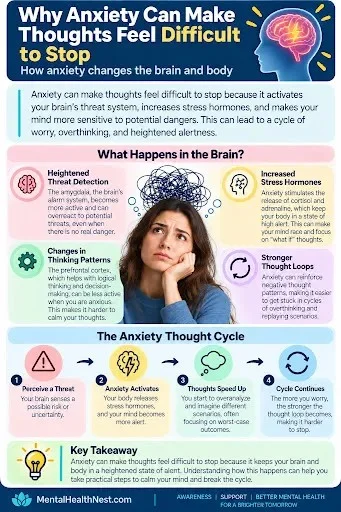
Infographic explaining how anxiety can increase alertness, worry, stress responses, and repetitive thought loops.
Anxiety can make thoughts feel difficult to stop because anxious thinking often keeps attention focused on possible threats, uncertainty, or negative outcomes. The mind may continue analyzing a situation in an attempt to anticipate problems or gain a sense of control. This can create a cycle in which worry increases attention to the concern, and continued attention keeps the concern mentally active.
The experience can be frustrating.
A person may recognize that they have been thinking about the same issue for a long time and still feel unable to simply “switch it off.”
This does not necessarily mean that the person lacks self-control. Anxiety can involve strong emotional and attentional processes that make certain concerns feel especially important.
THE MIND MAY TREAT UNCERTAINTY AS SOMETHING THAT NEEDS TO BE SOLVED
Everyday life contains uncertainty.
You may not know how another person will respond, whether a future event will go according to plan, or exactly how a difficult situation will develop.
For most situations, complete certainty is impossible.
When anxiety is high, however, uncertainty can feel particularly uncomfortable. The mind may respond by repeatedly examining possibilities in an effort to reduce that uncertainty.
For example:
“What if I missed something?”
“What if I made the wrong choice?”
“What if something unexpected happens?”
“What if I am not prepared?”
“What if I cannot handle it?”
The person may believe that one more round of thinking will finally provide enough certainty to feel safe.
But many real-life questions do not have completely certain answers.
This can keep the thinking going even after reasonable preparation or problem-solving has already taken place.
ANXIETY CAN INCREASE ATTENTION TO POSSIBLE THREATS
Anxiety is associated with heightened attention to potential threats and concerns.
When someone is anxious, information related to the concern may become especially noticeable.
For example, a person who is worried about being judged at work may pay close attention to a coworker’s facial expression or tone of voice.
A neutral expression might then be interpreted as possible disapproval.
That interpretation may produce another anxious thought.
“Did I do something wrong?”
The person may then examine the conversation again, looking for evidence that something went wrong.
This does not mean that anxiety makes people irrational or that every interpretation is incorrect. It illustrates how anxiety can influence what receives attention and how uncertainty may become difficult to leave unresolved.
THINKING CAN FEEL LIKE A FORM OF PROTECTION
One reason overthinking can persist is that it may feel useful in the moment.
A person may think:
“If I consider every possibility, I will be prepared.”
“If I analyze the conversation carefully, I can avoid making the same mistake.”
“If I keep checking, I will know that everything is okay.”
“If I anticipate every problem, I can prevent something bad from happening.”
The intention is often understandable.
The person is trying to protect themselves, prepare, solve a problem, or avoid making a mistake.
The difficulty is that mental analysis cannot remove every possible risk.
When thinking becomes a repeated attempt to achieve complete certainty, it may become exhausting without producing the certainty the person is seeking.
THE ANXIETY-THINKING CYCLE CAN REINFORCE ITSELF
A common pattern can look like this:
A concern appears.
↓
Anxiety increases.
↓
The person begins analyzing the concern.
↓
More possible problems are noticed.
↓
The person becomes more uncertain.
↓
More analysis begins.
↓
Anxiety remains active.
This cycle does not happen to everyone, and it does not mean that a person is deliberately maintaining their anxiety.
It simply illustrates how repetitive thinking and anxious feelings can interact.
For some people, the cycle may become particularly noticeable during periods of stress or when facing situations that cannot be completely controlled.
MENTAL CHECKING CAN KEEP A CONCERN ACTIVE
Overthinking can sometimes involve repeated mental checking.
Someone might repeatedly review:
What they said
What another person said
Whether they made a mistake
Whether a decision was correct
Whether a physical sensation means something is wrong
Whether they have prepared enough
Whether something bad could happen
Mental checking can feel different from ordinary problem-solving because it may continue even after the person has already reviewed the relevant information.
The mind keeps returning to the question because it is still looking for certainty.
This pattern can be especially tiring because the person may feel that they cannot trust their previous conclusion.
ANXIETY CAN ALSO AFFECT CONCENTRATION AND SLEEP
Persistent worry can compete with attention needed for other activities.
Someone may be trying to read, work, study, watch a movie, or have a conversation while part of their attention remains focused on a concern.
At night, there are often fewer distractions and fewer immediate demands competing for attention. This can make worries more noticeable.
A person may lie awake thinking about tomorrow’s responsibilities, a recent conversation, a relationship concern, work, finances, health, or another unresolved issue.
Sleep difficulties can then leave the person tired the next day, which may make concentration and emotional regulation more difficult.
This does not mean that every sleep problem is caused by anxiety. Sleep difficulties have many possible causes and may need separate attention when persistent.
WHY “JUST STOP THINKING” USUALLY ISN’T A USEFUL GOAL
Trying to force unwanted thoughts completely out of your mind can sometimes make the experience more frustrating.
Thoughts are a normal part of mental activity. The goal is not to achieve a completely empty mind.
A more practical goal may be to change how you respond when repetitive thoughts appear.
For example, instead of:
“I have to figure this out completely before I can relax.”
A person might gradually work toward:
“I have considered what I can reasonably do. Some uncertainty remains, and I do not have to solve all of it right now.”
This does not guarantee that anxiety will disappear.
It simply changes the task from eliminating every thought to responding to thoughts in a more flexible way.
WHEN REPEATED THOUGHTS BECOME A PROBLEM
Having recurring thoughts does not automatically mean that something is wrong.
The more important considerations include how persistent the thoughts are, how distressing they feel, how difficult they are to control, and whether they interfere with everyday functioning.
If anxiety or repetitive worrying is consistently interfering with sleep, work, school, relationships, or daily responsibilities, professional support may be worth considering.
A qualified healthcare or mental-health professional can help assess the broader pattern rather than relying on one symptom or one article.
EXPERT TIP
When a thought keeps returning, ask yourself whether there is a new piece of information that needs your attention. If there is, address it. If there is not, you may be dealing with repetition rather than additional problem-solving. Recognizing that difference can help you decide whether more thinking is actually useful.
TRANSITION
Anxiety-related overthinking does not always look the same. For one person it may involve repeatedly worrying about the future; for another, it may involve replaying conversations, checking decisions, or imagining negative outcomes. The next section explores some of these common patterns.
5. Common Patterns of Anxiety-Related Overthinking
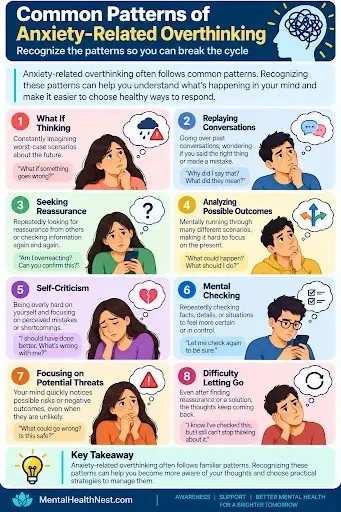
Infographic showing common anxiety-related overthinking patterns, including what-if thinking, reassurance seeking, and self-criticism.
Anxiety-related overthinking can take many forms. Some people repeatedly anticipate what might go wrong, while others replay conversations, question decisions, seek reassurance, or mentally check whether they have made a mistake. These patterns are not diagnoses, and experiencing one or more of them does not necessarily mean that someone has an anxiety disorder.
The common feature is often a repeated attempt to resolve uncertainty, prevent a negative outcome, or understand something that feels emotionally important.
WORRYING ABOUT WHAT MIGHT HAPPEN
One common pattern is repeatedly imagining future problems.
A person may think about an upcoming event and begin considering multiple negative possibilities.
“What if I forget what I need to say?”
“What if everyone notices my mistake?”
“What if something goes wrong?”
“What if I cannot handle it?”
Some preparation can be useful. Thinking through likely challenges may help someone prepare appropriately.
The difficulty arises when the mind continues generating increasingly unlikely possibilities without leading to a practical response.
This can leave a person feeling as though they must mentally prepare for every possible outcome before they can relax.
REPLAYING CONVERSATIONS
Another pattern involves repeatedly reviewing conversations.
Someone might remember something they said and begin wondering how another person interpreted it.
“Did I sound rude?”
“Why did I say that?”
“Did they notice that I was nervous?”
“Should I have answered differently?”
The person may mentally replay the conversation several times, looking for evidence that something went wrong.
This can happen after ordinary social interactions, especially when someone is already feeling uncertain or self-conscious.
Replaying a conversation once may help someone learn from it. Repeatedly examining the same interaction without reaching a useful conclusion can become mentally exhausting.
SECOND-GUESSING DECISIONS
Anxiety can also make ordinary decisions feel unusually difficult.
A person may repeatedly question whether they chose correctly.
“What if the other option would have been better?”
“Did I make a mistake?”
“Should I change my decision?”
“What if I regret this later?”
Decision-making naturally involves uncertainty. There is often no way to know in advance whether one option will produce the best possible outcome.
When anxiety makes uncertainty difficult to tolerate, a person may keep reopening a decision that has already been reasonably considered.
FEARING MISTAKES
Some people become highly focused on preventing mistakes.
They may repeatedly check their work, review messages before sending them, or mentally rehearse what they plan to say.
Careful checking can be useful in situations where accuracy matters.
But repeated checking can become unhelpful when the person continues checking even after the relevant information has already been confirmed.
The underlying concern may be less about the actual mistake and more about the possibility of feeling regret, embarrassment, criticism, or uncertainty afterward.
IMAGINING NEGATIVE OUTCOMES
Anxiety-related overthinking can involve creating detailed mental scenarios about what could go wrong.
For example, someone waiting for an important response may imagine several negative explanations for the delay.
A person may begin with:
“They have not responded yet.”
Then move to:
“Maybe they are upset with me.”
Then:
“Maybe I did something wrong.”
Then:
“Maybe this is going to damage our relationship.”
The mind has moved from an uncertain fact to a series of increasingly negative possibilities.
The possibilities may feel real because they are being imagined in detail.
But imagining an outcome does not establish that the outcome will occur.
SEEKING REASSURANCE REPEATEDLY
Some people respond to uncertainty by repeatedly asking other people for reassurance.
For example:
“Are you sure everything is okay?”
“Do you think I made a mistake?”
“Do you think they are angry with me?”
“Are you certain this will work out?”
Reassurance can be appropriate and healthy. People naturally seek support from friends, family members, colleagues, or professionals.
The difficulty can arise when reassurance provides only temporary relief and the same question soon returns.
A person may feel better immediately after receiving reassurance but become anxious again when uncertainty returns.
This can create a pattern in which reassurance becomes another way of trying to achieve complete certainty.
MENTALLY CHECKING FOR SIGNS THAT SOMETHING IS WRONG
Another pattern is repeatedly monitoring thoughts, feelings, situations, or other information for evidence that something may be wrong.
For example, a person may repeatedly ask themselves:
“Do I still feel anxious?”
“Why am I feeling this way?”
“Does this sensation mean something?”
“Do I seem okay?”
“Was that reaction normal?”
Self-awareness can be useful.
However, constant monitoring can keep attention focused on the very concern the person is trying to resolve.
This is particularly relevant when someone becomes preoccupied with bodily sensations or health concerns. Physical symptoms can have many causes, and persistent or concerning symptoms should be discussed with an appropriate healthcare professional rather than interpreted through repeated online checking.
TRYING TO ACHIEVE PERFECT CERTAINTY
Some forms of overthinking are driven by the belief that a decision should not be made until every possible doubt has been resolved.
But many everyday decisions cannot be made with complete certainty.
You may not know exactly how a new job will turn out.
You may not know how another person will respond.
You may not know whether a particular decision will eventually lead to the outcome you hope for.
Waiting for absolute certainty can therefore keep a person thinking long after reasonable information has already been considered.
PERFECTIONISTIC THINKING
Overthinking may also appear alongside perfectionistic thinking.
A person might repeatedly ask whether something is good enough, whether they could have done more, or whether a small imperfection could cause a larger problem.
For example:
“Could I have made this better?”
“Did I overlook something?”
“What if someone finds a mistake?”
“Maybe I should start again.”
High standards are not inherently harmful. Wanting to do something carefully can be valuable.
The concern is when the pursuit of an ideal result creates persistent distress, excessive checking, avoidance, or difficulty completing ordinary tasks.
FOCUSING ON PAST MISTAKES
Anxiety-related overthinking can also involve repeatedly returning to previous mistakes.
A person may think:
“I should have known better.”
“Why did I do that?”
“How could I have handled it differently?”
“I cannot believe I made that mistake.”
Reflection can help people learn from experience.
But repeatedly punishing yourself mentally is different from constructive reflection.
A useful reflection identifies what can be learned and what might be done differently in the future.
Repetitive self-criticism may instead keep the person focused on an event that cannot be changed.
AVOIDING ACTION BY THINKING ABOUT IT
Sometimes overthinking can appear productive while actually delaying action.
A person may spend a long time researching, comparing, planning, or considering possibilities without taking a reasonable next step.
For example, someone who wants to have a difficult conversation may spend days thinking about exactly how it should go but never decide when or how to begin.
Planning has a purpose when it prepares someone for action.
When additional thinking repeatedly replaces action, it may be worth asking whether the thinking is solving the problem or helping the person avoid uncertainty.
THE SAME PATTERN CAN APPEAR IN DIFFERENT AREAS OF LIFE
Anxiety-related overthinking is not limited to one subject.
It may involve:
Relationships
Work
School
Health
Finances
Family
Social situations
Important decisions
Future plans
Past experiences
The subject can change while the underlying thinking pattern remains similar.
For example, someone may overthink a work conversation on Monday, a relationship concern on Tuesday, and a health concern later in the week.
This does not mean that all of these concerns have the same cause. It simply shows that repetitive thinking can become a general response to uncertainty or emotional discomfort.
WHEN AN OVERTHINKING PATTERN IS WORTH PAYING ATTENTION TO
The presence of repetitive thoughts is not automatically a sign of a mental-health disorder.
It may be useful to pay closer attention when the pattern is persistent, difficult to control, causes substantial distress, or interferes with important areas of life.
You might notice that you are spending significant time mentally reviewing situations, avoiding decisions because you cannot feel completely certain, losing sleep because of repetitive thoughts, or finding it difficult to concentrate on other activities.
These experiences do not provide enough information to diagnose an anxiety disorder.
If they are persistent or significantly affecting your life, a qualified mental-health or healthcare professional can help you understand the broader pattern and discuss appropriate support.
EXPERT TIP
When you notice a repetitive thinking pattern, identify its purpose. Ask, “Am I trying to solve a problem, prepare for something, learn from an experience, or eliminate uncertainty?” If the thinking is no longer producing useful information or action, that can be a signal to pause rather than continue analyzing.
TRANSITION
Recognizing these patterns can help you notice when overthinking is becoming more than an occasional habit. The next step is understanding how to tell when repetitive thinking is beginning to affect everyday life.
FIND THE ANXIETY TOPIC THAT FITS YOUR QUESTION
If you want to explore a specific aspect of anxiety, these related MentalHealthNest articles may help:
Anxiety vs. Depression: Understanding the Differences and Overlap — Explore how anxiety and depression differ and why some symptoms can overlap.
Anxiety and Sleep: How Anxiety Can Affect Your Sleep — Learn about the relationship between anxiety, repetitive thoughts, and sleep.
Anxiety and Physical Symptoms: How Anxiety Can Affect the Body — Understand common physical sensations associated with anxiety while remembering that physical symptoms can have many possible causes.
Panic Attacks vs. Anxiety Attacks: What’s the Difference? — Learn why “anxiety attack” is commonly used but is not a formal clinical diagnosis, and how panic attacks are understood.
Health Anxiety: When Worry About Health Becomes Persistent — Explore how ongoing health-related worry can affect everyday life.
Social Anxiety in Adults: Symptoms, Avoidance, and Support — Learn how social anxiety can affect interactions, relationships, and daily activities.
Anxiety at Work: How Workplace Stress and Uncertainty Can Affect Mental Health — Explore the relationship between workplace pressures, persistent worry, and emotional wellbeing.
Anxiety and Relationships: Understanding the Connection — Learn how anxiety and repetitive worry can affect communication, connection, and relationships.
How to Calm an Anxious Mind: Practical Ways to Manage Anxiety — Explore practical, evidence-informed approaches for responding to anxious thoughts and managing everyday anxiety.
When Does Anxiety Become a Problem? — Learn when persistent anxiety or worry may begin interfering with daily functioning and when professional support may be appropriate.
Continue exploring the MentalHealthNest Anxiety Guide to find the topic that best matches your questions.
6. Signs That Overthinking May Be Affecting Your Daily Life
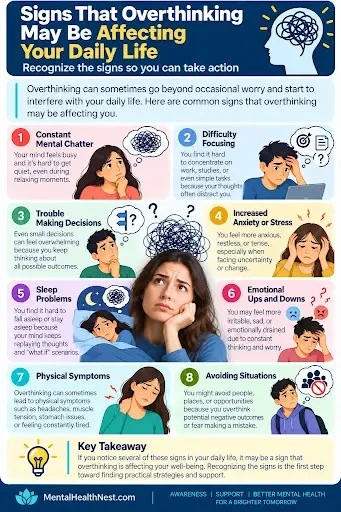
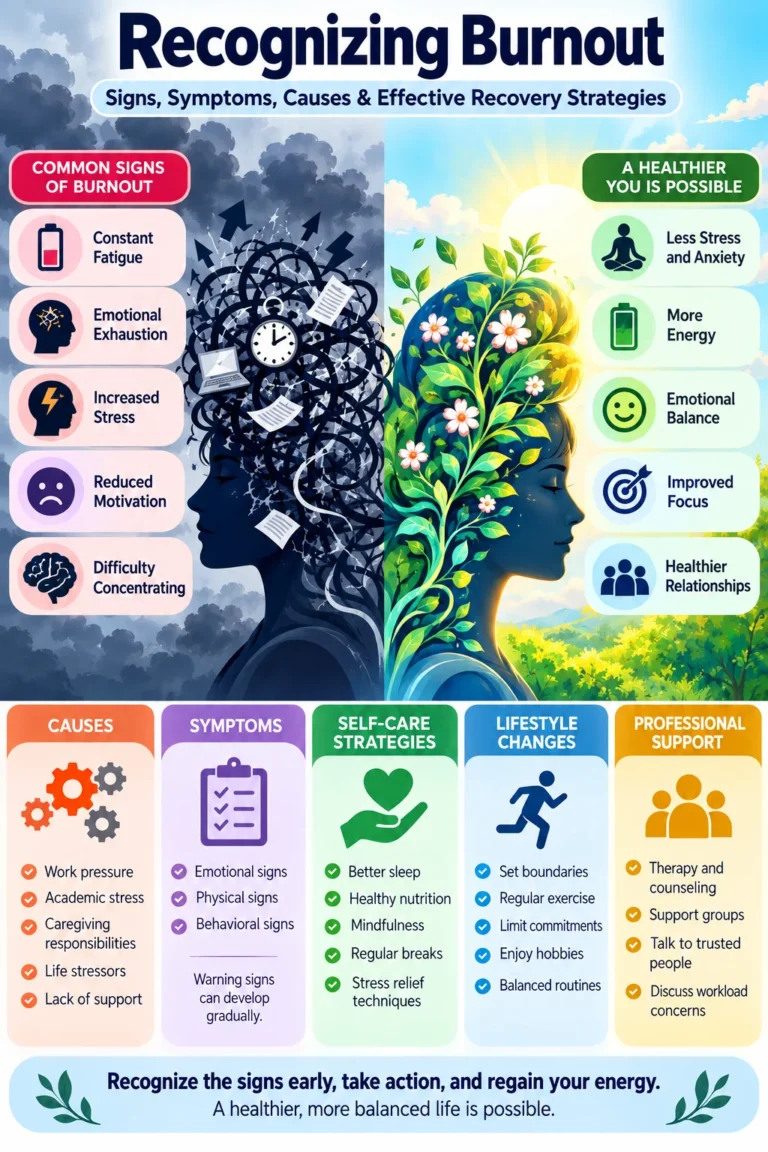
Infographic showing signs that overthinking may affect focus, decisions, sleep, emotions, and daily functioning.
Overthinking may be becoming a significant concern when repetitive thoughts are persistent, difficult to control, emotionally distressing, or disruptive to everyday activities. The impact matters more than simply counting how often you think. Sleep, concentration, work, relationships, decision-making, and enjoyment of daily activities can all be affected when anxiety-related thinking becomes difficult to manage.
Everyone experiences periods of increased worry or repeated thinking. A demanding week, relationship difficulty, important decision, health concern, examination, financial pressure, or major life change can temporarily occupy a person’s thoughts.
The concern is more about the pattern and its effect on daily functioning.
You may notice several different signs.
REPEATED THOUGHTS TAKE UP A LOT OF YOUR ATTENTION
One possible sign is that the same concern repeatedly returns throughout the day.
You may be working, studying, talking with someone, or trying to relax when your attention returns to the same question.
“What if something goes wrong?”
“Did I make a mistake?”
“Should I have handled that differently?”
“Do I need to check this again?”
Occasional thoughts like these are normal.
The concern increases when they repeatedly interrupt activities and become difficult to redirect.
YOU FIND IT DIFFICULT TO LET A QUESTION REMAIN UNANSWERED
Some situations do not have immediate answers.
You may have to wait for a response, see how a situation develops, or make a decision without knowing exactly what will happen.
If uncertainty becomes especially uncomfortable, you may feel a strong need to keep analyzing the situation until you feel completely certain.
Complete certainty, however, is not always possible.
When the search for certainty continues long after reasonable information has been considered, the thinking itself can become exhausting.
YOUR SLEEP IS BEING AFFECTED
Repetitive thoughts may become particularly noticeable when you are trying to sleep.
During the day, work, conversations, responsibilities, and other activities may occupy your attention. At night, there may be fewer distractions, making worries or unresolved concerns feel more prominent.
You may find yourself mentally reviewing the day, anticipating tomorrow, or repeatedly thinking about a problem.
Persistent sleep difficulties can have many causes, so they should not automatically be attributed to overthinking or anxiety. However, if repetitive worry regularly interferes with sleep, it is worth taking the pattern seriously.
YOUR CONCENTRATION BECOMES MORE DIFFICULT
Overthinking can compete with attention needed for other tasks.
You may read the same paragraph several times because your mind keeps returning to another concern.
You may have difficulty following a conversation because part of your attention is focused on what happened earlier.
You may sit down to work but spend much of the time thinking about a problem unrelated to the task.
Everyone becomes distracted sometimes.
The difference may become noticeable when repetitive thinking regularly interferes with activities that normally require your attention.
DECISIONS FEEL MUCH HARDER THAN THEY USED TO
Anxiety-related overthinking can make ordinary decisions feel unusually complicated.
You may repeatedly compare options, search for additional information, ask others for reassurance, or reconsider a decision after you have already made it.
The difficulty may not be a lack of information.
Instead, you may feel uncomfortable moving forward without knowing that you have chosen perfectly.
Most everyday decisions involve some uncertainty.
If the need to feel completely certain repeatedly prevents you from making reasonable decisions, it may be worth examining the pattern.
YOU KEEP REVISITING PAST CONVERSATIONS OR MISTAKES
You may repeatedly replay something you said or did.
The mind may search for the exact moment when something went wrong or try to determine what another person was thinking.
Reflection can sometimes help people learn from experience.
But repeatedly revisiting the same event without reaching a useful conclusion can become emotionally draining.
A helpful distinction is whether the reflection produces learning or simply produces another round of self-questioning.
YOU AVOID ACTIVITIES BECAUSE OF POSSIBLE OUTCOMES
Overthinking can sometimes lead to avoidance.
A person may avoid making a phone call because they are worried about how the conversation might go.
They may delay applying for a job because they keep imagining possible rejection.
They may avoid social situations because they are concerned about saying something embarrassing.
They may postpone a decision because they cannot predict the outcome.
Avoidance can provide short-term relief from anxiety, but repeatedly avoiding situations can also restrict daily life.
Not every decision to avoid something is anxiety-related. Avoidance may be reasonable when a situation is unsafe, inappropriate, or genuinely harmful. The concern is when fear and repetitive thinking unnecessarily prevent ordinary activities.
YOU SEEK REASSURANCE AGAIN AND AGAIN
Talking with someone you trust can be helpful.
The pattern may become less helpful when reassurance provides only brief relief and you soon feel the need to ask the same question again.
For example:
“Are you sure I did not offend them?”
A friend reassures you.
Then a few minutes later:
“But what if they were just being polite?”
The person may continue searching for reassurance because the underlying uncertainty has not disappeared.
Repeated reassurance-seeking can therefore become part of the cycle rather than resolving the concern.
YOU FEEL MENTALLY EXHAUSTED
Persistent repetitive thinking can be tiring.
You may feel as though your mind has been working continuously even when you have not been doing physically demanding work.
You may have difficulty relaxing because your attention keeps returning to unresolved questions.
Mental exhaustion can then make ordinary responsibilities feel more difficult.
This does not mean that feeling mentally tired proves that anxiety is present. Fatigue has many possible causes. It is the broader pattern that matters.
YOUR RELATIONSHIPS ARE BEING AFFECTED
Overthinking may sometimes influence relationships.
You may repeatedly analyze another person’s messages, tone, facial expressions, or behavior.
A delayed response may lead to questions about whether the person is upset.
A brief comment may be replayed repeatedly.
You may ask friends or family members for frequent reassurance.
These patterns can create stress for the person experiencing them and, over time, may affect communication with others.
Again, this does not mean that every concern about a relationship is overthinking. Sometimes there are genuine problems that deserve attention. The useful question is whether repeated analysis is helping you understand and address the situation or keeping you trapped in uncertainty.
YOU HAVE DIFFICULTY ENJOYING THE PRESENT MOMENT
Another possible sign is that your attention is repeatedly pulled away from what you are doing.
You may be spending time with family but thinking about tomorrow’s responsibilities.
You may be watching a movie but replaying a conversation.
You may be on vacation but worrying about what will happen when you return.
You may have completed an important task but immediately begin thinking about everything that could still go wrong.
When this happens frequently, the person may feel as though they are physically present but mentally occupied elsewhere.
WHEN SHOULD YOU TAKE THESE SIGNS SERIOUSLY?
The presence of one or two of these experiences does not mean that you have an anxiety disorder.
Mental-health symptoms exist on a spectrum, and temporary worry can occur during stressful periods.
It becomes particularly important to consider professional support when anxiety or repetitive thinking is persistent, difficult to control, causes significant distress, or interferes with important areas of life.
The National Institute of Mental Health recommends seeking professional help when anxiety symptoms interfere with everyday life, including work, school, relationships, or other activities.
A healthcare or mental-health professional can consider the full context of your experience rather than relying on one symptom or checklist.
A useful question is:
“Is my thinking helping me deal with this situation, or is it increasingly interfering with how I live my life?”
That question can help shift attention away from self-diagnosis and toward the actual impact on your wellbeing.
EXPERT TIP
Instead of asking yourself whether you are “overthinking too much,” look for changes in functioning. Notice whether repetitive thoughts are affecting your sleep, concentration, relationships, responsibilities, or ability to participate in activities that matter to you. Functional impact can provide a more useful signal than the number of thoughts you experience.
Transition
Once repetitive thinking begins affecting sleep, concentration, relationships, or daily responsibilities, it is natural to wonder whether the thinking itself can make anxiety worse. The next section examines that question and explains the relationship between overthinking and anxious feelings.
7. Can Overthinking Cause Anxiety?
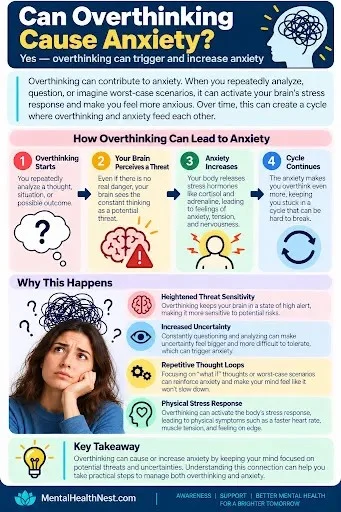
Infographic explaining how repetitive overthinking can contribute to anxiety and create a cycle of worry and stress.
Overthinking can contribute to or intensify feelings of anxiety, particularly when repetitive thinking keeps attention focused on possible threats, uncertainty, mistakes, or negative outcomes. However, overthinking by itself does not necessarily cause an anxiety disorder. Anxiety can develop through multiple interacting factors, including stress, life experiences, biology, and other individual circumstances.
The relationship between overthinking and anxiety is therefore better understood as an interaction rather than a simple cause-and-effect process.
HOW OVERTHINKING MAY INCREASE ANXIOUS FEELINGS
When the mind repeatedly examines possible problems, it may keep attention focused on the concern.
For example, imagine that you are waiting for an important response.
At first, you might think:
“They have not replied yet. They may be busy.”
If the uncertainty continues, your thoughts might become:
“Did I say something wrong?”
“What if they are upset with me?”
“What if something happened?”
“Maybe I should check my phone again.”
Each thought can create another question.
The situation itself may not have changed, but your attention has become increasingly focused on possible negative explanations.
That repeated attention can make the concern feel more immediate and emotionally important.
OVERTHINKING CAN KEEP THE BODY AND MIND IN A STATE OF ALERTNESS
Anxiety involves both mental and physical responses.
When someone becomes anxious, they may experience symptoms such as increased tension, restlessness, difficulty concentrating, changes in sleep, or other physical sensations.
If a person responds to these sensations by repeatedly analyzing them, the analysis itself can become another source of concern.
For example:
“Why is my heart beating faster?”
“Why do I feel tense?”
“Is something wrong?”
“What if this gets worse?”
The person may become more focused on the sensations, which can increase worry.
This does not mean that thinking alone creates physical symptoms in every situation. Physical symptoms can have many causes and should not automatically be attributed to anxiety.
The important point is that attention, interpretation, and emotional response can interact.
OVERTHINKING CAN MAKE UNCERTAINTY FEEL MORE IMPORTANT
One reason repetitive thinking may intensify anxiety is that it can create the impression that an uncertain situation must be completely resolved.
A person might think:
“I cannot relax until I know exactly what will happen.”
“I need to understand why they behaved that way.”
“I need to be completely certain that I made the right decision.”
But everyday life rarely provides complete certainty.
Trying to eliminate every possibility of something going wrong can therefore keep the mind searching for answers that may not exist.
This can make ordinary uncertainty feel more threatening than it initially seemed.
MORE THINKING DOES NOT ALWAYS PRODUCE MORE CONTROL
Overthinking often feels like problem-solving because the mind is actively doing something.
But thinking and problem-solving are not always the same.
Problem-solving usually involves identifying a specific issue, considering realistic options, choosing an appropriate action, and then allowing the situation to develop.
Overthinking may continue after those steps have already been completed.
For example:
Problem-solving:
“I am worried about tomorrow’s presentation. I will review my notes, practice once, and prepare what I need.”
Overthinking:
“I should practice again. What if I forget something? What if someone asks a question I cannot answer? What if I sound nervous? Maybe I should change the presentation again.”
The second pattern may provide the temporary feeling that you are preparing, while also keeping attention focused on possible failure.
CAN OVERTHINKING CREATE AN ANXIETY DISORDER?
There is not a simple answer that applies to everyone.
Anxiety disorders are complex conditions. They can involve genetic and biological factors, temperament, stressful or traumatic experiences, environmental circumstances, learned patterns, and other influences.
A person cannot develop an anxiety disorder simply because they occasionally overthink a problem.
Similarly, recognizing yourself in descriptions of worry or repetitive thinking does not establish a diagnosis.
For some people, however, persistent repetitive negative thinking may be associated with anxiety and other emotional difficulties. Research has examined worry, rumination, and related forms of repetitive negative thinking as processes that can occur across different mental-health conditions.
This is one reason it is more accurate to describe overthinking as something that may interact with anxiety rather than as a single cause of an anxiety disorder.
CAN ANXIETY ALSO LEAD TO MORE OVERTHINKING?
Yes.
The relationship can work in both directions.
Anxiety may increase worry and repetitive thinking.
Repeated thinking may then keep attention focused on the source of anxiety.
The continued focus can make the concern feel more urgent.
The person may then think even more.
This can create a reinforcing cycle.
For example:
An uncertain situation occurs.
↓
Anxiety increases.
↓
The person repeatedly analyzes what could happen.
↓
More possible problems become noticeable.
↓
Uncertainty feels greater.
↓
Anxiety remains active.
↓
More analysis begins.
Breaking this cycle does not necessarily require eliminating every anxious thought.
A more realistic goal is to recognize when additional thinking is no longer providing useful information and then redirect attention toward a practical response, another activity, or acceptance of uncertainty when no further action is available.
WHY SOME PEOPLE MAY BE MORE VULNERABLE TO THIS PATTERN
People respond differently to uncertainty and stressful experiences.
Some individuals may naturally be more prone to worry or repetitive thinking. Life circumstances, ongoing stress, previous experiences, coping habits, and other psychological or biological factors can also influence how someone responds to uncertainty.
This means that there is no single explanation for why one person becomes caught in overthinking while another person does not.
It also means that comparing yourself with other people is unlikely to provide a useful answer.
The more important question is how the pattern affects you and whether it is interfering with your daily life.
WHAT CAN YOU DO IF OVERTHINKING IS MAKING YOU MORE ANXIOUS?
The first step is recognizing the difference between useful thinking and repetitive analysis.
You can ask:
“Is there something I can reasonably do about this right now?”
If the answer is yes, identify the next practical step.
If the answer is no, continuing to analyze the situation may not create additional control.
You can then shift attention toward another meaningful activity rather than continuing to search for complete certainty.
Other strategies that may help include maintaining regular sleep habits, staying physically active in ways that are appropriate for you, spending time with supportive people, reducing avoidable stressors, and learning evidence-informed approaches for managing anxiety.
These strategies are not guaranteed to eliminate anxiety and should not be viewed as replacements for professional treatment when treatment is needed.
WHEN PROFESSIONAL SUPPORT MAY HELP
Consider speaking with a qualified mental-health or healthcare professional if anxiety or repetitive thinking is persistent, difficult to control, significantly distressing, or interfering with sleep, work, school, relationships, or other areas of daily life.
Professional assessment can help identify the broader pattern and determine whether anxiety, another concern, or multiple factors may be involved.
You do not need to diagnose yourself before seeking help.
Seeking professional support is about understanding what is happening and identifying appropriate options, not proving that you have a particular disorder.
EXPERT TIP
Instead of asking, “How can I think my way out of this uncertainty?” try asking, “What is within my control right now?” If there is a reasonable action, focus on that action. If there is no action available, practicing the ability to tolerate some uncertainty may be more useful than continuing the same mental analysis.
TRANSITION
Overthinking can affect more than anxious feelings in the moment. When repetitive thoughts continue into the evening or interrupt rest, they can also affect sleep and contribute to mental exhaustion. The next section looks at that connection.
8. Overthinking, Sleep, and Mental Exhaustion
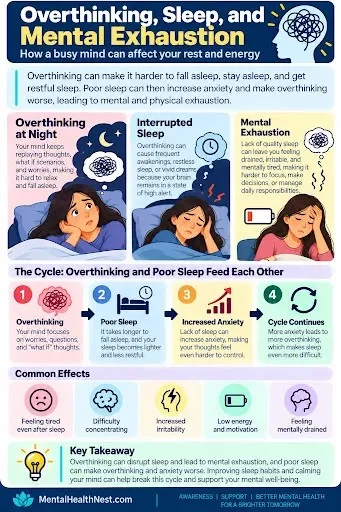
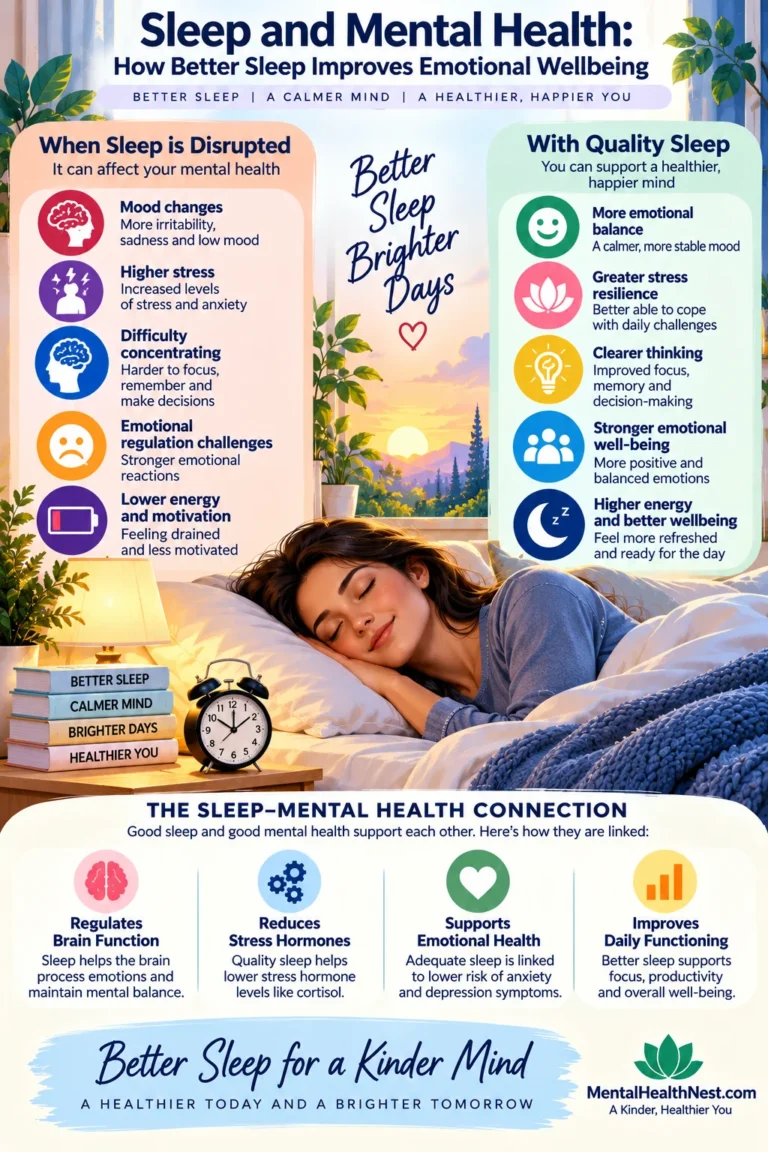
Infographic explaining how overthinking can disrupt sleep and contribute to mental fatigue, low energy, and poor focus.
Overthinking can interfere with sleep when repetitive worry or rumination keeps the mind mentally active when a person is trying to rest. Poor or disrupted sleep can then contribute to daytime tiredness, difficulty concentrating, and reduced emotional resilience. However, sleep problems have many possible causes, so persistent sleep difficulties should not automatically be attributed to anxiety or overthinking.
WHY OVERTHINKING CAN BECOME MORE NOTICEABLE AT NIGHT
During the day, your attention may be occupied by work, school, family responsibilities, conversations, errands, and other activities.
When the day becomes quieter, there may be fewer demands competing for your attention.
That can make unresolved concerns feel more noticeable.
You may suddenly begin thinking about:
A conversation from earlier in the day
An upcoming responsibility
A decision you need to make
A relationship concern
A financial problem
A health concern
Something you regret doing
Something that might happen tomorrow
The problem may not have suddenly become more serious.
You may simply have more mental space to notice it.
For someone already experiencing anxiety, that quiet period can become an opportunity for repetitive thinking to take over.
THE BED CAN BECOME ASSOCIATED WITH WORRY
If a person regularly spends bedtime worrying, mentally reviewing the day, or trying to solve problems, bedtime can gradually become associated with mental activity rather than relaxation.
The person may get into bed and immediately begin thinking:
“Why am I still awake?”
“I need to fall asleep.”
“What if I cannot sleep tonight?”
“How will I function tomorrow?”
These thoughts can create additional pressure.
The person may then become more focused on whether they are falling asleep, which can make relaxation more difficult.
This does not happen to everyone, and sleep difficulties can have many causes. But it illustrates how worry about sleep can sometimes become part of the problem.
ANXIETY AND SLEEP CAN AFFECT EACH OTHER
The relationship between anxiety and sleep is not necessarily one-directional.
Anxiety can make it harder to relax or fall asleep.
Poor sleep can also leave a person feeling tired and less able to cope with stress the following day.
This does not mean that one difficult night will cause an ongoing anxiety problem.
Occasional sleep disruption is common.
The concern is when sleep difficulties and anxiety repeatedly occur together and begin affecting daily functioning.
MENTAL EXHAUSTION CAN FEEL DIFFERENT FROM PHYSICAL TIREDNESS
After spending a long period thinking about the same problem, a person may describe feeling mentally exhausted.
They may feel as though their mind has been working continuously.
Possible experiences include:
Difficulty concentrating
Feeling mentally drained
Trouble making decisions
Reduced patience
Difficulty switching attention between tasks
Feeling less motivated
Finding ordinary responsibilities harder to manage
These experiences are not specific to anxiety or overthinking. Mental fatigue can occur for many reasons, including insufficient sleep, stress, physical health conditions, demanding work, emotional difficulties, and other circumstances.
The broader pattern matters.
WHEN WORRY FOLLOWS YOU INTO BED
One useful observation is whether the same concerns that occupy your attention during the day regularly continue when you are trying to sleep.
For example, you may spend the evening thinking about an upcoming work obligation.
When you get into bed, the thought returns.
You begin planning.
Then you imagine something going wrong.
You consider how you would respond.
Then you think about another possible problem.
Before long, you are no longer preparing for one specific task. You are mentally rehearsing many possible scenarios.
Recognizing this pattern can be useful because it separates actual preparation from continued mental rehearsal.
A PRACTICAL WAY TO HANDLE BEDTIME WORRY
If a concern can be addressed before bedtime, consider giving it a specific place in your daytime routine.
For example, you might write down the concern and identify one reasonable next step for the following day.
The purpose is not to guarantee that the thought will disappear.
Instead, you are giving your mind a clear reminder:
“This concern has been recorded. I know what I can do next. I do not need to solve it completely tonight.”
A written note may also help prevent you from repeatedly reconstructing the same plan in your head.
KEEP BEDTIME FROM BECOMING A PROBLEM-SOLVING SESSION
It can be useful to create a transition between daytime responsibilities and sleep.
That might include:
Finishing demanding tasks before your intended bedtime
Writing down important concerns or tomorrow’s tasks
Reducing stimulating activities close to bedtime
Following a consistent sleep routine
Using a quiet activity that helps you wind down
Keeping your sleep environment comfortable and suitable for rest
These are general sleep-supportive practices rather than treatments for an anxiety disorder.
If sleep problems continue despite reasonable changes, professional advice may be appropriate.
BE CAREFUL ABOUT TRYING TO FORCE SLEEP
When someone notices that they are not falling asleep, anxiety about not sleeping can become another source of repetitive thinking.
“I have to fall asleep now.”
“Tomorrow will be terrible if I do not sleep.”
“Why am I still awake?”
These thoughts can increase frustration.
A more flexible approach is to recognize that sleep cannot always be forced through effort.
If you are awake and becoming increasingly frustrated, following established sleep-hygiene guidance and discussing persistent insomnia with a healthcare professional may be more useful than spending the night analyzing why you cannot sleep.
WHEN SLEEP PROBLEMS NEED MORE ATTENTION
Persistent or significant sleep problems deserve attention, particularly when they affect daytime functioning.
Consider speaking with a healthcare professional if you regularly have difficulty falling asleep, staying asleep, waking too early, or feeling rested despite having enough opportunity for sleep.
Sleep difficulties can be associated with anxiety, depression, medications, medical conditions, substance use, sleep disorders, environmental factors, and many other causes.
This is another reason not to assume that overthinking is the sole explanation.
If sleep problems are persistent, a professional can help consider the full picture.
MENTAL EXHAUSTION CAN BECOME A SIGNAL TO SLOW DOWN
When your mind repeatedly returns to the same concerns, mental exhaustion may be a sign that continued analysis is no longer helping.
You may not need another explanation.
You may need a pause.
That pause could involve stepping away from the problem, engaging in a routine activity, talking with someone you trust, or returning to the issue later when you have more information.
The goal is not to avoid important problems.
It is to recognize that continuous thinking is not always the same as productive thinking.
EXPERT TIP
If your mind becomes especially active at bedtime, keep a simple note nearby and write down the concern and the next reasonable action you can take tomorrow. Once it is recorded, gently return your attention to resting rather than repeatedly solving the same problem mentally.
WHEN TO SEEK PROFESSIONAL SUPPORT
If anxiety, repetitive thinking, or sleep difficulties are regularly interfering with your daily life, consider speaking with a qualified healthcare or mental-health professional.
Professional support can be particularly useful when the pattern is persistent, difficult to control, causes significant distress, or affects work, school, relationships, sleep, or other important areas of functioning.
You do not need to determine whether anxiety is the cause before asking for help.
A professional can help explore possible contributing factors and discuss appropriate options based on your individual circumstances.
TRANSITION
Understanding the effect of overthinking on sleep and mental energy is important, but understanding the pattern is only part of the process. The next question is what you can actually do when you notice anxious overthinking beginning to take over.
9. How to Respond to Anxious Overthinking
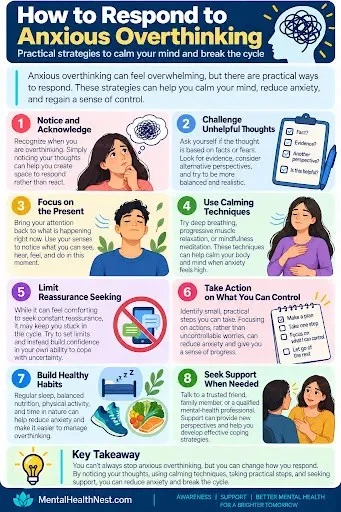
Infographic showing practical ways to respond to anxious overthinking, including grounding, calming techniques, and support.
Responding to anxious overthinking is usually less about forcing thoughts to stop and more about changing how you respond to them. Helpful approaches may include identifying what is within your control, separating practical problem-solving from repetitive worry, gently redirecting attention, and seeking professional support when anxiety becomes persistent or begins interfering with daily life.
The goal is not to eliminate every anxious thought. Everyone experiences unwanted, uncertain, or repetitive thoughts at times. Instead, the aim is to notice when thinking has stopped being useful and choose a more constructive response.
1. Notice the pattern without judging yourself
The first step is recognizing that you are caught in an overthinking cycle.
You might notice yourself repeatedly reviewing a conversation, imagining negative outcomes, questioning a decision, searching for certainty, or asking the same “what if?” question again and again.
Instead of criticizing yourself for thinking this way, try simply identifying what is happening:
“I am worrying about this again.”
“This thought keeps coming back.”
“I am trying to find certainty about something I cannot fully control.”
This kind of awareness can create a small amount of distance between you and the thought.
2. Ask whether there is a problem you can act on
One of the most useful distinctions is between a practical problem and a worry about something that may or may not happen.
If there is something you can realistically do, move from thinking toward problem-solving.
For example:
“I am worried about an upcoming appointment.”
A practical response might be checking the appointment time, preparing questions, or writing down what you need to bring.
But if the thought is:
“What if something goes wrong?”
and there is no additional action you can take right now, repeatedly imagining every possible outcome may not provide useful information.
The question becomes:
“Is there something I can reasonably do about this right now?”
If the answer is yes, identify the next step.
If the answer is no, it may be more helpful to acknowledge the uncertainty and redirect your attention.
3. Write the worry down
Putting repetitive thoughts into words can sometimes make them easier to examine.
You could write down:
What am I worried about?
What evidence or information do I actually have?
Is this a current problem or a future possibility?
Is there something I can do about it?
If there is, what is the next reasonable step?
If there is not, can I allow the uncertainty to remain without continuing to analyze it?
Writing does not need to become a long journal entry. A few sentences in a notebook or phone can be enough to make the thought more concrete.
4. Separate problem-solving from repetitive worry
Problem-solving usually moves toward an action, decision, or plan.
Overthinking can keep returning to the same question without producing anything new.
For example:
Problem-solving:
“I need to prepare for tomorrow’s presentation. I will review the main points tonight and prepare what I need.”
Repetitive worry:
“What if I forget something? What if people dislike it? What if I make a mistake? What if something unexpected happens?”
The second pattern can continue indefinitely because there is always another possibility to consider.
When you notice this difference, ask:
“Am I solving the problem, or am I repeatedly thinking about the possibility of a problem?”
5. Consider setting aside a short period for worries
Some structured approaches to managing worry use a technique sometimes called “worry time.”
Instead of trying to deal with every worry immediately, you can write it down and return to it during a planned, limited period later.
For example:
“I am worried about this right now. I will write it down and come back to it during my scheduled worry time.”
This does not mean ignoring important concerns. It creates a boundary around repetitive thinking so that every worry does not automatically take over the entire day.
For some people, this approach can make it easier to return attention to work, school, conversations, rest, or other activities.
6. Gently bring your attention back to the present
An anxious mind may spend a great deal of time reviewing the past or predicting the future.
Mindfulness and other attention-based practices can help some people notice this pattern and return their attention to what is happening in the present moment.
You might focus on:
The conversation you are currently having.
The task in front of you.
Sounds around you.
Physical sensations such as your feet touching the floor.
The natural rhythm of your breathing.
The purpose is not to force thoughts away. Thoughts may continue to appear. Instead, you are practicing the ability to notice them without automatically following every thought.
7. Avoid demanding complete certainty
Overthinking often becomes stronger when the mind tries to reach a level of certainty that may not be possible.
Questions such as “What if I am making the wrong decision?” or “How can I know for sure that everything will be okay?” may have no completely certain answer.
A more useful question can sometimes be:
“What information do I have, and what is a reasonable decision based on that information?”
Learning to tolerate some uncertainty is not the same as ignoring genuine risks. It means recognizing that not every situation can be predicted or controlled completely.
8. Take care of the basics that support mental wellbeing
Anxiety can become harder to manage when you are exhausted, under prolonged stress, or not getting enough restorative sleep.
Regular physical activity, adequate sleep, social connection, relaxation practices, and paying attention to factors that may increase anxiety can support overall mental wellbeing.
These habits are not substitutes for professional treatment when treatment is needed. They are part of a broader approach to caring for yourself.
9. Be careful with repeated reassurance and checking
When people feel uncertain, they may repeatedly search for answers, ask others for reassurance, reread messages, check information, or mentally review an event.
These behaviors can sometimes provide temporary relief while keeping attention focused on the same worry.
If you notice this happening repeatedly, pause and ask:
“Did this checking actually solve the problem, or did it only make me feel certain for a few minutes?”
That question can help you recognize whether the behavior is useful or whether it is becoming part of the overthinking cycle.
10. Treat yourself with patience
It can be frustrating to realize that your mind keeps returning to the same concern.
Try not to turn that frustration into another cycle of self-criticism.
Instead of:
“Why can’t I control my thoughts?”
you might try:
“My mind is feeling anxious right now. I can notice the thought and decide what deserves my attention.”
Managing anxious overthinking is usually a process rather than a single technique. Different approaches work differently for different people, and persistent anxiety may require professional support.
WHEN SELF-HELP IS NOT ENOUGH
If anxious thoughts are becoming difficult to manage, interfering with sleep, school, work, relationships, or daily responsibilities, or causing significant distress, consider speaking with a qualified mental-health or healthcare professional.
Psychotherapies such as cognitive behavioral therapy are commonly used to treat anxiety disorders, including generalized anxiety disorder. A professional can help determine whether the pattern is related to an anxiety disorder or another concern and discuss appropriate support.
PRACTICAL CHECKLIST
When you notice anxious overthinking, ask yourself:
What exactly am I worried about?
Is this a current problem or a future possibility?
Is there something I can reasonably do right now?
If yes, what is the next small step?
If no, can I allow some uncertainty and return my attention to the present?
Am I solving the problem, or repeatedly analyzing it?
Would writing the thought down help me step back from it?
Do I need support from someone I trust or a qualified professional?
The aim is not to make your mind completely quiet. It is to develop a healthier relationship with thoughts so that anxious thinking does not automatically control your attention, decisions, or daily life.
TRANSITION
Knowing how to respond to anxious overthinking can make the pattern easier to recognize and manage. But there are times when overthinking becomes more than an occasional struggle and begins affecting everyday functioning. The next section looks at when professional support may be appropriate.
10. When Should You Consider Professional Support?
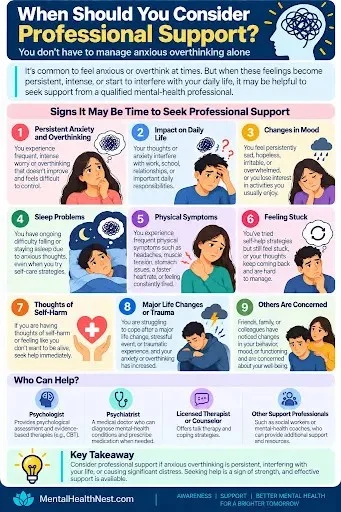
Infographic showing signs that persistent overthinking or anxiety may warrant support from a qualified mental-health professional.
Occasional overthinking is a common human experience and does not necessarily mean that someone has an anxiety disorder. Professional support may be worth considering when anxious thoughts become persistent, difficult to manage, cause significant distress, or begin interfering with sleep, relationships, work, school, or everyday responsibilities. A qualified professional can help clarify what may be contributing to the problem and discuss appropriate options for support.
WHEN OVERTHINKING STARTS INTERFERING WITH DAILY LIFE
The frequency of anxious thoughts is only part of the picture. What matters is also how much they affect your ability to function and participate in everyday life.
Consider seeking professional support if you notice that overthinking is regularly interfering with:
Sleep or rest
Concentration or decision-making
Work or school responsibilities
Relationships and social activities
Daily routines
Your ability to relax or enjoy activities
Your sense of emotional wellbeing
For example, worrying occasionally about an upcoming presentation is different from spending large portions of the day worrying about possible mistakes and finding it difficult to concentrate on anything else.
WHEN WORRY FEELS DIFFICULT TO CONTROL
Another important sign is a sense that your thoughts are repeatedly returning despite your efforts to move on.
You may find yourself:
Replaying conversations repeatedly
Constantly anticipating negative outcomes
Seeking reassurance again and again
Checking information repeatedly
Having difficulty making ordinary decisions because of fear of making the wrong choice
Spending long periods thinking about situations that cannot be changed
Finding it difficult to redirect your attention
When these patterns become persistent or distressing, talking with a qualified professional can provide a clearer understanding of what is happening.
WHEN ANXIETY AFFECTS YOUR SLEEP
Anxious overthinking can become especially difficult at night.
You may go to bed physically tired but find that your mind continues reviewing the day, planning for tomorrow, or imagining possible problems.
If this happens regularly and contributes to ongoing sleep difficulties, it is reasonable to discuss the problem with a healthcare or mental-health professional.
Sleep problems can have many possible causes, so professional assessment can help identify what may be contributing to them.
WHEN ANXIOUS THINKING CHANGES YOUR BEHAVIOR
Sometimes the effect of anxiety is easier to notice in behavior than in thoughts.
You might begin avoiding:
Social situations
Important conversations
Travel
Work or school activities
Medical appointments
New experiences
Ordinary responsibilities
Decisions that feel uncertain
Avoidance can provide short-term relief, but repeated avoidance may also restrict a person’s daily life.
If anxiety or overthinking is causing you to regularly avoid activities that matter to you, professional support may be helpful.
WHEN PHYSICAL SYMPTOMS ARE PART OF THE PATTERN
Anxiety can occur alongside physical sensations such as muscle tension, restlessness, difficulty sleeping, fatigue, sweating, or a racing heartbeat.
However, physical symptoms should not automatically be assumed to be caused by anxiety.
New, severe, persistent, or unexplained physical symptoms deserve appropriate medical attention. A healthcare professional can help determine whether anxiety may be contributing or whether another health issue should be considered.
YOU DO NOT NEED TO WAIT UNTIL THE PROBLEM BECOMES SEVERE
Professional support is not only for people experiencing extreme distress.
You can seek help when you are simply noticing a pattern that you do not understand or are finding difficult to manage on your own.
A conversation with a qualified professional may help you:
Understand what may be contributing to your anxiety
Identify patterns that keep repetitive thinking going
Learn evidence-based coping skills
Determine whether symptoms may fit an anxiety disorder or another mental-health concern
Discuss appropriate treatment or support options when needed
You do not have to diagnose yourself before asking for help.
WHO CAN YOU TALK TO?
Depending on your circumstances, you might begin with a primary care clinician, licensed mental-health professional, psychologist, psychiatrist, or another appropriately qualified healthcare provider.
The right starting point can depend on your symptoms, access to care, personal preferences, and whether physical symptoms are also present.
A mental-health professional can assess symptoms and discuss appropriate forms of support. A primary care clinician can also help evaluate physical symptoms and determine whether further mental-health assessment may be appropriate.
PROFESSIONAL SUPPORT DOES NOT MEAN YOU HAVE FAILED
Needing support is not a sign of personal weakness.
Anxiety can affect people in many different circumstances, including people who are functioning well in other areas of life.
Seeking professional help can simply mean recognizing that a recurring problem deserves attention rather than continuing to manage it alone.
WHEN URGENT HELP MAY BE NEEDED
If someone is in immediate danger, experiencing a medical emergency, or unable to stay safe, seek urgent help through appropriate emergency services.
In the United States, 911 can be used for immediate emergencies. The 988 Suicide & Crisis Lifeline provides free, confidential crisis support by call, text, or chat for people experiencing a mental-health or emotional crisis.
These services are different from routine professional support and are intended for situations requiring immediate assistance.
A FINAL QUESTION TO ASK YOURSELF
Instead of asking:
“Is my overthinking bad enough to need help?”
consider asking:
“Is this pattern causing enough distress or disruption that I would benefit from talking with someone?”
There is no requirement to reach a particular level of suffering before seeking support.
The important consideration is whether anxious thinking is becoming difficult to manage or is interfering with the life you want to live.
TRANSITION
Professional support can help when anxious overthinking becomes persistent or disruptive. But overthinking does not always look the same in every situation. The next section examines how anxiety-related overthinking can appear in areas such as relationships, work, health, social situations, and everyday decision-making.
11. Overthinking and Anxiety in Different Areas of Life
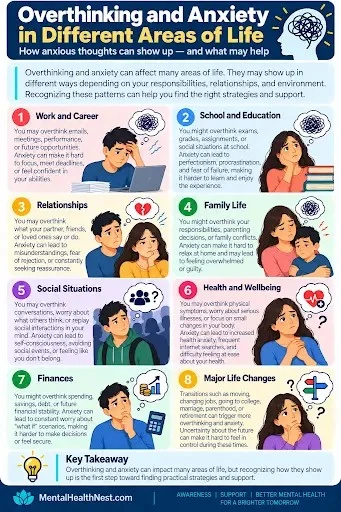
Infographic showing how overthinking and anxiety can affect work, relationships, family, school, health, finances, and life changes.
Overthinking can appear in many parts of everyday life. A person may repeatedly analyze a relationship, worry about health, replay a social interaction, anticipate problems at work, or struggle with ordinary decisions. The subject of the thoughts can change, but the underlying pattern may involve uncertainty, fear of negative outcomes, or difficulty disengaging from repetitive thinking.
OVERTHINKING AND RELATIONSHIPS
Relationships can create many situations where uncertainty feels uncomfortable.
Someone may repeatedly think about:
“What did they mean by that message?”
“Are they upset with me?”
“Did I say something wrong?”
“What if the relationship changes?”
“Should I have responded differently?”
Reviewing an interaction occasionally is normal. The difficulty can arise when the same questions are repeatedly analyzed without producing new information.
Relationship-related overthinking may also lead to repeatedly checking messages, seeking reassurance, or interpreting small changes in another person’s behavior as signs that something is wrong.
A useful question can be:
“Do I have new information, or am I repeatedly trying to solve the same uncertainty?”
OVERTHINKING AND SOCIAL SITUATIONS
Social situations can become a major source of repetitive thinking for some people.
Before an event, a person may imagine everything that could go wrong. During the interaction, they may become highly focused on how they are being perceived. Afterwards, they may replay the conversation and search for mistakes.
For example:
“Did I sound awkward?”
“Why did I say that?”
“Did everyone notice?”
“What if they think badly of me?”
Occasional self-reflection is normal. However, persistent fear of negative evaluation, avoidance of social situations, and significant distress may be associated with social anxiety and are worth discussing with a qualified professional.
OVERTHINKING AND WORK
Work-related responsibilities can generate repeated thoughts about performance, deadlines, mistakes, workplace relationships, or future consequences.
A person might repeatedly review an email before sending it, worry about making a mistake, replay feedback from a manager, or continue thinking about work long after the workday has ended.
Some preparation is useful.
The problem is when preparation turns into endless checking or worry without improving the situation.
A practical distinction is:
“Is there something I still need to complete?”
If there is, identify the next task.
If the work is complete, continuing to mentally review every possible problem may not provide additional protection.
OVERTHINKING AND SCHOOL
Students can experience repetitive thinking around grades, exams, assignments, friendships, presentations, and future plans.
Thoughts might include:
“What if I fail?”
“What if I forget everything?”
“What if everyone does better than me?”
“What if this affects my future?”
Some concern can encourage preparation. Persistent worry can make it harder to concentrate, sleep, or engage with school.
When academic worry begins interfering with daily functioning, talking with a trusted adult, school counselor, healthcare professional, or qualified mental-health professional may be appropriate.
OVERTHINKING AND HEALTH
Health concerns can also become a focus of repetitive thinking.
A person may notice a physical sensation and repeatedly search for explanations, compare symptoms, seek reassurance, or worry about what the sensation might mean.
Having questions about your health is not the same as having health anxiety.
However, when health-related worry becomes persistent, difficult to control, or disruptive to everyday life, it may be useful to discuss the pattern with a qualified healthcare or mental-health professional.
It is also important not to use anxiety as an automatic explanation for physical symptoms. New or concerning symptoms should receive appropriate medical evaluation.
OVERTHINKING AND DECISION-MAKING
Some people become stuck when making decisions because they are trying to find the perfect choice.
They may compare every possible outcome, search for additional information, ask several people for opinions, and repeatedly reconsider a decision after making it.
This can happen with both small and major decisions.
A useful distinction is between making an informed decision and trying to eliminate all uncertainty.
Most decisions involve some uncertainty. The goal is often to gather reasonable information, consider the important factors, make a decision, and accept that not every outcome can be predicted.
OVERTHINKING AND MONEY
Financial concerns can create understandable worry, particularly when someone is dealing with uncertainty about expenses, employment, debt, housing, or other responsibilities.
Problem-solving can be useful when there is a specific financial issue to address.
For example, reviewing a budget, identifying an upcoming expense, or seeking appropriate financial guidance may lead to a concrete next step.
Repeatedly imagining every possible financial disaster without taking an available practical step, however, can become mentally exhausting.
If financial stress is contributing significantly to anxiety, addressing both the practical problem and the emotional impact may be important.
OVERTHINKING AND THE FUTURE
Anxiety often focuses on what might happen next.
The mind may create multiple possible scenarios in an attempt to prepare for uncertainty.
“What if something goes wrong?”
“What if I make the wrong choice?”
“What if things change?”
“What if I am not prepared?”
Planning has value when it leads to realistic preparation.
Overthinking becomes less useful when the mind keeps generating hypothetical problems that cannot currently be resolved.
A helpful question is:
“What can I prepare for, and what do I need to accept that I cannot predict?”
OVERTHINKING AFTER MAKING A MISTAKE
Mistakes can also become a source of repetitive thinking.
Looking back can sometimes help a person learn what to do differently next time.
But repeatedly replaying the same event may shift from reflection into rumination.
A constructive reflection might be:
“What happened, what can I learn, and what would I do differently next time?”
Rumination may sound more like:
“Why did I do that?”
“How could I have been so stupid?”
“Why didn’t I handle it differently?”
The second pattern often keeps attention focused on self-criticism rather than learning.
A more useful response is to identify the lesson, make any reasonable repair, and allow the event to become part of the past.
OVERTHINKING CAN MOVE FROM ONE AREA TO ANOTHER
An important point is that anxious overthinking does not always remain focused on one subject.
Someone may worry about work during the day, relationships in the evening, and health concerns at night.
The specific topic changes, but the underlying pattern of repetitive worry may remain similar.
This is one reason it can be more useful to examine the thinking pattern itself rather than focusing only on the current subject of the worry.
THE IMPORTANT DISTINCTION
Overthinking about relationships, health, work, school, money, or the future does not automatically mean that someone has an anxiety disorder.
People naturally think deeply about important parts of their lives.
The concern becomes more significant when repetitive thinking is persistent, difficult to control, causes substantial distress, leads to avoidance or repeated reassurance-seeking, or interferes with sleep and everyday functioning.
When those patterns are present, professional assessment can help determine what may be happening and what type of support could be appropriate.
TRANSITION
Overthinking can take many forms depending on what matters most to a person. Understanding these patterns can make the experience easier to recognize, but readers often still have specific questions about why it happens and what it means. The next section answers common questions about overthinking and anxiety.
12. Frequently Asked Questions
FINAL FAQ NOTE
Overthinking is common, and having repetitive thoughts does not automatically mean that something is medically wrong. What matters is the pattern, the level of distress, how difficult it is to control, and whether it is interfering with everyday life.
For readers in the United States, professional support may be available through primary care clinicians, licensed mental-health professionals, psychologists, psychiatrists, community mental-health services, and other qualified healthcare providers.
PRACTICAL TAKEAWAYS
Overthinking can make an ordinary concern feel much larger because the mind keeps returning to the same question, possibility, or uncertainty. The goal is not to control every thought. It is to recognize when thinking has stopped being useful and respond in a way that supports your everyday life.
🔵 Overthinking is not the same as having an anxiety disorder. Everyone gets caught in repetitive thinking sometimes.
🟢 Ask yourself whether you are solving a real problem or repeatedly worrying about what might happen.
🟡 If there is something you can control, identify one realistic next step instead of continuing to analyze every possible outcome.
🟣 If there is nothing useful you can do right now, practice allowing some uncertainty rather than trying to obtain complete certainty.
🔵 Write recurring worries down. Seeing a thought on paper can sometimes make it easier to examine rather than automatically follow.
🟢 Pay attention to patterns that repeatedly trigger overthinking, such as relationship concerns, work pressure, health worries, financial uncertainty, social situations, or major decisions.
🟡 Notice whether repeated checking or reassurance gives you lasting clarity or only temporary relief before the same worry returns.
🟣 Give your attention somewhere meaningful. A conversation, walk, work task, hobby, family activity, or ordinary daily responsibility can help shift attention away from repetitive thinking.
🔵 Protect the basics that support mental wellbeing, including adequate sleep, regular activity, social connection, and time away from unnecessary sources of stress.
🟢 Be careful about turning self-reflection into self-criticism. Learning from a mistake is different from repeatedly punishing yourself for it.
🟡 Remember that uncertainty is part of everyday life. A reasonable decision does not always require complete information or a guarantee about the outcome.
🟣 If overthinking is regularly affecting your sleep, concentration, relationships, work, school, or ability to enjoy everyday activities, consider speaking with a qualified healthcare or mental-health professional.
🔵 You do not have to wait until anxiety becomes overwhelming before asking for help.
A SIMPLE QUESTION TO KEEP
When you notice your mind going around the same issue again, pause and ask:
“Is there something useful I can do about this right now?”
If the answer is yes, take the next reasonable step.
If the answer is no, give yourself permission to step away from the thought and return to what is happening in your life right now.
COMING BACK TO THIS ARTICLE
If you find yourself returning to the same worries repeatedly, you may find it useful to revisit this section rather than trying to remember everything at once.
Start with three questions:
What am I worried about?
What is within my control?
What is the next reasonable step?
Sometimes that is enough to interrupt the cycle and give your attention somewhere more useful to go.
TRANSITION
Understanding overthinking does not mean that every anxious thought will disappear. It means becoming better at recognizing the pattern, deciding when thinking is useful, and choosing where to place your attention. The next section brings the main ideas together and looks at what this connection between overthinking and anxiety ultimately means.
CONCLUSION
Overthinking and anxiety can become closely connected, especially when the mind repeatedly tries to predict problems, avoid mistakes, understand uncertainty, or gain reassurance. But having repetitive thoughts does not automatically mean that someone has an anxiety disorder.
What matters is the pattern and its impact.
Occasional overthinking is part of being human. We may replay a conversation, reconsider a decision, worry about an upcoming event, or wonder whether something could have gone differently. These thoughts can sometimes help us prepare, learn, or make better decisions.
The difficulty begins when thinking stops moving toward a useful solution and becomes a repetitive cycle.
You may keep asking the same question without gaining new information. You may repeatedly imagine negative outcomes that cannot be predicted. You may check, seek reassurance, or mentally review situations again and again. Over time, this can become exhausting and may interfere with sleep, concentration, relationships, work, school, or other parts of everyday life.
Recognizing that pattern is an important first step.
Instead of asking yourself to completely stop thinking, try asking a different question:
“Is this thought helping me solve something, or is it keeping me stuck?”
If there is a practical action available, take the next reasonable step.
If there is nothing useful you can do at that moment, acknowledge the uncertainty and gently return your attention to the present.
That shift may sound simple, but it changes the purpose of the conversation you are having with your own mind. You are no longer trying to win an argument with every anxious thought. You are learning to decide which thoughts deserve your attention and which ones can be allowed to pass.
For some people, these strategies may be enough to make occasional overthinking easier to manage. For others, persistent anxiety may require additional support.
If anxious thinking is regularly interfering with your daily life or causing significant distress, consider speaking with a qualified healthcare or mental-health professional. You do not need to diagnose yourself before reaching out.
Most importantly, overthinking does not have to define your life.
Your mind may sometimes return to the same worry. That does not mean you have to follow every thought wherever it leads.
You can pause.
You can identify what is within your control.
You can take one reasonable step.
And when there is nothing more to solve right now, you can return your attention to the life happening around you.
TRANSITION
Understanding the connection between overthinking and anxiety is only one part of the process. The most useful next step is knowing what to remember, where to find trustworthy information, and when additional support may be appropriate. The following sections provide those resources and final notes.
FINAL NOTES
Overthinking can feel very personal because the thoughts are happening inside your own mind. It can be easy to assume that you should simply be able to control them.
That is not always how the mind works.
An anxious thought can appear without being invited. What you can work on is how you respond to it.
You do not need to examine every thought, predict every possible outcome, or find complete certainty before moving forward.
When you notice yourself getting caught in repetitive thinking, come back to the basics:
What am I actually worried about?
Is there something I can do about it?
What is the next reasonable step?
If there is no useful action available right now, can I allow some uncertainty and return my attention to the present?
These questions are not a diagnosis or a treatment plan. They are simple ways of noticing when thinking may have stopped being productive.
For readers in the United States, reliable mental-health information is available through organizations such as the National Institute of Mental Health and other established healthcare and mental-health organizations. When concerns persist or begin interfering with everyday life, a qualified healthcare or mental-health professional can provide individualized assessment and guidance.
And if you return to this article because you are having a difficult day, you do not need to read the entire article again.
Start with one question:
“What is one reasonable thing I can do right now?”
Sometimes the next step does not need to solve everything. It only needs to move you forward.
A NOTE FOR RETURNING READERS
Mental health is rarely a one-topic journey.
If overthinking is connected to concerns about sleep, stress, relationships, work, physical symptoms, or anxiety itself, exploring those related topics can provide a broader understanding of what you are experiencing.
MentalHealthNest is designed to build those connections so that readers can move from one trustworthy mental-health topic to another rather than having to start from the beginning every time they have a new question.
Use the related resources below to continue exploring the topics that are most relevant to you.
If you would like to explore more anxiety-related topics, visit the MentalHealthNest Anxiety Guide to discover other related articles and continue your journey through the topic.
MENTALHEALTHNEST ANXIETY GUIDE
Explore the Anxiety Guide
Mental health questions are often connected. If you are exploring anxiety, you may find it helpful to continue with another related topic below.
ANXIETY CORE GUIDE
The central guide to understanding anxiety disorders, symptoms, causes, diagnosis, treatment, and when professional support may be appropriate.
EXPLORE RELATED ANXIETY TOPICS
Overthinking and Anxiety
Understand why anxious thoughts can become repetitive and why it may feel difficult to stop overthinking.
Anxiety vs. Stress
Learn how anxiety and stress are different, where they overlap, and how to recognize common patterns.
Anxiety vs. Depression
Explore the differences between anxiety and depression, including symptoms that may overlap.
Anxiety and Sleep
Learn how anxiety and repetitive thoughts can affect sleep and why sleep and anxiety can influence each other.
Anxiety and Physical Symptoms
Understand how anxiety may occur alongside physical sensations and why physical symptoms should not automatically be attributed to anxiety.
Panic Attacks vs. Anxiety Attacks
Understand the difference between panic attacks and the commonly used term “anxiety attack.”
Health Anxiety
Learn why worries about health can become persistent and how health-related anxiety may affect everyday life.
Social Anxiety in Adults
Explore social anxiety, fear of negative evaluation, avoidance, and how it can affect relationships and daily activities.
Anxiety at Work
Understand how workplace pressure, uncertainty, and persistent worry can affect mental wellbeing.
Anxiety and Relationships
Explore how anxiety and repetitive thinking can affect communication, connection, and relationships.
How to Calm an Anxious Mind
Explore practical approaches that may help you respond to anxious thoughts and manage everyday anxiety.
When Does Anxiety Become a Problem?
Learn when anxiety or persistent worry may be affecting daily functioning and when professional support may be worth considering.
KEEP EXPLORING
If one anxiety question leads to another, continue exploring the MentalHealthNest Anxiety Guide. Each topic is designed to help you understand another part of the bigger picture.
TRANSITION
The information in this article is intended to support understanding and informed next steps. The resources below provide additional places to explore reliable mental-health information before the article moves into its trusted resources, references, medical disclaimer, and author information.
TRUSTED MENTAL HEALTH RESOURCE
If you want to learn more about anxiety, overthinking, or related mental-health concerns, the following U.S.-focused resources provide reliable information and guidance.
1. National Institute of Mental Health (NIMH)
The National Institute of Mental Health is part of the National Institutes of Health and provides evidence-based information about anxiety disorders, symptoms, treatment, research, and finding professional help.
Recommended starting point:
NIMH Anxiety Disorders
https://www.nimh.nih.gov/health/topics/anxiety-disorders
For more detailed information about generalized anxiety disorder:
NIMH: Generalized Anxiety Disorder — What You Need to Know
https://www.nimh.nih.gov/health/publications/generalized-anxiety-disorder-gad
2. MedlinePlus
MedlinePlus is a health information service of the U.S. National Library of Medicine. It provides information about anxiety and related health conditions, along with links to additional trusted medical resources.
https://medlineplus.gov/anxiety.html
3. Substance Abuse and Mental Health Services Administration (SAMHSA)
SAMHSA is a U.S. government agency that provides information about mental health and substance use and helps people locate mental-health services and treatment resources.
For people looking for mental-health treatment and services in the United States, SAMHSA’s treatment locator can help identify available services in their area.
4. 988 Suicide & Crisis Lifeline
If you or someone you know is experiencing a mental-health or emotional crisis, the 988 Suicide & Crisis Lifeline provides free and confidential support in the United States.
Call or text 988, or use the online chat option at:
If there is an immediate life-threatening emergency, call 911.
5. When to Use These Resources
You do not need to wait until anxiety becomes overwhelming before looking for reliable information or professional support.
These resources can be useful when you want to:
Learn more about anxiety symptoms
Understand the difference between everyday worry and an anxiety disorder
Learn about available treatment approaches
Find qualified mental-health services
Prepare for a conversation with a healthcare professional
Find crisis support when immediate help is needed
REFERENCES
- McEvoy, P. M., Watson, H., Watkins, E. R., & Nathan, P. (2013). The relationship between worry, rumination, and comorbidity: Evidence for repetitive negative thinking as a transdiagnostic construct. Journal of Affective Disorders, 151(1), 313–320. https://doi.org/10.1016/j.jad.2013.06.014
- National Institute of Mental Health. (2025). Generalized Anxiety Disorder: What You Need to Know. U.S. Department of Health and Human Services, National Institutes of Health. https://www.nimh.nih.gov/health/publications/generalized-anxiety-disorder-gad
- Newman, M. G., Llera, S. J., Erickson, T. M., Przeworski, A., & Castonguay, L. G. (2013). Worry and generalized anxiety disorder: A review and theoretical synthesis of evidence on nature, etiology, mechanisms, and treatment. Annual Review of Clinical Psychology, 9, 275–297. https://doi.org/10.1146/annurev-clinpsy-050212-185544
- Brosschot, J. F., Gerin, W., & Thayer, J. F. (2006). The perseverative cognition hypothesis: A review of worry, prolonged stress-related physiological activation, and health. Journal of Psychosomatic Research, 60(2), 113–124. https://doi.org/10.1016/j.jpsychores.2005.06.074
- Cox, R. C., & Olatunji, B. O. (2020). Sleep in the anxiety-related disorders: A meta-analysis of subjective and objective research. Sleep Medicine Reviews, 51, 101282. https://doi.org/10.1016/j.smrv.2020.101282
- Rachman, S. (2009). Psychological treatment of anxiety: The evolution of behavior therapy and cognitive behavior therapy. Annual Review of Clinical Psychology, 5, 97–119. https://doi.org/10.1146/annurev.clinpsy.032408.153635
A NOTE ABOUT ONLINE MENTAL-HEALTH INFORMATION
Online information can help you understand mental-health topics, but it cannot replace an individualized evaluation by a qualified healthcare or mental-health professional.
Avoid using a single symptom, checklist, search result, or article to diagnose yourself or someone else.
If your concerns are persistent, distressing, or affecting your daily life, consider discussing them with an appropriate healthcare professional.
RESOURCE QUALITY MATTERS
When researching mental health online, look for information from government health agencies, major medical institutions, established professional organizations, and peer-reviewed research.
Be cautious with websites that promise guaranteed results, encourage self-diagnosis, or present complex mental-health conditions as having one simple cause or one universal solution.
MentalHealthNest aims to help readers understand mental-health topics while encouraging them to use reliable sources and seek appropriate professional support when needed.
TRANSITION
These resources provide places to continue learning beyond this article. The next section lists the key references used to support the information presented here, allowing readers to explore the underlying evidence in greater depth.
MEDICAL DISCLAIMER
The information provided in this article is for general educational and informational purposes only. It is intended to help readers better understand overthinking, anxiety, worry, rumination, and related mental-health topics.
This article is not a substitute for professional medical, psychological, psychiatric, or other healthcare advice, diagnosis, or treatment.
MentalHealthNest and its author are not providing individualized medical or mental-health care through this article. The information should not be used to diagnose yourself or another person or to determine whether you have an anxiety disorder or another mental-health condition.
Mental-health experiences can vary considerably from person to person. Symptoms that may appear similar can have different causes, and an appropriate assessment may require consideration of a person’s individual circumstances, history, symptoms, physical health, and level of functioning.
If you are concerned about persistent anxiety, overthinking, sleep difficulties, physical symptoms, or changes in your daily functioning, consider speaking with a qualified healthcare or mental-health professional.
If you are experiencing a mental-health or emotional crisis in the United States, you can call or text 988 to reach the 988 Suicide & Crisis Lifeline. If there is an immediate life-threatening emergency, call 911.
Emergency and crisis services are not substitutes for ongoing professional care. If you need continuing support, consider contacting an appropriate healthcare or mental-health professional.
EXTERNAL SOURCES AND LINKS
MentalHealthNest may provide links to government agencies, medical institutions, professional organizations, research publications, and other external resources for educational purposes.
Although care is taken to reference reputable sources, MentalHealthNest does not control external websites and is not responsible for changes to their content, availability, or policies.
CONTENT CURRENCY
Mental-health research and clinical guidance can change over time. Readers should consult current authoritative sources and qualified professionals for the most up-to-date information relevant to their individual circumstances.
By using the information in this article, you acknowledge that it is educational content and not individualized medical or mental-health advice.
• Mental Health Directory
• Psychologist Registration
• Psychiatrist Registration
Every article is designed to help you make informed decisions, strengthen your mental wellbeing, and connect with trusted professional support when needed.
ABOUT THE AUTHOR
Sujit Shetty is the founder of MentalHealthNest, a mental-health education platform created to make reliable, understandable, and compassionate mental-health information easier to find.
His work focuses on helping readers better understand mental health, emotional wellbeing, common mental-health concerns, and the everyday experiences that can affect how people think, feel, and function.
Sujit approaches mental-health content from the perspective of a mental-health advocate and educator, with an emphasis on clear explanations, trustworthy sources, practical information, and respect for the individual experiences of readers.
He is not a licensed mental-health or medical professional. MentalHealthNest therefore does not present its educational content as a substitute for professional diagnosis, treatment, or individualized medical advice.
For readers in the United States, the goal is simple: to create a place where you can come with a question about your mental health and leave with a clearer understanding of the topic, reliable information to explore, and appropriate next steps when additional support may be needed.
Mental health is not a subject that can be understood through one article, one definition, or one person’s experience.
That is why MentalHealthNest is being built as a connected library of carefully researched mental-health resources—so readers can return when a new question comes up, explore related topics, and continue learning at their own pace.
AUTHOR TRANSPARENCY
For more information about Sujit Shetty, his background, and the purpose behind MentalHealthNest, visit the About Author page.
For information about how MentalHealthNest develops, reviews, sources, and updates its educational content, visit the Editorial Policy and Standards page.
AUTHOR
Sujit Shetty
Founder and Mental Health Advocate
MentalHealthNest
Respect for therapists, psychologists, psychiatrists, and other healthcare professionals
MentalHealthNest.com aims to become one of the web’s most trusted educational resources for mental health while connecting readers with qualified mental health professionals through its growing therapist directory.