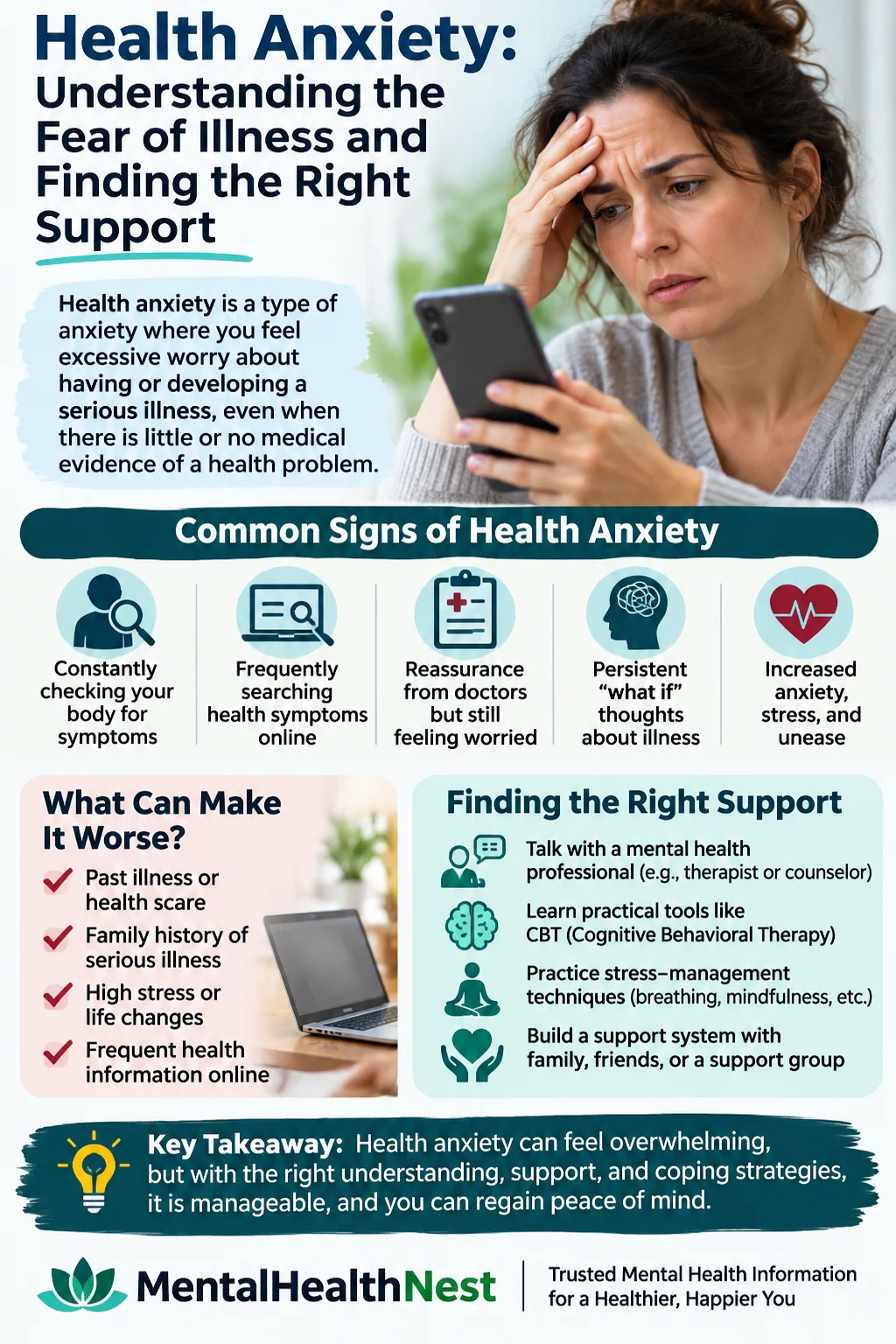
Introduction
Health is something most people think about from time to time. A new symptom, an upcoming medical appointment, or news about an illness can naturally cause concern. Paying attention to changes in your body and seeking medical advice when needed are important parts of looking after your health.
However, for some people, concern about illness becomes difficult to manage. A minor physical sensation may lead to repeated questions about what it means. A medical appointment may provide temporary relief, but the fear can return. Even after receiving reassurance, a person may continue worrying that something serious has been overlooked.
This experience is often described as health anxiety. It can make everyday decisions feel uncertain, affect confidence in medical advice, and take attention away from relationships, work, personal interests, and ordinary activities.
Health anxiety does not mean that someone is imagining physical symptoms or deliberately exaggerating their concerns. Physical sensations and medical conditions deserve appropriate attention. The difficulty arises when fear about illness becomes persistent or disproportionate and begins influencing how a person interprets health information, seeks reassurance, or makes healthcare decisions.
Understanding this pattern can be an important first step towards responding to health concerns more calmly and constructively. It is also important to recognise that health anxiety is not a substitute for a medical assessment. New, changing, or concerning physical symptoms should be discussed with an appropriate healthcare professional.
In this guide, we will explore what health anxiety means, why medical reassurance may not always resolve the fear, how it differs from certain related mental health conditions, and what professional support may help. We will also look at practical ways to build a more balanced relationship with medical information and healthcare—without dismissing genuine health concerns.
The aim is not to encourage people to ignore their bodies or avoid medical care. It is to help readers understand the difference between taking reasonable care of their health and living under the constant pressure of fearing illness.
Quick Answer: What Is Health Anxiety?
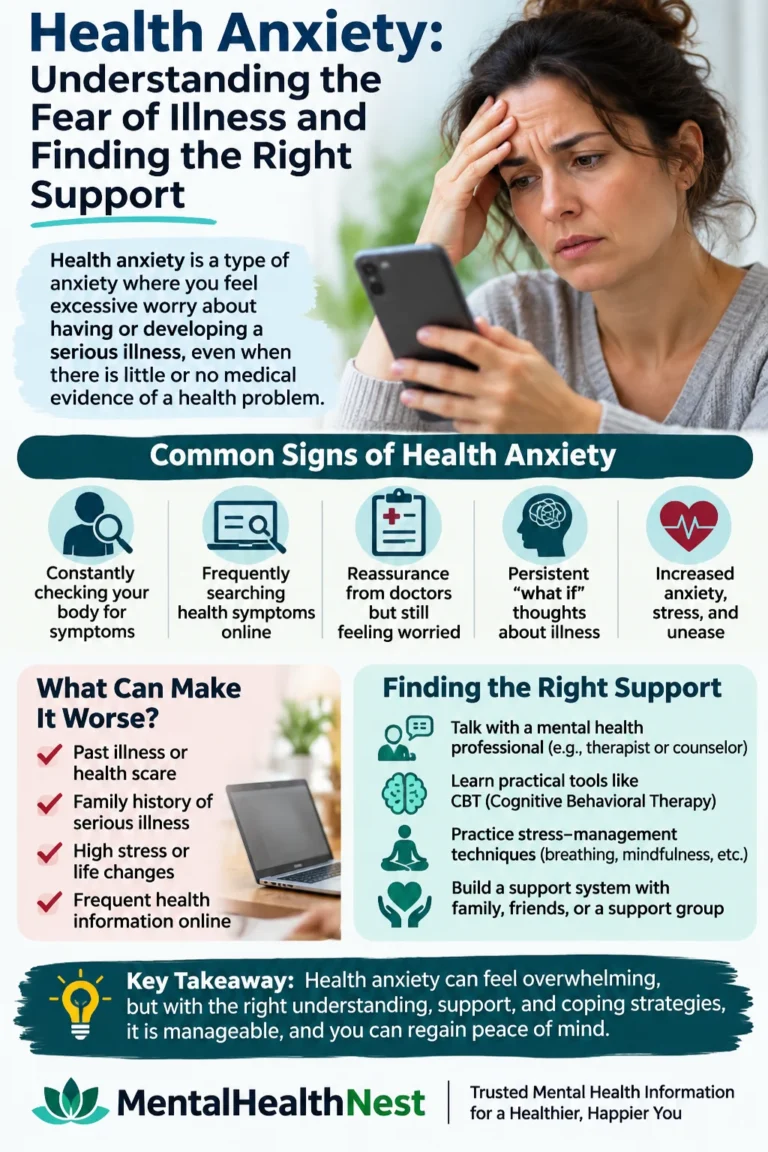
Health anxiety is a pattern of persistent worry or fear about having, developing, or overlooking a serious illness. It may lead someone to interpret ordinary bodily sensations as signs of disease, seek repeated medical reassurance, or spend considerable time checking health information. When these concerns become difficult to manage and interfere with everyday life, professional support may help.
KEY TAKEAWAYS
- Health anxiety involves persistent fear about illness: The concern may continue even when medical evaluations have not identified the feared condition.
- Reassurance may provide only temporary relief: Repeatedly seeking confirmation that everything is fine may not resolve the underlying fear.
- Health anxiety is not the same as a medical diagnosis: A qualified healthcare professional can help distinguish health-related anxiety from physical conditions and related mental health concerns.
- Healthcare decisions matter: Repeatedly seeking tests or appointments, or avoiding necessary medical care because of fear, may create additional difficulties.
- Professional support can help: Psychological approaches, including cognitive behavioral therapy (CBT), may help people understand and respond differently to persistent health-related fears.
- Balanced health information is important: Reliable sources and appropriate medical guidance are more useful than repeatedly searching online for explanations of symptoms.
- Support should be respectful and practical: Family members and friends can listen without dismissing genuine concerns or reinforcing endless reassurance-seeking.
- Progress does not require ignoring symptoms: The goal is to respond appropriately to physical concerns while reducing the disruption caused by persistent fear.
1. What Is Health Anxiety? Understanding Persistent Fear of Illness
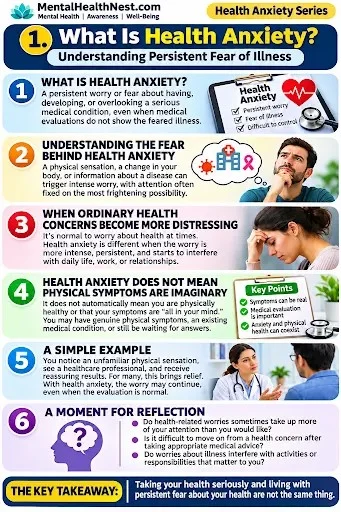
A six-part infographic explaining health anxiety, including its definition, the fear behind illness-related worries, the difference between ordinary health concerns and persistent anxiety, the reality of physical symptoms, a practical example, and questions for personal reflection. The key takeaway emphasizes that taking your health seriously is different from living with persistent fear about your health.
Health anxiety becomes a concern when thoughts about illness are difficult to control, repeatedly return despite appropriate medical guidance, and begin interfering with everyday life. The distinction is not simply how often someone thinks about their health, but how strongly the worry affects their attention, decisions, and wellbeing.
Health anxiety refers to persistent worry or fear about having, developing, or overlooking a serious medical condition. It goes beyond occasional concern about feeling unwell. The worry can become difficult to control, occupy a significant amount of attention, and interfere with everyday activities, even when appropriate medical evaluations have not identified the feared illness.
UNDERSTANDING THE FEAR BEHIND HEALTH ANXIETY
People experiencing health anxiety may become highly concerned about the possibility of having a serious illness. A physical sensation, a change in their body, or information about a particular disease may trigger thoughts about what could be wrong.
For example, someone might notice an unfamiliar sensation and immediately wonder whether it indicates a serious medical condition. Although several explanations may be possible, their attention can become fixed on the most frightening possibility.
The concern may continue even after the person has considered other explanations or received appropriate medical advice. They may find it difficult to feel confident that their health is okay or tolerate the uncertainty that sometimes comes with medical questions.
These experiences can be emotionally exhausting. The person may spend considerable time thinking about illness instead of concentrating on work, relationships, hobbies, or other everyday responsibilities.
WHEN ORDINARY HEALTH CONCERNS BECOME MORE DISTRESSING
Worrying about health is not automatically a sign of a mental health problem. It is reasonable to pay attention to physical changes, attend recommended health screenings, follow medical advice, and seek professional assessment when symptoms are concerning.
The difference is often found in the intensity, persistence, and impact of the worry.
With ordinary health concerns, a person may become worried about a symptom or medical situation but can generally return to everyday activities after taking appropriate steps. With more persistent health anxiety, the fear may remain prominent, repeatedly return, or become difficult to manage.
For some people, health-related thoughts begin influencing how they interpret everyday experiences and make decisions. They may struggle to concentrate because of illness-related worries or find that ordinary activities are increasingly interrupted by concerns about their health.
There is no single thought or behaviour that establishes whether someone has health anxiety. A qualified professional considers the broader pattern, how long the concerns have been present, the level of distress, and their effect on daily functioning.
HEALTH ANXIETY DOES NOT MEAN PHYSICAL SYMPTOMS ARE IMAGINARY
An important distinction is that experiencing health anxiety does not automatically mean a person is physically healthy or that their symptoms are imagined.
Someone may experience genuine physical sensations, have an existing medical condition, or be waiting for answers about an unexplained symptom while also experiencing significant health-related anxiety.
The presence of anxiety should never be used as a reason to dismiss a person’s physical concerns. Medical symptoms deserve appropriate assessment, and decisions about testing or treatment should be made with qualified healthcare professionals.
Health anxiety concerns the relationship between health-related thoughts, fear, attention, and behaviour. It is not a judgement about whether someone’s physical experiences are real.
A SIMPLE EXAMPLE: WHEN A HEALTH CONCERN BECOMES DIFFICULT TO SETTLE
Imagine a person who notices an unfamiliar physical sensation. They become concerned and arrange an appropriate medical appointment. The healthcare professional evaluates the concern and explains the findings.
For many people, this may be enough to return their attention to everyday life. However, someone experiencing persistent health anxiety may continue wondering whether something has been overlooked. The original concern may remain at the centre of their thoughts, even when they are trying to focus on other responsibilities.
This example does not establish a diagnosis. It illustrates how the fear surrounding a health concern can sometimes become more disruptive than the original uncertainty.
A MOMENT FOR REFLECTION
Consider these questions without using them to diagnose yourself:
- Do health-related worries sometimes take up more of your attention than you would like?
- Is it difficult to move on from a health concern after taking appropriate medical advice?
- Do worries about illness interfere with activities or responsibilities that matter to you?
If you recognise some of these experiences, it does not mean you necessarily have a mental health condition. It may simply be a reason to discuss your concerns with a qualified healthcare or mental health professional.
The important point: Taking your health seriously and living with persistent fear about your health are not the same thing. Understanding that distinction can help people seek appropriate medical care while also recognising when emotional support may be beneficial.
2. Why Medical Reassurance Does Not Always Resolve Health Anxiety
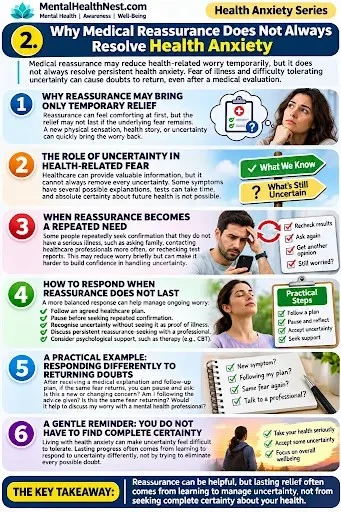
MentalHealthNest infographic explaining why medical reassurance may not resolve persistent health anxiety. It presents six sections: why reassurance brings temporary relief, the role of uncertainty, repeated reassurance-seeking, practical ways to respond when reassurance does not last, an example of responding differently to returning doubts, and a gentle reminder that complete certainty is not always possible. The key takeaway highlights learning to manage uncertainty while continuing appropriate medical care.
Medical reassurance may reduce health-related worry temporarily, but it does not always resolve persistent health anxiety. Fear of illness and difficulty tolerating uncertainty can cause doubts to return, even after an appropriate medical evaluation.
Medical reassurance can be helpful when someone is worried about their health. A clear explanation from a qualified healthcare professional may reduce uncertainty and help a person understand their symptoms and next steps. However, for someone experiencing persistent health anxiety, reassurance may not always bring lasting relief.
The difficulty is not necessarily that the medical explanation is unclear. Instead, the fear of illness may continue even after the person has received appropriate medical advice. Questions such as “What if something was missed?” or “What if my symptoms become worse?” may keep returning.
Understanding why reassurance sometimes has a limited effect can help explain an important part of health anxiety.
WHY REASSURANCE MAY BRING ONLY TEMPORARY RELIEF
When someone fears having a serious illness, reassurance can initially feel comforting. A medical explanation, a conversation with a trusted person, or an appropriate examination may reduce worry for a while.
However, the relief may not last if the underlying fear remains unresolved. A new physical sensation, an unfamiliar health-related story, or another uncertainty may bring the concern back.
For example, a person may feel reassured after discussing a symptom with a doctor but become worried again when they notice a different sensation. They may then feel a strong need for further confirmation.
This can create a pattern in which reassurance becomes increasingly important, yet the person finds it difficult to feel reassured for long.
THE ROLE OF UNCERTAINTY IN HEALTH-RELATED FEAR
Healthcare can provide valuable information, but it cannot always remove every uncertainty about the human body.
Some symptoms have several possible explanations. Investigations may take time, and healthcare professionals sometimes need to monitor changes before reaching a clearer conclusion. Even when an evaluation is reassuring, absolute certainty about future health is not possible.
For someone experiencing persistent health anxiety, this uncertainty can be particularly difficult to tolerate.
The mind may keep returning to questions about what could happen, whether an explanation is complete, or whether another medical opinion is necessary. Instead of accepting the information currently available, the person may continue searching for a level of certainty that healthcare cannot always provide.
Learning to manage uncertainty does not mean ignoring symptoms or refusing appropriate medical care. It means gradually developing the ability to live with unanswered questions while following reasonable medical guidance.
WHEN REASSURANCE BECOMES A REPEATED NEED
Some people repeatedly seek confirmation that they do not have a serious illness. They may ask family members for opinions, contact healthcare professionals more frequently than recommended, or look for repeated confirmation from medical reports.
These actions may be understandable responses to distress. However, when reassurance becomes the main way of managing fear, its effects may be short-lived.
The person may begin to depend on another explanation or confirmation whenever a new doubt appears. This can make it harder to develop confidence in their ability to respond to uncertainty.
It is important to distinguish repeated reassurance-seeking from appropriate follow-up care. Attending recommended appointments, reporting new or changing symptoms, and following a clinician’s advice are responsible healthcare behaviours. The concern is when repeated confirmation is driven primarily by persistent fear rather than a medical need identified through professional guidance.
HOW TO RESPOND WHEN REASSURANCE DOES NOT LAST
A more balanced response begins by recognising that reassurance and certainty are not always the same thing.
A person can take reasonable steps to protect their health without repeatedly seeking confirmation every time worry returns.
Some practical approaches may include:
- Follow an agreed healthcare plan: Discuss appropriate investigations, follow-up appointments, and warning signs with a qualified healthcare professional.
- Pause before seeking repeated confirmation: When a familiar worry returns, consider whether there is genuinely new information or whether the same concern is resurfacing.
- Recognise uncertainty without treating it as proof of illness: Not having complete certainty does not automatically mean that something serious has been overlooked.
- Discuss persistent reassurance-seeking: If the need for repeated confirmation is affecting daily life, explain this pattern to a healthcare or mental health professional.
- Consider psychological support: A qualified mental health professional can help explore the fears and responses that keep health anxiety going.
These approaches should not be used to delay medical assessment when symptoms are new, worsening, or concerning. Decisions about medical care should remain guided by appropriate professional advice.
A PRACTICAL EXAMPLE: RESPONDING DIFFERENTLY TO RETURNING DOUBTS
Imagine someone who has discussed a health concern with their doctor and received an explanation and follow-up plan. A few days later, the same fear returns.
Instead of immediately looking for another online explanation or asking several people for reassurance, the person might pause and ask:
- Is this a new or changing physical concern?
- Am I following the medical advice and follow-up plan I was given?
- Is this the same fear returning without new information?
- Would discussing my ongoing worry with a mental health professional be helpful?
If there is a new or concerning symptom, the person should seek appropriate medical advice. If the concern is the return of a familiar fear, psychological support may help them develop a more manageable response.
A GENTLE REMINDER: YOU DO NOT HAVE TO FIND COMPLETE CERTAINTY
Living with health anxiety can make uncertainty feel difficult to tolerate. It may seem as though one more explanation, examination, or reassurance will finally settle every concern.
However, lasting progress may involve learning to respond to uncertainty differently rather than trying to eliminate every possible doubt.
You deserve to have genuine health concerns taken seriously. You also deserve support when fear about illness begins taking too much space in your everyday life.
The goal is not to stop caring about your health. It is to build a healthier balance between appropriate medical attention and emotional wellbeing.
3. Health Anxiety vs. Illness Anxiety Disorder vs. Somatic Symptom Disorder
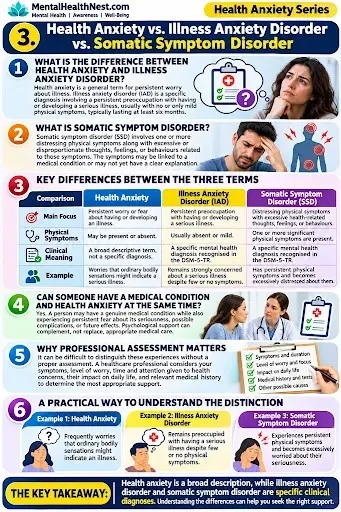
MentalHealthNest infographic comparing health anxiety, illness anxiety disorder, and somatic symptom disorder. Six numbered sections explain the differences between health anxiety and illness anxiety disorder, describe somatic symptom disorder, compare the three terms by main focus, physical symptoms, clinical meaning, and examples, explain how medical conditions can coexist with health anxiety, highlight the importance of professional assessment, and present three practical examples. The key takeaway distinguishes health anxiety as a broad descriptive term from illness anxiety disorder and somatic symptom disorder as specific clinical diagnoses.
Health anxiety is a broad term for persistent fear about illness, while illness anxiety disorder and somatic symptom disorder are distinct clinical diagnoses. They differ mainly in whether the primary concern is developing a serious illness or experiencing distressing physical symptoms and excessive related worry.
The terms health anxiety, illness anxiety disorder, and somatic symptom disorder are closely related, but they do not mean exactly the same thing. Understanding the differences can help readers recognise why mental health professionals consider both a person’s physical experiences and their emotional response to those experiences.
Health anxiety is a broad descriptive term for persistent fear or worry about illness. Illness anxiety disorder and somatic symptom disorder are specific diagnostic conditions recognised in the Diagnostic and Statistical Manual of Mental Disorders, Fifth Edition, Text Revision (DSM-5-TR).
Although these conditions can share features, they differ in how physical symptoms and health-related concerns are experienced.
WHAT IS THE DIFFERENCE BETWEEN HEALTH ANXIETY AND ILLNESS ANXIETY DISORDER?
Health anxiety describes a pattern of excessive or persistent concern about physical health. It can vary in intensity and does not automatically mean that someone has a diagnosable mental health disorder.
Illness anxiety disorder (IAD), on the other hand, is a formal mental health diagnosis. It involves a persistent preoccupation with having or developing a serious illness, accompanied by significant health-related anxiety.
People with illness anxiety disorder generally experience no physical symptoms or symptoms that are mild in intensity. Their main source of distress is often what they fear the symptoms might mean rather than the symptoms themselves.
For example, a person may notice an ordinary bodily sensation and become strongly convinced that it could indicate a serious disease. Even after an appropriate medical evaluation, the fear may continue.
Under DSM-5-TR diagnostic criteria, the illness-related preoccupation generally persists for at least six months, although the particular illness a person fears may change during that period.
Not everyone who experiences health anxiety meets the criteria for illness anxiety disorder. A qualified professional considers the duration, intensity, distress, behaviour, medical history, and effect on everyday functioning before making a diagnosis.
WHAT IS SOMATIC SYMPTOM DISORDER?
Somatic symptom disorder (SSD) is another recognised diagnosis involving significant physical symptoms accompanied by excessive or disproportionate thoughts, feelings, or behaviours related to those symptoms.
A person may experience persistent pain, fatigue, digestive discomfort, or other physical complaints. These symptoms may be associated with an established medical condition, or their cause may not yet be clear.
The diagnosis does not depend on proving that the symptoms have no physical explanation. A person can have a genuine medical condition and also experience somatic symptom disorder.
The central concern is the degree of distress and the excessive attention, worry, or time and energy devoted to the symptoms and related health concerns.
For example, someone with a diagnosed medical condition may become so preoccupied with every change in their symptoms that the worry significantly disrupts daily activities. A professional would assess the overall pattern rather than assume that the physical condition alone explains everything.
Importantly, somatic symptom disorder does not mean that a person is pretending, inventing, or deliberately exaggerating physical symptoms.
KEY DIFFERENCES BETWEEN THE THREE TERMS
The following comparison explains their general distinctions. It is educational, not a diagnostic checklist.
1. Health Anxiety
- Main focus: Persistent worry or fear about having or developing an illness.
- Physical symptoms: Symptoms may be present or absent.
- Clinical meaning: A broad descriptive term, not a specific diagnosis by itself.
- Example: Someone repeatedly worries that ordinary bodily sensations might indicate a serious illness.
2. Illness Anxiety Disorder
- Main focus: Persistent preoccupation with having or developing a serious illness.
- Physical symptoms: Usually absent or mild.
- Clinical meaning: A specific mental health diagnosis recognised in the DSM-5-TR.
- Example: Someone remains strongly concerned about having a serious illness despite experiencing few or no physical symptoms.
3. Somatic Symptom Disorder
- Main focus: Distressing physical symptoms accompanied by excessive health-related thoughts, feelings, or behaviours.
- Physical symptoms: One or more significant physical symptoms are present.
- Clinical meaning: A specific mental health diagnosis recognised in the DSM-5-TR.
- Example: Someone experiences persistent physical symptoms and becomes excessively distressed or preoccupied with their impact.
These descriptions explain general differences, not diagnostic criteria. Only a qualified professional can determine whether someone meets the criteria for a particular condition.
These conditions can overlap in their emotional and behavioural features. The distinction depends partly on whether the main concern is the possibility of having a serious illness or the physical symptoms themselves and the response to them.
CAN SOMEONE HAVE A MEDICAL CONDITION AND HEALTH ANXIETY AT THE SAME TIME?
Yes. Having a medical condition does not automatically rule out health anxiety, illness anxiety disorder, or somatic symptom disorder.
A person may be managing a genuine health condition while also experiencing persistent fear about its seriousness, possible complications, or future effects.
For example, someone receiving treatment for a medical condition may become excessively worried about every bodily change, even when following an appropriate care plan. Another person may have unexplained physical symptoms that cause significant distress and require continued medical assessment.
Healthcare professionals consider the medical condition, the person’s symptoms, their level of anxiety, and how their thoughts and behaviours affect everyday functioning.
This distinction matters because psychological support should complement appropriate medical care, not replace it.
WHY PROFESSIONAL ASSESSMENT MATTERS
It can be difficult to distinguish these experiences without a proper assessment. Similar concerns may occur in different mental health conditions, and physical symptoms can have many possible explanations.
A healthcare professional may consider:
- The nature, frequency, and duration of physical symptoms.
- How much time and attention the person devotes to health concerns.
- Whether the main fear involves having an illness or the symptoms themselves.
- Whether health-related worry affects work, relationships, sleep, or everyday responsibilities.
- Relevant medical history, current conditions, and appropriate examination findings.
- Other possible medical or mental health explanations.
A diagnosis should never be based on a single symptom, an online questionnaire, or a person’s search history.
If you are concerned about persistent health-related fear, discussing both your physical symptoms and emotional distress with a qualified healthcare professional can help clarify what kind of support may be appropriate.
A PRACTICAL WAY TO UNDERSTAND THE DISTINCTION
Consider three hypothetical examples:
Example 1: Health anxiety
A person frequently worries that ordinary bodily sensations might indicate an illness. The concern is distressing, but their experience has not necessarily been assessed against the criteria for a specific disorder.
Example 2: Illness anxiety disorder
A person remains preoccupied with having a serious illness despite experiencing few or no physical symptoms. The fear persists, causes significant distress, and meets the relevant diagnostic criteria following professional assessment.
Example 3: Somatic symptom disorder
A person experiences persistent, distressing physical symptoms and becomes excessively worried about their seriousness. The symptoms and related concerns significantly affect everyday functioning.
These examples illustrate general differences. They cannot establish a diagnosis for any individual.
The important point: Health anxiety is a broad description of an experience, while illness anxiety disorder and somatic symptom disorder are specific clinical diagnoses. Understanding this distinction helps prevent unnecessary self-labelling and supports more informed conversations with healthcare professionals.
4. When Health Concerns Begin Influencing Medical Decisions and Healthcare Use
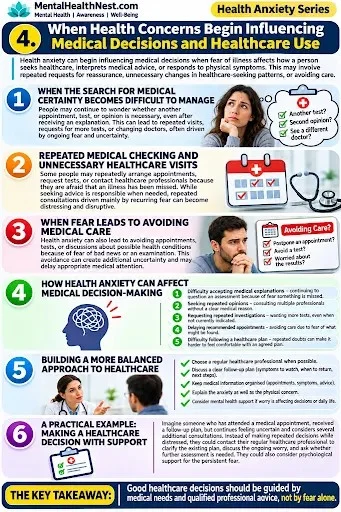
A six-section MentalHealthNest infographic explaining how health anxiety can influence medical decisions and healthcare use. It covers difficulty managing the search for medical certainty, repeated medical checking and unnecessary healthcare visits, fear-driven avoidance of medical care, five ways health anxiety can affect medical decision-making, practical steps toward a balanced healthcare approach, and an example of making healthcare decisions with professional support. The key takeaway emphasizes making healthcare decisions according to medical needs and qualified professional advice rather than fear alone.
Health anxiety can begin influencing medical decisions when fear of illness affects how a person seeks healthcare, interprets medical advice, or responds to physical symptoms. This may involve repeated requests for reassurance, unnecessary changes in healthcare-seeking patterns, or avoiding recommended care because of fear.
WHEN THE SEARCH FOR MEDICAL CERTAINTY BECOMES DIFFICULT TO MANAGE
People experiencing persistent health anxiety may find it difficult to feel confident about medical decisions. Even after receiving an explanation from a healthcare professional, they may continue wondering whether another appointment, test, or opinion is necessary.
For some, this can lead to repeated healthcare visits or requests for additional investigations without a clear medical reason identified by their healthcare professional.
Others may repeatedly change doctors because they remain uncertain about previous explanations. They may find it difficult to accept a medical assessment when it does not provide the level of certainty they are hoping for.
These behaviours do not automatically indicate health anxiety. Additional medical opinions and investigations can be appropriate in many circumstances. The important consideration is whether fear is repeatedly driving decisions beyond the medical guidance and follow-up plan.
REPEATED MEDICAL CHECKING AND UNNECESSARY HEALTHCARE VISITS
Some people may repeatedly arrange appointments, request tests, or contact healthcare professionals because they are afraid that an illness has been missed.
Although seeking medical advice is responsible when symptoms require attention, repeated consultations driven mainly by recurring fear may become distressing and disruptive.
For example, someone may receive an appropriate medical evaluation and follow-up advice but continue arranging further consultations because they cannot feel confident about the explanation.
A more constructive approach is to discuss these concerns openly with a healthcare professional. Together, they can establish a clear plan for follow-up, identify when further assessment is appropriate, and consider whether support for persistent health-related anxiety would be beneficial.
WHEN FEAR LEADS TO AVOIDING MEDICAL CARE
Health anxiety does not always lead to more healthcare visits. Some people respond to their fear by avoiding medical appointments, tests, or discussions about possible health conditions.
They may worry about receiving bad news, undergoing an examination, or discovering an illness. As a result, they may postpone recommended care even when they recognise that an appointment is important.
This avoidance can create additional uncertainty and may delay appropriate medical attention.
If fear is making it difficult to attend an appointment, discussing that fear with a healthcare professional or mental health professional may help. Support can make it easier to approach necessary medical care without feeling that the person must manage every concern alone.
HOW HEALTH ANXIETY CAN AFFECT MEDICAL DECISION-MAKING
Persistent health-related fear may influence decisions in several ways:
1. Difficulty accepting medical explanations
A person may continue questioning an appropriate medical assessment because they fear that something has been overlooked.
2. Seeking repeated opinions
They may consult multiple healthcare professionals without a clear medical reason for doing so, hoping that another explanation will finally remove the uncertainty.
3. Requesting repeated investigations
Fear may create a strong desire for additional tests, even when the treating professional has explained why further investigation is not currently indicated.
4. Delaying recommended appointments
Someone may avoid medical care because they are frightened of what an examination or test might reveal.
5. Difficulty following a healthcare plan
Repeated doubts may make it challenging to feel comfortable with an agreed treatment or follow-up plan.
These patterns are not a checklist for diagnosis. They are examples of how persistent fear may affect healthcare decisions and why an individual assessment can be useful.
BUILDING A MORE BALANCED APPROACH TO HEALTHCARE
A balanced approach does not mean ignoring symptoms, refusing medical investigations, or avoiding healthcare professionals. It means making medical decisions with appropriate professional guidance rather than allowing recurring fear to become the only influence.
Some practical steps may help:
- Choose a regular healthcare professional when possible: Having a consistent point of contact can help maintain continuity and reduce confusion caused by repeatedly seeking different opinions.
- Discuss a clear follow-up plan: Ask which symptoms require further assessment, when to return, and whether any additional investigations are recommended.
- Keep medical information organised: Maintain a simple record of appointments, relevant symptoms, medical advice, and agreed next steps.
- Explain the anxiety as well as the physical concern: Tell the healthcare professional if fear continues even after receiving medical explanations.
- Consider mental health support: If health-related worry is influencing medical decisions or everyday functioning, a qualified mental health professional may help address the emotional difficulties involved.
The appropriate healthcare plan will depend on the person’s symptoms, medical history, and professional assessment. These suggestions should complement—not replace—individual medical advice.
A PRACTICAL EXAMPLE: MAKING A HEALTHCARE DECISION WITH SUPPORT
Imagine someone who has attended a medical appointment and received a follow-up plan. They understand the explanation but continue feeling uncertain and begin considering several additional consultations.
Rather than making repeated decisions while distressed, they could contact their regular healthcare professional to clarify the existing plan. They could explain that the uncertainty is causing ongoing worry and ask whether further medical assessment is indicated.
If the professional does not recommend additional investigations at that time, the person could also discuss psychological support for the persistent fear.
This approach recognises both sides of the concern: physical health deserves appropriate attention, and ongoing emotional distress deserves support too.
The important point: Good healthcare decisions should be guided by medical needs and qualified professional advice, not by fear alone. Learning to work with a clear healthcare plan can help people respond to genuine concerns while addressing the distress that persistent health anxiety may create.
5. How Healthcare Professionals Evaluate Persistent Health-Related Fears
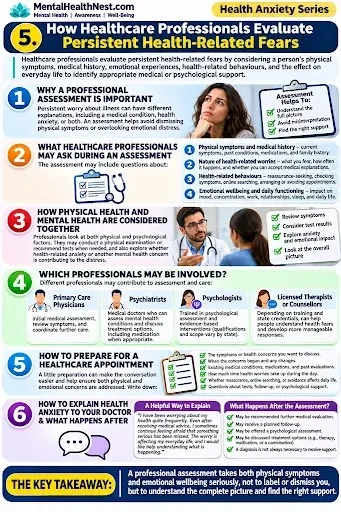
A six-section MentalHealthNest infographic explaining how healthcare professionals evaluate persistent health-related fears. It covers why professional assessment matters, questions about physical symptoms and medical history, how physical and mental health are considered together, the professionals who may be involved, preparing for a healthcare appointment, explaining health anxiety to a doctor, and what may happen after assessment. The key takeaway emphasizes taking physical symptoms and emotional wellbeing seriously to identify appropriate support.
Healthcare professionals evaluate persistent health-related fears by considering a person’s physical symptoms, medical history, emotional experiences, health-related behaviours, and the effect of their concerns on everyday life. The assessment helps distinguish appropriate medical concerns from patterns of anxiety and identify whether further medical or psychological support may be beneficial.
WHY A PROFESSIONAL ASSESSMENT IS IMPORTANT
Persistent worry about illness can have different explanations. Some people may have an underlying medical condition, while others may experience significant health-related anxiety. In some situations, both can occur together.
A professional assessment helps avoid two important mistakes: assuming that every physical symptom is caused by anxiety or overlooking the emotional distress associated with persistent health fears.
The aim is to understand the person’s overall experience rather than focus on one symptom or a single episode of worry.
WHAT HEALTHCARE PROFESSIONALS MAY ASK DURING AN ASSESSMENT
An assessment may involve questions about several areas of a person’s health and daily experience.
1. Physical symptoms and medical history
The healthcare professional may ask about current symptoms, when they began, how they have changed, existing medical conditions, medications, previous investigations, and relevant family medical history.
This information helps determine whether further medical evaluation is appropriate.
2. Nature of health-related worries
The professional may explore what illnesses the person fears, how often these thoughts occur, and what makes the concerns stronger or more manageable.
They may also ask whether the person finds it difficult to accept appropriate medical explanations.
3. Health-related behaviours
Questions may cover repeated requests for reassurance, checking bodily sensations, searching for medical information, arranging appointments, or avoiding healthcare because of fear.
These behaviours can help professionals understand how health-related worry influences everyday decisions.
4. Emotional wellbeing and daily functioning
The assessment may explore whether health concerns affect concentration, relationships, work, sleep, personal responsibilities, or participation in ordinary activities.
The professional may also ask about other emotional difficulties that could be contributing to the person’s distress.
HOW PHYSICAL HEALTH AND MENTAL HEALTH ARE CONSIDERED TOGETHER
An important part of the assessment is considering physical and psychological factors together.
A healthcare professional may conduct a physical examination or recommend investigations when clinically appropriate. The type of assessment depends on the person’s symptoms, medical history, and individual circumstances.
If medical findings do not fully explain the person’s distress, the professional may also explore whether health-related anxiety or another mental health concern is contributing to the experience.
However, an absence of findings from an initial examination does not automatically establish a mental health diagnosis. Further medical assessment may sometimes be necessary, depending on how symptoms develop and the clinical circumstances.
WHICH PROFESSIONALS MAY BE INVOLVED?
Different professionals may contribute to assessment and care:
- Primary care physicians: Often provide the initial medical assessment, review health history, evaluate physical symptoms, and coordinate further care when needed.
- Psychiatrists: Medical doctors who can assess mental health conditions, consider possible diagnoses, and discuss appropriate treatment options, including medication when clinically indicated.
- Psychologists: Professionals trained in psychological assessment and evidence-based psychological interventions. Their qualifications and scope of practice vary by state.
- Licensed therapists or counsellors: Depending on their training and state credentials, they may help people understand persistent health-related fears and develop more manageable responses.
Not everyone needs to consult all these professionals. The appropriate starting point depends on the person’s needs and access to healthcare.
HOW TO PREPARE FOR A HEALTHCARE APPOINTMENT
Discussing persistent health-related fears can sometimes feel uncomfortable. A little preparation may make the conversation easier and help ensure that both physical concerns and emotional distress receive attention.
Before an appointment, consider writing down:
- The physical symptoms or health concerns you want to discuss.
- When the concerns began and whether anything has changed.
- Existing medical conditions, medications, and relevant previous evaluations.
- How much time health-related worries occupy during the day.
- Whether repeated reassurance, online searching, or avoidance is affecting daily life.
- Questions about recommended investigations, follow-up, or psychological support.
You do not need to prepare a perfect explanation. Describing your experience honestly is more important than finding the right medical terminology.
HOW TO EXPLAIN HEALTH ANXIETY TO YOUR DOCTOR
Some people find it easier to discuss physical symptoms than to explain the fear surrounding them. However, both are important.
You might say:
“I have been worrying about my health quite frequently. Even after receiving medical advice, I sometimes continue feeling afraid that something serious has been missed. The worry is affecting my everyday life, and I would like help understanding what is happening.”
This gives the healthcare professional an opportunity to consider both your physical concerns and your emotional wellbeing.
You can also ask whether a referral to a qualified mental health professional would be appropriate.
WHAT HAPPENS AFTER THE ASSESSMENT?
The next steps depend on the findings and the person’s individual needs.
A healthcare professional may recommend further medical evaluation, a planned follow-up, psychological assessment, or a combination of appropriate approaches.
If persistent health anxiety is identified, psychological treatment may be discussed. The professional can explain available options, expected benefits, possible limitations, and whether additional support is needed.
A diagnosis is not always necessary before someone can discuss emotional distress or seek appropriate support.
The important point: A professional assessment should take physical symptoms and emotional wellbeing seriously. The purpose is not to label someone or dismiss their concerns, but to understand the complete picture and identify an appropriate path forward.
6. Evidence-Based Psychological Treatments for Health Anxiety
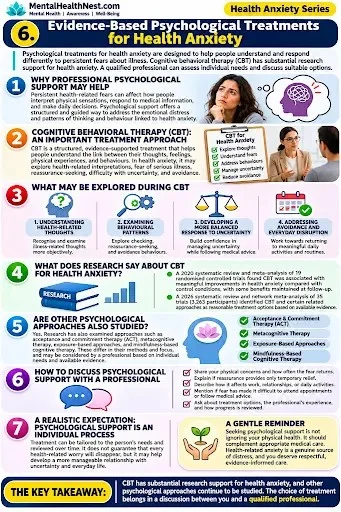
MentalHealthNest infographic explaining evidence-based psychological treatments for health anxiety. It covers why professional psychological support may help, cognitive behavioral therapy (CBT), therapeutic elements explored during CBT, research findings, other psychological approaches including ACT and metacognitive therapy, discussing psychological support with a professional, realistic expectations of treatment, and the importance of combining psychological support with appropriate medical care. The key takeaway highlights CBT’s substantial research support and the importance of choosing treatment with a qualified professional.
Psychological treatments for health anxiety are designed to help people understand and respond differently to persistent fears about illness. Cognitive behavioral therapy (CBT) has substantial research support for health anxiety. A qualified mental health professional can assess an individual’s needs and discuss whether this or another appropriate psychological approach may be beneficial.
WHY PROFESSIONAL PSYCHOLOGICAL SUPPORT MAY HELP
Persistent health-related fears can influence how people interpret physical sensations, respond to medical information, and make everyday decisions. Even when someone recognises that their worry is becoming difficult to manage, changing established patterns can be challenging.
Psychological support provides an opportunity to explore these experiences in a structured and professionally guided setting.
The purpose is not to convince someone that physical symptoms are unimportant or that medical concerns should be ignored. Rather, psychological treatment may help address the emotional distress and patterns of thinking and behaviour associated with persistent health anxiety.
The appropriate approach depends on the person’s circumstances, clinical assessment, preferences, and treatment needs.
COGNITIVE BEHAVIORAL THERAPY (CBT): AN IMPORTANT TREATMENT APPROACH
Cognitive behavioral therapy is a structured form of psychological treatment in which a trained therapist helps people understand connections between their thoughts, feelings, physical experiences, and behaviours.
CBT has been studied specifically for health anxiety and is an important psychological treatment discussed in clinical literature.
In the context of health anxiety, a therapist may explore:
- Health-related interpretations: How someone understands unfamiliar physical sensations or medical information.
- Fear of serious illness: How frightening possibilities influence emotions and everyday decisions.
- Repeated reassurance-seeking: Whether repeatedly asking for confirmation is contributing to ongoing distress.
- Difficulty managing uncertainty: Why unanswered health questions may feel particularly difficult.
- Avoidance: Whether fear is interfering with appropriate healthcare or ordinary activities.
The therapist works collaboratively with the individual to identify relevant patterns and develop more balanced ways of responding.
CBT is not simply positive thinking. It is a structured psychological approach that requires professional assessment and an individualised treatment plan.
WHAT MAY BE EXPLORED DURING CBT
CBT for health anxiety may include several therapeutic elements. Their use depends on the person’s needs and the therapist’s clinical judgement.
1. Understanding health-related thoughts
A therapist may help someone recognise when a possible illness is being interpreted as though it were a confirmed diagnosis.
The purpose is to examine thoughts more objectively and consider alternative explanations without dismissing genuine physical concerns.
2. Examining behavioural patterns
A therapist may explore whether repeated checking, reassurance-seeking, or avoidance is contributing to ongoing distress.
Understanding these behaviours can help identify what may need attention during treatment.
3. Developing a more balanced response to uncertainty
Healthcare cannot always provide complete certainty about every physical sensation or future health possibility.
Psychological treatment may help people develop greater confidence in responding to uncertainty while continuing to follow appropriate medical advice.
4. Addressing avoidance and everyday disruption
When health-related fear interferes with ordinary activities, a therapist may help the person work towards restoring participation in meaningful parts of everyday life.
Any therapeutic work involving feared situations should be individually assessed and professionally guided. It should never require ignoring new or concerning symptoms or avoiding medically recommended care.
WHAT DOES RESEARCH SAY ABOUT CBT FOR HEALTH ANXIETY?
Research provides encouraging evidence for CBT as a psychological treatment for health anxiety.
A systematic review and meta-analysis published in 2019 examined 19 randomised controlled trials. The researchers found that cognitive behavioral therapy (CBT) was associated with meaningful improvements in health anxiety compared with control conditions. Some improvements were maintained during follow-up.
A further systematic review and network meta-analysis published in 2026 examined 35 trials involving 3,263 participants. It evaluated several psychological approaches and identified CBT and certain related approaches as reasonable treatment options based on the available evidence.
These findings support the importance of psychological treatment research, but they should be interpreted carefully. Study results do not establish that one approach will work for everyone, and they do not replace an individual professional assessment.
ARE OTHER PSYCHOLOGICAL APPROACHES ALSO STUDIED?
Yes. Researchers have also examined approaches such as acceptance and commitment therapy (ACT), metacognitive therapy, exposure-based approaches, and mindfulness-based cognitive therapy.
These approaches differ in their methods and therapeutic focus. Some may be considered by qualified professionals depending on the person’s circumstances and the available evidence.
It is important not to assume that every psychological approach has the same level of research support, or that all are suitable for every person experiencing health anxiety.
A qualified professional can explain the potential benefits, limitations, and suitability of different approaches.
HOW TO DISCUSS PSYCHOLOGICAL SUPPORT WITH A PROFESSIONAL
Starting a conversation about persistent health-related fear can sometimes feel uncomfortable. A person may worry that their physical concerns will be dismissed or that their emotional experiences will not be understood.
It can help to explain both sides of the experience:
- What physical concerns have been causing worry.
- How frequently health-related fears return.
- Whether reassurance provides only temporary relief.
- Whether the concerns affect work, relationships, or everyday activities.
- Whether fear has made it difficult to attend appointments or follow medical advice.
People can also ask a qualified professional about their experience treating health anxiety, the psychological approaches they use, their professional qualifications, and how progress is reviewed.
In the United States, readers can check applicable professional credentials and licensing requirements through their state’s licensing board.
A REALISTIC EXPECTATION: PSYCHOLOGICAL SUPPORT IS AN INDIVIDUAL PROCESS
Consider someone whose fear of illness has begun affecting their daily routine. They have received appropriate medical attention, but the worry continues and makes it difficult to concentrate on ordinary responsibilities.
During a professional assessment, a qualified mental health professional may explore the person’s health-related fears, emotional distress, and behavioural patterns. If appropriate, they may discuss CBT or another psychological approach.
The treatment process can then be tailored to the individual’s needs and reviewed over time.
Experiences and outcomes vary. Psychological treatment does not guarantee that every health-related worry will disappear, but appropriate support may help people develop a more manageable relationship with uncertainty and everyday life.
7. How to Build a Balanced Relationship With Medical Information and Healthcare
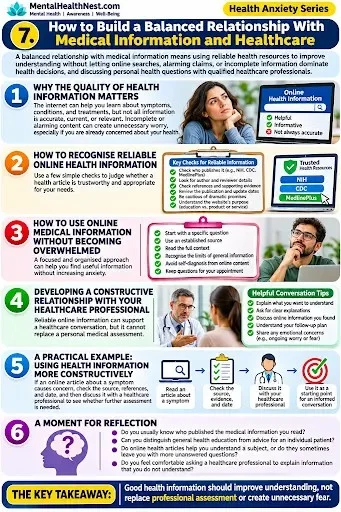
A six-section MentalHealthNest infographic explaining how to build a balanced relationship with medical information and healthcare. It covers why information quality matters, how to recognise reliable online health information, how to avoid becoming overwhelmed by medical searches, developing a constructive relationship with healthcare professionals, using online health information more constructively, and reflecting on personal health-information habits. The key takeaway emphasizes that reliable health information should improve understanding without replacing professional assessment or creating unnecessary fear.
A balanced relationship with medical information means using reliable health resources to improve understanding without allowing online searches, alarming claims, or incomplete information to dominate health-related decisions. It also involves recognising the limits of general medical information and discussing personal health questions with qualified healthcare professionals.
WHY THE QUALITY OF HEALTH INFORMATION MATTERS
The internet provides access to information about symptoms, medical conditions, investigations, and treatments. This can help people become more informed and prepare useful questions for healthcare appointments.
However, not everything published online is accurate, current, or relevant to an individual’s circumstances.
A health-related article may describe symptoms associated with several different conditions without explaining how common those symptoms are or what other factors healthcare professionals consider. A personal account may describe one person’s experience but cannot establish what another person is experiencing.
For someone already concerned about illness, incomplete or alarming information can create additional confusion.
The goal should not be to avoid medical information altogether. It should be to understand where information comes from, how reliable it is, and whether it is appropriate to apply to a personal health situation.
HOW TO RECOGNISE RELIABLE ONLINE HEALTH INFORMATION
The U.S. National Library of Medicine recommends evaluating health websites by considering who operates them, their purpose, the quality of their information, their sources, and their review processes.
Before relying on a health-related article, consider the following:
1. Check who publishes the information
Look for established government health agencies, recognised medical institutions, universities, and professional healthcare organisations.
Examples of useful U.S. resources include:
- National Institutes of Health (NIH)
- Centers for Disease Control and Prevention (CDC)
- MedlinePlus, a service of the National Library of Medicine
- Recognised medical schools and professional healthcare organisations
A website’s domain ending alone does not establish that its information is reliable. Consider the organisation behind the content.
2. Look for author and reviewer information
Check whether the article identifies its author and, where applicable, its qualified medical or clinical reviewer.
Understand the difference between an article written by a health educator, a healthcare professional, and a qualified clinical reviewer. These roles should not be presented as interchangeable.
3. Check references and supporting evidence
Reliable health information should explain where important medical claims come from. Look for references to scientific research, recognised clinical guidance, and reputable medical organisations.
Be cautious when an article makes strong medical claims without showing supporting evidence.
4. Check Publication and Review Dates
Medical and mental health information can change as new research emerges and professional guidance is updated. When reading health-related articles, check their original publication date and, where available, the date of their most recent review or update.
Older articles may still contain useful information, but readers should be cautious about relying on outdated guidance for medical or mental health decisions. For important clinical information, consult current guidance from recognised health authorities and qualified healthcare professionals.
5. Be cautious about dramatic promises
Treat claims of guaranteed cures, miracle treatments, instant results, or one solution for everyone with caution.
Health information should explain relevant evidence, limitations, and uncertainty rather than promising outcomes.
6. Understand the website’s purpose
Consider whether the website is primarily providing education or trying to sell a product, service, or treatment.
Commercial interests do not automatically make information inaccurate, but readers should understand when financial interests may influence the content.
HOW TO USE ONLINE MEDICAL INFORMATION WITHOUT BECOMING OVERWHELMED
Searching for health information can be useful when there is a clear purpose. However, repeatedly moving between articles, videos, discussion forums, and symptom descriptions may make it difficult to identify reliable information.
A more organised approach can help:
- Start with a specific question: Identify what you want to understand rather than searching broadly for every possible explanation.
- Choose an established source: Begin with a recognised medical institution or government health resource.
- Read the context: Do not rely on a headline, short social media post, or isolated list of symptoms.
- Recognise the limits of general information: An article cannot evaluate your medical history, examine you, or determine the cause of your individual symptoms.
- Avoid treating online descriptions as a diagnosis: Similar symptoms can occur for different reasons, and their significance depends on the complete clinical picture.
- Keep useful questions for your appointment: If something remains unclear, discuss it with a qualified healthcare professional rather than trying to reach a personal diagnosis through internet searches.
If health-related searching is becoming difficult to manage or interfering with everyday activities, it may be helpful to discuss that experience with a qualified mental health professional.
DEVELOPING A CONSTRUCTIVE RELATIONSHIP WITH YOUR HEALTHCARE PROFESSIONAL
Reliable online information can support a healthcare conversation, but it cannot replace an individual medical assessment.
A constructive relationship with a healthcare professional involves open communication, shared understanding, and clarity about the next steps.
You may find it helpful to:
1. Explain what you want to understand
Describe your concerns in ordinary language. You do not need to arrive with a diagnosis or use medical terminology.
2. Ask questions about medical explanations
If an explanation is unclear, ask the professional to explain it in simpler terms or clarify what the findings mean.
3. Discuss information you have found online
If an article or medical claim has raised questions, mention its source and ask whether the information is accurate and relevant to your circumstances.
4. Understand your follow-up arrangements
Ask what follow-up is recommended, what changes should be reported, and whom to contact if your concerns change.
5. Share emotional concerns honestly
If fear about illness is affecting your daily life, explain that as well. Healthcare professionals need to understand the emotional impact of health concerns, not just the physical symptoms.
These conversations can help people become better informed and participate more confidently in their healthcare.
A PRACTICAL EXAMPLE: USING HEALTH INFORMATION MORE CONSTRUCTIVELY
Imagine someone reads an online article describing a physical symptom associated with several medical conditions. One of the conditions sounds frightening, and the person becomes concerned that the information may apply to them.
Instead of treating the article as evidence of a diagnosis, they could check who published it, examine its references and publication date, and consider whether it provides balanced information.
If the concern relates to a personal symptom, they can discuss it with an appropriate healthcare professional and ask whether further assessment is necessary.
The article then becomes a starting point for an informed conversation rather than a substitute for medical evaluation.
A MOMENT FOR REFLECTION
Consider these questions about your relationship with health information:
- Do you usually know who published the medical information you read?
- Can you distinguish general health education from advice intended for an individual patient?
- Do online health articles help you understand a subject, or do they sometimes leave you with more unanswered questions?
- Do you feel comfortable asking a healthcare professional to explain information that you do not understand?
These questions are intended to encourage thoughtful use of health information, not to assess or diagnose health anxiety.
The important point: Good health information should improve understanding, not replace professional assessment or create unnecessary fear. Learning to recognise reliable sources, understand the limits of online information, and communicate openly with healthcare professionals can support a more balanced approach to personal health.
8. Supporting Someone With Health Anxiety: What Helps and What to Avoid
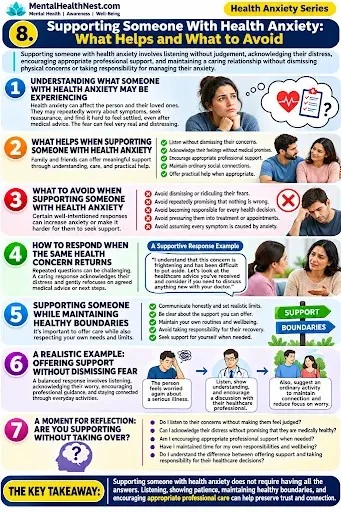
A seven-section MentalHealthNest infographic explaining how to support someone experiencing health anxiety. It covers understanding their emotional experiences, helpful ways family and friends can offer support, responses to avoid, handling recurring health concerns, maintaining healthy personal boundaries, a practical example of supportive communication, and reflection questions for caregivers and loved ones. The key takeaway emphasizes listening without judgment, acknowledging distress without making medical promises, maintaining healthy boundaries, and encouraging appropriate professional care.
Supporting someone with health anxiety involves listening without judgement, acknowledging their distress, encouraging appropriate professional support, and maintaining a caring relationship. Family members and friends can offer practical help without dismissing physical concerns, repeatedly providing medical certainty, or taking responsibility for managing the person’s anxiety.
UNDERSTANDING WHAT SOMEONE WITH HEALTH ANXIETY MAY BE EXPERIENCING
Health anxiety can affect more than the person experiencing the worry. Family members, partners, and friends may also find themselves involved in conversations about symptoms, medical appointments, online health information, and fears about illness.
Someone experiencing persistent health anxiety may repeatedly express concern about a physical sensation, ask whether something serious could be wrong, or struggle to feel reassured after receiving medical advice.
These experiences can be difficult for both sides. The person experiencing the anxiety may feel frightened or misunderstood, while those supporting them may feel uncertain about what to say or how to respond.
It is helpful to remember that health-related fear can feel very real and distressing, even when the feared illness has not been identified through medical assessment.
Understanding this experience can make it easier to respond with patience rather than frustration or criticism.
WHAT HELPS WHEN SUPPORTING SOMEONE WITH HEALTH ANXIETY
Family members and friends do not need clinical training to offer meaningful emotional and practical support. Their role is to provide understanding, maintain healthy communication, and encourage appropriate professional care.
1. Listen without dismissing their concerns
Allow the person to explain what they are experiencing. You do not need to agree with every feared interpretation to acknowledge their distress.
For example, instead of saying, “You are worrying about nothing,” you could say:
“I can see that this is causing you a lot of worry. Would you like to talk about what has been troubling you?”
This communicates care without confirming an unverified medical fear.
2. Acknowledge their feelings without making medical promises
It can be tempting to say, “You definitely do not have anything serious” because you want the person to feel better.
However, family members and friends cannot determine someone’s medical condition or guarantee a particular health outcome.
A more balanced response might be:
“I understand that you are worried. I cannot determine what is causing the concern, but I can support you in discussing it with your healthcare professional.”
This provides emotional support without pretending to offer a medical assessment.
3. Encourage appropriate professional support
If health-related worry is affecting the person’s everyday life, gently encourage a conversation with a qualified healthcare or mental health professional.
You might offer to help them arrange an appointment, prepare questions, or accompany them if they would find that useful.
Avoid pressuring them or treating professional support as a punishment for worrying. The decision should be approached respectfully and with consideration for their circumstances.
4. Maintain ordinary social connections
Try not to let every conversation revolve around health concerns.
Continue inviting the person to participate in activities they enjoy, such as spending time together, sharing a meal, enjoying a hobby, or taking part in ordinary family activities.
These interactions can help maintain connection and remind the person that their identity and relationships extend beyond their health worries.
5. Offer practical help when appropriate
Small gestures can make a meaningful difference.
For example, you might help organise appointment information, accompany them to a healthcare visit with their agreement, or assist with an everyday responsibility when they are feeling overwhelmed.
Ask what kind of support they would find useful rather than assuming you know what they need.
WHAT TO AVOID WHEN SUPPORTING SOMEONE WITH HEALTH ANXIETY
Good intentions do not always lead to helpful responses. Certain patterns can increase tension, undermine trust, or make it harder for the person to seek appropriate support.
1. Avoid dismissing or ridiculing their fears
Comments such as “You are imagining everything” or “Stop being dramatic” may make someone feel embarrassed or reluctant to discuss their distress.
Even when a fear appears disproportionate, the emotional experience deserves respectful attention. Understanding how anxiety can affect relationships and communication may also help loved ones respond with greater empathy and patience.
2. Avoid repeatedly promising that nothing is wrong
You can express care and offer emotional reassurance without repeatedly making statements about someone’s medical condition.
If the same health question keeps returning, consider responding with empathy and encouraging the person to follow their agreed healthcare plan rather than trying to provide medical certainty yourself.
Learning practical Strategies for managing anxiety may also help individuals respond to recurring worries without relying entirely on reassurance from others.
3. Avoid becoming responsible for every health-related decision
Supporting someone does not mean taking over their medical decisions, interpreting their symptoms, or deciding which investigations they need.
These responsibilities belong with the individual and their qualified healthcare professionals.
4. Avoid pressuring them into treatment or appointments
Encouragement can be helpful, but repeated pressure, criticism, or threats may damage communication.
Instead, ask what concerns they have about seeking support and whether there is a practical way you can help.
5. Avoid treating every physical concern as anxiety
A history of health anxiety does not mean that every new physical symptom is caused by anxiety.
New, changing, or concerning symptoms should receive appropriate medical attention. Family members should not discourage someone from seeking assessment when it is medically appropriate.
HOW TO RESPOND WHEN THE SAME HEALTH CONCERN RETURNS
Repeated conversations about the same illness-related fear can be challenging for family members and friends.
A caring response can acknowledge the person’s distress without turning every conversation into another attempt to establish medical certainty.
For example, you might say:
“I understand that this concern is frightening and that it has been difficult to put aside. I care about how you are feeling. Perhaps we can look at the healthcare advice you have already received and consider whether you need to discuss anything new with your healthcare professional.”
If repeated reassurance-seeking is an established pattern, the person may benefit from discussing with their mental health professional how family members can respond supportively.
It is important not to suddenly withdraw reassurance or introduce strict rules without understanding the person’s circumstances and any professional guidance they are following.
SUPPORTING SOMEONE WHILE MAINTAINING HEALTHY BOUNDARIES
Supporting a loved one can sometimes become emotionally demanding, particularly when health-related fears repeatedly interrupt conversations or everyday responsibilities.
Family members and friends also have their own needs, responsibilities, and limits.
Healthy boundaries can help preserve the relationship without withdrawing care.
Some helpful approaches include:
- Communicate honestly: Explain when a conversation is becoming difficult and suggest returning to it at a more suitable time.
- Offer realistic support: Be clear about what you can reasonably help with rather than promising constant availability.
- Maintain your own routines: Continue making time for work, relationships, rest, and personal interests.
- Avoid taking responsibility for recovery: You can encourage and support someone, but you cannot control their feelings or make treatment decisions for them.
- Seek support when needed: If the situation is affecting your own wellbeing, consider speaking with a qualified professional or trusted support person.
Setting boundaries should not be used to shame, punish, or isolate someone. The aim is to maintain a supportive relationship that respects both people’s needs.
A REALISTIC EXAMPLE: OFFERING SUPPORT WITHOUT DISMISSING FEAR
Imagine a family member who frequently becomes worried about having a serious illness. They have received medical advice but continue expressing concern and asking relatives whether they think something has been missed.
One relative becomes frustrated and responds by telling them to stop worrying. Another relative repeatedly promises that everything is definitely fine.
Neither response fully addresses the person’s distress.
A more supportive approach might involve listening calmly, acknowledging that the fear is difficult, and encouraging the person to discuss ongoing concerns with their healthcare professional.
The family member could also offer practical help with an appointment or suggest spending time together on an ordinary activity.
This approach respects the person’s feelings without assuming responsibility for diagnosing or resolving their health concerns.
A MOMENT FOR REFLECTION: ARE YOU SUPPORTING WITHOUT TAKING OVER?
If you are supporting someone with health anxiety, consider these questions:
- Do I listen to their concerns without making them feel judged?
- Can I acknowledge their distress without promising that they are medically healthy?
- Am I encouraging appropriate professional support when needed?
- Have I maintained time for my own responsibilities and wellbeing?
- Do I understand the difference between offering support and taking responsibility for another person’s healthcare decisions?
These questions are intended to encourage thoughtful support, not to evaluate or blame family members and friends.
The important point: Supporting someone with health anxiety does not require having all the answers. Listening, showing patience, maintaining healthy boundaries, and encouraging appropriate professional care can help preserve trust and connection while respecting the person’s individual needs.
9. When to Seek Professional Help for Persistent Health-Related Worry
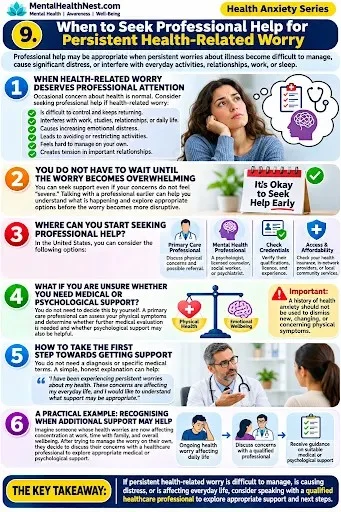
A six-section MentalHealthNest infographic explaining when persistent health-related worry may require professional help. It covers signs that health-related worry deserves attention, why people do not need to wait until distress becomes overwhelming, where to begin seeking professional help in the United States, how to distinguish the need for medical and psychological support, how to start a conversation with a healthcare professional, and a practical example of recognising when additional support may help. The key takeaway encourages people experiencing persistent distress or disruption to everyday life to discuss their concerns with a qualified healthcare professional.
Professional help may be appropriate when persistent worries about illness become difficult to manage, cause significant distress, or interfere with everyday activities, relationships, work, or sleep. A healthcare professional can assess physical concerns and help determine whether psychological support or further medical evaluation may be beneficial.
WHEN HEALTH-RELATED WORRY DESERVES PROFESSIONAL ATTENTION
Occasional concern about health is a normal experience. However, when illness-related fears begin taking up a considerable part of someone’s attention or influencing important areas of life, additional support may be worth considering.
You may want to speak with a qualified professional if:
- Worry is becoming difficult to control: Thoughts about possible illnesses keep returning and are difficult to put aside.
- Daily responsibilities are affected: Health-related concerns interfere with work, education, relationships, or activities that previously mattered to you.
- Emotional distress is increasing: Fear about illness is causing ongoing distress or making ordinary decisions feel increasingly difficult.
- Personal activities are becoming restricted: You are avoiding meaningful activities or making significant changes to everyday life because of health-related fears.
- You feel unable to manage the concerns independently: Your usual ways of dealing with worry are no longer helping you feel able to function comfortably.
- Health concerns are affecting relationships: Persistent worry is creating tension or making it difficult to maintain ordinary social connections.
These experiences do not automatically indicate a particular diagnosis. They are reasons to consider discussing your concerns with a qualified professional.
YOU DO NOT HAVE TO WAIT UNTIL THE WORRY BECOMES OVERWHELMING
Some people delay seeking psychological support because they believe their concerns are not serious enough. Others worry that a professional may dismiss their physical symptoms or tell them that everything is caused by anxiety.
However, professional support is not reserved only for people experiencing severe distress.
If health-related worry is repeatedly affecting your quality of life, you can discuss it with a healthcare professional even if you are unsure how to describe the experience.
Seeking help earlier may also make it easier to understand what is happening and consider appropriate options before the concerns become more disruptive.
WHERE CAN YOU START SEEKING PROFESSIONAL HELP?
For people in the United States, several professional routes may be available.
1. Start with a primary care professional
A primary care physician or other qualified healthcare professional can discuss physical concerns, review relevant medical history, and help determine whether further medical assessment is appropriate.
They can also discuss persistent health-related anxiety and whether a mental health referral may be useful.
2. Consider a qualified mental health professional
A licensed mental health professional can assess emotional distress and discuss appropriate psychological support.
Depending on state licensing requirements and individual qualifications, relevant professionals may include psychologists, licensed clinical social workers, licensed professional counselors, and psychiatrists.
3. Check professional credentials
Before choosing a provider, review their qualifications, relevant experience, professional licence, and scope of practice.
In the United States, state licensing boards provide information about professional credentials and licensing requirements.
4. Explore access and affordability
Health insurance plans may provide information about covered mental health services and in-network providers. Community mental health centres and other local services may also offer options for people who need affordable care.
Availability, eligibility, and costs vary, so it is useful to confirm these details directly with the provider or service.
WHAT IF YOU ARE UNSURE WHETHER YOU NEED MEDICAL OR PSYCHOLOGICAL SUPPORT?
It is not always easy to distinguish a physical health concern from the emotional distress surrounding it.
You do not need to make that distinction by yourself.
A primary care professional can help assess physical symptoms and consider whether additional medical evaluation is needed. If persistent fear or worry is also affecting your wellbeing, psychological assessment may be appropriate alongside medical care.
Importantly, a history of health anxiety should never be used as a reason to automatically dismiss new, changing, or concerning physical symptoms.
Sudden or severe physical symptoms that may indicate a medical emergency require prompt emergency medical attention. Do not assume that such symptoms are caused by anxiety.
HOW TO TAKE THE FIRST STEP TOWARDS GETTING SUPPORT
Starting a conversation can feel difficult, particularly when someone is unsure whether their concerns will be understood.
You do not need to have a diagnosis or know the correct clinical terminology before asking for help.
A simple explanation may be enough:
“I have been experiencing persistent worries about my health. These concerns are affecting my everyday life, and I am finding it difficult to manage the emotional distress. I would like to understand what support may be appropriate.”
You can also explain if you have genuine physical symptoms that need assessment. Both your physical health concerns and emotional wellbeing deserve attention.
A PRACTICAL EXAMPLE: RECOGNISING WHEN ADDITIONAL SUPPORT MAY HELP
Imagine someone who has been worried about their health for some time. The concerns are no longer limited to occasional moments. They are affecting concentration at work, making it difficult to enjoy time with family, and creating ongoing emotional strain.
The person may have tried to manage these feelings independently but is finding that the worry continues to interfere with everyday life.
Rather than waiting until the situation becomes more difficult, they decide to discuss both their physical concerns and emotional distress with a qualified healthcare professional.
The professional can help assess the situation and explain what further medical or psychological support may be appropriate.
This example illustrates that seeking help can be a thoughtful step towards understanding persistent distress. It does not require someone to prove that their worries are serious enough to deserve attention.
A GENTLE REMINDER: ASKING FOR HELP IS A REASONABLE STEP
Health anxiety can make people feel uncertain about their bodies, their health decisions, and their ability to trust their own judgement.
If these concerns are affecting your everyday life, you deserve to be heard and treated respectfully.
You do not have to choose between looking after your physical health and seeking support for your emotional wellbeing. Both matter, and appropriate professional care can take both into account.
The important point: Consider professional support when health-related worry becomes persistent, distressing, or disruptive. You do not need to diagnose yourself or wait until everyday life becomes overwhelming. A qualified healthcare professional can help you understand your concerns and identify appropriate next steps.
Frequently Asked Questions
CONCLUSION
Health anxiety can make uncertainty about illness feel overwhelming. What may begin as an ordinary concern about health can sometimes develop into persistent fear that affects medical decisions, relationships, work, and everyday activities.
Understanding health anxiety involves recognising the difference between appropriate attention to physical health and ongoing fear that becomes difficult to manage. It also means understanding that health anxiety, illness anxiety disorder, and somatic symptom disorder are related but distinct concepts.
Throughout this guide, we have explored why medical reassurance may not always provide lasting relief, how healthcare professionals evaluate persistent health-related fears, and how evidence-based psychological approaches such as cognitive behavioral therapy may support people experiencing health anxiety.
We have also considered the importance of reliable medical information, constructive communication with healthcare professionals, and compassionate support from family members and friends.
One important message deserves emphasis: health anxiety does not mean that physical symptoms should be ignored or automatically attributed to anxiety. Appropriate medical assessment remains essential, and psychological support can complement physical healthcare when persistent worry affects emotional wellbeing.
If concerns about illness are taking too much space in your life, consider speaking with a qualified healthcare or mental health professional. You do not need to wait until everyday activities become overwhelming before discussing your concerns.
Learning to care for your health while developing a more balanced relationship with uncertainty is a worthwhile goal. With appropriate information, professional support when needed, and understanding from others, it is possible to approach health concerns with greater perspective and protect the parts of life that matter beyond illness.
Your health matters, but your life is about more than your health worries. You deserve attention, understanding, and support for both.
A Gentle Reminder: You Do Not Have to Face Health Anxiety Alone
Living with persistent worries about illness can be emotionally exhausting. You may find yourself questioning physical sensations, struggling with uncertainty, or feeling that your health concerns are difficult to explain to others.
It is important to remember that experiencing health anxiety does not make you weak, unreasonable, or responsible for your distress.
Your physical health deserves appropriate attention, and your emotional wellbeing deserves care too. You do not have to dismiss genuine symptoms to acknowledge that persistent fear may also need support.
If health-related worries are affecting your everyday life, consider discussing both your physical concerns and emotional experiences with a qualified healthcare or mental health professional. You deserve to be listened to without judgement and supported with respect.
Progress does not require complete certainty about every aspect of your health. It can begin with understanding your concerns, following appropriate medical guidance, and recognising that support is available.
You deserve a life in which caring for your health does not mean living under constant fear of illness.
Explore More on MentalHealthNest: Anxiety Series
Understanding health anxiety is one part of developing a broader understanding of anxiety and emotional wellbeing. Our MentalHealthNest Anxiety Series explores different aspects of anxiety, from recognising its effects to understanding how it may influence everyday life, relationships, sleep, and physical wellbeing.
Explore the following articles to learn more:
1. Anxiety Disorders: Understanding Symptoms, Types, and Treatment
Learn about different anxiety disorders, their common symptoms, their effects on everyday life, and available assessment and treatment options.
2. Overthinking and Anxiety: Why Your Mind Won’t Slow Down
Explore repetitive worrying, anxious thought patterns, and practical approaches that may help.
3. Anxiety vs. Stress: What’s the Difference and How Can You Tell?
Understand how anxiety and stress differ, where they overlap, and when either may begin affecting everyday life.
4. Anxiety vs. Depression: Understanding the Differences and Overlap
Explore how anxiety and depression may differ, where symptoms can overlap, and why recognising these differences matters.
5. Anxiety and Sleep: Why Anxiety Can Keep You Awake
Discover how anxiety may interfere with sleep and how sleep difficulties and anxious thoughts can reinforce each other.
6. Anxiety and Physical Symptoms: How Anxiety Can Affect the Body
Understand how anxiety may be associated with physical experiences, including muscle tension, a racing heart, and digestive discomfort.
7. Panic Attacks vs. Anxiety Attacks: What Is the Difference?
Learn about panic attacks, how they differ from general experiences of anxiety, and why “anxiety attack” is not a formal clinical diagnosis.
8. Social Anxiety in Adults: Symptoms, Causes, and What May Help
Explore how fear of judgment or embarrassment may affect social situations, relationships, work, and everyday activities.
9. Anxiety at Work: How Workplace Stress Can Affect Mental Health
Learn how workplace pressures and anxiety may interact and explore practical sources of support.
10. Anxiety and Relationships: Why Anxiety Can Affect Connection and Communication
Discover how anxiety may influence communication, trust, reassurance, and emotional connection.
11. How to Calm an Anxious Mind: Practical Strategies for Managing Anxiety
Explore practical approaches to responding to anxious thoughts and feelings, managing everyday worries, and recognising when additional support may be appropriate.
12. When Does Anxiety Become a Problem?
Understand when anxiety may be more than an occasional response to stress, particularly when it becomes persistent, difficult to manage, or disruptive to everyday activities.
13. How to Help Someone With Anxiety: What to Say, What to Avoid, and How to Offer Support
Find guidance on supporting someone experiencing anxiety through compassionate communication, practical assistance, and respect for their individual needs.
Each article explores a different aspect of anxiety. Together, these resources aim to help readers develop a broader understanding of mental health, recognise when additional support may be useful, and make more informed decisions about their wellbeing.
A Note for Our Returning Readers
If you have been following the MentalHealthNest Anxiety Series, you may already be familiar with how anxiety can affect thoughts, sleep, physical experiences, relationships, and everyday decisions.
This article explores a more specific concern: health anxiety and the persistent fear of having or developing a serious illness.
Although health anxiety can overlap with other forms of anxiety, it has some distinct challenges. These may include difficulty feeling reassured after medical evaluations, uncertainty about physical symptoms, repeated searches for health information, and concerns about when to seek medical attention.
Our aim is to help you understand these experiences without dismissing genuine health concerns or encouraging unnecessary fear. We also explain how healthcare professionals assess persistent health-related worries and where appropriate psychological support may fit.
Each article in this series addresses a different aspect of anxiety. Together, they are intended to offer clear, practical, evidence-informed information while recognising that everyone’s experiences and support needs are different.
Thank you for continuing to read and learn with MentalHealthNest.
TRUSTED MENTAL HEALTH RESOURCE
The following U.S.-based organisations provide reliable information about anxiety, mental health support, and ways to find qualified professionals. These resources can help readers learn more and explore appropriate support.
1. National Institute of Mental Health (NIMH)
NIMH is a U.S. federal agency that provides research-based information about mental health conditions, including anxiety disorders, their symptoms, and available treatment approaches.
Website: https://www.nimh.nih.gov/health/topics/anxiety-disorders
Find Mental Health Support: https://www.nimh.nih.gov/health/find-help
2. MedlinePlus – U.S. National Library of Medicine
MedlinePlus provides accessible, reliable health information from the National Library of Medicine. Its anxiety resource includes information about anxiety symptoms, assessment, treatment, and related health topics.
Website: https://medlineplus.gov/anxiety.html
3. Substance Abuse and Mental Health Services Administration (SAMHSA)
SAMHSA is a U.S. government agency that helps individuals and families find mental health services, treatment programmes, and community support. Its website also explains how to explore available care and locate appropriate services.
Website: https://www.samhsa.gov/find-support
FindTreatment.gov
FindTreatment.gov is an official U.S. government treatment locator supported by the Substance Abuse and Mental Health Services Administration (SAMHSA). It helps individuals and families find mental health and substance use treatment facilities across the United States. It provides an alternative way to access treatment information when SAMHSA.gov pages are unavailable.
Website: https://findtreatment.gov/
SAMHSA National Helpline: 1-800-662-4357
4. American Psychological Association (APA) – Psychologist Locator
The American Psychological Association provides a directory that can help people search for psychologists by location or area of practice. Readers can use it as one starting point when looking for a psychologist.
Website: https://locator.apa.org/
A note about using these resources: Online information can support learning, but it cannot determine whether a particular physical symptom is caused by anxiety or another health condition. New, changing, or concerning symptoms should be discussed with an appropriate healthcare professional. Mental-health concerns can also be discussed with a qualified mental-health professional.
For immediate emotional crisis support in the United States, call or text 988 to reach the 988 Suicide & Crisis Lifeline. For a life-threatening medical emergency, call 911.
REFERENCES
- American Psychological Association. (2023). Illness Anxiety Disorder. APA Dictionary of Psychology.
https://dictionary.apa.org/illness-anxiety-disorder - American Psychological Association. (2023). Somatic Symptom Disorder. APA Dictionary of Psychology.
https://dictionary.apa.org/somatic-symptom-disorder - Lai, L., Liu, Y., Axelsson, E., Tyrer, P., Li, Y., Lu, Y., Shi, C., & Ren, Z. (2026). The comparative effectiveness of psychological interventions for health anxiety: Systematic review and a network meta-analysis of randomised controlled trials. The British Journal of Psychiatry.
https://doi.org/10.1192/bjp.2026.10647 - Axelsson, E., & Hedman-Lagerlöf, E. (2019). Cognitive behavior therapy for health anxiety: Systematic review and meta-analysis of clinical efficacy and health economic outcomes. Expert Review of Pharmacoeconomics & Outcomes Research, 19(6), 663–676.
https://doi.org/10.1080/14737167.2019.1703182 - Cooper, K., Gregory, J. D., Walker, I., Lambe, S., & Salkovskis, P. M. (2017). Cognitive behaviour therapy for health anxiety: A systematic review and meta-analysis. Behavioural and Cognitive Psychotherapy, 45(2), 110–123.
https://doi.org/10.1017/S1352465816000527 - Scarella, T. M., Boland, R. J., & Barsky, A. J. (2019). Illness anxiety disorder: Psychopathology, epidemiology, clinical characteristics, and treatment. Psychosomatic Medicine, 81(5), 398–407.
https://doi.org/10.1097/PSY.0000000000000691 - McMullan, R. D., Berle, D., Arnáez, S., & Starcevic, V. (2019). The relationships between health anxiety, online health information seeking, and cyberchondria: Systematic review and meta-analysis. Journal of Affective Disorders, 245, 270–278.
https://doi.org/10.1016/j.jad.2018.11.037 - Schenkel, S. K., Jungmann, S. M., Gropalis, M., & Witthöft, M. (2021). Conceptualizations of cyberchondria and relations to the anxiety spectrum: Systematic review and meta-analysis. Journal of Medical Internet Research, 23(11), e27835.
https://doi.org/10.2196/27835 - National Health Service (NHS). (2023). Health anxiety. https://www.nhs.uk/mental-health/conditions/health-anxiety/
- National Institute for Health and Care Excellence (NICE). (2011, updated 2020). Generalised anxiety disorder and panic disorder in adults: Management (Clinical Guideline CG113). https://www.nice.org.uk/guidance/cg113. Reference note: These sources provide background evidence and clinical context for this educational article. They do not replace an individual medical assessment. Research findings should be interpreted in light of each study’s methods, population, and limitations.
About MentalHealthNest: Editorial Policy and Content Standards
OUR MISSION
MentalHealthNest is an independent mental-health education platform committed to making reliable, understandable, and compassionate mental-health information accessible to readers. Our aim is to support greater awareness, reduce stigma, encourage informed conversations, and help readers understand when professional support may be appropriate.
We believe mental-health information should be responsible, respectful, practical, and centred on the needs of readers.
EVIDENCE-INFORMED CONTENT
Our articles are developed using credible medical and mental-health information, recognised professional guidance, peer-reviewed research, and resources from established health organisations.
We aim to explain mental-health topics in clear language while distinguishing established evidence from emerging research, general information, and areas where scientific understanding may still be developing.
ACCURACY AND SOURCE TRANSPARENCY
We make reasonable efforts to verify factual and health-related information before publication. Where appropriate, articles include references and links to the original sources so readers can explore the evidence further.
We do not intentionally present unsupported claims, invented research, fabricated quotations, or misleading health information as established facts. When evidence has limitations, those limitations should be communicated clearly.
CONTENT CREATION AND EDITORIAL REVIEW
MentalHealthNest content is prepared and reviewed under an editorial process that prioritises accuracy, originality, readability, compassion, and reader safety.
Artificial intelligence tools may assist with research, organisation, or drafting. However, AI-generated material is not treated as medical authority. Content must be checked for factual accuracy, source reliability, clarity, and responsible presentation before publication.
Editorial responsibility remains with the publisher. We aim to review and improve published material when important evidence, guidance, or factual information changes.
MEDICAL REVIEW AND PROFESSIONAL LIMITATIONS
MentalHealthNest is an educational platform, not a medical practice or mental-health treatment provider. Its founder and publisher, Sujit Shetty, is a mental-health advocate and blogger, not a licensed mental-health professional.
Unless an article explicitly identifies a qualified professional who has genuinely reviewed it, readers should not assume that the content has undergone clinical review.
Our articles do not replace diagnosis, medical advice, psychotherapy, or individualised care from qualified healthcare professionals.
RESPONSIBLE USE OF MENTAL HEALTH INFORMATION
Mental-health experiences differ from person to person. We avoid diagnosing readers, making promises about treatment outcomes, or suggesting that one approach is suitable for everyone.
Our content is intended to support understanding and informed conversations, not to encourage self-diagnosis, delay necessary medical care, or replace professional assessment.
We encourage readers to discuss personal health concerns with appropriately qualified professionals and seek urgent help when an emergency arises.
OUR COMMITMENT TO READERS
We are committed to maintaining a respectful, inclusive, transparent, and reader-first educational platform. This includes correcting significant errors when identified, reviewing content when important information changes, maintaining useful references, and improving the clarity and accessibility of our articles.
MentalHealthNest is being developed as an interconnected educational ecosystem that brings together mental-health guides, topic-specific articles, practical learning resources, and pathways to help readers find qualified professionals.
Our publishing standards also emphasise originality, transparency, responsible presentation, and a positive reader experience.
Our promise: To put accuracy before popularity, evidence before speculation, compassion before sensationalism, and reader wellbeing before promotion.
MEDICAL DISCLAIMER
The information provided in this article is intended for general educational and informational purposes only. It is not a substitute for professional medical advice, diagnosis, treatment, or individualised mental-health care.
Health anxiety and related conditions can affect people differently. The information presented here is not intended to diagnose any mental-health condition or determine the cause of an individual’s physical symptoms.
Do not assume that physical symptoms are caused by anxiety. New, persistent, changing, or concerning symptoms should be discussed with a qualified healthcare professional. Do not delay necessary medical evaluation or disregard medical advice based on information in this article.
The discussion of psychological treatments, including cognitive behavioral therapy (CBT), is provided for educational purposes. Decisions about assessment and treatment should be made with appropriately qualified healthcare professionals who understand an individual’s circumstances.
MentalHealthNest does not provide medical services, diagnosis, psychotherapy, or emergency care. Reading this article, using its resources, or contacting MentalHealthNest does not establish a healthcare professional–patient relationship.
If you or someone you know is experiencing a mental-health crisis in the United States, call or text 988 to contact the 988 Suicide & Crisis Lifeline. For an immediate medical emergency, call 911.
By using this information, readers acknowledge that personal health decisions should be made in consultation with qualified healthcare professionals.
• Mental Health Directory
• Psychologist Registration
• Psychiatrist Registration
Every article is designed to help you make informed decisions, strengthen your mental wellbeing, and connect with trusted professional support with qualified health care professional.
About the Author
Sujit Shetty is the founder and publisher of MentalHealthNest, an independent mental-health education platform dedicated to promoting mental-health awareness and making evidence-informed information accessible to readers, particularly in the United States.
As a mental-health advocate and blogger, Sujit is committed to helping readers better understand mental-health conditions, emotional wellbeing, and the importance of seeking appropriate professional support.
Through MentalHealthNest, he works to develop educational articles and resources that prioritise accuracy, compassion, transparency, and reader trust.
Sujit is not a licensed mental-health professional. His work focuses on mental-health education and awareness, not clinical diagnosis, treatment, or professional medical advice.
Website: https://mentalhealthnest.com/