Introduction
Have you ever experienced a sudden wave of intense fear, a racing heartbeat, or difficulty catching your breath and wondered whether you were having a panic attack or an anxiety attack? These experiences can feel overwhelming, and it is understandable that many people use the two terms interchangeably. However, panic attacks and general experiences of anxiety are not exactly the same.
Panic attacks involve a sudden surge of intense fear or discomfort that can bring noticeable physical and emotional symptoms. Anxiety, on the other hand, may develop gradually in response to stress, uncertainty, or perceived threats and can continue over time. Although people commonly use the expression “anxiety attack” to describe intense periods of anxiety, it is not a formal clinical diagnosis.
Understanding these differences can help you recognise what you are experiencing, identify possible triggers, and make more informed decisions about seeking support. It is also important to remember that experiencing a panic attack does not automatically mean you have panic disorder or another mental health condition.
In this guide, MentalHealthNest explores the meaning of panic attacks, how they differ from general anxiety experiences, their common symptoms and possible triggers, and practical ways to respond. We will also explain when professional mental health support or medical evaluation may be appropriate.
Quick Answer: What Is the Difference Between Panic Attacks and Anxiety Attacks?
A panic attack is a sudden episode of intense fear or discomfort that can involve physical symptoms such as a racing heart, sweating, trembling, and shortness of breath. The term “anxiety attack” is commonly used to describe periods of intense anxiety, but it is not a formal clinical diagnosis. Unlike panic attacks, which often involve a sudden surge of fear, anxiety may develop gradually in response to stress, worry, or perceived threat.
KEY TAKEAWAYS
- Panic attacks involve a sudden surge of intense fear or discomfort, often accompanied by physical symptoms.
- Anxiety can develop gradually and may persist in response to stress, uncertainty, or perceived threats.
- “Anxiety attack” is an informal expression rather than a formal clinical diagnosis.
- Panic attacks can occur in different anxiety-related conditions and do not automatically indicate panic disorder.
- Recognising patterns, triggers, and symptoms can help people understand their experiences.
- Professional mental health support may help when anxiety or panic repeatedly interferes with everyday life.
- New, severe, or unexplained physical symptoms should receive appropriate medical evaluation.
1. What Is a Panic Attack?
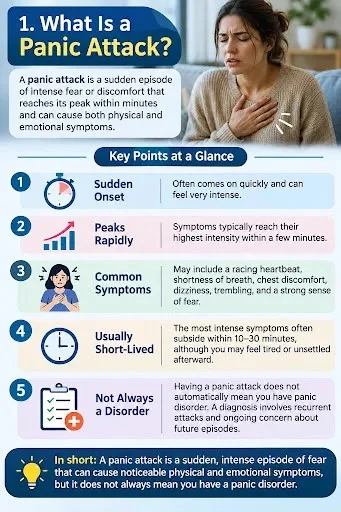
This infographic explains what a panic attack is, including its sudden onset, rapid increase in intensity, common physical and emotional symptoms, and typically short-lived nature. It also clarifies that experiencing a panic attack does not automatically mean someone has panic disorder.
A panic attack is a sudden episode of intense fear or discomfort that reaches a peak within minutes. It can occur unexpectedly or in response to a particular situation, even when there is no obvious immediate danger. During an episode, a person may experience a combination of physical sensations, emotional distress, and frightening thoughts that can feel difficult to control.
Panic attacks can be particularly unsettling because the physical sensations may resemble symptoms of a medical emergency. A person might experience a racing heartbeat, chest discomfort, difficulty breathing, dizziness, or a sudden feeling that something terrible is about to happen.
Common Characteristics of a Panic Attack
Although experiences vary, panic attacks often share several characteristics:
- Sudden onset: Intense fear or discomfort can develop abruptly, sometimes without an identifiable trigger.
- Rapid escalation: Symptoms can become intense within a few minutes.
- Physical sensations: A person may experience a pounding heartbeat, sweating, trembling, dizziness, or breathing difficulties.
- Emotional distress: Feelings of losing control, impending danger, or intense fear may occur.
- Temporary episode: The most intense symptoms generally peak within minutes, although some symptoms and associated distress may continue longer.
What Happens During a Panic Attack?
A panic attack can affect both the body and the mind. Some people become intensely aware of their heartbeat or breathing, while others experience dizziness, nausea, trembling, or a feeling of detachment from their surroundings.
The experience can create a cycle in which frightening physical sensations increase fear, and that fear makes the sensations feel even more overwhelming.
For example, someone might notice their heart beating unusually fast and become frightened that something is seriously wrong. That fear can increase their awareness of other physical sensations, making the experience more distressing.
Common Physical and Emotional Symptoms
The symptoms of a panic attack may include:
Physical symptoms:
- Pounding or racing heartbeat
- Sweating or chills
- Trembling or shaking
- Shortness of breath or a sensation of difficulty breathing
- Chest pain or discomfort
- Dizziness or lightheadedness
- Nausea or stomach discomfort
- Tingling or numbness in the hands or other parts of the body
Emotional and psychological symptoms:
- Intense fear or sudden distress
- Fear of losing control
- Fear that something terrible is about to happen
- Feeling disconnected from oneself or one’s surroundings
- A strong sense of impending danger
Not everyone experiences all these symptoms, and their intensity can differ from one episode to another.
How Long Does a Panic Attack Last?
A panic attack usually reaches its highest intensity within minutes. The most intense symptoms may gradually subside, but some people continue to experience anxiety, tiredness, or emotional discomfort afterward.
The overall experience varies. Some episodes are relatively brief, while others may involve lingering symptoms or repeated waves of distress.
Does Having a Panic Attack Mean You Have Panic Disorder?
No. Experiencing a panic attack does not automatically mean someone has panic disorder.
A panic attack is an episode of intense fear or discomfort. Panic disorder is a recognised mental health condition involving recurrent, unexpected panic attacks, together with ongoing concern about additional attacks or significant changes in behaviour related to them.
Panic attacks can also occur in connection with other anxiety-related conditions or stressful experiences. A qualified healthcare professional can evaluate recurring symptoms and determine whether a mental health condition or another explanation may be involved.
When Should Physical Symptoms Be Medically Evaluated?
Some panic attack symptoms, particularly chest discomfort, breathing difficulties, dizziness, and a racing heartbeat, can overlap with symptoms of physical health conditions.
It is important not to automatically assume that new, severe, or unexplained symptoms are caused by anxiety. Seek prompt medical evaluation, and contact emergency services when symptoms suggest a possible medical emergency.
Understanding the experience: A panic attack can be frightening, but experiencing one does not mean that a person has a permanent mental health condition. Understanding the symptoms and seeking appropriate medical or mental health guidance can help people make informed decisions about their wellbeing.
2. What Do People Mean by an Anxiety Attack?
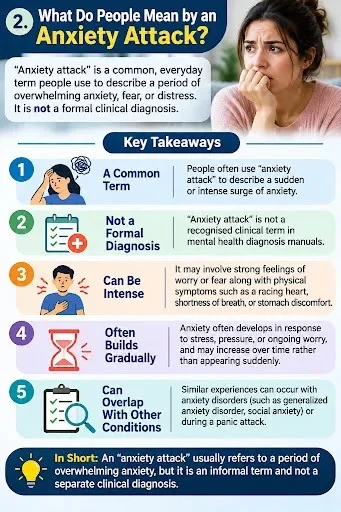
This infographic explains the commonly used term anxiety attack, describing periods of overwhelming anxiety, worry, or distress. It highlights that the term is informal rather than a formal clinical diagnosis and shows how anxiety may develop gradually and overlap with other mental health conditions.
An anxiety attack is an informal expression people use to describe a period of intense anxiety, fear, or emotional distress. Unlike a panic attack, which involves a sudden surge of intense fear or discomfort, overwhelming anxiety may build gradually in response to stress, persistent worry, uncertainty, or a perceived threat. The term “anxiety attack” is not a formal clinical diagnosis.
Many people use the expression “anxiety attack” when describing a period of overwhelming worry, nervousness, fear, or emotional distress. It may happen when everyday pressures become difficult to manage or when concerns about a particular situation begin to feel overwhelming.
However, it is important to understand that “anxiety attack” is not a formal clinical diagnosis in standard diagnostic terminology. Mental health professionals generally assess the specific symptoms, their duration, possible triggers, and their impact on everyday functioning rather than relying on this informal label.
Anxiety itself is a natural human response to uncertainty, stress, or situations perceived as challenging. It can affect thoughts, emotions, physical sensations, and behaviour. When anxiety becomes particularly intense, some people describe the experience as having an anxiety attack.
How Does an Anxiety Attack Feel?
People who use this expression may describe several emotional, mental, and physical experiences. The intensity can vary, and not everyone experiences the same symptoms.
Common experiences may include:
Emotional experiences:
- Feeling overwhelmed by worry or fear
- Becoming unusually nervous or distressed
- Feeling unable to relax
- Experiencing irritability or emotional tension
- Feeling apprehensive about what might happen next
Mental experiences:
- Repeatedly thinking about possible problems
- Difficulty concentrating or making decisions
- Expecting something negative to happen
- Finding it difficult to stop worrying
- Feeling mentally exhausted by persistent concerns
Physical experiences:
- Increased or noticeable heartbeat
- Muscle tension
- Sweating or trembling
- Stomach discomfort or nausea
- Headaches or dizziness
- Difficulty sleeping
- Feeling restless or physically unsettled
These experiences can overlap with symptoms of recognised anxiety conditions. Their presence alone does not establish a diagnosis.
Why Can Anxiety Build Gradually?
Unlike the sudden onset commonly associated with panic attacks, anxiety may develop over time as a person thinks about an upcoming challenge, uncertainty, or ongoing difficulty.
For example, someone preparing for an important examination, dealing with workplace pressure, or facing relationship uncertainty may become increasingly worried as the situation approaches.
Several factors may contribute to this growing sense of anxiety:
- Ongoing stress: Repeated demands at work, school, or home may increase emotional strain.
- Uncertainty: Not knowing what will happen can contribute to persistent worry.
- Health concerns: Fear about physical symptoms or a possible illness may increase anxiety.
- Relationship difficulties: Conflict, communication problems, or uncertainty about relationships may contribute to emotional distress.
- Financial pressures: Concerns about expenses, employment, or financial stability may increase worry.
- Major life changes: Moving, changing jobs, or adjusting to unfamiliar responsibilities can create anxiety.
Not every experience follows the same pattern. Anxiety can also occur without an obvious trigger.
Is an Anxiety Attack the Same as a Panic Attack?
Not necessarily. Although people sometimes use these expressions interchangeably, they describe different experiences in clinical discussions.
A panic attack is a recognised clinical term for a sudden episode of intense fear or discomfort that reaches a peak within minutes.
An anxiety attack, in contrast, is an informal expression rather than a recognised clinical diagnosis. People may use it to describe intense anxiety that builds gradually or becomes difficult to manage.
It is also possible for anxiety and panic symptoms to overlap. Someone experiencing intense anxiety may develop physical sensations such as a racing heartbeat, sweating, or shortness of breath. These symptoms do not automatically mean that the person is having a panic attack.
Understanding the pattern, intensity, duration, and circumstances surrounding the symptoms can help a qualified professional assess what may be happening.
When Can Intense Anxiety Become a Concern?
Occasional anxiety is a normal part of life. However, persistent or overwhelming anxiety deserves attention when it begins interfering with everyday activities.
You may benefit from discussing your experiences with a qualified healthcare or mental health professional if:
- Worry becomes difficult to control.
- Anxiety regularly interferes with sleep or concentration.
- You begin avoiding ordinary activities because of fear or worry.
- Emotional distress affects relationships, education, or work.
- Physical symptoms repeatedly accompany anxious feelings.
- You find it increasingly difficult to manage everyday responsibilities.
A professional can help assess the symptoms, consider possible explanations, and discuss appropriate support.
Understanding the terminology: Calling an experience an “anxiety attack” does not make the distress any less real. The important consideration is understanding the symptoms and their impact rather than focusing only on the label.
3. Panic Attacks vs. Anxiety Attacks: Key Differences
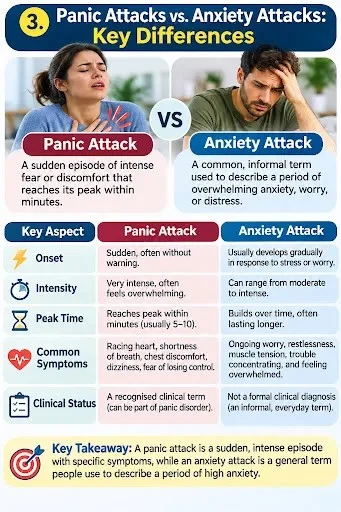
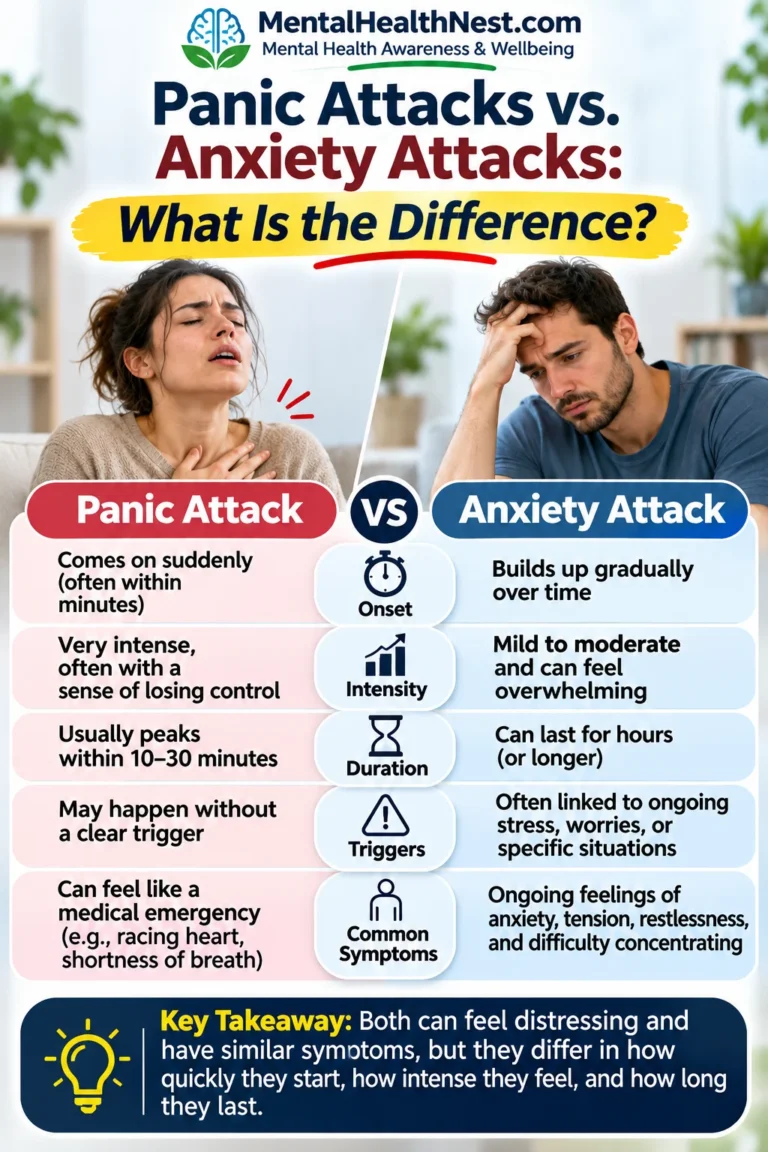
This comparison infographic highlights the differences between panic attacks and what people commonly call anxiety attacks. It compares their onset, intensity, peak timing, common symptoms, and clinical terminology to help readers understand how these experiences differ.
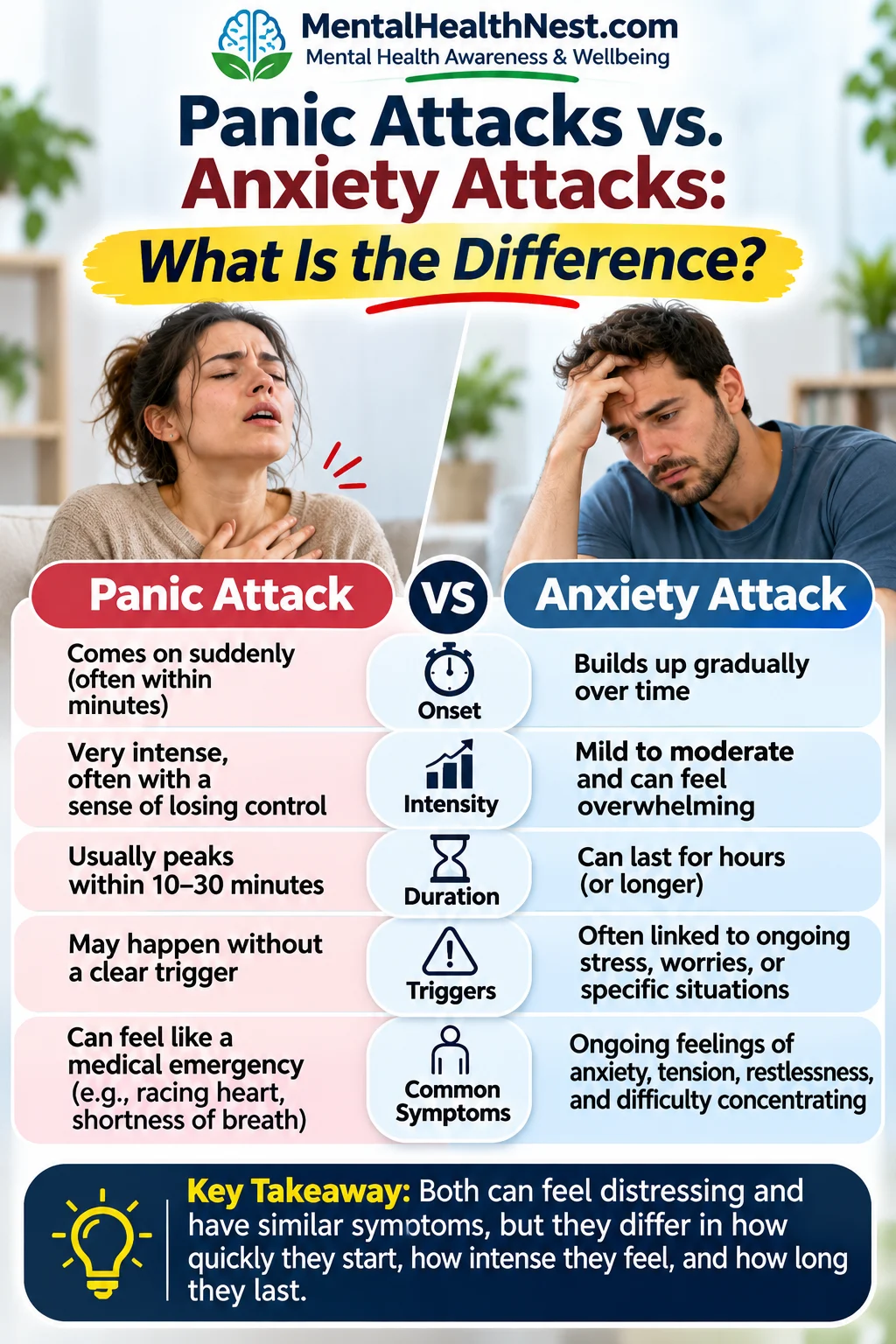
Panic attacks are sudden episodes of intense fear or discomfort that typically reach their peak within minutes. The term anxiety attack is an informal expression used to describe overwhelming anxiety, which may develop gradually in response to stress, worry, or uncertainty. The main difference is that panic attacks have a recognised clinical definition, whereas anxiety attacks do not have a separate formal clinical diagnosis.
Although panic attacks and experiences commonly described as anxiety attacks can share several symptoms, they are not interchangeable clinical terms. Understanding the distinction can help people describe their experiences more accurately and recognise when professional guidance may be helpful.
Panic Attacks vs. Anxiety Attacks: A Comparison
1. Clinical Recognition
Panic Attack: A recognised clinical term describing a sudden episode of intense fear or discomfort.
Anxiety Attack: An informal expression rather than a separate formal clinical diagnosis.
2. Onset
Panic Attack: Often begins suddenly, sometimes without an obvious warning or identifiable trigger.
Anxiety Attack: May develop gradually as worries accumulate or a stressful situation approaches. However, intense anxiety can also arise quickly.
3. Intensity
Panic Attack: Usually involves an intense surge of fear or discomfort, often accompanied by noticeable physical symptoms.
Anxiety Attack: Can range from moderate nervousness to overwhelming worry and emotional distress.
4. Duration
Panic Attack: Symptoms typically reach their peak within minutes, although some discomfort may continue afterward.
Anxiety Attack: Anxiety may persist or fluctuate over hours, days, or longer, depending on the circumstances.
5. Possible Triggers
Panic Attack: May occur unexpectedly or in response to a particular situation, fear, or perceived threat.
Anxiety Attack: Often associated with ongoing stress, work responsibilities, financial concerns, health worries, relationship difficulties, or uncertainty.
6. Physical Symptoms
Panic Attack: May involve a racing heartbeat, sweating, trembling, dizziness, chest discomfort, and shortness of breath.
Anxiety Attack: May involve muscle tension, restlessness, stomach discomfort, headaches, sleep difficulties, and a noticeable heartbeat.
7. Emotional Experiences
Panic Attack: May involve sudden intense fear, fear of losing control, or a feeling of impending danger.
Anxiety Attack: May involve persistent worry, apprehension, nervousness, and difficulty managing distressing thoughts.
Can Someone Experience Both Panic Attacks and Anxiety?
Yes. A person can experience ongoing anxiety and also have panic attacks.
For example, someone dealing with persistent worries about work or health may experience heightened anxiety over several days. During this period, they may also experience a sudden episode of intense fear and physical discomfort that meets the clinical description of a panic attack.
However, experiencing both does not automatically mean that the person has panic disorder or another specific mental health condition. A qualified professional can assess the overall pattern and determine whether further evaluation is appropriate.
Why Is It Important to Understand the Difference?
Understanding the distinction can help people:
- Describe their experiences more clearly when speaking with healthcare professionals.
- Recognise whether symptoms involve persistent anxiety, sudden panic, or both.
- Understand that an isolated panic attack does not automatically indicate panic disorder.
- Identify situations in which professional assessment may be helpful.
- Avoid making assumptions about their mental health based on symptoms alone.
Important: These differences describe common patterns, not absolute rules. Symptoms can overlap, and individual experiences vary. A qualified healthcare professional can assess the symptoms, their frequency, severity, and impact on daily life.
4. Common Symptoms of Panic Attacks
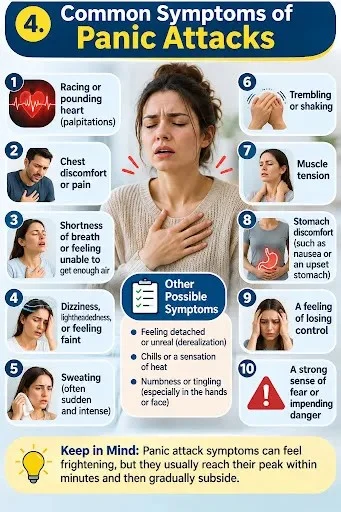
This infographic illustrates common symptoms associated with panic attacks, including a racing heartbeat, chest discomfort, shortness of breath, dizziness, sweating, trembling, muscle tension, stomach discomfort, fear of losing control, and a strong sense of danger. It also highlights other possible sensations, such as numbness, tingling, chills, and feeling detached or unreal.
Common symptoms of a panic attack include a racing heartbeat, sweating, trembling, shortness of breath, dizziness, chest discomfort, nausea, and sudden intense fear. Symptoms can affect both the body and mind, often developing rapidly and reaching their highest intensity within minutes. Not everyone experiences the same combination of symptoms.
A panic attack can produce a combination of physical sensations, emotional reactions, and changes in how a person experiences their surroundings. These symptoms may appear suddenly and can feel frightening, particularly when someone does not understand what is happening.
Some people primarily notice physical symptoms, such as a pounding heartbeat or difficulty breathing. Others experience intense fear, a sense of losing control, or a feeling that something terrible is about to happen. Many people experience both physical and emotional symptoms together.
1. Physical Symptoms of Panic Attacks
- Racing or pounding heartbeat: The heart may beat faster or more noticeably than usual.
- Sweating: A person may begin sweating even without physical exertion.
- Trembling or shaking: Hands, legs, or other parts of the body may feel shaky.
- Shortness of breath: Breathing may feel difficult, rapid, or uncomfortable.
- Choking sensations: A person may experience a sensation of choking or feeling unable to swallow comfortably.
- Chest discomfort: Some people experience chest pain, tightness, or pressure.
- Nausea or abdominal distress: Digestive discomfort or an unsettled stomach may occur.
- Dizziness or lightheadedness: A person may feel unsteady, faint, or dizzy.
- Chills or hot sensations: Some people experience sudden chills or feelings of heat.
- Numbness or tingling: Pins-and-needles sensations may occur in different parts of the body.
2. Emotional and Psychological Symptoms
Panic attacks can also affect thoughts, feelings, and a person’s sense of control.
Common psychological experiences include:
- Sudden intense fear: A powerful feeling of fear or sudden distress may appear, sometimes without an obvious explanation.
- Fear of losing control: A person may feel unable to manage what is happening during the episode.
- Fear of dying: Intense physical sensations may create a frightening fear of dying.
- Derealization: A feeling that the surrounding environment seems unreal, unfamiliar, or disconnected.
- Depersonalization: A feeling of being detached from yourself, your body, or your thoughts.
These experiences can be distressing, but they do not automatically indicate that a person has panic disorder.
3. Why Can Panic Attack Symptoms Feel So Intense?
During a panic attack, the body’s natural threat-response system becomes highly activated. This response can produce physical changes associated with preparing to respond to a perceived threat.
For example, someone may notice a sudden increase in their heartbeat, become frightened by the sensation, and then pay even closer attention to their physical symptoms. This increased fear and awareness can make the experience feel more overwhelming.
Breathing changes may also contribute to sensations such as dizziness, tingling, or lightheadedness.
Understanding that physical and emotional responses can occur together may help people make sense of the experience. However, symptoms should not automatically be attributed to panic without considering other possible explanations.
4. Do All Panic Attacks Have the Same Symptoms?
No. Panic attacks do not feel exactly the same for everyone.
One person may primarily experience a racing heartbeat and shortness of breath, while another may notice dizziness, trembling, nausea, or intense fear.
Clinical descriptions of a panic attack include an abrupt surge of intense fear or discomfort accompanied by multiple symptoms. The recognised symptom list includes 13 possible features, and a full panic attack involves at least four of them.
Some people may experience panic-like episodes with fewer symptoms. The number of symptoms alone should not be used to make a personal diagnosis.
5. Can Panic Attack Symptoms Be Mistaken for a Medical Problem?
Yes. Some panic attack symptoms overlap with symptoms of physical health conditions.
For example, chest discomfort, breathing difficulties, dizziness, and a racing heartbeat can have several possible explanations. A person experiencing new, severe, or unexplained symptoms should seek appropriate medical evaluation rather than assuming they are caused by anxiety.
If symptoms suggest a possible medical emergency, contact emergency services promptly.
A healthcare professional can consider the person’s symptoms and medical history and determine whether further evaluation is necessary.
6. What Happens After a Panic Attack?
Although the most intense symptoms may subside within minutes, the experience can leave someone feeling tired, unsettled, or emotionally drained.
Some people may also become concerned about experiencing another episode. When panic attacks recur, this concern may affect confidence, everyday activities, and willingness to enter situations associated with previous episodes.
If these experiences repeatedly interfere with daily life, discussing them with a qualified healthcare or mental health professional may be helpful.
Remember: Panic attack symptoms can be frightening, but experiencing these symptoms does not automatically mean someone has panic disorder. Understanding the symptoms, considering possible medical explanations, and seeking appropriate support are important steps toward better mental health.
5. How Anxiety Can Build and Affect Daily Life
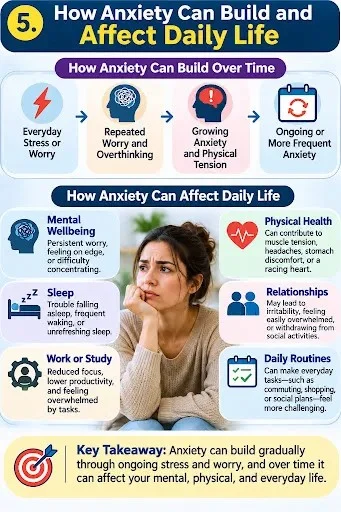
This infographic illustrates how everyday stress and repeated worry may contribute to increasing anxiety over time. It explains how persistent anxiety can affect mental wellbeing, physical health, sleep, relationships, work or studies, and everyday routines.
Anxiety can build gradually when ongoing worries, stressful situations, uncertainty, or perceived threats create increasing emotional tension. When anxiety becomes persistent or difficult to manage, it may affect concentration, sleep, physical comfort, relationships, work, and everyday activities. Its intensity and impact can vary from person to person.
Anxiety is a natural response to stress, uncertainty, or situations that feel challenging. In some circumstances, it can help people prepare for important responsibilities or recognise potential problems. However, when worries continue without adequate relief, anxiety may become increasingly difficult to manage.
For some people, anxiety develops around a specific concern, such as an important examination, workplace responsibility, financial uncertainty, or a health problem. For others, worries may extend across several areas of life, even when there is no immediate threat.
Understanding how anxiety builds and affects everyday functioning can help people recognise when occasional worry may be becoming a more persistent concern.
1. How Can Anxiety Build Over Time?
Anxiety does not always appear suddenly. It may develop gradually as concerns accumulate and a person repeatedly thinks about possible problems or uncertain outcomes.
For example, someone facing an important work responsibility may initially experience mild nervousness. As the deadline approaches, repeated worries about making mistakes, disappointing others, or failing to meet expectations may increase emotional tension.
Several experiences can contribute to this pattern:
- Ongoing stress: Repeated responsibilities at work, home, or school may contribute to emotional strain.
- Uncertainty: Not knowing what will happen can make it difficult to feel settled.
- Repeated worrying: Continuously thinking about possible negative outcomes may make concerns feel increasingly overwhelming.
- Fear of making mistakes: Worry about criticism, failure, or disappointing others may increase anxiety.
- Physical tension: Muscle tightness, restlessness, and sleep difficulties may add to an already stressful experience.
- Avoidance: Avoiding situations that create anxiety may provide temporary relief but can make certain fears harder to address over time.
These patterns do not occur in everyone, and anxiety can also arise without an obvious trigger
2. How Anxiety Can Affect Mental and Emotional Wellbeing
Persistent anxiety can influence how people think, feel, and respond to everyday situations.
Some common experiences include:
- Difficulty concentrating: Repeated worries may make it harder to focus on conversations, responsibilities, or decisions.
- Constant apprehension: A person may frequently expect something negative to happen.
- Irritability: Ongoing emotional tension may make ordinary frustrations more difficult to manage.
- Feeling overwhelmed: Even routine responsibilities may begin to feel demanding.
- Difficulty relaxing: A person may continue thinking about problems even during periods of rest.
- Reduced enjoyment: Worry may make it harder to enjoy hobbies, social activities, and time with family or friends.
These experiences can vary in frequency and intensity. They do not necessarily indicate an anxiety disorder, but persistent difficulties deserve attention.
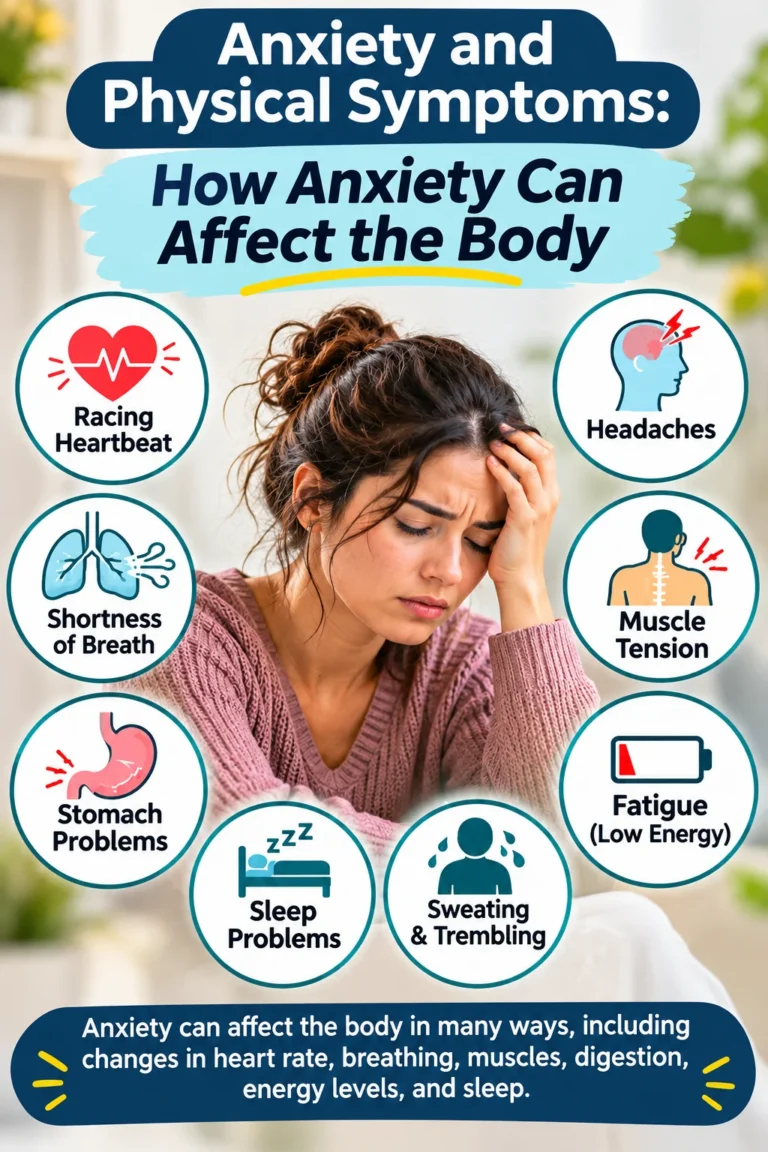
3. How Anxiety Can Affect Physical Wellbeing
Anxiety can affect the body as well as the mind. When the body’s stress-response system becomes activated, people may notice several physical sensations.
Possible experiences include:
- Muscle tension or aches
- Headaches
- Stomach discomfort or nausea
- A noticeable or faster heartbeat
- Sweating or trembling
- Restlessness
- Dizziness or lightheadedness
- Difficulty falling asleep or staying asleep
- Feeling tired during the day
Not everyone experiences the same physical symptoms. New, severe, or unexplained physical problems should be medically evaluated rather than automatically attributed to anxiety.
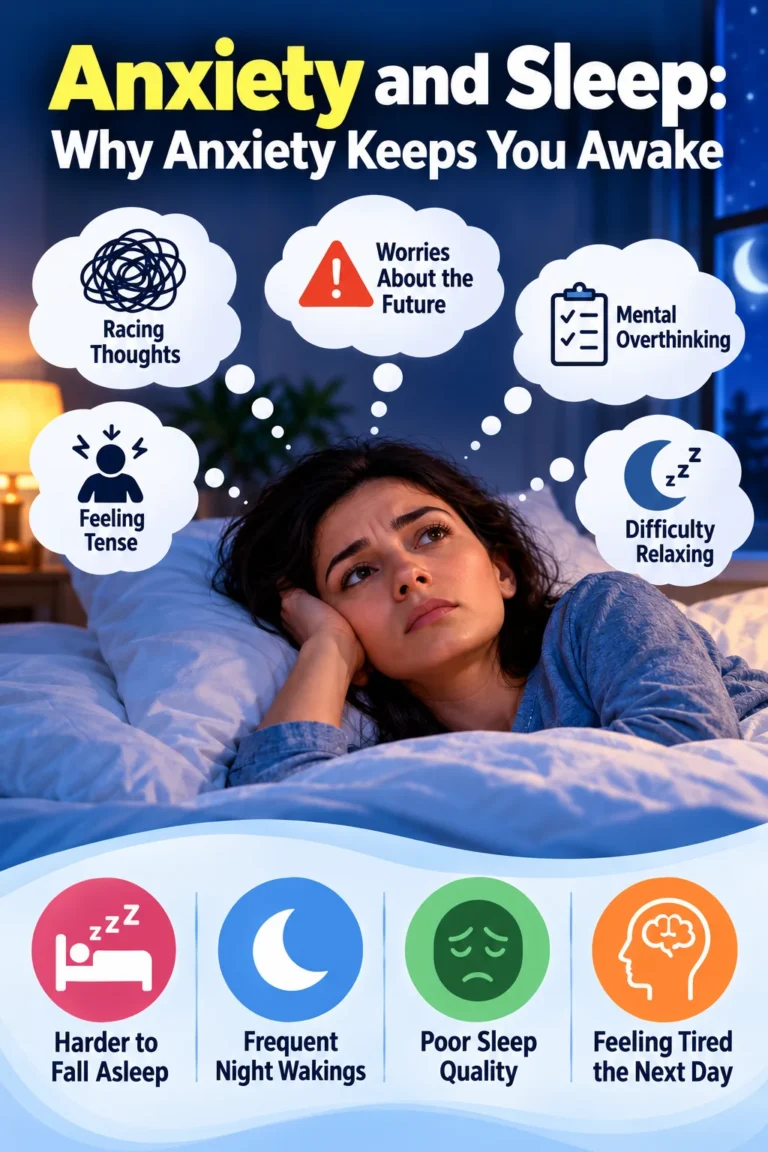
4. How Anxiety Can Affect Sleep
Worrying thoughts can make it difficult to relax at bedtime. Someone may repeatedly think about unfinished responsibilities, upcoming events, personal concerns, or situations they cannot control.
This may contribute to:
- Difficulty falling asleep
- Waking up during the night
- Feeling unrefreshed in the morning
- Daytime tiredness
- Difficulty concentrating after inadequate sleep
Sleep difficulties and anxiety can also influence each other. Poor sleep may make emotional regulation and everyday stress more difficult, while persistent anxiety may interfere with restful sleep.
5. How Anxiety Can Affect Relationships
Anxiety may influence communication and emotional connection with other people.
For example, someone experiencing persistent worry may:
- Overthink conversations or interactions.
- Become concerned about how others perceive them.
- Seek repeated reassurance.
- Withdraw from social activities.
- Misinterpret ordinary situations as signs of conflict or rejection.
- Find it difficult to communicate their feelings.
These experiences can sometimes create misunderstandings or emotional distance. Understanding the role anxiety may play can encourage more open communication and appropriate support.
6. How Anxiety Can Affect Work and Everyday Responsibilities
When anxiety becomes persistent, it may interfere with routine activities and responsibilities.
At work, a person may struggle to concentrate, make decisions, meet deadlines, or participate confidently in meetings.
In everyday life, anxiety may make it difficult to:
- Complete household responsibilities.
- Manage appointments and schedules.
- Make decisions about ordinary matters.
- Participate in social activities.
- Handle unexpected changes.
- Enjoy leisure time without worrying.
The impact differs between individuals. Some people continue managing their responsibilities while experiencing significant internal distress, whereas others may find that anxiety substantially disrupts their daily routines.
7. Can Anxiety Become a Self-Reinforcing Cycle?
Sometimes, anxiety and its consequences can influence one another.
For example, persistent worry may interfere with sleep. Poor sleep may contribute to tiredness and difficulty concentrating. These difficulties can make everyday responsibilities feel more challenging, creating additional concerns.
Similarly, avoiding situations that create anxiety may bring short-term relief. However, repeated avoidance can sometimes strengthen the belief that those situations are too difficult to manage.
Recognising these patterns can help people understand why anxiety may continue and why appropriate support can be beneficial.
8. When Does Anxiety Begin to Interfere With Daily Life?
Occasional anxiety is a normal human experience. However, it deserves attention when it becomes persistent, difficult to control, or disruptive to important areas of life.
Consider speaking with a qualified healthcare or mental health professional if:
- Worry regularly interferes with sleep.
- Concentration and decision-making become difficult.
- Anxiety affects relationships or work responsibilities.
- You frequently avoid situations because of fear or worry.
- Physical symptoms repeatedly accompany anxious feelings.
- Everyday activities become increasingly difficult to manage.
A professional can assess the symptoms, consider possible explanations, and discuss appropriate support.
Understanding the impact: Anxiety can affect several aspects of daily life, but its effects are not the same for everyone. Recognising persistent patterns and seeking appropriate support can help people better understand their experiences and take informed steps toward improved wellbeing
6. What Can Trigger Panic Attacks and Anxiety?
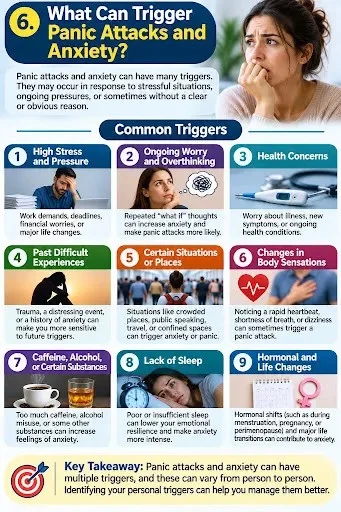
This infographic highlights nine possible triggers of panic attacks and anxiety, including high stress, ongoing worry, health concerns, difficult past experiences, certain situations, changes in body sensations, caffeine or other substances, insufficient sleep, and hormonal or life changes. It emphasizes that triggers can vary from person to person.
Panic attacks and anxiety can be triggered by various psychological, environmental, physical, and situational factors. Common triggers include ongoing stress, relationship difficulties, financial concerns, health worries, traumatic experiences, major life changes, and fear of losing control. However, panic attacks can also occur unexpectedly, without an identifiable trigger, and individual experiences vary.
Panic attacks and anxiety do not have one universal cause. Different factors can contribute to their development, and what triggers an episode in one person may not affect another person in the same way.
For some individuals, anxiety develops in response to ongoing pressures or uncertainty. For others, a panic attack may occur suddenly, even when there is no obvious external threat.
Understanding possible triggers can help people recognise patterns in their experiences and discuss them more effectively with qualified healthcare professionals.
1. Psychological and Emotional Triggers
Emotional experiences and patterns of thinking can contribute to anxiety and panic.
Some possible triggers include:
- Persistent worry: Repeatedly thinking about possible problems or negative outcomes may increase emotional tension.
- Fear of losing control: Concerns about being unable to manage a situation may intensify anxiety.
- Fear of judgment: Worry about criticism, embarrassment, or rejection can create distress in social situations.
- Negative expectations: Frequently anticipating the worst possible outcome may increase feelings of apprehension.
- Emotional strain: Ongoing frustration, uncertainty, or unresolved personal difficulties may contribute to anxiety.
These factors do not affect everyone equally, and they do not necessarily lead to panic attacks.
2. Stressful Life Events and Situations
Major life events and continuing responsibilities can contribute to increased anxiety.
Examples include:
- Workplace pressure or employment uncertainty
- Financial difficulties and unexpected expenses
- Relationship conflicts or family responsibilities
- Academic pressure and important examinations
- Illness or concerns about physical health
- Bereavement or significant personal loss
- Moving to a new location or adjusting to major life changes
Even positive events, such as marriage, becoming a parent, or starting a new job, may involve uncertainty and additional responsibilities that contribute to stress.
When several challenges occur together, emotional pressure may become more difficult to manage.
3. Physical Factors That May Contribute to Panic and Anxiety
Certain physical conditions and everyday circumstances may influence how the body responds to stress and anxiety.
Possible contributing factors include:
- Sleep difficulties: Inadequate or disrupted sleep may make emotional regulation and stress management more difficult.
- Physical exhaustion: Persistent tiredness may increase vulnerability to feeling overwhelmed.
- Caffeine sensitivity: Caffeine can increase alertness and may cause sensations such as a faster heartbeat or restlessness in some people.
- Changes in physical health: Illness, pain, or other medical concerns may contribute to anxiety.
- Breathing-related sensations: Changes in breathing can sometimes produce physical sensations that increase fear or distress.
These factors are not necessarily direct causes of panic attacks. Their relevance varies between individuals.
4. Traumatic or Difficult Past Experiences
Difficult experiences can sometimes influence how people respond to situations that remind them of earlier distress.
Experiences such as bullying, abuse, neglect, serious accidents, or other traumatic events may contribute to ongoing anxiety or heightened responses to perceived threats.
Certain reminders, environments, or situations may bring back feelings associated with earlier experiences.
However, not everyone who experiences trauma develops panic attacks or an anxiety disorder. The effects of difficult experiences vary, and professional support may be helpful when they continue to affect everyday wellbeing.
5. Situational Triggers of Panic Attacks
Some panic attacks occur in particular situations, while others appear unexpectedly.
Situations that may trigger panic in some people include:
- Speaking in front of an audience
- Travelling in crowded public places
- Being in enclosed or unfamiliar environments
- Driving or travelling
- Experiencing a situation associated with an earlier panic episode
- Facing an event that creates significant uncertainty
For example, someone who previously experienced intense anxiety in a crowded environment may become worried about returning to a similar situation.
It is important to remember that these situations are not universal triggers. A situation that causes panic for one person may feel completely manageable to another.
6. Why Can Panic Attacks Occur Without an Obvious Trigger?
Not every panic attack has an identifiable cause.
Some people experience a sudden episode of intense fear or discomfort while carrying out ordinary activities, resting, or even sleeping.
Researchers believe that biological processes, brain mechanisms involved in fear responses, genetics, and environmental influences may all contribute to panic-related conditions.
In some circumstances, a person may also become increasingly sensitive to physical sensations associated with anxiety . For example, noticing a change in heartbeat may increase concern, which can intensify the experience.
However, the exact reasons why some people experience unexpected panic attacks are not fully understood.
7. Can Worry About Another Panic Attack Become a Trigger?
Yes. Concern about experiencing another panic attack may contribute to a continuing cycle of anxiety for some people.
After an unsettling episode, someone may become increasingly attentive to ordinary physical sensations or situations associated with the experience.
For example:
- A person may become concerned whenever their heartbeat feels faster than usual.
- They may worry about experiencing another episode while travelling.
- They may avoid certain activities because they fear becoming overwhelmed.
- They may repeatedly seek reassurance about physical sensations.
In people with panic disorder, persistent concern about future attacks and related changes in behaviour are important clinical features.
Understanding this pattern can help explain why repeated panic experiences may affect confidence and everyday activities.
8. How Can Identifying Triggers Help?
Recognising possible triggers may help people understand when anxiety tends to increase and what circumstances may contribute to distress.
Some useful approaches to discussing these patterns with a healthcare professional include:
- Noticing situations in which anxiety tends to increase.
- Identifying recurring sources of stress.
- Observing whether sleep difficulties or physical discomfort accompany anxious experiences.
- Recognising situations that are increasingly being avoided.
- Discussing recurring symptoms and concerns with a qualified professional.
Identifying a possible trigger does not establish a diagnosis, and some panic attacks may remain difficult to explain.
Remember: Panic attacks and anxiety can have several contributing factors, and there is no single explanation that applies to everyone. Experiencing panic does not mean someone is weak or unable to cope. Understanding individual patterns and seeking appropriate professional guidance can help people make informed decisions about their mental health.
7. Why Panic Attacks and Panic Disorder Are Not the Same
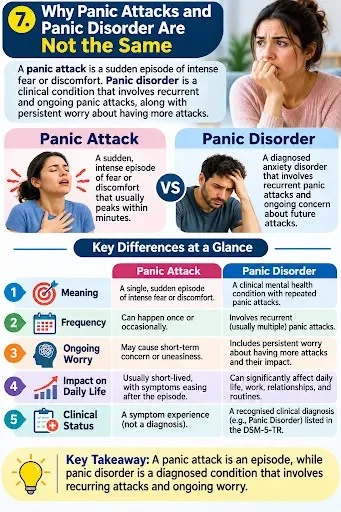
This infographic compares a panic attack with panic disorder, explaining the difference between an individual episode of intense fear and a clinical anxiety disorder involving recurrent panic attacks and ongoing concern about future episodes. It compares their meaning, frequency, emotional impact, and clinical status.
A panic attack is a sudden episode of intense fear or discomfort that reaches its peak within minutes, while panic disorder is a recognised mental health condition involving recurrent, unexpected panic attacks and ongoing concern about experiencing another attack or significant changes in behaviour related to the attacks. Having one panic attack does not automatically mean someone has panic disorder.
Panic attacks and panic disorder are closely related, but they describe two different clinical experiences. A panic attack refers to an episode of intense fear or discomfort, whereas panic disorder is a mental health condition in which recurring panic attacks and their associated effects become a continuing concern.
Understanding this distinction is important because not everyone who experiences a panic attack develops panic disorder. Some people may experience an isolated episode, while others may have recurring episodes that affect their confidence, relationships, work, and everyday activities.
1. What Is a Panic Attack?
A panic attack is a sudden episode of intense fear or discomfort that typically reaches its highest intensity within minutes.
It may involve physical and psychological symptoms such as:
- Racing or pounding heartbeat
- Sweating or trembling
- Shortness of breath
- Chest discomfort
- Dizziness or lightheadedness
- Fear of losing control
- Fear that something terrible is about to happen
Panic attacks can occur unexpectedly or in response to particular situations. They may also occur in connection with different mental health conditions.
Importantly, experiencing a panic attack does not automatically indicate the presence of a mental health disorder.
2. What Is Panic Disorder?
Panic disorder is a recognised mental health condition characterised by recurrent, unexpected panic attacks and continuing concern or behavioural changes associated with the attacks.
People experiencing panic disorder may become increasingly worried about when another episode might happen.
This concern may influence their everyday decisions and activities.
For example, someone may begin avoiding certain places, travelling alone, attending crowded events, or participating in activities because they fear experiencing another panic attack.
A diagnosis requires more than simply experiencing occasional panic symptoms. A qualified healthcare or mental health professional evaluates the overall pattern, duration, severity, and impact of the experiences.
3. Panic Attack vs. Panic Disorder: Key Differences
Panic Attack
- Describes an individual episode of intense fear or discomfort.
- May occur unexpectedly or in response to a particular situation.
- Can happen to someone without panic disorder.
- Does not automatically indicate a continuing mental health condition.
- May occur in connection with other anxiety-related conditions.
Panic Disorder
- Is a recognised mental health condition.
- Involves recurrent, unexpected panic attacks.
- Includes persistent concern about additional attacks or their consequences.
- May lead to significant changes in everyday behaviour.
- Can interfere with relationships, work, travel, and social participation.
- Requires professional assessment for diagnosis.
4. Can Someone Have a Panic Attack Without Having Panic Disorder?
Yes. A person can experience one or more panic attacks without meeting the diagnostic criteria for panic disorder.
Panic attacks can occur in different circumstances and may be associated with other mental health conditions or stressful experiences.
For example, someone may experience a sudden episode of intense fear before an important event or during a particularly stressful period.
Another person may experience a panic attack without identifying any obvious trigger.
Neither situation automatically establishes a diagnosis of panic disorder.
5. How Can Panic Disorder Affect Everyday Life?
When panic attacks recur, concern about experiencing another episode may gradually influence everyday activities.
Some people may experience:
- Anticipatory anxiety: Persistent worry about when another panic attack might happen.
- Avoidance: Staying away from places or situations associated with previous episodes.
- Reduced confidence: Feeling less comfortable participating in ordinary activities.
- Social difficulties: Avoiding gatherings or situations where leaving may feel difficult.
- Work-related challenges: Becoming concerned about experiencing an episode during meetings, presentations, or workplace responsibilities.
- Travel concerns: Feeling uncomfortable travelling alone or visiting unfamiliar places.
These experiences do not affect everyone in the same way. However, when fear and avoidance begin interfering with daily functioning, professional support may be beneficial.
6. How Is Panic Disorder Diagnosed?
A qualified healthcare or mental health professional evaluates symptoms and their history before determining whether someone may have panic disorder.
The assessment may consider:
- Whether panic attacks are recurrent and unexpected.
- Whether there is persistent concern about additional attacks or their consequences.
- Whether behaviour has changed significantly because of these concerns.
- How long these patterns have been present.
- Whether symptoms interfere with everyday functioning.
- Whether physical health conditions, medications, or other factors could explain the symptoms.
Under standard diagnostic criteria, the continuing concern or behavioural changes associated with recurrent unexpected panic attacks must persist for at least one month for panic disorder.
A healthcare professional may also recommend medical evaluation to consider other possible explanations for physical symptoms.
7. Can Panic Disorder Be Managed?
Yes. Panic disorder is a recognised and treatable mental health condition. Appropriate professional support can help people understand their symptoms and explore suitable treatment options.
Depending on individual needs, treatment may include:
- Cognitive behavioural therapy (CBT): A structured psychological approach that helps people understand and respond differently to unhelpful thoughts and behavioural patterns associated with panic.
- Medication: A qualified healthcare professional may discuss appropriate medication options when clinically indicated.
- Education about panic: Understanding physical sensations and panic-related responses may help reduce uncertainty and fear.
- Ongoing professional support: Regular follow-up can help assess progress and address continuing difficulties.
Treatment decisions should be made with qualified healthcare professionals based on individual circumstances.
Remember: A panic attack is an episode, while panic disorder is a recognised mental health condition involving recurring unexpected attacks and continuing concern or behavioural changes. Experiencing a panic attack does not mean someone automatically has panic disorder, and appropriate professional assessment can help clarify the difference.
8. How to Respond During a Panic Attack
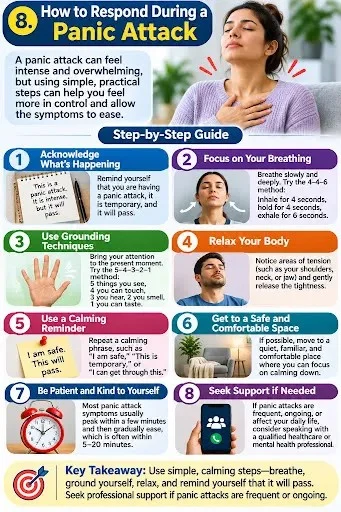
This infographic presents eight practical ways to respond during a panic attack, including acknowledging the experience, using comfortable breathing techniques, grounding yourself, relaxing tense muscles, repeating calming reminders, finding a comfortable space, practising self-kindness, and seeking professional support when needed.
During a panic attack, it may help to move to a comfortable and safe place, gently slow your breathing without forcing it, focus on your immediate surroundings, and remind yourself that the intense feelings may pass. If symptoms are new, severe, or medically unexplained, seek appropriate medical evaluation rather than assuming they are caused by panic.
A panic attack can feel overwhelming because physical sensations and intense fear may occur together. A racing heartbeat, dizziness, trembling, or difficulty breathing can make someone feel frightened or uncertain about what is happening.
Although these experiences can be distressing, there are practical ways to respond that may help someone feel more grounded and supported.
The goal is not to force the symptoms to disappear immediately. Instead, the focus is on creating a sense of safety, reducing additional stress, and responding calmly while the episode passes.
1. Move to a Comfortable and Safe Place
If possible, move away from an overwhelming environment and find a comfortable place where you can sit or stand safely.
For example, if a crowded or noisy environment is making the experience more difficult, moving to a quieter area may help reduce additional stimulation.
However, avoid rushing or making sudden movements if you feel dizzy or unsteady.
If you are in a situation where moving is unsafe, focus on remaining as comfortable and secure as possible.
2. Try Gentle, Comfortable Breathing
Breathing may become faster or feel uncomfortable during a panic attack.
If this happens, try bringing gentle attention to your breathing without forcing deep breaths or holding your breath.
You may find it helpful to:
- Breathe gently and naturally.
- Allow your shoulders to relax.
- Avoid repeatedly checking whether you are breathing correctly.
- Let your breathing settle at a comfortable pace.
Some people find slow, comfortable breathing helpful during periods of anxiety. However, no particular breathing technique works for everyone.
If focusing on breathing increases discomfort, shift your attention to something neutral in your surroundings instead.
3. Use Grounding to Focus on the Present
Grounding techniques can help redirect attention away from frightening thoughts and toward the immediate environment.
One commonly used approach is the 5-4-3-2-1 grounding exercise.
Notice:
- 5 things you can see: Look at objects, colours, or details around you.
- 4 things you can feel: Notice your feet on the floor or your hands resting comfortably.
- 3 things you can hear: Pay attention to nearby sounds.
- 2 things you can smell: Notice familiar or neutral scents.
- 1 thing you can taste: Notice a taste in your mouth or take a comfortable sip of water.
There is no need to complete the exercise perfectly. Simply noticing your surroundings may help you reconnect with the present moment.
4. Remind Yourself That the Experience Can Pass
During a panic attack, frightening thoughts may make the experience feel even more overwhelming.
If it feels helpful, use a simple, reassuring statement such as:
- “This is a difficult moment, but I can take it one step at a time.”
- “I do not need to solve everything right now.”
- “I can focus on what is happening around me.”
- “I can ask someone for support if I need it.”
These statements are not a substitute for medical assessment or professional care. They may simply provide a more balanced way to respond to distressing thoughts.
5. Avoid Adding More Pressure
Trying to force yourself to stop feeling anxious immediately can sometimes create additional frustration.
Instead of judging yourself for experiencing panic, allow yourself time to regain a sense of comfort.
You may find it helpful to:
- Reduce unnecessary noise or stimulation.
- Sit comfortably if you feel unsteady.
- Avoid rushing back into a stressful activity.
- Give yourself time to settle.
- Ask for assistance when needed.
Remember that experiencing a panic attack is not a personal failure.
6. Seek Support From Someone You Trust
If you are experiencing a panic attack around other people, it may help to let someone you trust know that you are feeling overwhelmed.
A supportive person may be able to:
- Stay nearby if you feel comfortable with their presence.
- Help you move to a quieter and safer place.
- Speak calmly without overwhelming you with questions.
- Assist you in obtaining medical care if necessary.
If someone else is experiencing a panic attack, avoid dismissing their feelings or telling them that they have nothing to worry about.
A calm, respectful approach can help them feel supported.
7. What Should You Avoid During a Panic Attack?
Some responses may unintentionally increase distress.
Consider avoiding:
- Forcing yourself to take deep breaths: Breathing should remain gentle and comfortable.
- Repeatedly checking physical sensations: Constantly monitoring every heartbeat or bodily change may increase worry.
- Criticising yourself: Feeling ashamed or frustrated about experiencing panic may add emotional pressure.
- Ignoring serious physical symptoms: New or severe symptoms should not automatically be attributed to anxiety.
- Using alcohol or non-prescribed substances to cope: These can create additional health risks and may complicate anxiety symptoms.
8. When Should You Seek Immediate Medical Help?
Panic attacks can involve symptoms that overlap with serious medical conditions.
Chest pain, breathing difficulties, faintness, and a racing heartbeat should not automatically be assumed to be caused by panic.
Seek prompt medical assessment for new, severe, or unexplained symptoms. Contact emergency services if symptoms suggest a possible medical emergency, particularly when there is severe chest discomfort, significant difficulty breathing, or loss of consciousness.
It is safer to obtain appropriate medical evaluation than to assume that unfamiliar physical symptoms are anxiety-related.
9. What Can Help After a Panic Attack?
After the most intense symptoms have passed, some people may feel tired, unsettled, or concerned about experiencing another episode.
It may help to:
- Allow yourself some time to recover.
- Return to ordinary activities gradually when comfortable.
- Notice possible circumstances surrounding the episode without blaming yourself.
- Discuss recurring experiences with a qualified healthcare professional.
- Follow an appropriate support or treatment plan if one has been recommended.
If panic attacks occur repeatedly or begin affecting your daily activities, professional assessment may help identify the underlying concerns and suitable treatment options.
Remember: You do not have to manage every difficult feeling perfectly during a panic attack. Moving to a safe place, responding gently to physical sensations, using grounding techniques, and seeking appropriate support are reasonable steps. Your safety and health should always come first.
9. When Should You Seek Professional Support?
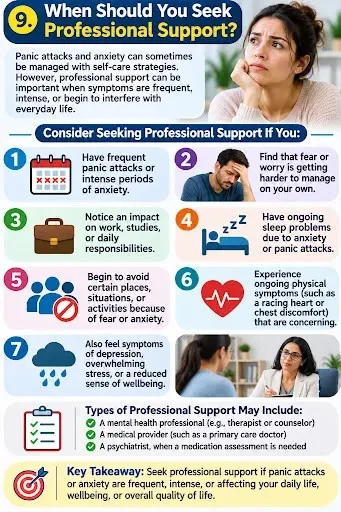
This infographic highlights situations when professional support may be helpful, including frequent panic attacks, difficult-to-manage anxiety, sleep problems, concerns affecting work or daily responsibilities, avoidance of activities, and ongoing physical symptoms. It also introduces different sources of support, including mental health professionals, primary care providers, and psychiatrists.
Professional support may be helpful when panic attacks or anxiety become frequent, difficult to manage, or disruptive to everyday life. Persistent worry, fear of future panic attacks, avoidance of activities, sleep difficulties, and problems with work or relationships are important reasons to seek an assessment from a qualified healthcare or mental health professional.
Experiencing occasional anxiety or a panic attack does not automatically mean someone has a mental health disorder. However, when these experiences become recurring, overwhelming, or begin interfering with everyday activities, seeking professional guidance can be an important step.
Some people delay seeking support because they believe their symptoms will eventually disappear or that they should be able to manage everything independently. Others may feel embarrassed about discussing their experiences.
There is no need to wait until anxiety becomes unbearable before asking for help. Understanding the symptoms and discussing them with a qualified professional can help identify possible causes and appropriate support.
1. When Panic Attacks Become Repeated
An isolated panic attack does not necessarily indicate panic disorder. However, repeated episodes deserve attention, particularly when they occur unexpectedly or create ongoing concern.
Consider seeking professional guidance if:
- Panic attacks occur repeatedly.
- You frequently worry about experiencing another episode.
- You become increasingly concerned about ordinary physical sensations.
- You feel uncertain about why the episodes are happening.
- Panic-related concerns begin influencing your everyday decisions.
A healthcare professional can assess the pattern, frequency, and circumstances surrounding these experiences.
2. When Anxiety Becomes Difficult to Control
Occasional worry is a normal part of life. However, persistent anxiety may require attention when it becomes difficult to manage.
Some signs include:
- Worrying excessively about several everyday situations.
- Finding it difficult to relax even when there is no immediate problem.
- Experiencing persistent nervousness or apprehension.
- Struggling to concentrate because of repeated worries.
- Feeling overwhelmed by ordinary responsibilities.
- Having difficulty managing uncertainty.
When these experiences continue or become disruptive, professional assessment may help clarify what is happening.
3. When Anxiety Interferes With Everyday Activities
One important reason to seek support is when anxiety begins affecting important areas of daily functioning.
Work or education:
- Difficulty concentrating on responsibilities.
- Avoiding meetings, presentations, or examinations.
- Struggling to complete ordinary tasks.
- Frequently worrying about making mistakes.
Relationships:
- Avoiding conversations or social activities.
- Repeatedly seeking reassurance.
- Experiencing communication difficulties.
- Withdrawing from family members or friends.
Everyday activities:
- Avoiding travel or unfamiliar places.
- Finding it difficult to attend appointments.
- Experiencing persistent worry about ordinary situations.
- Losing interest in activities that were previously enjoyable.
These difficulties can vary between individuals. However, when anxiety consistently limits participation in everyday life, professional support may be beneficial.
4. When Fear of Another Panic Attack Changes Your Behaviour
After experiencing a frightening panic attack, some people become increasingly concerned about having another one.
This may lead to changes such as:
- Avoiding places associated with previous episodes.
- Feeling uncomfortable travelling alone.
- Avoiding crowded environments.
- Depending heavily on reassurance from others.
- Restricting everyday activities because of fear.
In panic disorder, persistent concern about additional panic attacks and significant behavioural changes are important clinical features.
A qualified professional can assess these patterns and help determine whether they are associated with panic disorder or another concern.
5. When Physical Symptoms Need Medical Evaluation
Panic attacks can produce physical sensations that resemble symptoms of medical conditions.
These may include:
- Chest discomfort or pain.
- Racing or irregular heartbeat.
- Difficulty breathing.
- Dizziness or faintness.
- Nausea or stomach discomfort.
- Unexplained physical weakness.
It is important not to assume that every physical symptom is caused by anxiety.
New, severe, or unexplained symptoms should receive appropriate medical evaluation. Contact emergency services when symptoms suggest a possible medical emergency.
A healthcare professional can consider physical health conditions and other possible explanations before attributing symptoms to panic or anxiety.
6. Which Professional Can Help With Panic Attacks and Anxiety?
Different healthcare and mental health professionals can help assess anxiety-related concerns.
Primary Care Physician:
A primary care physician can review symptoms, consider possible physical health explanations, and recommend further assessment or referral when appropriate.
Psychologist:
A licensed psychologist can conduct psychological assessments and provide evidence-based psychotherapy for anxiety-related difficulties.
Psychiatrist:
A psychiatrist is a medical doctor who specialises in mental health assessment and treatment. They can evaluate mental health conditions and discuss appropriate treatment options, including medication when clinically indicated.
Licensed Clinical Social Worker:
A licensed clinical social worker may provide mental health assessment, counselling, psychotherapy, and support with accessing appropriate services, depending on their qualifications and scope of practice.
Choosing a qualified professional with experience in anxiety and panic-related concerns can help people receive appropriate guidance.
7. What Happens During a Professional Assessment?
Seeking professional support does not automatically mean receiving a mental health diagnosis.
During an assessment, a professional may ask questions about:
- When the symptoms first appeared.
- How frequently panic attacks or intense anxiety occur.
- How long the symptoms usually last.
- Whether particular situations appear to trigger them.
- How the experiences affect sleep, work, relationships, and everyday activities.
- Whether there are relevant physical health concerns.
- Whether other emotional or psychological difficulties are present.
Depending on the circumstances, a healthcare professional may recommend a physical examination or additional evaluation to consider other possible explanations.
The purpose is to understand the person’s experiences and identify appropriate next steps.
8. What Treatment and Support May Be Available?
Treatment depends on the individual’s symptoms, circumstances, preferences, and professional assessment.
Possible approaches include:
Cognitive Behavioural Therapy (CBT):
CBT is an evidence-based form of psychotherapy commonly used for panic disorder and several anxiety conditions. It helps people understand the relationship between thoughts, feelings, physical sensations, and behaviours.
Other Psychological Therapies:
A mental health professional may discuss other appropriate psychological approaches depending on the person’s needs and circumstances.
Medication:
A qualified medical professional may discuss medication when clinically appropriate. Decisions should consider individual health needs, potential benefits, and possible risks.
Ongoing Support:
Regular professional follow-up can help evaluate symptoms, discuss difficulties, and review whether the support being provided remains appropriate.
Not every person requires the same approach. Treatment decisions should be individualised rather than based on another person’s experience.
9. How Can Family and Friends Provide Support?
Understanding and encouragement from trusted people can make it easier to seek help.
Family members and friends can offer support by:
- Listening without judging or dismissing concerns.
- Taking anxiety-related experiences seriously.
- Encouraging appropriate professional guidance.
- Avoiding statements that make someone feel ashamed of their symptoms.
- Offering practical assistance when requested.
- Respecting individual needs and boundaries.
Supportive relationships can complement professional care, although they are not a replacement for appropriate assessment and treatment.
Remember: Seeking professional support for panic attacks or anxiety is a reasonable step toward understanding your mental health. You do not need to wait until symptoms significantly disrupt your life. Early conversations with qualified healthcare professionals can help identify concerns and explore appropriate support options.
10. How Are Panic Attacks and Panic Disorder Evaluated?
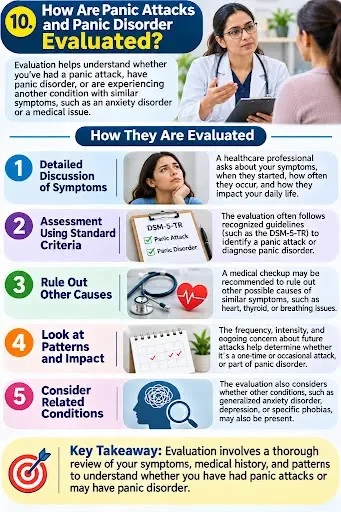
This infographic explains how healthcare professionals evaluate panic attacks and panic disorder through discussions about symptoms, assessment using recognized diagnostic criteria, medical evaluation to consider other possible causes, examination of symptom patterns, and consideration of related mental health conditions.
Panic attacks and panic disorder are evaluated through a professional assessment of symptoms, medical history, frequency of episodes, possible triggers, and their impact on everyday life. Healthcare professionals may also consider physical health conditions, medications, and other mental health concerns to understand the symptoms and determine whether the diagnostic criteria for panic disorder are met.
Experiencing a panic attack can be frightening, particularly when physical sensations such as a racing heartbeat, chest discomfort, dizziness, or breathing difficulties appear suddenly.
However, not every panic attack indicates panic disorder, and similar physical symptoms can occur for other medical or psychological reasons.
A professional evaluation helps distinguish an isolated panic attack from recurring panic-related difficulties and other possible health conditions. It also helps determine whether further assessment or treatment may be appropriate.
1. Understanding the Symptoms and Their History
A healthcare or mental health professional will usually begin by asking about the person’s experiences.
The discussion may include:
- When the symptoms first appeared.
- How frequently panic-like episodes occur.
- Whether symptoms develop suddenly or gradually.
- How long the most intense symptoms usually last.
- Whether episodes happen unexpectedly or in particular situations.
- Which physical and emotional symptoms occur.
- Whether there is ongoing worry about experiencing another episode.
These details help professionals understand the pattern of symptoms rather than relying on one isolated experience.
2. Reviewing Medical History and Physical Health
Physical symptoms associated with panic attacks can overlap with symptoms of several medical conditions.
For this reason, a healthcare professional may review:
- Existing medical conditions.
- Previous episodes of unexplained physical symptoms.
- Current medications and supplements.
- Caffeine and other substance use.
- Sleep patterns and general health.
- Relevant family medical history.
Depending on the symptoms and medical history, additional examinations or investigations may be recommended.
For example, a clinician may consider whether heart-related conditions, thyroid problems, breathing disorders, or medication effects could contribute to the symptoms.
Not everyone needs the same medical investigations. The decision depends on individual circumstances and clinical judgment.
3. Understanding the Frequency and Pattern of Panic Attacks
One important part of an evaluation is understanding whether panic attacks are isolated, recurrent, expected, or unexpected.
A professional may explore:
Unexpected panic attacks:
These occur without an obvious immediate trigger or situation that the person can identify.
Expected panic attacks:
These occur in connection with a particular situation, fear, or perceived threat.
Recurrent panic attacks:
These involve repeated episodes over time.
Understanding these patterns helps clinicians determine whether the experiences may be associated with panic disorder or another condition.
4. How Is Panic Disorder Diagnosed?
Panic disorder is diagnosed using established clinical criteria rather than the presence of one or two symptoms alone.
Under the DSM-5-TR (Diagnostic and Statistical Manual of Mental Disorders, Fifth Edition, Text Revision) diagnostic criteria, panic disorder involves:
- Recurrent unexpected panic attacks.
- At least one attack followed by at least one month of persistent concern about additional attacks or their consequences, or a significant change in behaviour related to the attacks.
- Symptoms that are not better explained by the effects of a substance, medication, another medical condition, or another mental disorder.
A qualified mental health professional considers the complete clinical picture before making a diagnosis.
Importantly, experiencing panic attacks does not automatically mean that someone meets the criteria for panic disorder.
5. Are Psychological Assessments Used?
Yes. Depending on the situation, a professional may use structured questions or standardised assessment tools to understand the severity and impact of anxiety and panic symptoms.
These assessments may explore:
- Frequency of panic attacks.
- Intensity of anxiety symptoms.
- Fear of future episodes.
- Avoidance of particular situations.
- Effects on work, relationships, and social activities.
- Sleep and everyday functioning.
Assessment questionnaires can provide useful information, but they do not independently establish a diagnosis.
A professional interprets the results alongside the person’s history and other clinical findings.
6. How Are Panic Attacks Distinguished From Other Anxiety Conditions?
Panic attacks can occur in connection with different mental health conditions. Therefore, a professional may consider whether symptoms are associated with:
Recurrent unexpected panic attacks accompanied by ongoing concern or behavioural changes.
Generalized Anxiety Disorder (GAD):
Persistent and excessive worry about different areas of everyday life.
Significant fear or anxiety about social situations in which a person may feel judged, embarrassed, or negatively evaluated.
Post-Traumatic Stress Disorder (PTSD):
A condition that may develop after exposure to traumatic events and can involve intrusive memories, avoidance, changes in mood, and heightened alertness.
Intense fear or anxiety associated with particular objects or situations.
These conditions have different diagnostic criteria, although some symptoms may overlap. A professional assessment helps clarify the possible explanation.
7. Why Is an Accurate Evaluation Important?
An accurate evaluation helps avoid assumptions based on symptoms alone.
For example, someone experiencing a racing heartbeat and shortness of breath may believe they are having a panic attack. However, similar sensations can have physical health explanations that require medical attention.
Professional assessment can help:
- Identify possible medical explanations.
- Understand whether panic attacks are recurring.
- Determine whether panic disorder or another condition may be present.
- Evaluate how symptoms affect daily functioning.
- Identify suitable treatment and support options.
- Monitor changes in symptoms over time.
8. What Should You Prepare Before an Appointment?
If you are planning to discuss panic attacks or anxiety with a healthcare professional, preparing a few details may make the conversation easier.
Consider noting:
- When you first noticed the symptoms.
- How often the episodes occur.
- What you experience physically and emotionally.
- Whether particular situations appear to be associated with the episodes.
- Any medications or supplements you currently use.
- How symptoms affect sleep, work, relationships, or daily activities.
- Any questions or concerns you would like to discuss.
You do not need to have all the answers before attending an appointment. The purpose of the consultation is to help you understand your experiences and discuss appropriate next steps.
Remember: Panic attacks and panic disorder cannot be accurately distinguished through online symptom lists alone. A qualified healthcare or mental health professional can assess symptoms, consider other possible explanations, and determine whether established diagnostic criteria are met.
11. Practical Ways to Manage Anxiety and Reduce Panic-Related Distress
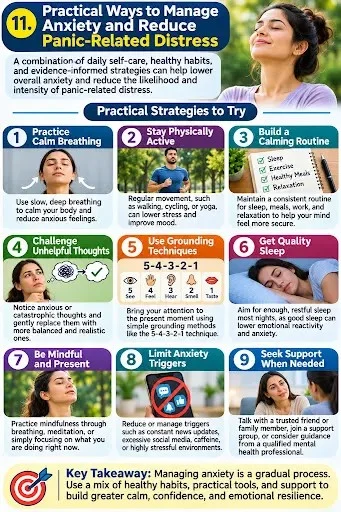
This infographic presents nine practical strategies for managing anxiety and reducing panic-related distress. These include calm breathing, regular physical activity, building a healthy daily routine, challenging unhelpful thoughts, grounding techniques, quality sleep, mindfulness, limiting anxiety triggers, and seeking support when needed. It highlights how consistent self-care, healthy habits, and appropriate support can contribute to emotional wellbeing and resilience.
Practical ways to manage anxiety and reduce panic-related distress include recognising anxiety triggers, practising gentle breathing and grounding techniques, maintaining healthy sleep habits, engaging in regular physical activity, and seeking appropriate professional support. Evidence-based approaches such as cognitive behavioural therapy (CBT) can also help people understand anxious thoughts, respond differently to fear, and manage recurring panic symptoms.
Anxiety and panic-related distress can affect different aspects of everyday life, including emotional wellbeing, physical comfort, sleep, relationships, and work. Although occasional anxiety is a normal human experience, persistent or overwhelming symptoms may require additional support.
There is no single strategy that works for everyone. However, developing practical coping skills, understanding personal anxiety patterns, and accessing appropriate professional care may help people manage their experiences more effectively.
The following approaches can support emotional wellbeing and complement professional treatment when needed.
1. Recognise and Understand Your Anxiety Triggers
Understanding situations that contribute to anxiety can be a useful starting point.
For some people, anxiety may increase around workplace responsibilities, financial uncertainty, health concerns, relationship difficulties, or major life changes.
Consider noticing:
- Situations in which anxiety tends to increase.
- Thoughts that repeatedly create worry.
- Physical sensations that accompany emotional distress.
- Activities or situations you have started avoiding.
- Circumstances in which you feel more comfortable and settled.
Keeping a simple journal of these experiences may help identify recurring patterns.
However, not every panic attack has an identifiable trigger. Avoid blaming yourself when the reason for an episode is unclear.
2. Practise Gentle Breathing Techniques
Breathing may become faster or feel uncomfortable during periods of anxiety.
Some people find gentle, controlled breathing helpful for managing physical tension and emotional distress.
You can try:
- Finding a comfortable sitting position.
- Relaxing your shoulders and jaw.
- Breathing gently without forcing deep breaths.
- Allowing your breathing to settle into a comfortable rhythm.
- Shifting your attention elsewhere if focusing on breathing feels uncomfortable.
Regularly practising a comfortable breathing exercise may help some people become more familiar with responding to anxious feelings.
No breathing technique works for everyone, and it should not replace medical evaluation when physical symptoms are concerning.
3. Use Grounding Techniques to Stay Connected With the Present
Grounding techniques can help redirect attention from overwhelming thoughts toward the immediate surroundings.
One commonly used approach is the 5-4-3-2-1 exercise.
Notice:
- Five things you can see: Identify objects, colours, or details around you.
- Four things you can feel: Notice your feet on the floor or your hands resting comfortably.
- Three things you can hear: Pay attention to sounds nearby.
- Two things you can smell: Notice familiar or neutral scents.
- One thing you can taste: Notice a taste in your mouth or take a comfortable sip of water.
You do not need to complete every step perfectly. The purpose is simply to bring your attention back to the present moment.
4. Maintain Consistent Sleep Habits
Sleep and anxiety can influence each other.
Persistent worry may make it difficult to fall asleep or remain asleep. Poor sleep may also make everyday stress and emotional regulation more challenging.
Some practical habits that may support better sleep include:
- Maintaining a reasonably consistent sleep schedule.
- Creating a comfortable and quiet sleeping environment.
- Allowing time to relax before bedtime.
- Reducing stimulating activities close to bedtime.
- Avoiding unnecessary late-night screen use.
- Discussing persistent sleep difficulties with a healthcare professional.
Healthy sleep habits can support emotional wellbeing, although they are not a standalone treatment for anxiety disorders.
5. Include Regular Physical Activity
Physical activity can support both physical and mental wellbeing.
Activities such as walking, cycling, swimming, stretching, or yoga may help some people manage everyday stress and improve their mood.
Consider choosing activities that are comfortable, enjoyable, and appropriate for your circumstances.
You do not need an intensive exercise routine to benefit from movement. Even ordinary activities such as walking outdoors or taking short movement breaks can provide opportunities to relax and change your focus.
If physical symptoms make activity uncomfortable, discuss suitable options with a healthcare professional.
6. Reduce Excessive Caffeine Where Appropriate
Caffeine can increase alertness, but it may also contribute to restlessness, sleep difficulties, or sensations such as a faster heartbeat in some people.
These sensations can sometimes make existing anxiety feel more noticeable.
Consider discussing caffeine intake with a healthcare professional if you notice a connection between caffeine and anxious symptoms.
Avoid using stimulants or other substances as a way to manage tiredness or emotional distress.
7. Challenge Unhelpful Thinking Patterns
Anxiety can sometimes involve repeatedly imagining negative outcomes or interpreting uncertain situations as threatening.
Cognitive behavioural therapy (CBT) helps people recognise and examine these patterns.
For example:
Anxious thought: “If I make one mistake during the presentation, everyone will think I am incapable.”
A more balanced perspective: “Making a mistake during a presentation does not define my abilities. I can prepare and respond to difficulties if they arise.”
Other helpful questions include:
- What evidence supports this concern?
- Am I assuming the worst possible outcome?
- Are there other explanations for this situation?
- What would I say to someone facing the same concern?
- Is there one practical step I can take?
These questions are examples of reflective thinking, not a replacement for structured CBT with a qualified professional.
8. Gradually Re-engage With Activities You Have Been Avoiding
Avoiding situations that create anxiety may provide temporary relief. However, repeated avoidance can sometimes make certain fears more difficult to manage.
With appropriate guidance, gradually returning to avoided activities may help people build confidence.
For example, someone who has become uncomfortable with social situations may begin by participating in a familiar, manageable activity before considering more challenging situations.
This process should be approached gradually and without unnecessary pressure.
For people with panic disorder, a trained professional may use exposure-based techniques as part of CBT.
9. Build Supportive Relationships
Talking with someone you trust can make it easier to express concerns and feel understood.
Supportive relationships may help people:
- Share worries without feeling judged.
- Discuss difficult experiences.
- Ask for practical assistance.
- Feel less isolated during stressful periods.
- Explore options for professional support.
Family members and friends do not need to solve every problem. Listening respectfully and offering appropriate encouragement can itself be valuable.
10. Consider Evidence-Based Professional Treatment
When anxiety or panic attacks become persistent or interfere with everyday functioning, professional treatment may be beneficial.
Several evidence-based approaches are available.
Cognitive Behavioural Therapy (CBT):
CBT is a well-studied psychological treatment for panic disorder and several anxiety conditions. It helps people understand how thoughts, emotions, physical sensations, and behaviours interact.
Exposure-Based Therapy:
Exposure-based approaches may be incorporated into CBT to help people gradually address situations or sensations associated with fear and avoidance. These techniques should be appropriately planned and guided by a trained professional.
Other Psychological Therapies:
Depending on the person’s needs and clinical assessment, other forms of psychotherapy may also be considered.
Medication:
A qualified medical professional may discuss medication when appropriate. Treatment decisions should consider individual circumstances, possible benefits, and potential risks.
The most suitable approach depends on the person’s symptoms, preferences, medical history, and professional assessment.
11. Set Realistic Expectations About Managing Anxiety
Managing anxiety is not about eliminating every uncomfortable feeling.
Anxiety is a normal human response, and occasional worry does not necessarily indicate a mental health problem.
Instead, practical goals may include:
- Understanding what contributes to anxiety.
- Recognising unhelpful thinking patterns.
- Developing healthier responses to stress.
- Maintaining meaningful everyday activities.
- Seeking support when symptoms become difficult to manage.
- Learning to respond to uncertainty without unnecessary self-criticism.
Progress may vary, and different approaches may be helpful at different times.
Remember: Practical coping strategies can support emotional wellbeing, but they are not substitutes for professional treatment when anxiety or panic becomes persistent or disruptive. Understanding your experiences, developing appropriate coping skills, and seeking qualified support when needed can help you take informed steps toward better mental health.
12. Frequently Asked Questions
CONCLUSION
Understanding the difference between panic attacks and anxiety attacks can help people make sense of experiences that may otherwise feel confusing or frightening. Although the two expressions are often used interchangeably, they do not have the same clinical meaning.
A panic attack is a recognised clinical term describing a sudden episode of intense fear or discomfort that reaches its peak within minutes. An anxiety attack, on the other hand, is an informal expression commonly used to describe overwhelming anxiety. It is not a separate formal clinical diagnosis.
Both experiences can involve physical sensations, emotional distress, and difficulties with everyday activities. However, having a panic attack does not automatically mean someone has panic disorder, and experiencing anxiety does not necessarily indicate an anxiety disorder.
Recognising recurring symptoms, understanding possible triggers, developing practical coping strategies, and seeking appropriate professional guidance can help people make informed decisions about their mental health.
If panic attacks or persistent anxiety begin affecting your sleep, relationships, work, or everyday activities, consider speaking with a qualified healthcare or mental health professional. Appropriate assessment can help clarify what may be happening and identify suitable support.
Remember: Experiencing anxiety or panic does not make someone weak, and seeking help is a reasonable step toward better wellbeing. With appropriate understanding and support, people can learn to respond to these experiences in healthier and more informed ways.
Explore More On MentalHealthNest Anxiety Series
Anxiety can affect people in different ways, from persistent worry and sleep difficulties to physical symptoms, workplace pressures, and challenges in relationships. Our 13-article Anxiety Series explores these experiences through accessible, evidence-informed mental health education.
Whether you are learning about anxiety for the first time or exploring a particular concern, these articles can help you understand the topic in greater depth.
- Anxiety Disorders: Understanding Symptoms, Types, and Treatment
Learn about different anxiety disorders, their common symptoms, their effects on everyday life, and available assessment and treatment options. - Overthinking and Anxiety: Why Your Mind Won’t Slow Down
Explore repetitive worrying, anxious thought patterns, and practical approaches that may help. - Anxiety vs. Stress: What’s the Difference and How Can You Tell?
Understand how anxiety and stress differ, where they overlap, and when either may begin affecting everyday life. - Anxiety vs. Depression: Understanding the Differences and Overlap
Explore how anxiety and depression may differ, where symptoms can overlap, and why recognising these differences matters. - Anxiety and Sleep: Why Anxiety Can Keep You Awake
Discover how anxiety may interfere with sleep and how sleep difficulties and anxious thoughts can reinforce each other. - Anxiety and Physical Symptoms: How Anxiety Can Affect the Body
Understand how anxiety may be associated with physical experiences, including muscle tension, a racing heart, and digestive discomfort. - Panic Attacks vs. Anxiety Attacks: What Is the Difference?
Learn about panic attacks, how they differ from general experiences of anxiety, and why “anxiety attack” is not a formal clinical diagnosis. - Health Anxiety: When Worry About Your Health Becomes Overwhelming
Understand how persistent fears about illness can affect daily life and why appropriate medical guidance and mental health support may help. - Social Anxiety in Adults: Symptoms, Causes, and What May Help
Explore how fear of judgment or embarrassment may affect social situations, relationships, work, and everyday activities. - Anxiety at Work: How Workplace Stress Can Affect Mental Health
Learn how workplace pressures and anxiety may interact and explore practical sources of support. - Anxiety and Relationships: Why Anxiety Can Affect Connection and Communication
Discover how anxiety may influence communication, trust, reassurance, and emotional connection. - How to Calm an Anxious Mind: Practical Strategies for Managing Anxiety
Explore practical approaches to responding to anxious thoughts and feelings, managing everyday worries, and recognising when additional support may be appropriate. - When Does Anxiety Become a Problem?
Understand when anxiety may be more than an occasional response to stress, particularly when it becomes persistent, difficult to manage, or disruptive to everyday activities.
Continue exploring MentalHealthNest to develop a clearer understanding of anxiety, its different experiences, and the support options that may be available.
A Note to Our Returning Readers
Thank you for continuing to explore MentalHealthNest and making mental-health awareness part of your learning journey.
We are continually developing our mental-health education library to cover different experiences, challenges, and aspects of emotional wellbeing.
Whether you are returning to understand anxiety more deeply, supporting someone you care about, or exploring information for your own awareness, we hope our articles provide useful knowledge and practical perspectives.
We encourage you to explore related articles, revisit topics whenever you need clarification, and remember that educational information is not a substitute for individual medical advice or professional mental-health care.
MentalHealthNest is here to support informed understanding, greater awareness, and responsible conversations about mental health.
TRUSTED MENTAL HEALTH RESOURCE
For additional information about panic attacks, anxiety disorders, symptoms, assessment, and treatment, readers can explore the following established health organisations.
1. National Institute of Mental Health (NIMH)
A U.S. government organisation providing research-based information about panic disorder, anxiety conditions, symptoms, and treatment.
Website: https://www.nimh.nih.gov/
2. MedlinePlus – U.S. National Library of Medicine
Provides accessible health information about panic disorder, anxiety, medical conditions, and treatment.
Website: https://medlineplus.gov/
3. American Psychiatric Association (APA)
Provides educational information about mental health conditions, psychiatric care, and evidence-based treatment approaches.
Website: https://www.psychiatry.org/
4. U.S. Department of Health and Human Services (HHS)
A U.S. government department providing information and resources on mental health, substance use disorders, prevention, and access to health services.
https://www.hhs.gov/programs/prevention-and-wellness/mental-health-substance-use-disorder/index.html
5. National Health Service (NHS), United Kingdom
Provides practical health information about anxiety, panic attacks, symptoms, and available treatment approaches.
Website: https://www.nhs.uk/
These resources are provided to help readers access further health information. They do not replace individual medical assessment or professional guidance.
REFERENCES
- National Institute of Mental Health (NIMH). Panic Disorder: What You Need to Know. U.S. Department of Health and Human Services.
https://www.nimh.nih.gov/health/publications/panic-disorder-when-fear-overwhelms - National Institute of Mental Health (NIMH). Generalized Anxiety Disorder: What You Need to Know. U.S. Department of Health and Human Services.
https://www.nimh.nih.gov/health/publications/generalized-anxiety-disorder-gad - MedlinePlus. Panic Disorder. U.S. National Library of Medicine.
https://medlineplus.gov/panicdisorder.html - National Health Service (NHS). Panic Disorder.
https://www.nhs.uk/mental-health/conditions/panic-disorder/ - National Health Service (NHS). Get Help with Anxiety, Fear or Panic.
https://www.nhs.uk/mental-health/feelings-symptoms-behaviours/feelings-and-symptoms/anxiety-fear-panic/ - American Psychiatric Association. Diagnostic and Statistical Manual of Mental Disorders, Fifth Edition, Text Revision (DSM-5-TR). American Psychiatric Association Publishing, 2022.
https://www.psychiatry.org/psychiatrists/practice/dsm - World Health Organization (WHO). Anxiety Disorders.
https://www.who.int/news-room/fact-sheets/detail/anxiety-disorders - American Psychological Association (APA). Understanding Psychotherapy and Mental Health Treatment Resources.
https://www.apa.org/topics/psychotherapy
These references provide additional information about panic attacks, panic disorder, anxiety symptoms, clinical assessment, and evidence-based treatment. Readers should consult qualified healthcare professionals for individual medical guidance.
MEDICAL DISCLAIMER
The information provided in this article is intended for general educational and mental-health awareness purposes only. It is not a substitute for professional medical advice, diagnosis, or treatment.
MentalHealthNest does not provide medical diagnoses, prescribe medication, or replace the care of qualified healthcare professionals.
Panic attacks, anxiety symptoms, and other physical or emotional experiences can have different causes. Readers should not attempt to diagnose themselves based solely on information presented in this article.
If you experience recurring panic attacks, persistent anxiety, or symptoms that interfere with everyday activities, consider consulting a qualified healthcare or mental health professional.
New, severe, or unexplained physical symptoms should receive appropriate medical evaluation. If you believe you are experiencing a medical emergency, contact your local emergency services.
Always seek guidance from a qualified healthcare professional before making decisions about your health, treatment, or medication.
About MentalHealthNest: Editorial Policy and Content Standards
MentalHealthNest is committed to providing responsible, accessible, and evidence-informed mental-health education. Our goal is to help readers understand mental health, emotional wellbeing, and common psychological challenges through clear, practical, and trustworthy information.
Our editorial approach is guided by the following principles:
1. Evidence-Informed Information
We aim to develop articles using reliable health information, established medical organisations, scientific research, and recognised mental-health resources.
2. Accuracy and Transparency
We strive to present information accurately, distinguish established clinical knowledge from general guidance, and avoid unsupported medical claims or misleading statements.
3. Compassionate and Respectful Communication
We believe mental-health education should encourage understanding, dignity, and respect. Our content avoids stigma, shame, fear-based messaging, and judgement.
4. Reader Education and Awareness
Our articles are designed to improve mental-health awareness, explain common experiences, and help readers make informed decisions about seeking appropriate support.
5. Responsible Health Information
MentalHealthNest does not replace qualified healthcare professionals. We encourage readers to seek appropriate professional guidance for personal medical or mental-health concerns.
6. Content Review and Updates
We aim to review and update our published information when relevant guidance, research, or authoritative health recommendations change.
Our Commitment
MentalHealthNest is dedicated to making mental-health knowledge more accessible through responsible education, transparency, and a reader-first approach.
We believe that better understanding can encourage informed conversations, reduce stigma, and support a more compassionate approach to mental health and wellbeing.
• Mental Health Directory
• Psychologist Registration
• Psychiatrist Registration
Every article is designed to help you make informed decisions, strengthen your mental wellbeing, and connect with trusted professional support when needed.
ABOUT THE AUTHOR
Sujit Shetty – Founder of MentalHealthNest | Mental Health Advocate and Blogger
Sujit Shetty is the founder of MentalHealthNest, an independent mental-health education platform dedicated to improving awareness and understanding of mental health and emotional wellbeing.
Through MentalHealthNest, he focuses on making mental-health information accessible, understandable, and practical for readers. His work covers anxiety, stress, emotional resilience, mental health conditions, self-awareness, and everyday wellbeing.
As a mental health advocate and blogger, Sujit believes that reliable information, compassionate communication, and greater public awareness can help reduce stigma and encourage people to seek appropriate professional support when needed.
Author Transparency: Sujit Shetty is a mental health advocate and blogger, not a licensed mental-health or medical professional. MentalHealthNest provides educational information and does not offer clinical diagnosis or treatment.
To learn more, visit the MentalHealthNest About page and explore our Editorial Policy and Content Standards.
Respect for therapists, psychologists, psychiatrists, and other healthcare professionals
MentalHealthNest.com aims to become one of the web’s most trusted educational resources for mental health while connecting readers with qualified mental health professionals through its growing therapist directory.