Introduction
Work is an important part of many people’s lives. It can provide financial stability, a sense of purpose, opportunities for personal growth and meaningful connections with others. Yet, for some people, the workplace can also become a source of persistent worry and emotional pressure.
A demanding workload, uncertainty about job security, difficult conversations with supervisors, tight deadlines or the feeling of constantly needing to prove oneself can gradually make working life emotionally exhausting. Over time, these pressures may contribute to workplace stress and burnout, particularly when employees have limited opportunities to recover from ongoing work demands.
Sometimes, the pressure does not end when the working day is over. Thoughts about unfinished assignments, upcoming meetings or possible mistakes may continue long after someone has left the office or closed their laptop.
This experience can be difficult to explain, particularly when someone is trying to meet professional responsibilities while managing growing emotional demands.
Workplace stress and anxiety are related, but they are not identical. Stress may develop in response to challenging working conditions, while anxiety can involve ongoing worry or apprehension that sometimes continues beyond the immediate situation.
It is also important to recognise that workplace anxiety is not always the result of an individual’s ability to handle pressure. The way an organisation distributes responsibilities, communicates expectations, supports employees and responds to concerns can influence workplace wellbeing.
Understanding this relationship is an important first step towards recognising what may be happening and identifying appropriate sources of support.
QUICK ANSWER: WHAT IS ANXIETY AT WORK?
Anxiety at work refers to feelings of worry, apprehension or uneasiness connected with professional responsibilities, workplace situations or employment-related uncertainty. It may arise alongside work-related stress and can affect concentration, confidence, communication and overall wellbeing. Its causes and intensity vary, and persistent or disruptive anxiety may warrant professional support.
KEY TAKEAWAYS
- Workplace pressures can contribute to emotional distress and anxiety.
- Excessive workloads, unclear expectations, job insecurity and limited workplace support may affect employee wellbeing.
- Work-related stress and anxiety are connected but are not interchangeable.
- Workplace anxiety may influence concentration, decision-making, communication and professional confidence.
- Employees should not be expected to manage every workplace problem through individual coping strategies alone.
- Supportive managers, reasonable workloads, clear communication and healthier organisational practices matter.
- Professional support may be helpful when anxiety becomes persistent or interferes with everyday functioning.
1. Understanding Anxiety at Work: What Does It Mean?
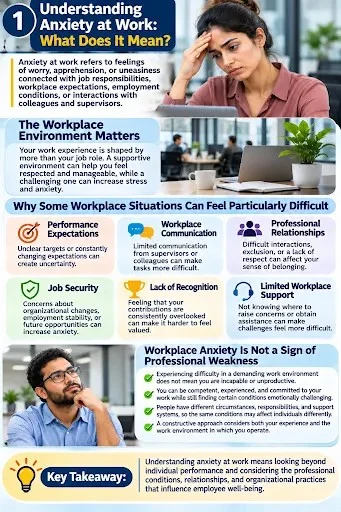
This infographic explains workplace anxiety through realistic office scenes and six contributing workplace factors: performance expectations, communication, professional relationships, job security, recognition, and limited workplace support. It highlights the importance of a supportive work environment and explains why experiencing workplace anxiety does not indicate professional weakness. The closing takeaway emphasizes the role of organizational conditions, workplace relationships, and employee well-being.
Anxiety at work refers to feelings of worry, apprehension or uneasiness connected with professional responsibilities, workplace expectations, employment conditions or interactions with colleagues and supervisors. It may be influenced by how work is organised, how employees are treated and whether people feel supported, respected and able to manage their responsibilities.
For some employees, the difficulty may involve uncertainty about performance expectations. Others may feel uncomfortable speaking up during meetings, raising concerns with management or asking for help when responsibilities become difficult to manage.
These experiences can be particularly challenging when employees feel that they must maintain a professional appearance while privately dealing with ongoing workplace pressures.
THE WORKPLACE ENVIRONMENT MATTERS
A person’s experience at work is influenced by more than their job title or daily responsibilities. The broader working environment can also shape how comfortable, respected and supported they feel.
Consider two employees with similar responsibilities. One works in an organisation where expectations are clearly communicated, managers listen to concerns and contributions are acknowledged. The other works in an environment where priorities change frequently, feedback is unclear and employees feel uncomfortable raising problems.
Although their professional responsibilities may be similar, their experiences of the workplace can be very different.
The World Health Organization recognises that workplace conditions, including excessive workloads, limited control over work, inadequate support and negative organisational practices, can create psychosocial risks for employees.
This highlights an important point: workplace wellbeing is not solely an individual responsibility. Employers and organisations also influence the conditions in which people carry out their work.
WHY SOME WORKPLACE SITUATIONS CAN FEEL PARTICULARLY DIFFICULT
Certain professional situations may create additional emotional pressure, particularly when employees feel uncertain about how others will respond.
Examples include:
1. Performance expectations: Unclear targets or constantly changing expectations may leave employees uncertain about what is required of them.
2. Workplace communication: Limited communication from supervisors or colleagues may make everyday responsibilities more difficult to navigate.
3. Professional relationships: Difficult interactions, exclusion or a lack of respect may affect an employee’s sense of belonging.
4. Job security: Concerns about organisational changes, employment stability or future opportunities may create additional uncertainty.
5. Lack of recognition: Employees who feel that their contributions are consistently overlooked may find it harder to feel valued in their roles.
6. Limited workplace support: Not knowing where to raise concerns or obtain assistance can make challenging situations feel more difficult.
These examples are not a checklist for identifying an anxiety disorder. They illustrate workplace circumstances that may influence an employee’s emotional wellbeing.
WORKPLACE ANXIETY IS NOT A SIGN OF PROFESSIONAL WEAKNESS
Employees may sometimes hesitate to acknowledge workplace difficulties because they worry about being judged as incapable, unproductive or unable to handle responsibility.
However, experiencing difficulty in a demanding working environment does not automatically indicate a lack of professional ability.
People can be competent, experienced and committed to their work while still finding certain workplace conditions emotionally challenging.
It is equally important to recognise that employees have different circumstances, responsibilities and support systems. The same working conditions may affect individuals differently.
A constructive approach therefore considers both the employee’s experience and the environment in which the work takes place.
An important takeaway: Understanding anxiety at work means looking beyond individual performance and considering the professional conditions, relationships and organisational practices that influence employees’ everyday experiences. A healthier workplace begins with recognising that employee wellbeing deserves attention alongside productivity and business performance.
2. How Workplace Pressures Can Influence Emotional Wellbeing
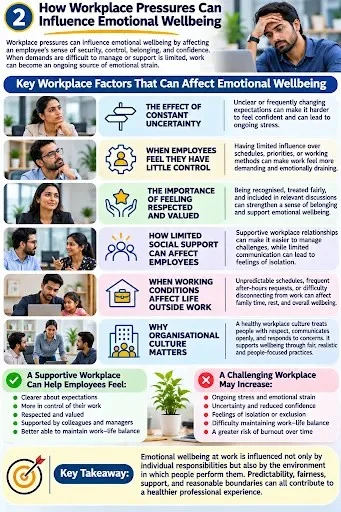
This infographic illustrates six workplace factors that can influence emotional wellbeing: constant uncertainty, limited employee control, lack of respect or recognition, inadequate social support, difficulties maintaining work-life boundaries, and organizational culture. It contrasts supportive workplace conditions with challenging environments and highlights the importance of clear expectations, fairness, respectful relationships, employee participation, and reasonable boundaries. The closing takeaway emphasizes that emotional wellbeing depends on both individual responsibilities and the working environment.
Workplace pressures can influence emotional wellbeing by affecting an employee’s sense of security, control, belonging and confidence. When professional demands remain difficult to manage or employees feel unsupported, the working environment may become an ongoing source of emotional strain. The effects can extend beyond individual tasks and influence how people experience their jobs, relationships and everyday lives.
The relationship between work and mental health is not simply about how many hours someone works or how demanding a particular position may be. It also involves how responsibilities are managed, whether employees feel respected and whether they have sufficient resources and support to perform their roles.
The World Health Organization recognises that workplace conditions and organisational practices can either protect mental health or create psychosocial risks. Understanding how these conditions influence emotional wellbeing helps explain why a supportive working environment matters.
THE EFFECT OF CONSTANT UNCERTAINTY
Employees generally need a reasonable understanding of their responsibilities, priorities and expectations. When these remain unpredictable, it can become difficult to feel confident about everyday professional decisions.
For example, an employee may receive conflicting instructions from different supervisors or find that previously agreed priorities change without explanation. Even when the employee is making a genuine effort, uncertainty about what is expected can make the working environment feel less predictable.
Over time, this may affect confidence in decision-making and make employees increasingly dependent on approval or reassurance before completing routine responsibilities.
Clear communication, consistent expectations and accessible managerial support can help create a more predictable working environment.
WHEN EMPLOYEES FEEL THEY HAVE LITTLE CONTROL
Having some influence over how work is organised can contribute to a greater sense of professional independence.
However, when employees have little say in their schedules, priorities or working methods, they may feel that they have limited ability to influence their everyday working experience.
Consider an employee who is regularly assigned additional responsibilities without being consulted about existing commitments. Even when the employee understands the importance of the work, having little opportunity to discuss priorities can make the situation more difficult.
The National Institute for Occupational Safety and Health (NIOSH) identifies the organisation of work and the relationship between job demands and available resources as important considerations in occupational health.
Providing reasonable decision-making authority, discussing workload priorities and involving employees in decisions that affect their work can contribute to healthier working conditions.
THE IMPORTANCE OF FEELING RESPECTED AND VALUED
People generally want their contributions to be treated fairly and their professional efforts to be recognised.
When employees consistently feel overlooked, excluded from important discussions or treated without respect, their sense of belonging may gradually weaken.
For instance, an employee who regularly contributes to team projects but receives little acknowledgement may begin questioning whether their work is valued. Similarly, being excluded from relevant workplace communication can create a sense of professional isolation.
These experiences do not affect everyone in the same way. However, organisational fairness, respectful communication and opportunities for participation are important elements of a psychologically healthier workplace.
Recognition does not always require financial rewards or formal appreciation. Sometimes, listening to an employee’s concerns, acknowledging their contribution and providing constructive feedback can make a meaningful difference.
HOW LIMITED SOCIAL SUPPORT CAN AFFECT EMPLOYEES
Workplace relationships can provide an important source of practical and emotional support.
A supportive colleague or approachable manager may help an employee clarify responsibilities, discuss a difficult situation or feel more comfortable raising concerns.
In contrast, an environment where people are reluctant to communicate openly may leave employees feeling isolated when they encounter difficulties.
This can be particularly relevant for remote workers, new employees and people working in roles with limited opportunities for regular interaction.
Supportive professional relationships do not require colleagues to become personal counsellors. They involve creating an environment where people can communicate respectfully, exchange information and seek appropriate assistance without unnecessary embarrassment.
WHEN WORKING CONDITIONS AFFECT LIFE OUTSIDE WORK
Professional responsibilities do not always remain confined to working hours.
For some employees, unpredictable schedules, repeated requests after working hours or difficulty disconnecting from professional responsibilities can affect their ability to maintain personal routines and relationships.
An employee who regularly works beyond scheduled hours may have less time for family responsibilities, social connections, rest and activities that are important to everyday wellbeing.
Remote working can introduce additional challenges when the boundaries between professional and personal spaces become less clear.
The WHO identifies conflicting demands between work and home responsibilities as one of the workplace-related factors that can affect mental health.
Respecting working hours, establishing reasonable expectations for availability and allowing employees sufficient time away from work are therefore important organisational considerations.
WHY ORGANISATIONAL CULTURE MATTERS
Workplace culture is reflected in how an organisation treats people, communicates expectations, handles disagreements and responds when employees raise concerns.
An organisation may have formal wellbeing policies, but employees also need to experience those commitments in everyday working practices.
For example, encouraging employees to discuss their concerns has limited value if people feel that speaking openly could negatively affect their professional standing.
Similarly, offering wellbeing programmes may not address the underlying problem if employees continue to face unreasonable workloads, inadequate staffing or persistent workplace conflict.
The WHO’s guidance on mental health at work emphasises the importance of organisational interventions alongside individual-level support.
This means that improving workplace wellbeing requires more than encouraging employees to become better at managing pressure. Organisations must also examine whether their working conditions are reasonable, supportive and respectful.
An important takeaway: Emotional wellbeing at work is influenced not only by individual responsibilities but also by the environment in which people perform them. Predictability, fairness, meaningful participation, supportive relationships and reasonable boundaries can all contribute to a healthier professional experience.
3. What Workplace Factors Can Contribute to Anxiety?
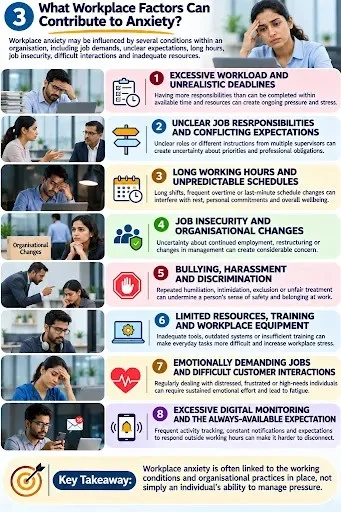
This infographic presents eight workplace factors that may contribute to anxiety: excessive workloads and unrealistic deadlines; unclear responsibilities and conflicting expectations; long working hours and unpredictable schedules; job insecurity and organisational changes; bullying, harassment and discrimination; inadequate resources, training and equipment; emotionally demanding jobs and difficult customer interactions; and excessive digital monitoring and expectations of constant availability. Each factor is illustrated with realistic workplace photography and a brief explanation. The closing takeaway emphasizes that workplace anxiety can be influenced by organisational conditions and practices rather than simply an individual’s ability to manage pressure.
Workplace anxiety may be influenced by several conditions within an organisation, including excessive job demands, unpredictable schedules, employment uncertainty, difficult professional interactions and inadequate resources. These factors do not affect everyone equally, but persistent exposure to challenging working conditions may contribute to emotional difficulties and make the workplace harder to navigate.
The World Health Organization identifies these conditions as psychosocial risks at work. They relate not only to individual job responsibilities but also to how organisations design jobs, manage employees and establish workplace policies.
Understanding these factors can help employees recognise which aspects of their working environment may need attention. It can also help employers identify opportunities to improve working conditions rather than placing the entire responsibility for wellbeing on individual workers.
1. EXCESSIVE WORKLOAD AND UNREALISTIC DEADLINES
One of the important workplace risk factors is having more responsibilities than can reasonably be completed within the available time and resources.
Employees may experience this when they are expected to manage several demanding assignments simultaneously, meet consistently tight deadlines or take on additional responsibilities without adjustments to their existing workload.
For example, an employee responsible for several projects may receive new assignments while continuing to work towards previously established deadlines. If priorities are not adjusted, it may become increasingly difficult to determine which responsibilities require attention first.
Understaffing can make this situation more challenging because the remaining employees may have to absorb additional duties.
The concern is not simply having a busy day. It is the possibility that excessive demands become a regular feature of working life without sufficient staffing, realistic deadlines or opportunities to discuss workload expectations.
2. UNCLEAR JOB RESPONSIBILITIES AND CONFLICTING EXPECTATIONS
Employees need a reasonable understanding of their responsibilities and the outcomes expected from their roles.
When job descriptions are unclear or different supervisors provide conflicting instructions, employees may find themselves uncertain about their priorities and professional obligations.
Consider a situation in which an employee receives one instruction from a department manager and a different instruction from a project supervisor. Both may expect their work to receive immediate attention.
Without clear communication about priorities and responsibilities, the employee may feel caught between competing expectations.
Role ambiguity and role conflict are recognised psychosocial risk factors. They can make professional responsibilities more difficult to manage, particularly when employees have limited opportunities to clarify expectations.
Clear reporting structures, documented responsibilities and consistent communication can help reduce unnecessary uncertainty.
3. LONG WORKING HOURS AND UNPREDICTABLE SCHEDULES
Working hours can influence how employees experience their professional responsibilities.
Long shifts, frequent overtime, rotating schedules and unpredictable changes to working hours may interfere with personal commitments and opportunities for adequate rest.
For example, an employee who regularly receives last-minute schedule changes may find it difficult to organise family responsibilities, transportation or personal appointments.
Shift workers may face additional challenges when their working hours change frequently or provide limited opportunities to maintain consistent daily routines.
These concerns can be particularly relevant in healthcare, hospitality, transportation, manufacturing and other industries that depend on shift-based operations.
Reasonable scheduling practices, adequate staffing and sufficient notice of changes can help employees manage their professional and personal responsibilities more predictably.
4. JOB INSECURITY AND ORGANISATIONAL CHANGES
Uncertainty about continued employment can be an important source of workplace concern.
Employees may feel unsettled when organisations announce restructuring, downsizing, department closures or major changes in management.
For someone supporting a family or managing financial responsibilities, uncertainty about future employment may carry additional significance.
Even when job losses have not been announced, inconsistent communication about organisational changes can leave employees uncertain about what may happen next.
Other concerns may include temporary contracts, limited career opportunities, changes in compensation or uncertainty about future responsibilities.
Employers cannot always eliminate economic or organisational uncertainty. However, transparent communication, fair procedures and appropriate employee support can help prevent avoidable confusion and uncertainty.
5. BULLYING, HARASSMENT AND DISCRIMINATION
Workplace bullying, harassment and discrimination can undermine an employee’s sense of safety, dignity and professional belonging.
These experiences may involve repeated humiliation, intimidation, inappropriate comments, exclusion, unfair treatment or unwanted conduct.
For example, an employee who is regularly subjected to humiliating remarks during team meetings may begin feeling uncomfortable participating in professional discussions.
Similarly, discriminatory treatment based on personal characteristics can create an environment in which employees feel excluded or unfairly judged.
Workplace harassment and bullying should not be dismissed as ordinary disagreements or personality differences.
They are important workplace concerns that require appropriate organisational attention, reporting procedures and safeguards against retaliation.
Employees experiencing these situations should not be made to feel responsible for the behaviour of others.
6. LIMITED RESOURCES, TRAINING AND WORKPLACE EQUIPMENT
Employees need appropriate resources and training to carry out their responsibilities effectively.
When essential equipment is unavailable, software frequently fails, instructions are inadequate or employees are expected to perform unfamiliar duties without sufficient preparation, routine tasks can become unnecessarily difficult.
For example, an employee may be held responsible for meeting productivity targets while working with outdated equipment or systems that regularly interrupt their work.
Similarly, someone promoted into a supervisory position without adequate preparation may find it difficult to manage new responsibilities.
These circumstances illustrate why workplace expectations should be matched with appropriate resources, training and practical support.
7. EMOTIONALLY DEMANDING JOBS AND DIFFICULT CUSTOMER INTERACTIONS
Some occupations require employees to manage emotionally demanding situations as part of their everyday responsibilities.
Healthcare workers, customer-service representatives, educators, emergency personnel and hospitality employees may regularly interact with people who are distressed, frustrated or experiencing difficult circumstances.
For example, a customer-service employee may be expected to remain polite while handling repeated complaints or aggressive interactions.
A healthcare worker may need to communicate compassionately with patients and families during emotionally difficult situations.
These responsibilities can require sustained emotional effort, particularly when employees have limited opportunities to recover between demanding interactions.
Appropriate staffing, supportive supervision, adequate breaks and access to workplace resources are important considerations in these settings.
8. EXCESSIVE DIGITAL MONITORING AND THE ALWAYS-AVAILABLE EXPECTATION
Technology has changed how many organisations communicate, allocate tasks and monitor professional performance.
Although digital tools can improve flexibility and efficiency, certain workplace practices may create additional pressure.
Examples include:
- Frequent monitoring of employee activity without clear justification.
- Constant performance notifications and productivity tracking.
- Expectations to respond to messages outside agreed working hours.
- Repeated online meetings that leave little time for focused work.
- Unclear boundaries between professional availability and personal time.
Remote and hybrid employees may be particularly affected when communication tools create an expectation of continuous availability.
The use of technology is not inherently harmful. Its impact depends partly on how organisations implement it, communicate expectations and respect employees’ working boundaries.
WHY THESE FACTORS SHOULD BE CONSIDERED TOGETHER
Workplace risk factors do not always occur independently.
An employee may experience excessive responsibilities alongside inadequate staffing, unclear expectations and limited managerial support. Another may face job insecurity while dealing with unpredictable working hours.
When several difficult conditions occur together, the overall working environment may become more challenging.
The National Institute for Occupational Safety and Health (NIOSH) highlights the importance of examining how work is organised, supervised and supported when considering psychosocial hazards.
This broader perspective is important because addressing one isolated workplace issue may not be sufficient when several organisational problems remain unresolved.
An important takeaway: Workplace anxiety should not automatically be viewed as an individual employee’s inability to manage professional demands. Understanding the specific conditions that contribute to workplace difficulties can help employees, managers and organisations identify meaningful opportunities for improvement.
4. How Anxiety Can Affect Your Working Day
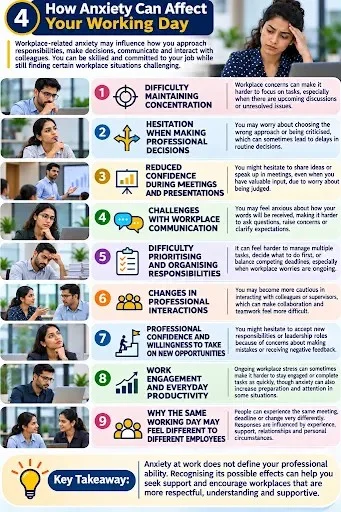
This infographic illustrates nine ways workplace anxiety may affect an employee’s working day: difficulty maintaining concentration, hesitation when making professional decisions, reduced confidence during meetings and presentations, communication challenges, difficulty prioritising responsibilities, changes in professional interactions, reluctance to pursue new opportunities, changes in work engagement and productivity, and differences in how employees experience the same working conditions. Each section uses realistic workplace photography and a concise explanation. The closing takeaway emphasizes that anxiety does not define professional ability and that supportive workplace environments can help employees navigate challenging situations.
Workplace-related anxiety may influence how employees approach responsibilities, participate in discussions, make decisions and interact with colleagues. For some people, it may make ordinary professional tasks feel more demanding. For others, the effects may be more noticeable during meetings, performance evaluations, presentations or situations involving uncertainty.
Importantly, experiencing anxiety does not automatically mean someone is less capable of doing their job. People can remain skilled, productive and professionally committed while experiencing emotional difficulties. The nature and extent of any impact depend on the individual, the working environment and the situation.
Understanding these possible effects can help employees and managers recognise when additional workplace support may be useful.
1. DIFFICULTY MAINTAINING CONCENTRATION
Concentration is important for completing assignments, following instructions and managing competing responsibilities.
When an employee is preoccupied with workplace concerns, it may become harder to direct attention towards the task in front of them.
For example, someone preparing a report may find their attention repeatedly returning to an upcoming performance discussion or an unresolved disagreement with a colleague.
This does not mean that every mistake or lapse in concentration is caused by anxiety. However, ongoing emotional concerns can compete with the attention and mental resources needed for certain professional activities.
A supportive working environment, clear priorities and reasonable opportunities to focus can help employees manage their responsibilities more effectively.
2. HESITATION WHEN MAKING PROFESSIONAL DECISIONS
Work frequently requires employees to make decisions, sometimes within limited timeframes.
An employee experiencing workplace-related anxiety may become particularly concerned about choosing the wrong approach, receiving criticism or being held responsible if an outcome is unsuccessful.
For instance, someone may repeatedly review a routine decision before submitting it for approval, even when they have the necessary information and professional experience.
In some situations, this hesitation may delay progress or make ordinary responsibilities feel unnecessarily complicated.
However, careful consideration is not inherently a problem. Thoughtful decision-making is an important professional skill. The difficulty arises when fear of negative evaluation or uncertainty makes it harder to move forward with reasonable decisions.
Clear decision-making authority, constructive feedback and accessible managerial guidance can help create a more supportive environment.
3. REDUCED CONFIDENCE DURING MEETINGS AND PRESENTATIONS
Meetings and presentations often involve sharing ideas, answering questions and responding to feedback in front of other people.
For employees who are concerned about negative evaluation, these situations may feel particularly challenging.
Someone may have valuable knowledge but hesitate to contribute because they are worried about being criticised or misunderstood.
For example, an employee may remain silent during a team discussion despite having information that could help resolve a problem.
Over time, repeatedly avoiding professional discussions may limit opportunities to demonstrate skills, contribute ideas or participate in decisions.
Managers can help by encouraging respectful discussions, allowing employees reasonable opportunities to prepare and ensuring that feedback focuses on the work rather than personal criticism.
4. CHALLENGES WITH WORKPLACE COMMUNICATION
Professional communication involves more than exchanging information. It also requires listening, asking questions, clarifying expectations and responding appropriately to different situations.
When employees are worried about how their words will be received, they may hesitate to raise concerns, request clarification or communicate disagreement.
For example, an employee who is uncertain about a deadline may avoid asking their supervisor for clarification because they do not want to appear inexperienced.
Similarly, someone may spend considerable time reviewing an email before sending it because they are concerned that its wording could be misunderstood.
These experiences can make everyday workplace communication more demanding.
Organisations can help by creating an environment in which employees feel comfortable asking questions, discussing difficulties and seeking clarification without unnecessary judgement.
5. DIFFICULTY PRIORITISING AND ORGANISING RESPONSIBILITIES
Managing several professional responsibilities requires employees to understand priorities, allocate time and respond to changing demands.
When workplace concerns occupy considerable attention, organising competing tasks may become more difficult for some individuals.
An employee handling several assignments, for example, may spend too much time worrying about which task will receive criticism if it is delayed.
This can make it harder to establish a clear sequence of priorities.
However, responsibility for workload management should not rest entirely with the employee. Managers also need to communicate deadlines, establish realistic expectations and clarify which assignments take priority when competing demands arise.
6. CHANGES IN PROFESSIONAL INTERACTIONS
Workplace relationships can become more difficult to navigate when someone is concerned about criticism, disagreement or how colleagues perceive them.
An employee may become reluctant to approach a supervisor, participate in informal conversations or request assistance from team members.
For example, someone who has previously experienced negative feedback may hesitate before discussing a problem with the same manager again.
This can affect opportunities for collaboration and make employees feel less connected to their teams.
It is important not to assume that someone who becomes quieter or less communicative is uninterested in their work. There may be circumstances affecting their experience that are not immediately visible to colleagues.
Respectful communication and approachable management can make it easier for employees to participate without feeling unnecessarily judged.
7. PROFESSIONAL CONFIDENCE AND WILLINGNESS TO TAKE ON NEW OPPORTUNITIES
Professional development often involves taking on unfamiliar responsibilities, learning new skills and accepting opportunities that require some uncertainty.
However, employees who are particularly concerned about making mistakes or receiving negative feedback may become hesitant about these opportunities.
For example, an employee may decline to lead a project despite having the necessary experience because they are worried about how others will evaluate their performance.
It is important to recognise that hesitation does not establish a lack of ability or professional potential.
Managers can support development by providing constructive feedback, reasonable training opportunities and clear expectations rather than relying on criticism or unrealistic performance demands.
8. WORK ENGAGEMENT AND EVERYDAY PRODUCTIVITY
When workplace difficulties remain unresolved, employees may find it harder to remain engaged with their responsibilities.
Some may take longer to complete certain assignments, find it difficult to participate in team activities or feel less connected to their professional goals.
However, anxiety should never be treated as automatic evidence of poor performance.
Research on workplace anxiety is more nuanced than that assumption. A 2026 review published in Annual Review of Organizational Psychology and Organizational Behavior explains that anxiety can have different effects depending on the situation. It may interfere with wellbeing and performance in some circumstances, while also encouraging preparation, vigilance or attention to potential problems in others.
A separate study examining social-evaluative workplace anxiety found that anxiety was not necessarily associated with poorer subsequent job performance.
These findings reinforce an important distinction: an employee’s emotional experience should not be used as a substitute for assessing their actual professional ability.
Fair performance evaluations, reasonable expectations and supportive management practices are essential.
9. WHY THE SAME WORKING DAY MAY FEEL DIFFERENT TO DIFFERENT EMPLOYEES
Two employees can experience the same meeting, deadline or organisational change very differently.
One may approach a new assignment with confidence, while another may feel uncertain about expectations or concerned about making mistakes.
Their responses may be influenced by professional experience, available support, workplace relationships, previous experiences and circumstances outside work.
This does not mean one employee is stronger or more capable than the other.
It simply illustrates why workplace wellbeing cannot be understood through a single standard of how everyone should respond to professional demands.
Organisations benefit from recognising these differences and providing reasonable opportunities for employees to communicate their needs.
An important takeaway: Anxiety at work does not define an employee’s professional ability. Someone can be knowledgeable, experienced and committed while finding particular workplace situations challenging. Recognising the possible effects on everyday working life can help employees seek appropriate support and encourage organisations to create more respectful and supportive working environments.
5. Why Work-Related Worries Can Follow You Home
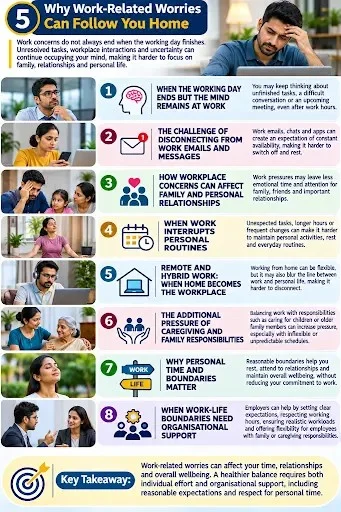
This infographic illustrates eight ways work-related worries can affect personal life: difficulty mentally disconnecting after work, pressure from emails and messages, effects on family relationships, interruptions to personal routines, remote-work boundary challenges, caregiving responsibilities, the importance of personal time, and the need for organisational support. Realistic workplace and home-life photographs accompany each section. The closing takeaway emphasizes that maintaining a healthier work-life balance requires both individual boundaries and organisational responsibility, including reasonable expectations and respect for personal time.
Work-related worries do not always end when the working day finishes. Unresolved responsibilities, difficult workplace interactions, upcoming deadlines and uncertainty about professional expectations may continue occupying someone’s attention during personal time. When work concerns repeatedly intrude into time meant for family, relationships or personal activities, maintaining a healthy separation between professional and personal life can become more difficult.
For some employees, the working day may officially end at 5 p.m., but their attention remains focused on unfinished assignments, conversations with supervisors or decisions that need to be made the following morning.
This experience can be particularly challenging when employees have limited control over their schedules or feel expected to remain available outside normal working hours.
The World Health Organization recognises conflicting work and home demands as one of the psychosocial risks that can influence mental health. This highlights why the relationship between professional responsibilities and personal life deserves attention.
1. WHEN THE WORKING DAY ENDS BUT THE MIND REMAINS AT WORK
Leaving the office or closing a laptop does not always mean that someone has mentally finished their professional responsibilities.
An employee may continue thinking about an important meeting, an unfinished assignment or a conversation that did not go as expected.
For example, someone who received critical feedback from a supervisor may find themselves revisiting the conversation during dinner or while spending time with family.
Another employee may keep thinking about an upcoming presentation, wondering whether everything has been prepared correctly.
Occasional thoughts about work are normal. However, when professional concerns repeatedly occupy personal time, it may become difficult to give attention to activities and relationships outside work.
Recognising this pattern can help employees consider whether their workload, workplace expectations or communication practices need attention.
2. THE CHALLENGE OF DISCONNECTING FROM WORK EMAILS AND MESSAGES
Digital communication has made it easier for employees to remain connected to their workplaces.
Emails, messaging applications, project-management platforms and online meetings can provide flexibility. However, they can also make professional boundaries less clear.
For example, an employee may receive a work message during dinner and feel pressure to respond immediately, even when the matter is not urgent.
Someone working remotely may find it difficult to establish a clear distinction between professional availability and personal time because the same devices and spaces are used for both.
Over time, an expectation of constant availability can make it harder to establish predictable periods away from work.
Organisations can help by communicating reasonable response expectations, distinguishing urgent matters from routine requests and respecting agreed working hours.
3. HOW WORKPLACE CONCERNS CAN AFFECT FAMILY AND PERSONAL RELATIONSHIPS
Work-related difficulties may sometimes influence how people interact with family members, friends and other important people in their lives.
Someone who has spent the day managing demanding professional responsibilities may have less attention available for personal conversations and shared activities.
For instance, an employee may become distracted during a family discussion because they are thinking about an unresolved workplace issue.
Another person may repeatedly postpone social plans because professional responsibilities seem to demand more time and attention.
These experiences do not mean someone cares less about their relationships. They may reflect the difficulty of managing competing demands.
Open communication can help family members and friends understand that professional pressures are affecting personal time, without making workplace difficulties the centre of every conversation.
4. WHEN WORK INTERRUPTS PERSONAL ROUTINES
A healthy personal routine includes time for responsibilities, relationships, recreation and activities that matter outside employment.
However, when professional demands regularly extend beyond scheduled hours, these activities may become difficult to maintain.
For example:
- An employee may repeatedly postpone personal appointments because of unexpected work assignments.
- A parent may find it difficult to participate in family activities because of unpredictable working hours.
- Someone working remotely may continue checking professional messages during personal activities.
- An employee may struggle to make plans with friends because their schedule changes frequently.
The issue is not that employees should never work additional hours. Some occupations involve genuine operational demands and occasional schedule changes.
The concern arises when interruptions become an ongoing expectation rather than an occasional exception.
Reasonable scheduling practices and respect for personal commitments can help employees maintain a more sustainable relationship with work.
5. REMOTE AND HYBRID WORK: WHEN HOME BECOMES THE WORKPLACE
Remote and hybrid arrangements provide flexibility and can reduce commuting demands. For many employees, they offer valuable opportunities to organise professional and personal responsibilities.
However, working from home can also create boundary challenges.
When professional activities take place in the same environment used for relaxation and family life, it may become harder to establish a clear separation between the two.
For example, an employee may continue checking assignments after completing their scheduled hours simply because their laptop is nearby.
Another person may find that household responsibilities and professional tasks repeatedly compete for attention during the same part of the day.
These challenges are not inevitable features of remote work. Their impact depends on the nature of the job, household circumstances, organisational expectations and the flexibility available to employees.
Clear working hours, agreed communication practices and a reasonably defined workspace may help create better separation.
6. THE ADDITIONAL PRESSURE OF CAREGIVING AND FAMILY RESPONSIBILITIES
Some employees manage professional responsibilities alongside caring for children, older family members or relatives who need additional assistance.
When working schedules are unpredictable or inflexible, these responsibilities may become particularly difficult to coordinate.
For example, a parent may have to manage school-related commitments while meeting professional deadlines. Someone caring for an older family member may find it challenging to respond to unexpected workplace demands.
These circumstances should not be viewed simply as individual time-management problems.
The WHO recognises conflicting work and home demands, including caregiving responsibilities, as relevant workplace mental-health considerations.
Where operationally possible, predictable schedules, flexible arrangements and appropriate workplace accommodations can help employees manage their responsibilities more realistically.
7. WHY PERSONAL TIME AND BOUNDARIES MATTER
Time away from work provides opportunities to attend to relationships, personal interests, household responsibilities and other important parts of life.
Having reasonable boundaries does not mean being less committed to professional responsibilities. It means recognising that employees also have legitimate needs outside their working roles.
Depending on the nature of employment, useful boundaries may include:
- Agreeing on normal working hours with supervisors.
- Clarifying which situations genuinely require after-hours responses.
- Avoiding unnecessary work-related notifications during personal time.
- Communicating workload concerns before responsibilities become unmanageable.
- Protecting agreed personal commitments whenever reasonably possible.
- Discussing flexible arrangements when family or caregiving responsibilities require them.
These suggestions cannot resolve every organisational problem. Employees may have limited control over their schedules, particularly in shift-based or essential-service occupations.
For this reason, responsibility for healthy boundaries should be shared between employees and employers.
8. WHEN WORK-LIFE BOUNDARIES NEED ORGANISATIONAL SUPPORT
Some workplace difficulties cannot be addressed through individual decisions alone.
An employee may understand the importance of disconnecting from work but still receive repeated after-hours requests from supervisors.
Another may want to maintain predictable working hours but have little influence over scheduling decisions.
In these situations, organisational policies and management practices become particularly important.
Employers can support healthier work-life boundaries through:
- Clear communication about working hours and availability.
- Reasonable expectations regarding after-hours messages.
- Predictable scheduling wherever operationally possible.
- Adequate staffing and realistic workloads.
- Respect for approved leave and personal commitments.
- Appropriate flexibility for employees with caregiving responsibilities.
The WHO recommends organisational interventions that address working conditions and environments rather than relying exclusively on individual-level approaches.
This is an important principle for creating workplaces where employee wellbeing is treated as part of responsible organisational management.
An important takeaway: Work-related worries can sometimes follow employees into their personal lives, affecting relationships, routines and opportunities to disconnect. A healthier relationship with work requires more than individual effort. Reasonable expectations, supportive management and respect for personal time are important responsibilities within the workplace itself.
6. Practical Ways to Respond to Anxiety at Work
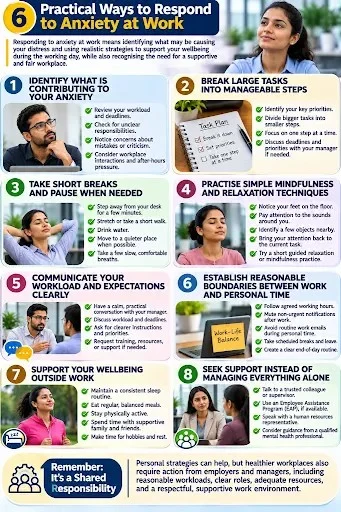
This infographic presents eight practical ways to respond to anxiety at work: identifying contributing factors, breaking large tasks into manageable steps, taking short breaks, practising mindfulness and relaxation, communicating workload expectations, establishing work-life boundaries, supporting personal wellbeing outside work, and seeking appropriate support. Each strategy includes practical suggestions and realistic workplace imagery. The closing message emphasizes shared responsibility, explaining that personal coping strategies should be accompanied by reasonable workloads, clear responsibilities, adequate resources, and supportive organisational practices.
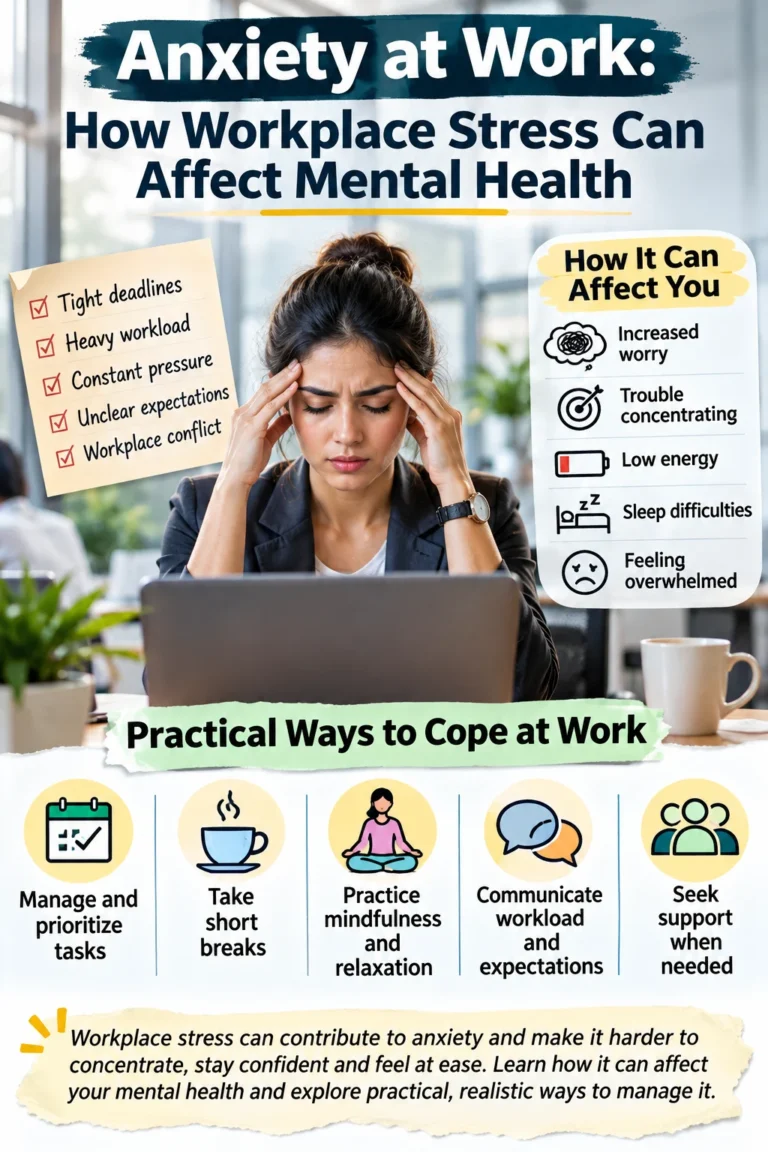
Responding to anxiety at work does not mean forcing yourself to stay calm, ignoring difficult circumstances, or expecting yourself to manage every challenge perfectly. It means identifying what may be contributing to your distress and finding realistic ways to support your wellbeing during the working day. Some approaches may help you feel more organised, regain a sense of control, and communicate your needs. However, individual coping strategies cannot replace reasonable workloads, respectful management, adequate resources, and a psychologically safer workplace.
START BY IDENTIFYING WHAT IS CONTRIBUTING TO YOUR ANXIETY
When work feels overwhelming, it can be difficult to identify exactly what is causing the distress. Taking a moment to examine the situation may help you recognize patterns and decide what needs attention. Consider asking yourself:
- Is my workload greater than I can reasonably manage?
- Are my responsibilities or deadlines unclear?
- Am I worried about making mistakes or receiving criticism?
- Are workplace interactions affecting my sense of safety or confidence?
- Am I finding it difficult to disconnect from work after hours?
You may find it useful to write down recurring workplace concerns. A short record of situations, expectations, and challenges can help you identify patterns and prepare for a constructive conversation with a manager or another appropriate support person. The purpose is not to blame yourself. It is to understand which concerns may be manageable through personal adjustments and which require changes or support from the workplace
BREAK LARGE TASKS INTO MANAGEABLE STEPS
A long list of responsibilities can make the working day feel difficult to manage, particularly when several deadlines compete for attention. Instead of trying to complete everything at once, identify the most important tasks and divide larger assignments into smaller steps. For example, if you have a report to complete, you might:
- Review the information you already have.
- Identify what is still missing.
- Complete one section at a time.
- Set a realistic time for reviewing the finished work.
A short daily priority list can also help you distinguish urgent responsibilities from tasks that can reasonably wait. If the workload cannot be completed within the available time, discuss priorities and deadlines with your manager rather than assuming you must manage everything alone. Breaking tasks into smaller steps does not remove an unreasonable workload, but it may make the next action clearer.
TAKE SHORT BREAKS AND PAUSE WHEN NEEDED
Working continuously without a pause can make it harder to maintain concentration and manage demanding situations. Where your role and workplace arrangements allow, take brief breaks during the day. You might:
- Step away from your desk for a few minutes.
- Stretch or take a short walk.
- Drink some water.
- Move to a quieter place when possible.
- Pause between demanding tasks before beginning the next one.
If you notice that you are becoming overwhelmed, a brief pause and a few comfortable, slow breaths may help you settle your attention in the present moment. You do not need to force deep breathing or expect a breathing exercise to resolve the underlying problem. Small pauses are not a substitute for adequate staffing, reasonable schedules, or sufficient recovery time. They are simply one practical way to create space during a demanding day.
PRACTICE SIMPLE MINDFULNESS AND RELAXATION TECHNIQUES
Mindfulness involves paying attention to the present moment rather than becoming completely absorbed in worries about what might happen next. At work, a brief grounding exercise may help you redirect your attention:
- Notice your feet resting on the floor.
- Pay attention to the sounds around you.
- Identify a few objects in your immediate surroundings.
- Bring your attention back to the task directly in front of you.
Some people also find short guided relaxation exercises or mindfulness practices helpful. These approaches are not equally useful for everyone, and their effects can vary. The World Health Organization includes mindfulness-based and other psychosocial approaches among interventions that may help workers develop stress-management skills. These approaches should be considered supportive options, not guaranteed solutions to workplace anxiety.
COMMUNICATE YOUR WORKLOAD AND EXPECTATIONS CLEARLY
Unclear instructions, competing deadlines, and unrealistic expectations can make workplace concerns more difficult to manage. When appropriate, consider having a calm and practical conversation with your manager or supervisor. Explain the specific work-related difficulty and identify what might help. For example, you could say: “I have several deadlines scheduled for the same period. Could we review the priorities and agree on which tasks should be completed first?” You might also ask for:
- Clearer instructions about responsibilities.
- More realistic deadlines.
- Regular feedback about priorities.
- Additional training or resources.
- A discussion about workload distribution.
You do not necessarily have to disclose personal mental health details to explain a work-related concern. You can begin by discussing the practical conditions affecting your ability to complete your responsibilities. If the concern involves bullying, harassment, discrimination, or unsafe working conditions, consider the appropriate reporting or employee-support channels available in your workplace.
ESTABLISH REASONABLE BOUNDARIES BETWEEN WORK AND PERSONAL TIME
When work messages, emails, or unfinished tasks continue to occupy your attention after working hours, it may become difficult to make time for rest and personal responsibilities. Where your job allows, consider setting boundaries such as:
- Following agreed working hours.
- Muting non-urgent work notifications outside those hours.
- Avoiding routine work emails during personal time.
- Taking scheduled breaks and using available leave.
- Creating a clear end-of-day routine.
Some occupations require shift work, on-call responsibilities, or flexible availability. In these situations, boundaries may need to be agreed with the employer rather than established by the employee alone. The aim is to protect reasonable opportunities for recovery while recognising that workplace policies and job requirements differ.
SUPPORT YOUR WELL-BEING OUTSIDE WORK
Workplace anxiety can become harder to manage when there is little opportunity to recover between demanding days. Everyday routines may help support emotional wellbeing, although they cannot eliminate every source of work-related distress. Consider making space for:
- A reasonably consistent sleep routine.
- Regular meals and adequate hydration.
- Physical activity that suits your abilities and preferences.
- Time with supportive friends or family members.
- Hobbies and activities unrelated to work.
- Periods of rest without work-related interruptions.
The National Institute of Mental Health identifies sleep routines, physical activity, relaxation practices, and supportive relationships among approaches people can explore when managing stress. These habits are not a test of discipline or a guarantee against anxiety. They are practical ways to support your overall wellbeing.
SEEK SUPPORT INSTEAD OF MANAGING EVERYTHING ALONE
You do not have to handle every workplace concern independently. Depending on your circumstances, support may be available through a trusted colleague, supervisor, human resources representative, employee assistance program (EAP), or qualified mental health professional. An EAP, where available, may provide confidential support or referrals for personal and work-related concerns. Before using any workplace service, check its confidentiality arrangements and how information may be shared. If workplace difficulties involve harassment, discrimination, or concerns about safety, an appropriate formal reporting channel may also be necessary. Support can help you consider practical options and decide what steps may be appropriate for your circumstances
REMEMBER THAT HEALTHIER WORKPLACES REQUIRE SHARED RESPONSIBILITY
Personal coping strategies can be useful, but they should not place the entire responsibility for workplace mental health on individual employees. If anxiety is being contributed to by excessive workloads, inadequate staffing, unclear responsibilities, discrimination, or persistent pressure to remain available, those conditions also need attention. The World Health Organization recommends workplace interventions that address psychosocial risks, alongside individual support and reasonable accommodations where appropriate. A healthier approach combines practical support for employees with meaningful action from employers and managers. Workers should not have to rely on breathing exercises, better time management, or personal resilience alone to cope with preventable workplace problems.
7. How Employers and Managers Can Support Employee Mental Health
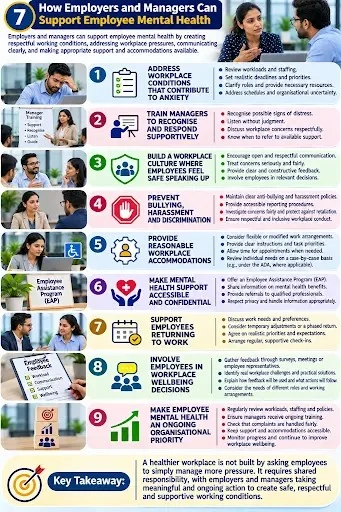
This infographic presents nine ways employers and managers can support employee mental health: addressing workplace conditions, training managers to respond supportively, creating a safe communication culture, preventing bullying and discrimination, providing reasonable accommodations, making confidential mental health support accessible, supporting employees returning to work, involving employees in wellbeing decisions, and making mental health an ongoing organisational priority. Each section includes practical organisational actions and realistic workplace imagery. The closing takeaway emphasizes shared responsibility and the importance of creating safe, respectful and supportive working conditions.
Employers and managers can support employee mental health by creating respectful working environments, addressing avoidable workplace pressures, communicating clearly, and making appropriate support available. Their responsibility extends beyond offering wellness programmes: it includes reviewing working conditions, preventing discrimination and harassment, and helping employees access reasonable workplace support when needed.
ADDRESS WORKPLACE CONDITIONS THAT CONTRIBUTE TO ANXIETY
One of the most important ways employers can support mental health is by examining the working conditions that may contribute to ongoing anxiety and emotional strain. Workplace wellness initiatives may be helpful, but they cannot compensate for persistent understaffing, unrealistic deadlines, excessive workloads, or a culture in which employees feel unable to raise concerns. Employers can take practical steps such as:
- Reviewing workloads and staffing levels to identify unreasonable demands.
- Setting realistic deadlines and priorities.
- Clarifying job responsibilities and reporting arrangements.
- Providing adequate equipment, training, and resources.
- Reviewing work schedules and expectations about availability.
- Addressing repeated organisational changes that create unnecessary uncertainty.
The World Health Organization recommends organisational interventions that assess and address psychosocial risks in working conditions. This means identifying workplace problems and taking steps to reduce, modify, or remove them rather than relying only on individual stress-management programmes. A healthier working environment begins with understanding what employees are experiencing and taking their concerns seriously.
TRAIN MANAGERS TO RECOGNISE AND RESPOND SUPPORTIVELY
Managers influence employees’ everyday working experiences through their communication, decisions, expectations, and leadership style. However, managers should not be expected to diagnose or treat mental health conditions. Their role is to recognise when an employee may be experiencing difficulty, respond respectfully, and help connect that person with appropriate workplace or professional support. Useful manager training can cover:
- Recognising possible signs of emotional distress without making assumptions.
- Listening without judgment or dismissing concerns.
- Having respectful conversations about workplace difficulties.
- Understanding how workload, schedules, and management practices affect wellbeing.
- Responding appropriately when an employee requests support.
- Knowing when and how to refer employees to available resources.
The WHO recommends mental health training for managers. Its guidance also makes clear that this training is intended to strengthen supportive management practices, not turn managers into mental health-care providers. A manager does not need to have all the answers. Listening carefully, respecting the employee, and helping identify appropriate next steps can make a meaningful difference.
BUILD A WORKPLACE CULTURE WHERE EMPLOYEES FEEL SAFE SPEAKING UP
Employees may hesitate to discuss workplace concerns when they fear embarrassment, unfair treatment, damaged professional relationships, or negative consequences for their careers. Employers can help create a more supportive environment by encouraging respectful communication and responding constructively when concerns are raised. This includes:
- Making it easier for employees to raise concerns without intimidation.
- Treating questions and requests for clarification respectfully.
- Encouraging managers to provide clear and constructive feedback.
- Taking reports of bullying, harassment, and discrimination seriously.
- Applying workplace policies consistently and fairly.
- Involving employees in decisions that affect their work.
Psychological safety does not mean avoiding accountability or eliminating professional expectations. It means employees can ask questions, acknowledge difficulties, and raise legitimate concerns without unnecessary fear of humiliation or retaliation. A workplace that listens to employees is better positioned to identify problems before they become more difficult to address.
PREVENT BULLYING, HARASSMENT, AND DISCRIMINATION
Bullying, harassment, and discrimination can undermine an employee’s sense of safety, dignity, and belonging. Employers should not treat these experiences as ordinary workplace disagreements or expect employees to tolerate harmful behaviour as part of their jobs. Practical organisational measures include:
- Establishing clear anti-bullying and anti-harassment policies.
- Providing accessible and appropriate reporting procedures.
- Training managers and employees on respectful workplace conduct.
- Investigating complaints fairly and consistently.
- Protecting employees from retaliation for raising legitimate concerns.
- Taking appropriate action when unacceptable behaviour is established.
Employees should be able to understand where to report concerns and what process will follow. Reporting procedures should also respect privacy as far as reasonably and legally possible. A supportive workplace requires more than written policies. Employers need to communicate expectations clearly and put those policies into practice.
PROVIDE REASONABLE WORKPLACE ACCOMMODATIONS
Some employees may need changes to their working arrangements because of a mental health condition or related functional difficulties. Appropriate adjustments can help eligible employees perform their essential job responsibilities and participate more fully at work. Depending on the person’s needs and the nature of the job, possible adjustments may include:
- Flexible or modified working hours.
- Adjustments to work schedules or shift arrangements.
- Written instructions or clearer task priorities.
- A quieter workspace or reduced distractions.
- Additional time for certain tasks where appropriate.
- Time away from work for healthcare appointments.
- Regular supportive meetings with a supervisor.
An accommodation should be considered individually. The same adjustment will not be appropriate for every employee, role, or workplace. For U.S. readers, the Americans with Disabilities Act (ADA) may provide protections for qualified employees with mental health conditions that meet its disability requirements. Depending on the circumstances, employers may have to consider reasonable accommodations unless doing so would create an undue hardship. Employees can discuss accommodation requests with an appropriate supervisor or human resources representative. The U.S. Equal Employment Opportunity Commission (EEOC) explains that covered employers must also protect confidential medical information and avoid employment decisions based on stereotypes about mental health conditions. Specific legal rights depend on the circumstances and applicable law.
MAKE MENTAL HEALTH SUPPORT ACCESSIBLE AND CONFIDENTIAL
Employers can help employees find support by making relevant workplace resources easy to understand and access. Depending on the organisation, these resources may include:
- An employee assistance program (EAP).
- Information about health insurance mental health benefits.
- Referrals to qualified mental health professionals.
- Occupational health or employee wellbeing services.
- Clear information about leave and accommodation procedures.
- Educational resources that explain where employees can seek help.
An EAP may offer confidential counselling, short-term support, or referrals, depending on the programme. Employees should be able to understand what the service includes, whether there are costs, and what confidentiality protections and limits apply. Employers should not pressure employees to disclose personal mental health information unnecessarily. Medical information should be handled carefully and shared only as permitted or required under applicable rules. Providing a resource is only the first step. Employers should also make sure employees know how to access it without unnecessary barriers or fear of unfair treatment.
SUPPORT EMPLOYEES RETURNING TO WORK
An employee returning after a period of leave related to a health condition may need time and appropriate support to resume their responsibilities. A thoughtful return-to-work approach can include:
- Discussing the employee’s work-related needs and preferences.
- Reviewing whether temporary adjustments may be appropriate.
- Agreeing on realistic priorities and expectations.
- Considering a phased return where suitable and agreed.
- Arranging regular check-ins without unnecessary pressure.
- Reviewing the arrangements as circumstances change.
The aim is to help the employee return in a sustainable and respectful way while recognising the needs of the role and workplace. Managers should avoid making assumptions about an employee’s abilities based on their health history. Any adjustments should be considered individually and in accordance with applicable employment requirements.
INVOLVE EMPLOYEES IN WORKPLACE WELLBEING DECISIONS
Workplace mental health initiatives are more likely to address real concerns when employees have a meaningful opportunity to contribute. Employers can gather feedback through confidential surveys, employee representatives, staff meetings, consultation sessions, or other appropriate channels. Employees may be able to identify practical problems that are not immediately visible to senior management, such as unrealistic schedules, unclear responsibilities, communication difficulties, or barriers to taking breaks. Employers should explain how feedback will be considered and what actions will follow. Asking employees for their views without responding can weaken trust. Meaningful participation also means considering different roles, working arrangements, accessibility needs, and the experiences of employees who may face additional workplace barriers.
MAKE EMPLOYEE MENTAL HEALTH AN ONGOING ORGANISATIONAL PRIORITY
Supporting employee mental health should not be limited to a single awareness campaign or an occasional wellness event. It requires continued attention to workplace conditions, management practices, employee feedback, and access to appropriate support. Organisations can review whether their efforts are making a practical difference by examining:
- Whether workloads and staffing arrangements are reasonable.
- Whether employees understand their responsibilities.
- Whether managers receive appropriate training.
- Whether workplace complaints are handled fairly.
- Whether employees can access support and accommodations.
- Whether employees feel comfortable raising concerns.
The World Health Organization recommends integrating mental health into workplace policies and involving workers in decisions that affect their wellbeing. Employers do not need to promise a workplace free from every challenge. They do need to take reasonable steps to prevent avoidable harm, respond to concerns, and create conditions in which employees are treated with dignity and respect. Ultimately, a healthier workplace is not built by asking employees to become better at tolerating unreasonable pressure. It is built when organisations take responsibility for the conditions in which people work.
8. When Should You Consider Professional Support for Workplace Anxiety
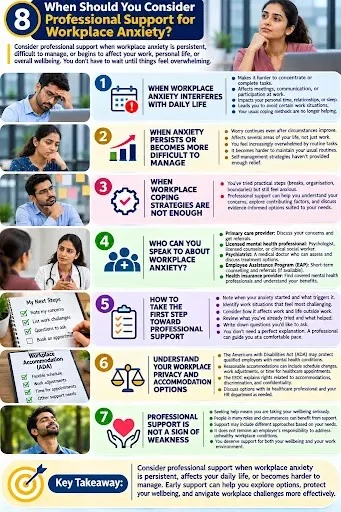
This infographic presents seven considerations for seeking professional support for workplace anxiety. It covers anxiety interfering with daily life, persistent or worsening concerns, coping strategies that are no longer sufficient, available healthcare and workplace support options, preparing for a first professional conversation, understanding workplace privacy and reasonable accommodations under the ADA, and recognizing that seeking support is not a sign of weakness. Realistic workplace and healthcare photographs accompany each section. The closing takeaway encourages seeking appropriate guidance before workplace anxiety becomes overwhelming while recognizing the importance of healthier workplace conditions.
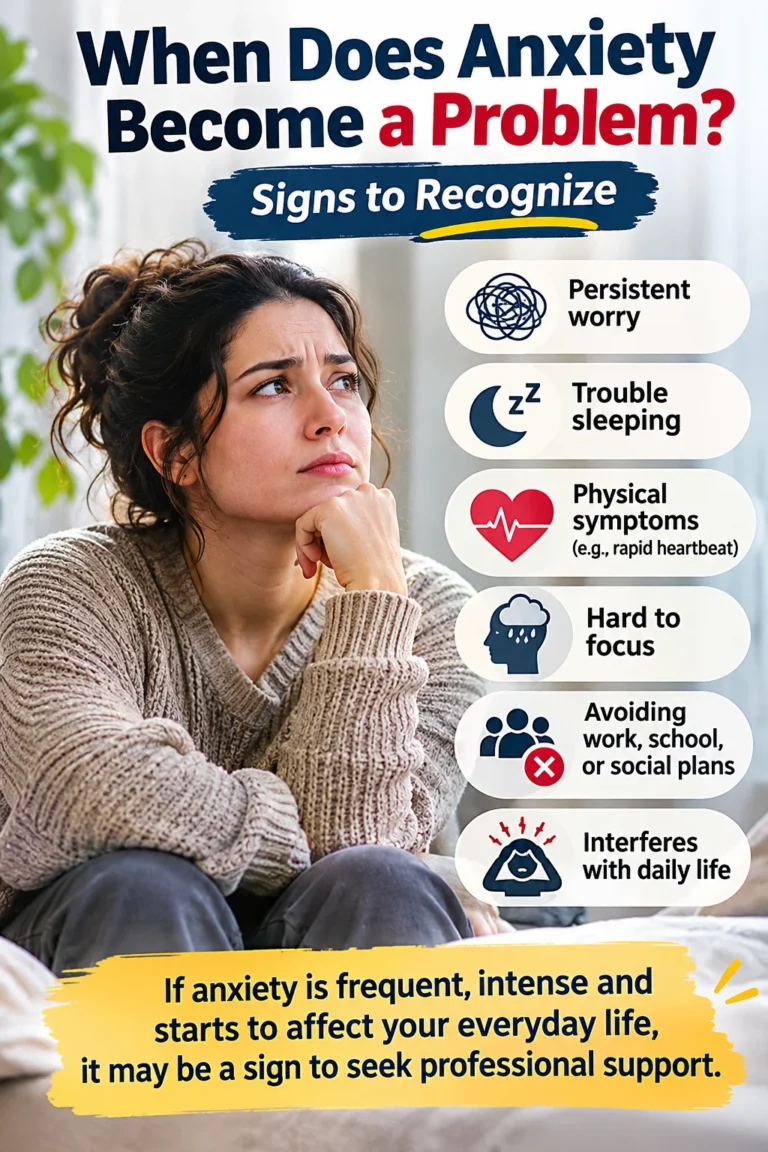
Workplace anxiety may be worth discussing with a qualified mental health professional when it becomes persistent, difficult to manage, or begins interfering with your work and personal life. You do not have to wait until your difficulties become overwhelming before asking for help. Early support can help you understand what you are experiencing and consider appropriate ways forward. Feeling anxious about an important meeting, a demanding project, or a change at work does not automatically mean you have an anxiety disorder. However, when worry continues, affects everyday functioning, or becomes difficult to manage, speaking with a healthcare professional can be a useful next step.
WHEN WORKPLACE ANXIETY STARTS INTERFERING WITH DAILY LIFE
Consider seeking professional support if anxiety is making it increasingly difficult to manage responsibilities or participate in activities that matter to you. You may notice that:
- Work-related worries regularly interfere with your ability to concentrate or complete everyday responsibilities.
- You find it increasingly difficult to attend meetings, communicate with colleagues, or take part in normal workplace activities.
- Worry about work continues to affect your personal time, relationships, or sleep.
- You frequently avoid work-related situations because of anxiety.
- You feel that your usual ways of managing difficult days are no longer helping.
These experiences do not establish a diagnosis. They are reasons to consider discussing your concerns with a qualified professional who can understand your circumstances and help determine what support may be appropriate. The National Institute of Mental Health advises seeking professional help when anxiety begins causing problems in everyday life, including at work and in relationships.
WHEN ANXIETY PERSISTS OR BECOMES MORE DIFFICULT TO MANAGE
Occasional work-related worry may ease when a demanding situation passes. However, if anxiety continues over time, repeatedly returns, or becomes more difficult to manage, it may be helpful to seek an assessment. Consider speaking with a professional if:
- Your concerns remain difficult to manage even after workplace circumstances improve.
- Anxiety is affecting several areas of your life rather than only one work situation.
- You feel increasingly overwhelmed by ordinary work responsibilities.
- You are having difficulty maintaining your usual routines outside work.
- Attempts to manage the situation independently have not provided enough relief.
There is no single waiting period that applies to everyone. The decision to seek support should take account of how you are feeling, how your daily life is affected, and whether you would benefit from professional guidance.
WHEN WORKPLACE COPING STRATEGIES ARE NOT ENOUGH
Practical strategies such as taking breaks, organising tasks, setting reasonable boundaries, and discussing workload concerns may help some employees. However, these approaches do not always address persistent anxiety or the underlying conditions contributing to it. If you have tried reasonable adjustments and still find that anxiety is affecting your wellbeing, consider speaking with a qualified healthcare or mental health professional. Professional support can help you:
- Understand the concerns and experiences you are facing.
- Explore whether workplace circumstances or other factors may be contributing.
- Consider appropriate evidence-based support options.
- Develop strategies suited to your individual needs.
- Discuss whether further assessment or treatment may be helpful.
You should not interpret the need for additional support as a personal failure. It is a reasonable step when your wellbeing needs more attention than self-management alone can provide.
WHO CAN YOU SPEAK TO ABOUT WORKPLACE ANXIETY?
There are several types of professionals and services that may help, depending on your needs, preferences, location, and available healthcare coverage. Possible starting points include:
- Primary care provider: A primary care clinician can discuss your concerns, consider whether other health factors may be involved, and help identify appropriate next steps or referrals.
- Licensed mental health professional: A qualified psychologist, licensed clinical social worker, licensed professional counselor, or other appropriately licensed provider may offer assessment and mental health support within their professional scope.
- Psychiatrist: A psychiatrist is a medical doctor who can assess mental health concerns and discuss medical treatment options when appropriate.
- Employee assistance program (EAP): If your employer offers an EAP, it may provide short-term counselling, support, or referrals. Check the programme’s services and confidentiality arrangements.
- Health insurance provider: Your insurance plan may help you identify covered mental health professionals and understand available benefits. You do not need to know exactly which type of professional you need before asking for guidance. A primary care provider or an appropriate mental health service can help you identify a suitable starting point.
HOW TO TAKE THE FIRST STEP TOWARD PROFESSIONAL SUPPORT
Starting a conversation about anxiety can feel difficult, especially if you are concerned about being judged or misunderstood. You can begin with a simple description of what has been happening and how it is affecting your everyday life. Before an appointment, you may find it helpful to consider:
- When you first noticed that work-related anxiety was becoming difficult to manage.
- Which workplace situations seem particularly challenging.
- How your concerns affect your work and life outside work.
- What you have already tried and whether it has helped.
- What questions you would like to ask.
You do not need to prepare a perfect explanation. A healthcare professional can ask questions and help you explore your concerns at a comfortable pace. If discussing your situation with a manager feels difficult, remember that seeking professional mental health support and disclosing personal health information at work are separate decisions. You can ask a healthcare professional about your options before deciding what, if anything, to share with your employer.
UNDERSTAND YOUR WORKPLACE PRIVACY AND ACCOMMODATION OPTIONS
Some employees may need workplace adjustments to manage a health condition while continuing to perform their job responsibilities. In the United States, the Americans with Disabilities Act (ADA) may protect qualified employees with mental health conditions that meet its disability requirements. Depending on the circumstances, reasonable accommodations may include modified schedules, changes to certain workplace arrangements, written instructions, or time away for healthcare appointments. The U.S. Equal Employment Opportunity Commission (EEOC) explains that employees may have rights relating to reasonable accommodations, workplace discrimination, and the confidentiality of medical information. These protections depend on the applicable law and individual circumstances. If you are considering requesting an accommodation, a qualified healthcare professional may be able to provide supporting documentation when appropriate. You can also ask your employer’s human resources department about its accommodation process. You do not need to share your personal health information with colleagues simply because you are receiving professional support.
PROFESSIONAL SUPPORT IS NOT A SIGN OF WEAKNESS
Workplace anxiety can affect people in many different roles and circumstances. Seeking professional support does not mean you are incapable of doing your job or that you have failed to manage your responsibilities. It means you are taking your wellbeing seriously and considering appropriate help. Professional support may involve different approaches depending on an individual’s needs and circumstances. A qualified provider can discuss available options, explain their potential benefits and limitations, and help determine what may be suitable. It is also important to remember that professional support for an employee does not remove an employer’s responsibility to address unhealthy workplace conditions. If excessive workloads, harassment, inadequate resources, or unreasonable expectations are contributing to the problem, those issues deserve attention too. You deserve support that considers both your individual wellbeing and the working conditions affecting your everyday life.
9. Building a Healthier Relationship With Work and Mental Wellbeing
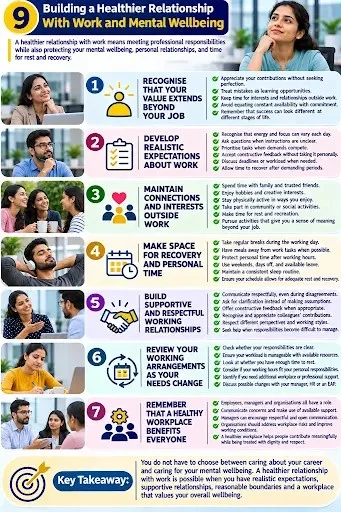
This infographic presents seven ways to build a healthier relationship with work and mental wellbeing. These include recognizing personal value beyond professional achievement, developing realistic work expectations, maintaining relationships and interests outside work, making time for rest and recovery, building respectful workplace relationships, reviewing working arrangements as personal needs change, and recognizing shared responsibility for workplace wellbeing. Each section includes practical suggestions and realistic workplace or lifestyle photography. The closing takeaway emphasizes that career commitment and mental wellbeing can coexist through reasonable boundaries, supportive relationships, realistic expectations, and healthier workplace practices.
Building a healthier relationship with work means finding a sustainable way to meet professional responsibilities while protecting your mental wellbeing, personal relationships, and time for recovery. It involves realistic expectations, supportive working relationships, reasonable boundaries, and workplace conditions that allow people to contribute without experiencing persistent, avoidable pressure. Work is an important part of life, but it does not have to define your entire identity or determine your sense of personal worth. A healthier relationship with work develops through everyday choices, supportive relationships, and organisational practices that respect employees as people.
RECOGNISE THAT YOUR VALUE EXTENDS BEYOND YOUR JOB
Professional responsibilities can be meaningful. Work may provide financial security, opportunities to develop skills, social connections, a sense of purpose, and personal achievement. However, your professional performance is only one part of who you are. A difficult project, a missed deadline, constructive criticism, or a career setback does not determine your overall value as a person. A more balanced perspective may involve:
- Recognising your contributions without expecting perfection.
- Treating mistakes as opportunities to learn where appropriate.
- Allowing yourself to have interests and relationships outside work.
- Avoiding the assumption that constant availability demonstrates commitment.
- Acknowledging that professional success can look different at different stages of life. You can care about your work and take pride in doing it well without making your entire identity dependent on professional achievement.
DEVELOP REALISTIC EXPECTATIONS ABOUT WORK
Every job involves responsibilities, deadlines, and occasional challenges. However, expecting yourself to perform at your highest level every day can create unnecessary pressure. A sustainable approach recognises that energy, concentration, workload, and personal circumstances can change. Consider developing expectations that allow room for:
- Learning new responsibilities over time.
- Asking questions when instructions are unclear.
- Prioritising tasks when several demands compete.
- Accepting constructive feedback without treating it as a personal judgment.
- Recognising when a deadline or workload needs to be discussed.
- Taking reasonable time to recover after demanding periods.
Realistic expectations do not mean lowering professional standards. They mean understanding what can reasonably be achieved with the time, resources, and support available.
MAINTAIN CONNECTIONS AND INTERESTS OUTSIDE WORK
A healthier relationship with work includes making room for activities and relationships that are important beyond professional responsibilities. Supportive relationships can provide connection, perspective, and opportunities to discuss experiences outside the workplace. Where possible, make time for:
- Family members and trusted friends.
- Hobbies and creative interests.
- Physical activity that you enjoy and can comfortably manage.
- Community activities and meaningful social connections.
- Rest, recreation, and personal interests.
- Activities that give you a sense of purpose beyond your job.
These parts of life do not need to be productive or connected to career development. Their value can simply come from enjoyment, connection, and personal meaning. Work-life balance will look different for people with different schedules, caregiving responsibilities, financial circumstances, and occupations. The aim is not to follow one ideal routine but to create a realistic balance within your circumstances.
MAKE SPACE FOR RECOVERY AND PERSONAL TIME
A sustainable working life requires opportunities to rest and recover. When work repeatedly extends into personal time, employees may have fewer opportunities to attend to relationships, responsibilities, and activities outside their jobs. Where your role and working arrangements allow, consider protecting time for:
- Regular breaks during working hours.
- Meals away from work tasks when practical.
- Personal time after scheduled working hours.
- Weekends, days off, and available leave.
- Sleep and routines that support recovery.
For shift workers, remote employees, caregivers, and people with unpredictable schedules, recovery may require different arrangements. The important consideration is whether working patterns provide reasonable opportunities for rest. Employers also have a role in establishing schedules and expectations that make recovery possible. Personal boundaries are harder to maintain when workplace demands consistently disregard them.
BUILD SUPPORTIVE AND RESPECTFUL WORKING RELATIONSHIPS
The people you work with can influence how comfortable, respected, and supported you feel during the working day. Positive professional relationships do not require everyone to become close friends. They depend on mutual respect, clear communication, fairness, and appropriate support. You can contribute to healthier working relationships by:
- Communicating respectfully, including during disagreements.
- Asking for clarification instead of making assumptions.
- Offering constructive feedback when appropriate.
- Recognising the contributions of colleagues.
- Respecting different perspectives and working styles.
- Seeking help when responsibilities or expectations become difficult to manage.
A supportive workplace also requires managers and organisations to address harmful behaviour, provide fair processes, and make it safe for employees to raise legitimate concerns. Healthy professional relationships are built through shared respect rather than the expectation that individual employees must tolerate unacceptable behaviour.
REVIEW YOUR WORKING ARRANGEMENTS AS YOUR NEEDS CHANGE
Your professional and personal circumstances may change over time. A role that once felt manageable may become more demanding because of new responsibilities, organisational changes, health needs, or caregiving commitments. Periodically consider whether your current working arrangements remain sustainable. You might reflect on:
- Whether your responsibilities are clear.
- Whether your workload is manageable with available resources.
- Whether you have sufficient opportunities for rest.
- Whether you can raise concerns with an appropriate person.
- Whether your working hours allow time for important personal responsibilities.
- Whether you need additional workplace or professional support.
If something needs to change, consider which concerns can be discussed with your manager and which may require guidance from human resources, an employee assistance programme, or a qualified professional. A healthier relationship with work is not a fixed achievement. It may require adjustments as your circumstances and responsibilities evolve.
REMEMBER THAT A HEALTHY WORKPLACE BENEFITS EVERYONE
Employees can take steps to support their own wellbeing, but sustainable workplace mental health cannot depend on individual effort alone. Employers, managers, and employees all have different responsibilities. Employees can communicate concerns and use available support. Managers can encourage respectful communication and respond appropriately. Organisations must examine working conditions, address psychosocial risks, and provide reasonable systems of support. The World Health Organization emphasises that meaningful worker participation, organisational interventions, manager training, and appropriate support for employees with mental health conditions are important parts of improving mental health at work. This approach recognises that wellbeing is influenced not only by personal habits but also by how work is designed, organised, and managed. A healthier relationship with work is possible when people can contribute meaningfully while being treated with dignity, having reasonable opportunities to recover, and receiving support when difficulties arise. You do not have to choose between caring about your career and caring about your mental wellbeing. Both deserve attention.
Frequently Asked Questions
A Gentle Reminder:
You Do Not Have to Manage Workplace Anxiety Alone. If work has been affecting your mental wellbeing, remember that you do not have to dismiss your concerns or manage every difficulty by yourself. You can care about your responsibilities, take pride in your work, and still recognise when something needs to change. Asking for clearer expectations, discussing an unreasonable workload, setting appropriate boundaries, or seeking professional support are reasonable steps—not signs of weakness. You also deserve to work in an environment where you are treated with respect, your concerns are taken seriously, and your wellbeing matters. Not every workplace challenge can be resolved immediately. Some circumstances may require support, careful decisions, or changes over time. Take one manageable step at a time, and remember that your worth is not measured by your productivity or professional achievements. Your mental wellbeing deserves attention, both at work and beyond it.
CONCLUSION: Creating a Healthier Relationship Between Work and Mental Health
Work can provide purpose, financial stability, professional growth, and meaningful connections. However, when workplace pressures become difficult to manage, they can affect emotional wellbeing, confidence, relationships, and life outside working hours. Understanding anxiety at work is an important first step. Recognising workplace pressures, identifying situations that affect your wellbeing, communicating concerns, and seeking appropriate support can help you make more informed decisions about your working life. Individual strategies may provide useful support, but employees should not be expected to manage unhealthy workplace conditions alone. Employers and managers also have a responsibility to address excessive demands, promote respectful working relationships, provide appropriate resources, and make support accessible. If workplace anxiety is becoming difficult to manage, consider speaking with a qualified healthcare or mental health professional. You do not need to wait until your wellbeing is seriously affected before asking for help. A healthier working life does not require perfection or constant productivity. It requires reasonable expectations, mutual respect, opportunities for recovery, and an environment where people can contribute while protecting their mental wellbeing. Your work matters, but your mental health matters too.
Explore More on MentalHealthNest: Anxiety and Mental Wellbeing
Explore our anxiety education series to understand different aspects of anxiety, how it may affect everyday life, and where appropriate support may be available.
- Anxiety Disorders: Understanding Symptoms, Types, and Treatment Learn about different anxiety disorders, their common symptoms, their effects on everyday life, and available assessment and treatment options.
- Overthinking and Anxiety: Why Your Mind Won’t Slow Down Explore repetitive worrying, anxious thought patterns, and practical approaches that may help.
- Anxiety vs. Stress: What’s the Difference and How Can You Tell? Understand how anxiety and stress differ, where they overlap, and when either may begin affecting everyday life.
- Anxiety vs. Depression: Understanding the Differences and Overlap Explore how anxiety and depression may differ, where symptoms can overlap, and why recognising these differences matters.
- Anxiety and Sleep: Why Anxiety Can Keep You Awake Discover how anxiety may interfere with sleep and how sleep difficulties and anxious thoughts can reinforce each other.
- Anxiety and Physical Symptoms: How Anxiety Can Affect the Body Understand how anxiety may be associated with physical experiences, including muscle tension, a racing heart, and digestive discomfort.
- Panic Attacks vs. Anxiety Attacks: What Is the Difference? Learn about panic attacks, how they differ from general experiences of anxiety, and why “anxiety attack” is not a formal clinical diagnosis.
- Health Anxiety: When Worry About Your Health Becomes Overwhelming Understand how persistent fears about illness can affect daily life and why appropriate medical guidance and mental health support may help.
- Social Anxiety in Adults: Symptoms, Causes, and What May Help Explore how fear of judgment or embarrassment may affect social situations, relationships, work, and everyday activities.
- Anxiety and Relationships: Why Anxiety Can Affect Connection and Communication Discover how anxiety may influence communication, trust, reassurance, and emotional connection.
- How to Calm an Anxious Mind: Practical Strategies for Managing Anxiety Explore practical approaches to responding to anxious thoughts and feelings, managing everyday worries, and recognising when additional support may be appropriate.
- When Does Anxiety Become a Problem? Understand when anxiety may be more than an occasional response to stress, particularly when it becomes persistent, difficult to manage, or disruptive to everyday activities.
Each article explores a different aspect of anxiety and mental wellbeing. Together, they provide readers with a broader educational resource for understanding anxiety and exploring appropriate support.
A NOTE TO OUR RETURNING READERS
If you have previously explored our MentalHealthNest anxiety guides, you may already understand that anxiety can influence different areas of everyday life.
This article takes a closer look at one particular setting: the workplace.
Work-related anxiety deserves attention because professional responsibilities, workplace expectations and organisational culture can influence how people experience their working days.
Our intention here is not to repeat what you have already learned in our other anxiety articles. Instead, we want to explore the workplace dimension more closely, including the pressures employees may encounter, the importance of supportive working environments and the options available when work begins to affect emotional wellbeing.
Whether you work in an office, manage a team, work remotely or are trying to understand someone else’s experience, we hope this guide offers a useful perspective.
You do not have to dismiss your concerns simply because workplace pressure is often treated as an ordinary part of professional life.
TRUSTED MENTAL HEALTH RESOURCE
The following organisations provide reliable information about mental health, workplace wellbeing, professional support, and employee rights. Most of these resources are U.S.-based and are particularly relevant to employees, employers, and individuals seeking additional guidance.
1. National Institute of Mental Health (NIMH)
The National Institute of Mental Health is a U.S. federal research agency offering evidence-based information about mental health conditions, research, treatment, and finding professional support. Website: https://www.nimh.nih.gov/ Find Mental Health Support: https://www.nimh.nih.gov/health/find-help
2. Substance Abuse and Mental Health Services Administration (SAMHSA)
SAMHSA provides information about mental health services, treatment options, and support resources across the United States.
Website:
https://www.samhsa.gov/ Find Mental Health Support: https://www.samhsa.gov/find-help Workplace Mental Health Support: https://www.samhsa.gov/find-support/how-to-cope/workplace
3. Centers for Disease Control and Prevention (CDC)
The CDC provides public health information and resources about mental health, including workplace wellbeing and ways organisations can support employees. Website: https://www.cdc.gov/ Providing Support for Worker Mental Health: https://www.cdc.gov/mental-health/caring/providing-support-for-workers-and-professionals.html
4. World Health Organization (WHO)
The WHO provides international guidance on mental health at work, including workplace risk prevention, organisational interventions, manager training, and employee support. Website: https://www.who.int/ Mental Health at Work: https://www.who.int/news-room/fact-sheets/detail/mental-health-at-work
5. U.S. Equal Employment Opportunity Commission (EEOC)
The EEOC explains workplace protections relating to disability discrimination, mental health conditions, reasonable accommodations, and employee rights under applicable federal employment laws. Website: https://www.eeoc.gov/ Mental Health Conditions: Resources for Job Seekers, Employees, and Employers: https://www.eeoc.gov/mental-health-conditions-resources-job-seekers-employees-and-employers
6. U.S. Department of Labor (DOL)
The Department of Labor provides information about workplace rights, employment protections, leave provisions, and related resources for workers and employers. Website: https://www.dol.gov/
7. 988 Suicide & Crisis Lifeline
For people in the United States experiencing emotional distress or a mental health crisis, the 988 Suicide & Crisis Lifeline provides free, confidential support by phone, text, or online chat, 24 hours a day. Call or text: 988 Website: https://988lifeline.org/
8. FindTreatment.gov
This SAMHSA resource helps people in the United States locate mental health and substance use treatment services. Website: https://findtreatment.gov/
A note about these resources: These organisations provide educational information, support services, or workplace guidance. Their inclusion does not constitute an endorsement of a particular provider, service, or treatment. Readers should check the relevant organisation’s website for current services, eligibility, and contact information.
REFERENCES
- World Health Organization (WHO). (2026). Mental Health at Work. Provides current guidance on workplace mental health, psychosocial risks, excessive workloads, job insecurity, workplace discrimination, and organisational action. https://www.who.int/news-room/fact-sheets/detail/mental-health-at-work
- World Health Organization (WHO). (2022). Guidelines on Mental Health at Work. Evidence-based recommendations covering organisational interventions, manager training, worker training, individual interventions, reasonable accommodations, and return-to-work support. https://www.who.int/publications/i/item/9789240053052
- National Institute of Mental Health (NIMH). Generalized Anxiety Disorder: What You Need to Know. Explains anxiety, common experiences associated with generalized anxiety disorder, its effects on everyday functioning, and when professional help may be appropriate. https://www.nimh.nih.gov/health/publications/generalized-anxiety-disorder-gad
- Centers for Disease Control and Prevention (CDC), National Institute for Occupational Safety and Health (NIOSH). (2024). An Urgent Call to Address Work-related Psychosocial Hazards and Improve Worker Well-being. Discusses work-related psychosocial hazards and the importance of addressing workplace conditions that may affect employee health and wellbeing. https://www.cdc.gov/niosh/bulletin/2024/workplace-psychosocial-hazards.html
- U.S. Equal Employment Opportunity Commission (EEOC). Depression, PTSD, and Other Mental Health Conditions in the Workplace: Your Legal Rights. Explains relevant protections under the Americans with Disabilities Act (ADA), including reasonable accommodations, workplace discrimination, and medical privacy. https://www.eeoc.gov/laws/guidance/depression-ptsd-other-mental-health-conditions-workplace-your-legal-rights
- Substance Abuse and Mental Health Services Administration (SAMHSA). Mental Health, Drug and Alcohol: Support for the Workplace. Provides information for employees and employers about workplace mental health support, employee assistance programmes, and available resources. https://www.samhsa.gov/find-support/how-to-cope/workplace
- Trougakos, J. P., Beal, D. J., & Moghaddas, M. (2026). The process model of anxiety: A framework and review of anxiety in the workplace. Annual Review of Organizational Psychology and Organizational Behavior. https://doi.org/10.1146/annurev-orgpsych-040225-084746
- Zhang, I. Y., Powell, D. M., & Bonaccio, S. (2022). The role of fear of negative evaluation in interview anxiety and social-evaluative workplace anxiety. International Journal of Selection and Assessment, 30(2), 302–310. https://doi.org/10.1111/ijsa.12365
MEDICAL DISCLAIMER
The information provided in this article, Anxiety at Work: How Workplace Stress Can Affect Mental Health, is intended for general educational and informational purposes only. It is not a substitute for professional medical advice, diagnosis, psychological assessment, or treatment. Mental health experiences vary from person to person. The information discussed here should not be used to diagnose yourself or another individual with an anxiety disorder or any other mental health condition. If workplace anxiety or related concerns are affecting your daily life, consider speaking with a qualified healthcare provider or licensed mental health professional. They can help assess your individual circumstances and discuss appropriate support options. Do not delay seeking professional care or disregard advice from a qualified healthcare professional because of information published on MentalHealthNest. Workplace policies, employment protections, reasonable accommodations, and legal rights vary according to individual circumstances and applicable laws. Information about U.S. workplace protections in this article is general educational information, not legal advice. For guidance about a specific employment situation, consult an appropriate employment-law professional or relevant government agency. MentalHealthNest is an independent mental health education platform. Its content is developed for public awareness and education and does not establish a healthcare provider–patient relationship. If you are experiencing an immediate mental health crisis in the United States, call or text 988 to contact the 988 Suicide & Crisis Lifeline. If there is immediate danger or a medical emergency, contact emergency services.
About MentalHealthNest: Editorial Policy and Content Standards
MentalHealthNest is an independent mental health education platform dedicated to improving mental health awareness, strengthening mental health literacy, reducing stigma, and helping readers make informed decisions about their wellbeing. Our goal is to provide original, accessible, compassionate, and evidence-informed educational content for individuals, families, caregivers, students, and professionals.
OUR EDITORIAL COMMITMENT
We aim to publish mental health information that is:
- Evidence-informed: Based on credible research, recognised health organisations, established clinical guidance, and trustworthy publications.
- Accurate and responsible: Important health-related statements are checked against appropriate sources, with uncertainty and limitations acknowledged.
- Reader-focused: Written in clear, respectful language that addresses genuine questions and practical concerns.
- Original and useful: Developed to provide meaningful explanations rather than reproduce existing articles or offer generic information.
- Transparent: Clear about the platform’s educational purpose, the qualifications of contributors, and whether professional clinical review has taken place.
HUMAN EDITORIAL ACCOUNTABILITY AND AI-ASSISTED CONTENT
MentalHealthNest may use artificial intelligence tools to assist with research organisation, outlining, drafting, language improvement, and editorial preparation. AI-generated information is not automatically treated as accurate, clinically established, or suitable for publication. Content must undergo human editorial assessment, including review of factual claims, supporting evidence, clarity, originality, relevance, and potential reader impact. Sujit Shetty, founder and editor of MentalHealthNest, retains responsibility for the final editorial decisions and published content. AI tools do not replace qualified healthcare professionals, clinical judgment, independent evidence verification, or appropriate professional review.
CLINICAL EVIDENCE AND SOURCE VERIFICATION
MentalHealthNest prioritises reliable information from recognised public health organisations, established medical institutions, professional organisations, and peer-reviewed research. Where relevant, our editorial process considers:
- Whether a source is authoritative and appropriate for the subject.
- Whether research findings are accurately represented.
- Whether evidence is established, emerging, limited, or uncertain.
- Whether statistics, dates, and clinical claims are supported by their original sources.
- Whether references and external links are relevant and accessible.
- Whether readers can distinguish general educational information from individual medical advice. We do not intentionally present unverified claims, invented research, fabricated quotations, or unsupported treatment promises as established facts.
PROFESSIONAL LIMITATIONS AND CLINICAL TRANSPARENCY
MentalHealthNest is an educational platform, not a healthcare provider. Its founder and editor, Sujit Shetty, is a mental health advocate and blogger, not a licensed mental health professional. Content published on the platform should not be interpreted as a personal diagnosis, clinical assessment, or treatment recommendation. Where clinical expertise is necessary, readers are encouraged to consult appropriately qualified and licensed healthcare professionals. Any clinical review, professional contribution, or expert consultation will be identified transparently when it has genuinely taken place.
OUR COMMITMENT TO A TRUSTED MENTAL HEALTH EDUCATION ECOSYSTEM
MentalHealthNest aims to develop a connected knowledge network through cornerstone articles, supporting educational resources, mental health guides, topic-specific article series, and access to therapist information. Our purpose is to:
- Improve public understanding of mental health and wellbeing.
- Encourage respectful and stigma-free conversations.
- Help readers recognise when professional support may be appropriate.
- Connect related educational topics through useful internal resources.
- Promote informed help-seeking and responsible mental health awareness.
- Maintain a consistent standard of quality, transparency, and reader trust.
CONTINUOUS EDITORIAL IMPROVEMENT
Mental health research, public health guidance, and professional recommendations can change over time. We therefore aim to review and update published content when significant new evidence, corrections, or relevant guidance becomes available. Our editorial standards reflect our commitment to accuracy, transparency, responsible health communication, and the trust of our readers. We continuously strive to provide original, evidence-informed, accessible, and genuinely useful mental health education.
Our promise: MentalHealthNest is committed to putting readers first, respecting the complexity of mental health, and communicating responsibly so that people can access reliable information and make informed decisions about their wellbeing.
Every article is designed to help you make informed decisions, strengthen your mental wellbeing, and connect with trusted professional support when needed.
ABOUT THE AUTHOR
Sujit Shetty is the founder and editor of MentalHealthNest, an independent mental health education platform focused on improving public understanding of mental health and emotional wellbeing.
As a mental health advocate and blogger, Sujit is committed to making mental health information accessible, practical, respectful, and evidence-informed, particularly for readers seeking reliable educational resources in the United States.
His editorial work focuses on mental health awareness, anxiety, emotional wellbeing, workplace mental health, and the importance of reducing stigma around mental health conditions.
Sujit is not a licensed mental health professional. His work at MentalHealthNest is educational and does not replace professional medical advice, diagnosis, or treatment.
Through MentalHealthNest, he aims to build a trusted educational resource that encourages informed conversations, responsible help-seeking, and greater awareness of mental health and wellbeing.
Respect for therapists, psychologists, psychiatrists, and other healthcare professionals
MentalHealthNest.com aims to become one of the web’s most trusted educational resources for mental health while connecting readers with qualified mental health professionals through its growing therapist directory.