Introduction
Anxiety is a familiar human experience. It can arise before an important decision, during an uncertain period, or when something meaningful feels difficult to manage. Sometimes, these feelings settle as circumstances improve. At other times, anxiety gradually becomes a more persistent part of everyday life, leaving a person wondering whether what they are experiencing deserves greater attention.
But when does anxiety become a problem?
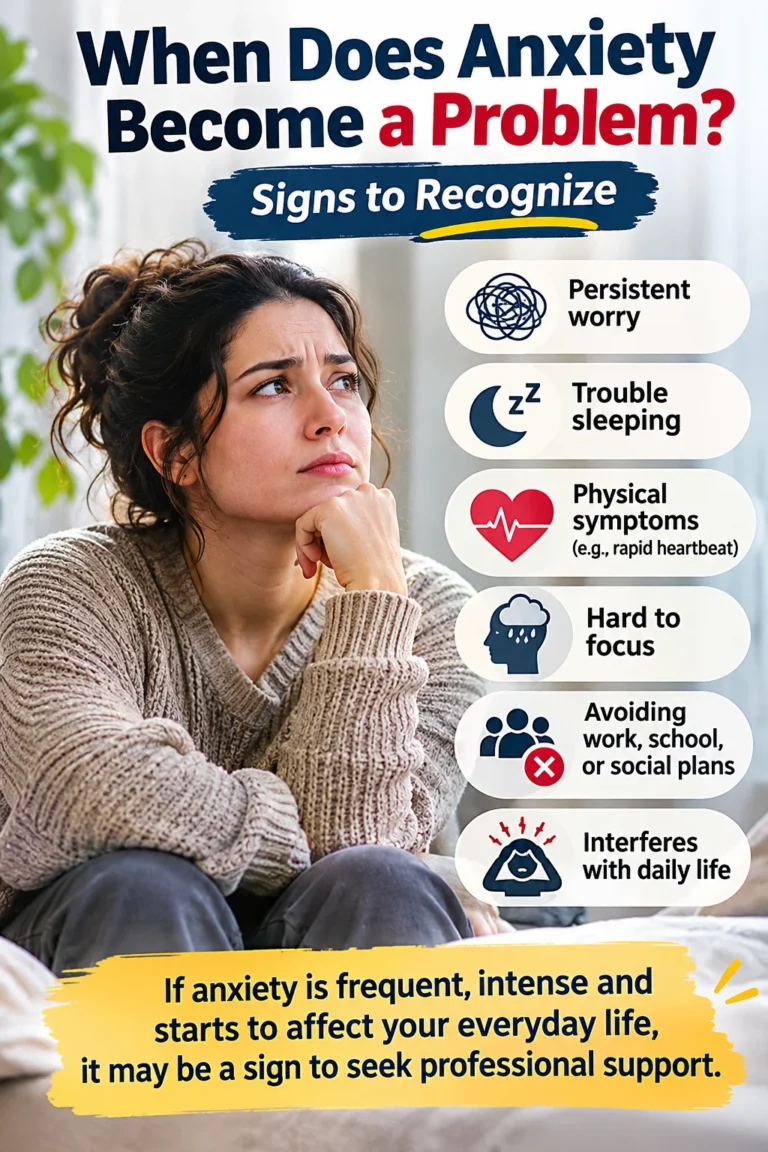
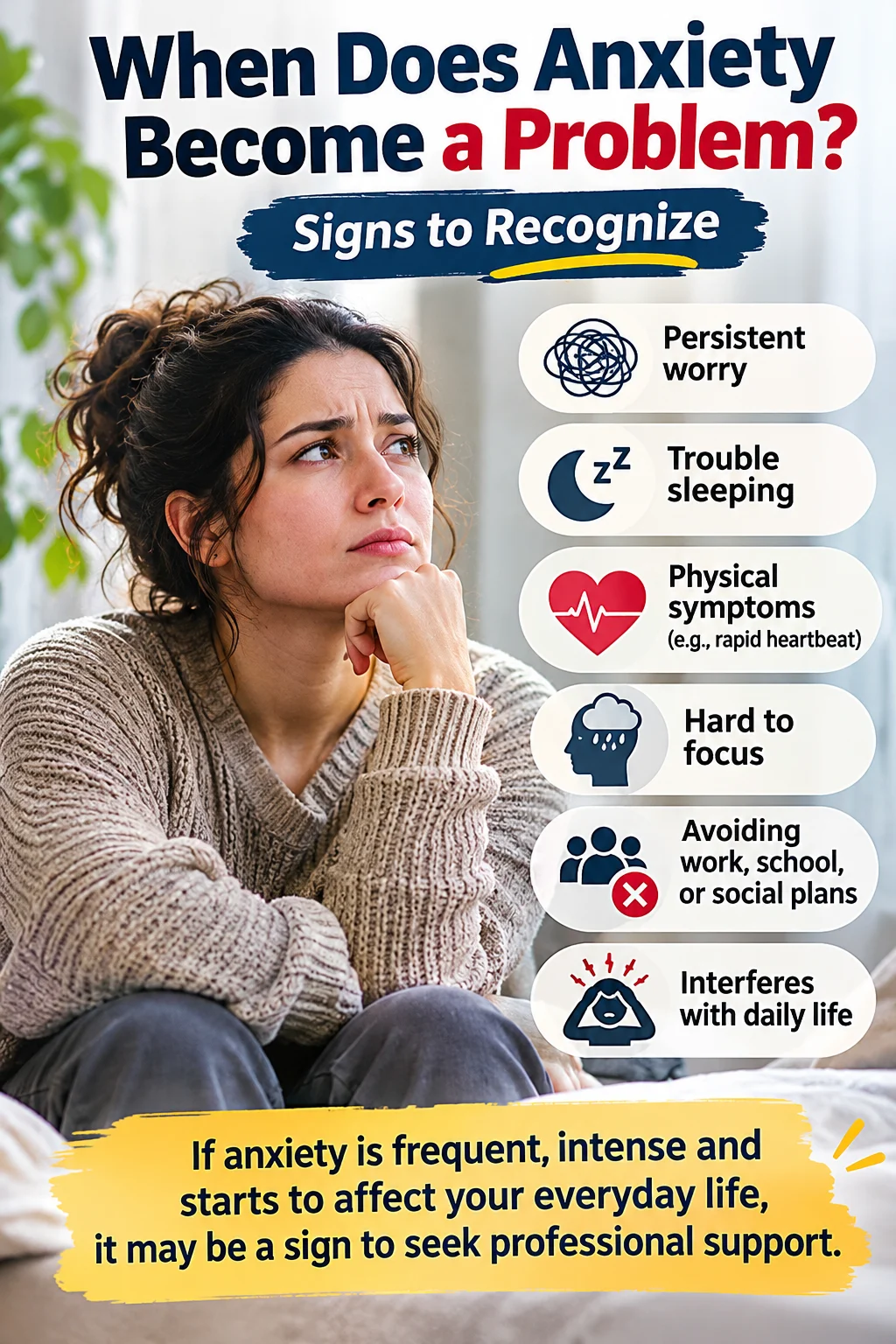
The answer is not determined by one uncomfortable feeling, a particular number of anxious days, or a single difficult experience. Anxiety may deserve closer attention when it becomes persistent, difficult to manage, causes significant emotional distress, or begins interfering with a person’s everyday activities and quality of life.
One important aspect is that the effects are not always visible to other people. Someone may continue working, studying, maintaining responsibilities and participating in family life while privately finding ordinary activities increasingly demanding. Appearing to function normally does not necessarily mean that someone is experiencing no emotional difficulty.
It is also important to understand that experiencing anxiety does not automatically mean having an anxiety disorder. Different circumstances, personal experiences and health factors can influence how anxiety develops and affects an individual. A qualified healthcare professional can help assess these concerns rather than relying on symptoms or online information alone.
If you have already explored our articles about overthinking, anxiety and sleep, physical symptoms, relationships or everyday coping, this guide takes the discussion a step further. Rather than revisiting those subjects, we will focus on recognising when anxiety deserves attention, how it may affect everyday functioning, and when speaking with a qualified professional could be a helpful next step.
Understanding this distinction can help people approach their experiences with greater clarity and without judging themselves.
Quick Answer: When Does Anxiety Become a Problem?
Anxiety may become a problem when it is persistent, difficult to manage, causes significant emotional distress, or interferes with everyday responsibilities, activities and quality of life. Unlike occasional stress, ongoing anxiety may affect sleep. It does not have to reach a particular level of severity or last for a fixed period before someone can seek guidance from a qualified healthcare professional.
KEY TAKEAWAYS
- Anxiety is a normal human response, but it may deserve attention when it becomes persistent or difficult to manage.
- The impact on everyday functioning and quality of life matters, not just how frequently someone feels anxious.
- A person can experience considerable emotional distress even while continuing to meet work, study or family responsibilities.
- The six-month duration criterion for generalized anxiety disorder is a diagnostic requirement, not a waiting period someone must complete before seeking professional guidance.
- Experiencing anxiety does not automatically mean having an anxiety disorder.
- A qualified healthcare professional can consider individual circumstances and help determine whether further assessment or support is appropriate
1. When Does Anxiety Move Beyond an Ordinary Emotional Response?
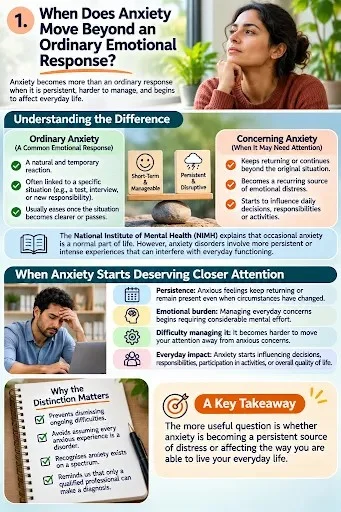
This infographic explains the difference between ordinary anxiety and anxiety that may deserve closer attention. The comparison section shows ordinary anxiety as a temporary response to specific situations and concerning anxiety as persistent distress that may affect everyday responsibilities and activities. A reference to the National Institute of Mental Health (NIMH) highlights the distinction between occasional anxiety and anxiety disorders. The next section identifies four considerations: persistence, emotional burden, difficulty managing anxious concerns, and impact on everyday life. A notebook illustration explains why recognizing this distinction matters, while the final takeaway emphasizes persistent distress and interference with daily living rather than the mere presence of anxious feelings.
Anxiety moves beyond an ordinary emotional response when it becomes more than a temporary reaction to a challenging situation and starts creating ongoing emotional distress or difficulty managing everyday life. The important distinction is not simply whether someone experiences anxiety, but how persistent, manageable and disruptive that experience becomes.
UNDERSTANDING THE DIFFERENCE BETWEEN ORDINARY AND CONCERNING ANXIETY
Anxiety itself is not necessarily a sign that something is wrong. It is a natural emotional response that can help people recognise uncertainty, prepare for challenges and respond to situations that require attention.
For example, feeling anxious while waiting for an important decision or facing an unfamiliar responsibility is understandable. Once the situation becomes clearer or the challenge passes, those feelings may gradually settle.
This type of anxiety is generally connected to a particular circumstance. Although it may feel uncomfortable, it does not necessarily take over a person’s everyday decisions or prevent them from participating in activities that matter to them.
The experience can be different when anxiety becomes a recurring source of distress, continues beyond the circumstances that initially prompted it, or begins influencing how someone approaches ordinary life.
The National Institute of Mental Health (NIMH) explains that occasional anxiety is a normal part of life. However, anxiety disorders involve more persistent or intense experiences that can interfere with everyday functioning.
WHEN ANXIETY STARTS DESERVING CLOSER ATTENTION
There is no single experience that determines when anxiety has become a problem. Several aspects of a person’s experience may deserve attention:
- Persistence: Anxious feelings keep returning or remain present even when the original circumstances have changed.
- Emotional burden: Managing everyday concerns begins requiring considerable mental effort.
- Difficulty managing it: A person finds it increasingly difficult to move their attention away from anxious concerns.
- Everyday impact: Anxiety begins influencing decisions, responsibilities, participation in activities or overall quality of life.
These are useful considerations, not a diagnostic checklist. Their significance depends on the individual’s circumstances, experiences and overall wellbeing.
For some people, anxiety may be noticeable because it repeatedly interrupts their daily routine. For others, the difficulty may be less obvious. They might continue fulfilling their responsibilities while experiencing considerable internal distress.
Neither experience should be dismissed simply because someone else appears to be coping better or because the person is still managing everyday tasks.
WHY THE DISTINCTION MATTERS
Recognising when anxiety deserves attention can help people take their experiences seriously and consider whether additional support may be useful.
It also helps avoid the opposite misunderstanding: assuming that every anxious experience indicates a mental health condition.
Anxiety exists on a broad spectrum of human experience. A temporary emotional response, recurring distress and a clinically diagnosed anxiety disorder are not interchangeable terms.
A diagnosis requires an appropriate assessment by a qualified professional. An article cannot establish whether an individual has an anxiety disorder simply by describing common experiences.
The more useful question is whether anxiety is becoming a persistent source of distress or affecting the way someone is able to live their everyday life.
Understanding this distinction provides a foundation for recognising more specific patterns that may indicate a need for additional attention.
2. How to Recognize When Anxiety Is Becoming Difficult to Manage
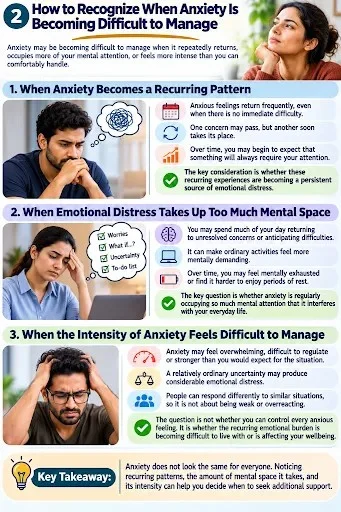
This infographic illustrates three signs that anxiety may be becoming difficult to manage. The first describes recurring anxiety, where worries repeatedly return and become a persistent source of emotional distress. The second highlights mental preoccupation, including repeatedly thinking about unresolved concerns, difficulty concentrating on ordinary activities, and feeling mentally exhausted. The third explains how anxiety may become overwhelming or difficult to regulate, even in situations involving ordinary uncertainty. The closing takeaway emphasizes recognizing recurring patterns, the amount of mental attention anxiety occupies, and its intensity when considering whether additional support may be helpful.
Anxiety may be becoming difficult to manage when it repeatedly returns, occupies an increasing amount of mental attention, or feels more intense than a person can comfortably handle. These patterns do not automatically indicate an anxiety disorder, but they may suggest that the emotional burden deserves closer attention.
WHEN ANXIETY BECOMES A RECURRING PATTERN
An occasional anxious experience does not necessarily indicate a problem. However, when anxiety repeatedly becomes part of a person’s daily experience, it may be worth paying attention to the pattern.
For example, someone might notice that feelings of uneasiness return frequently, even when there is no immediate difficulty that needs to be addressed. A particular concern may pass, but another worry soon takes its place. Over time, the person may begin to expect that something will always require their attention or concern.
The important consideration is not simply how often anxiety occurs. It is whether these recurring experiences are becoming a persistent source of emotional distress.
Some people notice that their anxiety changes with their circumstances. It may become more noticeable during demanding periods and ease when life becomes more settled. Others experience recurring anxiety across different situations without identifying one clear explanation.
Noticing when anxiety keeps returning can help someone describe the pattern more clearly when discussing their experience with a healthcare professional.
WHEN EMOTIONAL DISTRESS STARTS TAKING UP TOO MUCH MENTAL SPACE
Anxiety can occupy considerable mental attention, even when there is little outward indication that someone is struggling.
A person may spend much of their day mentally returning to unresolved concerns, anticipating possible difficulties or feeling unable to give their full attention to the present moment. This can make ordinary activities feel more mentally demanding than they once did.
The experience is not necessarily about thinking excessively about one particular subject. It may involve a broader sense of mental preoccupation in which concerns repeatedly compete for attention.
For example, someone might sit down to complete an ordinary task but find that their attention keeps returning to unresolved concerns. Even when they want to concentrate on something enjoyable or important, their emotional discomfort may make it harder to feel mentally present.
Over time, this experience may leave a person feeling mentally exhausted or less able to enjoy periods that would otherwise be relaxing.
It is worth distinguishing this experience from ordinary periods of intense concentration or temporary concern. The more important question is whether anxiety is regularly occupying so much mental attention that it interferes with a person’s ability to engage with everyday life.
WHEN THE INTENSITY OF ANXIETY FEELS DIFFICULT TO MANAGE
The intensity of anxiety also matters. Two people may experience similar circumstances but respond with very different levels of emotional distress. Individual differences, personal circumstances and other health factors can influence these experiences.
Anxiety may deserve closer attention when its intensity feels overwhelming, difficult to regulate or disproportionate to the situation from the person’s perspective.
For example, a relatively ordinary uncertainty may produce considerable emotional distress that is difficult to put aside. A person might recognise that their reaction feels stronger than they expected, yet still struggle to regain a sense of emotional balance.
This does not mean that the person is overreacting deliberately or lacking emotional strength. Emotional experiences are influenced by many factors, and they should not be judged simply by how another person might respond to the same situation.
It is also important not to assume that intense anxiety always means someone has a particular mental health condition. A qualified professional can consider the nature of the experience, its duration, its effects and other relevant circumstances.
A useful distinction: The question is not whether someone can completely control every anxious feeling. It is whether the recurring emotional burden is becoming difficult to live with or is beginning to affect their wellbeing.
Anxiety does not have to look the same for everyone. For some, its impact is noticeable through recurring emotional distress. For others, it becomes clearer through the increasing effort required to manage ordinary responsibilities. This brings us to another important consideration: how anxiety can affect everyday functioning even when other people do not notice.
3. How Anxiety Can Affect Everyday Functioning Without Being Obvious
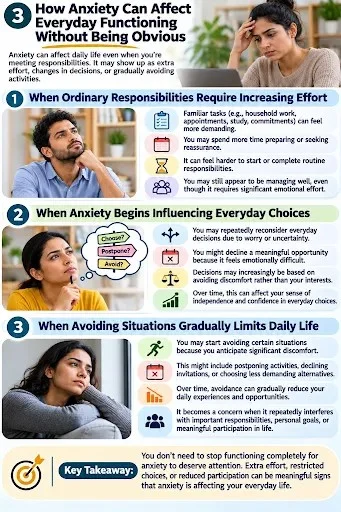
This infographic illustrates three ways anxiety can affect everyday functioning without being immediately obvious. The first section shows how familiar responsibilities, such as household tasks, appointments, studying, and personal commitments, may require increasing mental and emotional effort. The second explains how anxiety can influence everyday choices through repeated reconsideration, declining meaningful opportunities, and decisions driven by anticipated discomfort. The third highlights gradual avoidance, including postponing activities, declining invitations, and choosing less demanding alternatives. The closing takeaway emphasizes that anxiety deserves attention even when someone continues meeting responsibilities, particularly when extra effort, restricted choices, or reduced participation affect daily life.
Anxiety can affect everyday functioning even when a person continues to meet responsibilities and appears to manage life normally. Its impact may become noticeable through the additional effort required to complete ordinary tasks, changes in personal decisions or gradually avoiding activities that once felt manageable.
WHEN ORDINARY RESPONSIBILITIES REQUIRE INCREASING EFFORT
One way anxiety may affect everyday functioning is by making familiar responsibilities feel more demanding than they previously did.
A person might continue completing household tasks, attending appointments, studying or managing personal commitments. However, activities that once felt straightforward may increasingly require preparation, reassurance or considerable emotional effort.
For example, someone may spend much longer preparing for an ordinary appointment because they feel uncertain about what might happen. Another person may find it increasingly difficult to begin a routine responsibility, even though they understand what needs to be done.
From the outside, these individuals may appear to be managing their lives successfully. Their responsibilities are still being completed, and other people may not recognise the effort involved.
However, maintaining everyday responsibilities does not necessarily mean someone is experiencing no difficulty. The emotional effort required to keep everything going can itself become an important part of their experience.
It is worth recognising when ordinary activities repeatedly begin to feel unusually demanding, particularly when this represents a noticeable change in someone’s usual functioning.
WHEN ANXIETY BEGINS INFLUENCING EVERYDAY CHOICES
Anxiety may also influence the decisions people make, sometimes without them immediately recognising its role.
Everyday choices are normally influenced by personal preferences, responsibilities, priorities and circumstances. However, when anxiety becomes an important influence, decisions may increasingly revolve around avoiding uncertainty or reducing anticipated emotional discomfort.
For example, someone might repeatedly reconsider an ordinary decision because they are worried about making the wrong choice. Another person may decline an otherwise meaningful opportunity because the uncertainty surrounding it feels difficult to tolerate.
These decisions do not automatically indicate a mental health problem. People have legitimate reasons to change plans, decline invitations or reconsider their priorities.
The important distinction is whether anxiety is increasingly determining what someone feels able to choose, rather than allowing decisions to reflect their actual interests and circumstances.
Over time, this may affect a person’s sense of independence, confidence in everyday decisions and ability to participate in activities that matter to them.
Recognising this influence can help someone understand why certain decisions have become more difficult without blaming themselves for experiencing anxiety.
WHEN AVOIDING SITUATIONS GRADUALLY LIMITS DAILY LIFE
Avoidance is another possible way anxiety can affect everyday functioning.
A person may begin avoiding particular situations because they anticipate considerable emotional discomfort or feel uncertain about how they will manage them.
Initially, these changes may seem relatively small. Someone might postpone an activity, decline an opportunity or choose an alternative that feels less demanding.
However, when avoidance becomes increasingly frequent, it may gradually restrict everyday experiences and opportunities.
For example, a person might stop participating in an activity they previously enjoyed, avoid an ordinary responsibility or repeatedly change plans because anticipated distress feels difficult to face.
The concern is not that every decision to avoid something is unhealthy. Avoiding genuinely unsafe situations or setting reasonable personal boundaries can be appropriate.
Rather, attention is warranted when anxiety repeatedly influences avoidance in ways that interfere with important responsibilities, personal goals or meaningful participation in life.
The extent of this impact can vary considerably between individuals. Some may experience noticeable restrictions in several areas, while others may continue participating in most activities but feel increasingly limited in particular circumstances.
These less visible effects may be difficult for others to recognise, but they can provide important context when someone considers whether additional support could be helpful.
4. Why You Should Not Wait for a Specific Time Period Before Seeking Help
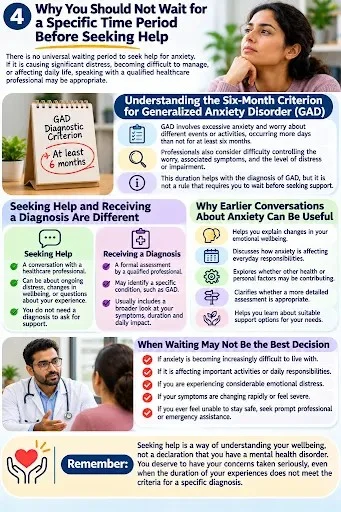
This infographic explains why people should not wait for a specific time period before seeking professional help for anxiety. The first section describes the six-month duration criterion associated with generalized anxiety disorder (GAD), clarifying that it is a diagnostic requirement rather than a waiting period for accessing support. The second compares seeking professional help with receiving a formal diagnosis, explaining that people can discuss emotional distress without already having a diagnosed condition. The third highlights the benefits of earlier conversations with healthcare professionals, including understanding changes in emotional wellbeing, discussing everyday difficulties, and exploring appropriate support options. The fourth identifies circumstances in which waiting may not be appropriate, including significant distress, interference with daily responsibilities, rapidly changing symptoms, or safety concerns. The closing reminder emphasizes that seeking help is about understanding wellbeing, not assuming a diagnosis.
There is no universal waiting period before someone can seek professional help for anxiety. If anxiety is causing significant emotional distress, becoming difficult to manage or interfering with everyday life, speaking with a qualified healthcare professional may be appropriate. Diagnostic duration requirements apply to particular conditions, not to a person’s eligibility to ask for support.
UNDERSTANDING THE SIX-MONTH CRITERION FOR GENERALIZED ANXIETY DISORDER
One reason people become confused about when to seek help is the six-month duration criterion associated with generalized anxiety disorder (GAD).
The six-month duration used in the diagnostic criteria for Generalized Anxiety Disorder is not a requirement for seeking help. You can speak with a qualified healthcare professional whenever anxiety begins affecting your well-being or everyday life.
Under established diagnostic criteria, GAD involves excessive anxiety and worry about different events or activities, occurring more days than not for at least six months. The assessment also considers difficulty controlling the worry, associated symptoms and clinically significant distress or impairment.
This duration requirement helps qualified professionals determine whether an individual’s experiences meet the diagnostic criteria for this particular condition.
However, it should not be interpreted as a general rule for all anxiety experiences or as a requirement to delay seeking professional guidance.
The National Institute of Mental Health (NIMH) explains that people who think they may be experiencing GAD should speak with a healthcare provider. It also identifies problems with everyday activities as an important reason to seek professional help.
WHY SEEKING HELP AND RECEIVING A DIAGNOSIS ARE DIFFERENT
Seeking professional guidance does not mean someone must already have a diagnosed anxiety disorder.
A person may want to understand recurring emotional distress, discuss changes in their wellbeing or explore whether their experiences deserve further attention. These are reasonable reasons to arrange a conversation with a qualified healthcare professional.
Professional assessment is not limited to determining whether someone meets the criteria for a particular diagnosis. It can also help clarify what may be contributing to their experiences and whether any further support or evaluation is appropriate.
For example, someone who has been experiencing increasing emotional difficulty for several weeks may decide to speak with a primary care provider. They do not need to wait until six months have passed simply because that duration appears in the diagnostic criteria for GAD.
WHY EARLIER CONVERSATIONS ABOUT ANXIETY CAN BE USEFUL
Discussing anxiety with a healthcare professional earlier can provide an opportunity to understand what is happening before concerns become more disruptive.
A conversation may help someone:
- Explain changes in their emotional wellbeing.
- Discuss how anxiety is affecting everyday responsibilities.
- Explore whether other health or personal circumstances may be contributing.
- Understand whether a more detailed assessment is appropriate.
- Learn about suitable support options based on their individual needs.
Not every conversation leads to a diagnosis or a recommendation for formal treatment. Sometimes, the immediate benefit is gaining a clearer understanding of the situation and knowing what options are available.
Clinical guidance also emphasises that an assessment should consider the degree of distress and functional impairment rather than relying exclusively on symptom numbers, severity or duration.
WHEN WAITING MAY NOT BE THE BEST DECISION
When anxiety becomes increasingly difficult to manage, affects important activities or causes considerable emotional distress, seeking professional guidance can be appropriate regardless of how long the symptoms have been present. Individual circumstances and the impact on wellbeing matter more than comparisons with other people’s experiences.
If distress is severe or symptoms are worsening, seeking prompt professional guidance is important. If someone is in immediate danger or unable to remain safe, emergency assistance is needed.
Remember: Seeking help is a way of understanding your wellbeing, not a declaration that you have a mental health disorder. You deserve to have your concerns taken seriously even when the duration of your experiences does not meet the criteria for a specific diagnosis.
With this distinction understood, the next question becomes more practical: when might speaking with a mental health professional be an appropriate next step?
5. When Is It Appropriate to Speak With a Mental Health Professional?
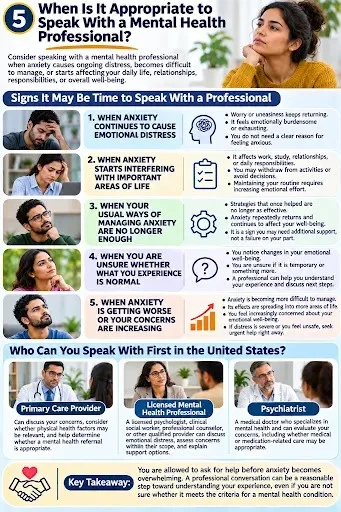
This infographic presents five situations in which speaking with a mental health professional may be appropriate: ongoing emotional distress, interference with important areas of life, coping strategies that are no longer sufficient, uncertainty about emotional experiences, and worsening anxiety. It also identifies three possible starting points for support in the United States: a primary care provider, a licensed mental health professional, and a psychiatrist. Each provider is accompanied by a brief explanation of their potential role. The closing takeaway emphasizes that people do not need a confirmed diagnosis or overwhelming symptoms before asking for professional guidance.
Speaking with a mental health professional may be appropriate when anxiety causes ongoing distress, becomes difficult to manage, or starts interfering with a person’s daily life, relationships, responsibilities, or sense of well-being. You do not need a confirmed diagnosis or severe symptoms to ask for guidance. If you are concerned about how anxiety is affecting you, a professional conversation can help clarify what is happening and what support may be suitable.
WHEN ANXIETY CONTINUES TO CAUSE EMOTIONAL DISTRESS
Consider speaking with a qualified professional if anxiety continues to feel emotionally burdensome, even when there is no obvious immediate reason for it. You may find that worry or uneasiness keeps returning, makes it difficult to feel settled, or leaves you feeling emotionally exhausted.
The important consideration is not whether you experience anxiety occasionally. It is whether the experience has become distressing enough that you would benefit from discussing it with someone qualified to help.
You also do not have to wait until you can explain exactly why you feel anxious. Uncertainty about what is happening is a valid reason to seek guidance.
WHEN ANXIETY STARTS INTERFERING WITH IMPORTANT AREAS OF LIFE
Professional guidance may be helpful when anxiety begins affecting areas of life that matter to you. This can include difficulty keeping up with everyday responsibilities, withdrawing from activities, changes in how you approach important decisions, or increasing difficulty maintaining your usual routines.
Some people continue working, studying, caring for family members, and meeting other responsibilities while experiencing considerable emotional distress. Being able to function does not automatically mean that anxiety is having no meaningful effect.
If maintaining your usual routine increasingly requires emotional effort, or if anxiety is narrowing the activities and choices available to you, discussing these changes with a professional may be worthwhile.
WHEN YOUR USUAL WAYS OF MANAGING ANXIETY ARE NO LONGER ENOUGH
People develop different ways of responding to anxiety. Some find that ordinary adjustments and support from trusted people help them manage occasional anxious periods.
However, if these approaches no longer seem sufficient, or if anxiety repeatedly returns and continues affecting your well-being, professional guidance can help you explore the situation more carefully.
This does not mean that you have failed to manage your emotions. It simply means that the support you currently have may not fully address what you are experiencing.
WHEN YOU ARE UNSURE WHETHER WHAT YOU EXPERIENCE IS NORMAL
You may recognise some changes in your emotional well-being without knowing whether they are significant. Perhaps anxiety has become more noticeable, but you are unsure whether it is temporary, related to current circumstances, or part of a broader concern.
You do not need to determine this on your own.
A qualified mental health professional or healthcare provider can ask about your experiences, consider how they affect your daily life, and help identify whether further assessment or support may be appropriate. A conversation does not automatically lead to a diagnosis.
WHEN ANXIETY IS GETTING WORSE OR YOUR CONCERNS ARE INCREASING
It may be especially important to seek professional guidance if anxiety is becoming more difficult to manage, its effects are spreading into additional areas of life, or you feel increasingly concerned about your emotional well-being.
You should not feel that you have to wait for a particular symptom, duration, or level of impairment before asking for help. If you are experiencing severe distress or have immediate concerns about your safety, seek urgent help rather than waiting for a routine appointment.
WHO CAN YOU SPEAK WITH FIRST?
In the United States, possible starting points include:
- Primary care provider: A primary care professional can discuss your concerns, consider whether physical health factors may be relevant, and help determine whether a mental health referral is appropriate.
- Licensed mental health professional: A licensed psychologist, clinical social worker, professional counselor, or other qualified mental health provider can discuss emotional distress, assess concerns within their professional scope, and explain available support options.
- Psychiatrist: A psychiatrist is a medical doctor who specialises in mental health and can evaluate mental health concerns, including whether medical or medication-related care may be appropriate.
The right starting point depends on your circumstances, preferences, access to care, and the type of support you are seeking.
The central point is simple: you are allowed to ask for help before anxiety becomes overwhelming. A professional conversation can be a reasonable step toward understanding your experiences, even when you are not sure whether they meet the criteria for a mental health condition.
6. What Does a Professional Anxiety Assessment Actually Consider?
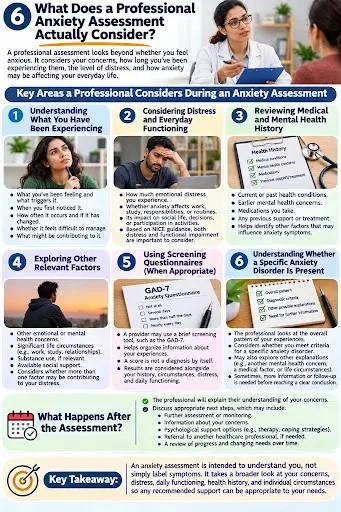
This infographic explains six key areas considered during a professional anxiety assessment. These include understanding symptoms and triggers, evaluating emotional distress and everyday functioning, reviewing medical and mental health history, exploring other relevant personal and health factors, using screening questionnaires such as the GAD-7 when appropriate, and determining whether a specific anxiety disorder may be present. The infographic also illustrates what may happen after an assessment, including further evaluation, psychological support, referrals, and follow-up. Its closing takeaway emphasizes understanding the individual’s overall circumstances rather than simply labeling symptoms.
A professional anxiety assessment looks beyond whether someone feels anxious. A qualified provider considers the nature of the person’s concerns, how long they have been experiencing them, the level of emotional distress, and whether anxiety affects everyday functioning. The assessment may also explore health history, other mental health concerns, current circumstances, and previous support to understand the person’s needs more fully.
UNDERSTANDING WHAT YOU HAVE BEEN EXPERIENCING
An assessment usually begins with a conversation about what has brought you to seek help. The professional may ask you to describe your concerns in your own words rather than expecting you to use clinical terminology.
Questions may explore:
- What you have been feeling and what situations tend to bring it on.
- When you first noticed the concerns.
- How frequently they occur and whether they have changed over time.
- Whether you find the feelings difficult to manage.
- What you believe may be contributing to your concerns.
There is no requirement to describe everything perfectly. An honest account of what you have noticed can help the professional understand your experience.
CONSIDERING DISTRESS AND EVERYDAY FUNCTIONING
Professionals do not assess anxiety only by counting symptoms. They also consider how much distress a person experiences and whether the concerns affect important areas of life.
For example, an assessment may explore whether anxiety has affected responsibilities, education, work, social participation, personal decisions, or the ability to maintain usual routines.
This distinction matters because two people can report similar experiences but have different levels of distress and functional difficulty. A comprehensive assessment considers the individual’s circumstances rather than relying on a single symptom or score.
The National Institute for Health and Care Excellence (NICE) specifically recommends considering both emotional distress and functional impairment when assessing suspected generalized anxiety disorder NICE Clinical Guideline CG113: Generalised Anxiety Disorder and Panic Disorder in Adults – Management
REVIEWING MEDICAL AND MENTAL HEALTH HISTORY
A provider may ask about previous or current health conditions, earlier mental health concerns, medications, and any support or treatment the person has received.
This information can help identify factors that may influence anxiety or contribute to similar experiences. Some medical conditions, medications, and other health-related factors can produce symptoms that deserve separate evaluation.
Depending on the circumstances, a primary care provider may review physical health concerns or recommend further medical evaluation. A mental health assessment should not automatically assume that every experience of anxiety has the same explanation.
EXPLORING OTHER FACTORS THAT MAY BE RELEVANT
Anxiety does not always occur in isolation. A professional may ask about other emotional or mental health concerns, significant life circumstances, substance use, and available social support.
These questions help build a broader understanding of the person’s situation. They are not intended to assign blame or make assumptions about someone’s choices.
The purpose is to consider whether additional factors may be contributing to the person’s distress and whether more than one concern needs attention. NICE guidance recommends considering coexisting mental health conditions, substance-related concerns, medical conditions, previous mental health history, and responses to earlier treatment when assessing suspected generalized anxiety disorder.
USING SCREENING QUESTIONNAIRES WHEN APPROPRIATE
A provider may use a brief screening questionnaire or a more detailed assessment tool to help understand the person’s experiences.
The Generalized Anxiety Disorder 7-item scale (GAD-7) is a commonly used screening questionnaire that asks about anxiety-related experiences over the previous two weeks. It can help healthcare professionals assess the frequency and severity of anxiety symptoms, but its score alone cannot establish a diagnosis.
However, a questionnaire score is not a diagnosis by itself. Screening tools help organize information and identify whether further evaluation may be useful. A qualified professional considers the results alongside the person’s history, circumstances, distress, and everyday functioning.
WHETHER A SPECIFIC ANXIETY DISORDER IS PRESENT
If the assessment suggests a possible anxiety disorder, the professional may consider whether the person’s experiences meet the relevant diagnostic criteria.
Different anxiety-related conditions have different features and diagnostic requirements. The professional considers the overall pattern rather than assigning a diagnosis simply because someone reports feeling anxious.
Sometimes, the assessment may identify a specific anxiety disorder. In other situations, the person’s distress may be connected with another mental health concern, a medical factor, current life circumstances, or a combination of influences.
An assessment may also conclude that more information or follow-up is needed before reaching a clear conclusion. That does not make the person’s concerns any less worthy of attention.
WHAT HAPPENS AFTER THE ASSESSMENT?
After considering the available information, the professional should explain their understanding of the person’s concerns and discuss appropriate next steps.
Depending on the findings and individual needs, these may include:
- Further assessment or monitoring.
- Information about the nature of the concerns.
- Discussion of available psychological support.
- Referral to another qualified healthcare professional when appropriate.
- A review of progress and changing needs over time.
An assessment does not automatically mean that someone will receive a diagnosis, be prescribed medication, or need the same type of support as another person. Decisions should reflect the individual’s circumstances and be discussed with them.
The most important point is that an anxiety assessment is intended to understand the person, not simply label the symptoms. It considers the wider picture, including emotional distress, daily functioning, health history, and individual circumstances, so that any recommended support is appropriate to the person’s needs.
7. Can Someone Need Support Even Without an Anxiety Disorder Diagnosis?
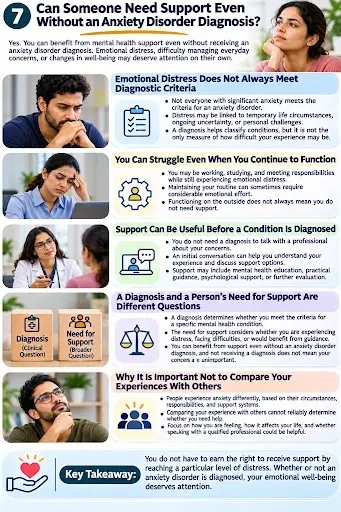
This infographic explains why people may need mental health support even without an anxiety disorder diagnosis. It covers five important points: emotional distress does not always meet diagnostic criteria; someone can struggle while continuing everyday responsibilities; professional support can be useful before a diagnosis; clinical diagnosis and the need for support are different considerations; and comparing personal experiences with others cannot determine whether help is needed. Realistic photographs and visual illustrations accompany each section. The closing takeaway emphasizes that emotional well-being deserves attention regardless of whether a specific anxiety disorder is diagnosed.
Yes. Someone can benefit from mental health support even without receiving an anxiety disorder diagnosis. Emotional distress, difficulty managing everyday concerns, or changes in personal well-being may deserve attention on their own. A diagnosis is a clinical determination, not a requirement for asking questions, discussing concerns, or exploring appropriate support.
EMOTIONAL DISTRESS DOES NOT ALWAYS MEET DIAGNOSTIC CRITERIA
Not every person who experiences significant anxiety meets the diagnostic criteria for a specific anxiety disorder. Some people experience distress connected with temporary life circumstances, ongoing uncertainty, personal challenges, or other factors that do not fit a particular diagnosis.
This does not mean their experiences are unimportant.
Diagnostic criteria help qualified professionals identify and classify specific mental health conditions. They are not a complete measure of how difficult someone’s experiences may feel or how much support that person could benefit from.
YOU CAN STRUGGLE EVEN WHEN YOU CONTINUE TO FUNCTION
A person may continue working, studying, maintaining responsibilities, and participating in everyday activities while still experiencing emotional distress.
From the outside, their life may appear unchanged. However, they may feel that maintaining their usual routine requires considerable emotional effort.
The ability to complete daily responsibilities should not be treated as proof that someone has no need for support. What matters is the person’s overall well-being, the level of distress they experience, and whether additional guidance could be helpful.
SUPPORT CAN BE USEFUL BEFORE A CONDITION IS DIAGNOSED
People sometimes postpone seeking guidance because they believe their concerns are not serious enough or that they must first receive a formal diagnosis.
In reality, an initial conversation with a qualified professional can help someone understand their experiences, discuss available support, and consider appropriate next steps without assuming that a specific disorder is present.
Depending on individual circumstances, support may involve mental health education, practical guidance, psychological support, or further evaluation. The appropriate approach depends on the person’s needs and the professional’s assessment.
A DIAGNOSIS AND A PERSON’S NEED FOR SUPPORT ARE DIFFERENT QUESTIONS
A diagnosis answers a clinical question: whether a person’s experiences meet the criteria for a particular mental health condition.
The need for support is a broader question. It considers whether someone is experiencing distress, facing difficulties, or would benefit from guidance.
These two questions can have different answers. Someone may not meet the criteria for an anxiety disorder and still benefit from discussing their concerns with a qualified professional.
Equally, not receiving a diagnosis does not mean that the person’s experiences should be dismissed or that they should feel discouraged from seeking further guidance if their concerns continue.
WHY IT IS IMPORTANT NOT TO COMPARE YOUR EXPERIENCES WITH OTHERS
People sometimes compare their anxiety with what friends, family members, or others describe. They may conclude that their own concerns are not serious enough because someone else appears to experience greater difficulties.
However, emotional distress is personal. People have different circumstances, responsibilities, support systems, and ways of responding to difficult experiences.
Comparisons cannot reliably determine whether someone needs help. A more useful starting point is to consider how you are feeling, how your experiences affect your life, and whether speaking with a qualified professional could help you understand them.
You do not have to earn the right to receive support by reaching a particular level of distress. Whether or not an anxiety disorder is diagnosed, your emotional well-being deserves attention. Seeking guidance can be a reasonable step toward understanding what you are experiencing and identifying support that fits your circumstances.
Frequently Asked Questions
CONCLUSION
Anxiety is a normal human emotional response, but it deserves closer attention when it becomes persistent, difficult to manage, or begins affecting everyday functioning and quality of life.
Recognising when anxiety may be becoming a problem is not about comparing your experiences with someone else’s or waiting until you reach a particular level of distress. It is about understanding your own circumstances and recognising when additional guidance may be helpful.
A professional assessment can provide a clearer understanding of what you are experiencing, but a diagnosis is not a requirement for seeking support. People can benefit from appropriate guidance even when their experiences do not meet the diagnostic criteria for a specific anxiety disorder.
If anxiety has been affecting your emotional well-being, consider discussing your concerns with a qualified healthcare professional. You deserve an opportunity to understand your experiences and explore support that reflects your individual needs.
Mental health awareness begins with recognising that emotional well-being matters—not only when difficulties become overwhelming, but also when concerns first deserve attention.
A Gentle Reminder: You Do Not Have to Wait Until Anxiety Becomes Overwhelming
You do not have to wait until anxiety disrupts every part of your life before taking your emotional well-being seriously. You do not need a formal diagnosis, a particular number of symptoms, or a specific period of distress to ask questions or seek guidance.
Your experiences deserve to be taken seriously, even when they are difficult to explain or are not immediately visible to others.
If anxiety has become a concern, consider speaking with someone qualified to help you understand what you are experiencing. Taking that step does not mean something is wrong with you. It means you are giving your well-being the attention it deserves.
Seeking support is not a sign of weakness. It is a reasonable way to care for your mental health.
Explore More on MentalHealthNest Anxiety Series
Understanding anxiety involves looking at different experiences, circumstances, and challenges. Explore these related MentalHealthNest articles to learn more:
1. Anxiety Disorders: Understanding Symptoms, Types, and Treatment
Learn about different anxiety disorders, their symptoms, how they may affect everyday life, and the assessment and treatment options available.
2. Overthinking and Anxiety: Why Your Mind Won’t Slow Down
Explore how repetitive worries and difficulty disengaging from thoughts may be connected with anxiety, along with practical approaches to managing persistent worry.
3. Anxiety vs. Stress: What’s the Difference and How Can You Tell?
Understand how anxiety and everyday stress differ, where they overlap, and when ongoing difficulties may deserve additional attention.
4. Anxiety and Sleep: Why Anxiety Can Keep You Awake
Discover how worry and heightened alertness may affect sleep and explore approaches that can support healthier sleep habits.
5. Panic Attacks vs. Anxiety Attacks: What Is the Difference?
Understand the distinction between panic attacks and the informal term “anxiety attack,” including how symptoms may develop.
6. Health Anxiety: When Worry About Your Health Becomes Overwhelming
Learn about persistent health-related worry, how it can affect everyday life, and when professional support may be beneficial.
7. Social Anxiety in Adults: Symptoms, Causes, and What May Help
Explore how fear of judgment or embarrassment can affect social situations and learn about possible support options.
8. Anxiety at Work: How Workplace Stress Can Affect Mental Health
Understand how workplace pressures may contribute to anxiety and affect concentration, performance, and wellbeing.
9. Anxiety and Relationships: Why Anxiety Can Affect Connection and Communication
Explore how anxiety may influence communication, trust, and connection, and consider constructive ways to approach relationship challenges.
10. How to Calm an Anxious Mind: Practical Strategies for Managing Anxiety
Discover practical approaches to responding to anxious thoughts, navigating everyday stressors, and supporting emotional wellbeing.
11. How to Help Someone With Anxiety: What to Say, What to Avoid, and How to Offer Support
Find guidance on supporting someone experiencing anxiety through compassionate communication, practical assistance, and respect for their individual needs.
12. Anxiety vs. Depression: Understanding the Differences and OverlapExplore how anxiety and depression may differ, where symptoms can overlap, and why recognising these differences matters
Each article explores a different aspect of anxiety and its relationship with everyday life. Together, they provide readers with a broader educational resource for understanding anxiety.
Explore the MentalHealthNest anxiety series to continue learning at your own pace.
A Note to Our Returning Readers
If you have already explored our articles about anxiety at work, relationships, sleep, physical symptoms, overthinking, or practical ways of managing anxious thoughts, this article takes the discussion in a different direction.
Instead of revisiting those topics, we have focused on an important question: when does anxiety deserve closer attention, and when might professional guidance be appropriate?
Our aim is to make each MentalHealthNest article a meaningful part of a wider educational resource, offering additional understanding rather than repeating information you have already read.
Thank you for continuing to explore mental health awareness with MentalHealthNest.
TRUSTED MENTAL HEALTH RESOURCE
The following U.S. organisations provide reliable mental health information, guidance, and support resources.
1. National Institute of Mental Health (NIMH)
Provides research-based information about anxiety disorders, mental health conditions, symptoms, and treatment.
Website: https://www.nimh.nih.gov/
2. FindTreatment.gov
FindTreatment.gov is an official U.S. government treatment locator supported by the Substance Abuse and Mental Health Services Administration (SAMHSA). It helps individuals and families find mental health and substance use treatment facilities across the United States. It provides an alternative way to access treatment information of SAMHSA.gov.
Website: https://findtreatment.gov/
3. American Psychological Association (APA)
Offers educational resources about psychological health, anxiety, emotional well-being, and psychological care.
Website: https://www.apa.org/
4. National Alliance on Mental Illness (NAMI)
Provides mental health education, information, and support resources for individuals and families.
Website: https://www.nami.org/
5. 988 Suicide & Crisis Lifeline
For people in the United States experiencing a mental health crisis or emotional distress, the 988 Lifeline offers free, confidential support by call, text, or online chat.
Website: https://988lifeline.org/
These resources are intended to support mental health education and help readers explore appropriate assistance. They do not replace individual medical advice, assessment, or care from a qualified healthcare professional.
REFERENCES
The following authoritative clinical and research sources inform this article’s discussion of anxiety, generalized anxiety disorder, diagnostic criteria, emotional distress, functional impairment, and professional assessment.
- National Institute of Mental Health (NIMH). (2025). Generalized Anxiety Disorder: What You Need to Know.
- National Institute for Health and Care Excellence (NICE). (2011, updated 2020). Generalised anxiety disorder and panic disorder in adults: management (CG113).
- Spitzer, R. L., Kroenke, K., Williams, J. B. W., and Löwe, B. (2006). A brief measure for assessing generalized anxiety disorder: the GAD-7. Archives of Internal Medicine, 166(10), 1092–1097.
These sources provide educational, clinical, and research context. Diagnostic criteria and screening questionnaires are intended to support qualified professional assessment and should not be used independently to diagnose an anxiety disorder.
About MentalHealthNest: Editorial Policy and Content Standards
MentalHealthNest is an independent mental health education and awareness platform committed to providing readers with responsible, evidence-informed, accessible information about mental health and emotional well-being.
Our editorial approach prioritises accuracy, transparency, originality, reader understanding, and respect for people with lived experiences of mental health challenges.
Our editorial commitments include:
- Evidence-informed information: We prioritise credible sources, including established public-health organisations, recognised medical institutions, and relevant clinical guidance.
- Accuracy and responsible communication: Mental health information is presented carefully, with attention to context, limitations, and the distinction between general education and clinical guidance.
- Reader-first content: We aim to explain complex mental health topics in clear, practical, respectful language without sensationalism, stigma, or unnecessary repetition.
- Originality and usefulness: Articles are developed to provide meaningful educational value rather than simply repeat information available elsewhere.
- Responsible SEO practices: Search optimisation, structured content, and internal links are used to improve accessibility and discoverability without compromising accuracy or reader trust.
- Privacy and respect: We aim to discuss mental health experiences without judgement, discrimination, or assumptions about individuals.
- Ongoing editorial improvement: Content may be reviewed and updated when relevant evidence, recognised guidance, or important information changes.
Our use of technology and editorial responsibility
Digital tools and AI-assisted technologies may support research, organisation, drafting, or content development. However, technology does not replace the need for responsible editorial judgement, source verification, and human oversight.
MentalHealthNest’s founder and editor is a mental health advocate, not a licensed mental health professional. The platform does not represent its educational articles as individual medical advice or as clinical assessments.
Our commitment to reader trust
MentalHealthNest aims to build a dependable mental health education ecosystem where readers can explore related topics, understand important concepts, access credible resources, and make informed decisions about seeking appropriate professional support.
Our editorial standards also guide our commitment to responsible publishing, transparent information, search quality, and applicable advertising and publisher policies, including Google AdSense policies.
We believe mental health education should be informative, compassionate, evidence-informed, and accessible to everyone.
MEDICAL DISCLAIMER
The information provided in this article is intended for general educational and mental health awareness purposes only. It is not a substitute for professional medical advice, psychological assessment, diagnosis, or treatment.
Mental health experiences vary between individuals. The information discussed here should not be used to diagnose an anxiety disorder or determine whether a particular treatment is appropriate.
If you have concerns about anxiety or your emotional well-being, consider speaking with a qualified healthcare professional who can understand your individual circumstances and discuss appropriate options.
Do not delay seeking professional guidance because of something you have read on this website.
If you are experiencing a mental health crisis or have immediate concerns about your safety, seek urgent assistance from appropriate emergency or crisis support services in your location.
MentalHealthNest does not provide medical or clinical services, and reading its content does not establish a professional healthcare relationship.
• Mental Health Directory
• Psychologist Registration
• Psychiatrist Registration
Every article is designed to help you make informed decisions, strengthen your mental wellbeing, and connect with trusted professional support when needed.
ABOUT THE AUTHOR
Sujit Shetty – Founder and Mental Health Advocate, MentalHealthNest
Sujit Shetty is the founder of MentalHealthNest, an independent mental health education and awareness platform dedicated to making reliable mental health information more accessible to readers, particularly in the United States.
As a mental health advocate and blogger, he is interested in increasing awareness, encouraging informed conversations, and helping readers understand mental health challenges through accessible, evidence-informed educational content.
His work focuses on presenting complex mental health subjects in a compassionate, practical, and reader-friendly manner while encouraging individuals to seek qualified professional guidance when appropriate.
Sujit Shetty is not a licensed mental health professional. MentalHealthNest provides educational information and does not replace professional assessment, diagnosis, or treatment.
Learn more: https://mentalhealthnest.com/
Respect for therapists, psychologists, psychiatrists, and other healthcare professionals
MentalHealthNest.com aims to become one of the web’s most trusted educational resources for mental health while connecting readers with qualified mental health professionals through its growing therapist directory.