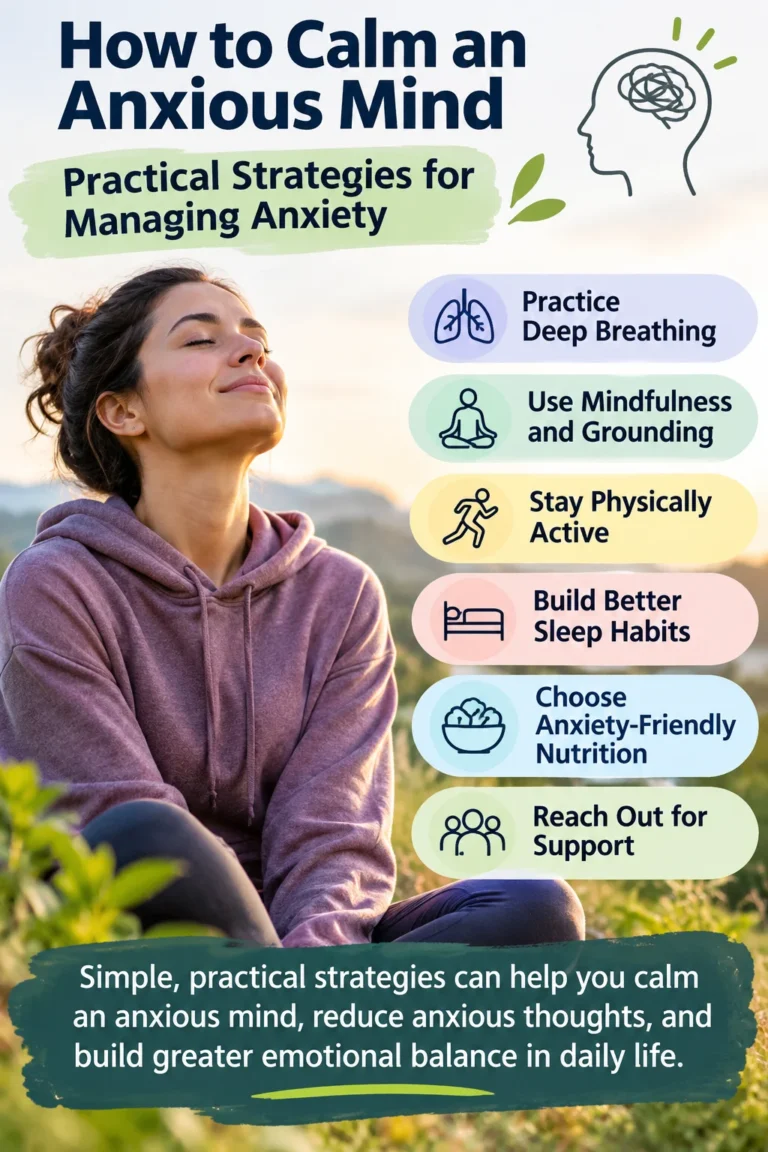
Introduction
An anxious mind can make even ordinary moments feel more difficult than they need to be. A simple decision may seem complicated, an upcoming responsibility may feel overwhelming, and finding a moment of mental quiet can become challenging. Sometimes, the more someone tries to force themselves to feel calm, the more frustrated they become when those feelings do not immediately settle.
Learning how to calm an anxious mind is not about eliminating every uncomfortable thought or expecting yourself to remain relaxed throughout the day. It is about developing practical ways to respond when anxiety arises, regain a sense of direction, and approach difficult moments with greater patience.
For some people, a helpful starting point may be shifting attention towards their immediate surroundings. Others may find comfortable breathing, gentle physical relaxation, or breaking a demanding task into smaller steps more useful. There is no single approach that works equally well for everyone, and discovering what feels helpful may take time.
If you have been following our MentalHealthNest anxiety series, you may already understand how anxiety can influence thoughts, emotions, sleep and everyday experiences. This guide takes the next step by focusing on practical responses. Rather than explaining anxiety again, it explores ways to approach anxious moments with greater awareness and flexibility.
You do not need to master every technique or practise everything at once. Even identifying one manageable action that helps you respond differently to a difficult moment can be a useful starting point.
Importantly, self-help strategies are not a substitute for professional care when anxiety is persistent, overwhelming or interfering with everyday life. Support from a qualified healthcare professional can help people understand their experiences and explore appropriate options.
Quick Answer: How Can You Calm an Anxious Mind?
You can begin calming an anxious mind by gently bringing your attention back to the present, slowing down your response to stressful situations, practising comfortable breathing, and choosing one manageable next step. Grounding, relaxation and mindful attention may also help. Different approaches work for different people, and persistent anxiety may require professional support.
KEY TAKEAWAYS
- Start with the present: Bringing your attention towards your immediate surroundings may help when anxious feelings become overwhelming.
- Choose manageable actions: Breaking a difficult task into smaller steps can make the next decision feel more approachable.
- Explore grounding techniques: Paying attention to what you can see, hear and physically feel may help redirect your attention.
- Practice comfortable relaxation: Gentle breathing and muscle relaxation may help some people manage moments of tension.
- Respond to thoughts with awareness: You do not have to accept every anxious thought as fact or struggle to eliminate every uncomfortable feeling.
- Find approaches that suit you: Different techniques may work differently depending on the person and situation.
- Recognise when additional support matters: Self-help strategies can be useful, but they do not replace professional assessment or appropriate treatment when needed.
1. How to Calm an Anxious Mind: Understanding What May Help
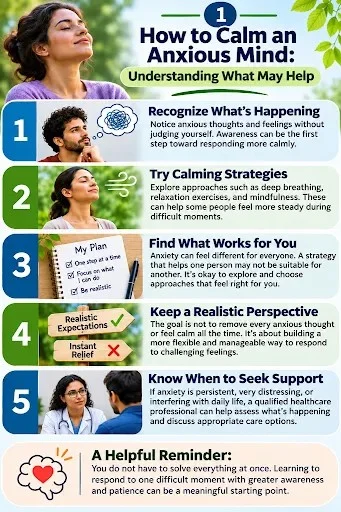
This infographic presents five practical approaches to responding to anxiety: recognizing anxious thoughts and feelings, exploring breathing and mindfulness techniques, choosing personally suitable strategies, maintaining realistic expectations, and seeking professional support when anxiety interferes with daily life. A closing reminder emphasizes patience, awareness, and taking one manageable step at a time.
Calming an anxious mind does not always mean making every worry disappear. Sometimes, it begins with recognising what is happening, allowing yourself a moment to pause, and choosing a more manageable way to respond. Practical anxiety-management strategies can help some people navigate difficult moments without expecting immediate or complete relief.
WHAT DOES IT MEAN TO CALM AN ANXIOUS MIND?
Calming an anxious mind means developing ways to respond to anxious thoughts and feelings without allowing them to dictate every decision or action. It may involve redirecting attention, becoming more aware of the present moment, practising relaxation, or approaching a difficult situation one step at a time.
The goal is not to eliminate normal emotions. Anxiety is a human response, and experiencing it occasionally does not necessarily indicate a mental-health condition. Instead, the aim is to develop a more flexible relationship with uncomfortable feelings so that they become easier to navigate.
For example, imagine that you have an important responsibility approaching. You may notice that it is becoming difficult to concentrate on anything else. Rather than demanding that your mind become completely quiet, you might acknowledge the feeling, identify what needs attention first, and give yourself permission to address one part of the situation at a time.
This small change in approach can make a difficult moment feel more manageable.
WHY IS FINDING THE RIGHT ANXIETY-MANAGEMENT APPROACH IMPORTANT?
People do not all experience anxiety in the same way. A strategy that feels helpful to one person may feel uncomfortable or ineffective to another. Personal circumstances, the intensity of the experience and individual preferences can all influence which approaches feel suitable.
Research and clinical guidance recognise several approaches that may support anxiety management, including mindfulness, relaxation practices, breathing exercises and structured psychological therapies. However, these approaches do not have identical purposes or levels of evidence.
Some people may find mindfulness, meditation or relaxation practices useful as complementary ways to manage stress and anxiety symptoms. Their usefulness can vary, and they should not replace evidence-based treatment when someone has an anxiety disorder.
Finding a suitable approach is therefore more useful than trying to follow every available technique.
CALMING YOUR MIND IS NOT ABOUT CONTROLLING EVERY THOUGHT
One common misconception is that successfully managing anxiety means always thinking positively or maintaining complete control over your emotions.
In reality, uncomfortable thoughts and feelings can arise even when someone is making healthy choices. Trying to suppress every unwanted thought or becoming frustrated whenever anxiety returns may add unnecessary pressure.
A more realistic approach involves recognising that an uncomfortable feeling can be present without requiring an immediate reaction. You can acknowledge what you are experiencing while still deciding how you want to respond.
This distinction is important: you do not have to feel completely calm before taking a reasonable next step.
WHAT SHOULD YOU EXPECT FROM PRACTICAL ANXIETY-MANAGEMENT STRATEGIES?
It helps to approach these strategies with realistic expectations. Some may provide a sense of steadiness during a difficult moment, while others may become more useful through regular practice. Not every technique will suit every situation.
Consider these three principles:
- Flexibility: You can explore different approaches rather than assuming one technique will work for every experience.
- Patience: A strategy may take practice, and its usefulness may vary from one day to another.
- Realistic expectations: The purpose is to develop helpful ways of responding, not to guarantee that anxiety will disappear.
It is also important to recognise the limits of self-help. When anxiety is persistent, particularly distressing or interfering with everyday activities, a qualified healthcare professional can help assess what is happening and discuss appropriate care options.
A helpful reminder: You do not have to solve everything at once. Learning to respond to one difficult moment with greater awareness and patience can be a meaningful starting point.
2. What to Do When Your Mind Feels Overwhelmed by Anxiety
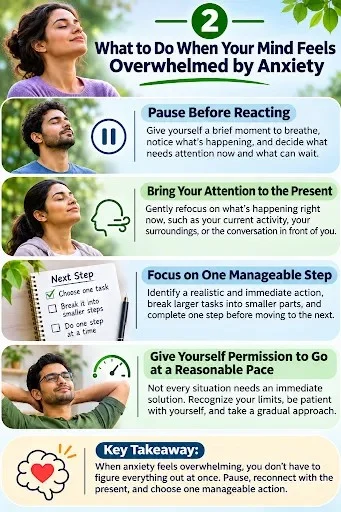
This infographic presents four practical ways to respond when anxiety feels overwhelming. It illustrates pausing before reacting, bringing attention back to the present, focusing on one manageable next step, and allowing yourself to move at a reasonable pace. Realistic human imagery, calming nature backgrounds, and simple visual symbols reinforce each concept. The final takeaway encourages pausing, reconnecting with the present, and choosing one manageable action instead of trying to solve everything at once.
When anxiety feels overwhelming, even deciding what to do next can become difficult. You may feel pressure to resolve everything immediately, regain control of your thoughts, or find a way to make the uncomfortable feeling disappear. However, responding to an anxious moment does not require solving every concern at once.
A more manageable approach is to slow down your response, reconnect with what is happening around you, and identify one small action you can take. These steps may help you approach a difficult moment with greater clarity rather than reacting to everything at the same time.
PAUSE AND GIVE YOURSELF A MOMENT BEFORE REACTING
When an anxious feeling becomes intense, your first instinct may be to respond immediately. You might rush into making a decision, abandon a task, or try to resolve several concerns simultaneously.
Giving yourself a brief pause can create an opportunity to respond more thoughtfully.
A pause does not mean ignoring a responsibility or avoiding a difficult situation. It simply means allowing yourself a little time before deciding what to do.
For example, imagine receiving an unexpected message about a responsibility you were not prepared for. You may immediately feel pressured to respond, explain yourself or find a solution. Instead, take a moment to understand what the message actually requires before deciding how to proceed.
During this pause, you might:
- Give yourself permission not to answer immediately when an immediate response is unnecessary.
- Notice what is happening without criticising yourself for feeling anxious.
- Separate what requires attention now from what can reasonably wait.
- Remind yourself that you can make decisions one at a time.
The purpose is not to force yourself to become calm. It is to avoid adding unnecessary pressure to an already difficult moment.
BRING YOUR ATTENTION BACK TO THE PRESENT
Anxiety can make it difficult to stay focused on what is happening right now. Your attention may move towards possible outcomes, upcoming responsibilities or situations that have not yet occurred.
When this happens, gently returning your attention to the present can help you reconnect with what is actually in front of you.
For example, if you are preparing for an ordinary daily responsibility but feel distracted by uncertainty about what might happen later, consider what needs your attention at this particular moment.
You do not need to answer every future question immediately. You can recognise that uncertainty exists while still giving your attention to the task in front of you.
A few simple ways to practise this include:
- Notice the immediate activity you are engaged in.
- Identify what is happening around you rather than focusing exclusively on imagined outcomes.
- Give your attention to one conversation or responsibility at a time.
- Remind yourself that something you are concerned about has not necessarily happened.
This is not about pretending that future responsibilities do not matter. It is about recognising that the present moment is often the only place where you can take a practical next step.
FOCUS ON ONE MANAGEABLE NEXT STEP
When several responsibilities or concerns compete for your attention, the entire situation may begin to feel difficult to handle. Trying to resolve everything simultaneously can increase the sense of pressure.
Instead, identify one action that is realistic and within your control.
For instance, if you have several unfinished responsibilities, you might begin by organising the information needed for the first task rather than thinking about everything that remains incomplete.
You could approach this by:
- Identifying the most immediate priority.
- Dividing a larger responsibility into smaller actions.
- Choosing something achievable rather than demanding perfection.
- Allowing yourself to complete one step before deciding what comes next.
Small actions do not necessarily remove anxiety, but they can make a demanding situation feel more approachable.
It is equally important to recognise when a responsibility genuinely needs more time, assistance or a different approach. Taking one step does not mean you must manage everything independently.
GIVE YOURSELF PERMISSION TO MOVE AT A REASONABLE PACE
Not every difficult moment needs an immediate solution. Sometimes, the most helpful response is to recognise your limits and allow yourself to approach a situation gradually.
You may not feel completely comfortable before taking the next step. That does not mean you are doing something wrong.
A helpful reminder: When anxiety feels overwhelming, you do not have to figure everything out at once. Pause, reconnect with the present and choose one manageable action. Progress can begin with a small, realistic decision rather than a complete solution.
3. Practical Grounding Techniques to Help Settle an Anxious Mind
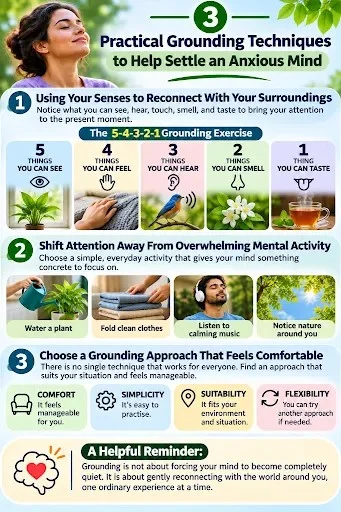
This infographic illustrates three practical grounding approaches for managing anxious feelings. The first presents the 5-4-3-2-1 sensory exercise, using examples of things to see, feel, hear, smell, and taste. The second shows everyday activities such as watering plants, folding clothes, listening to music, and observing nature to redirect attention towards the present. The third highlights four considerations when choosing a grounding technique: comfort, simplicity, suitability, and flexibility. A closing reminder explains that grounding is about gently reconnecting with the surrounding world rather than forcing the mind to become completely quiet.
When anxious feelings make it difficult to concentrate on your surroundings, grounding techniques may offer a simple way to reconnect with the present moment. These approaches direct attention towards immediate sensory experiences, familiar surroundings or a specific activity rather than allowing attention to remain entirely focused on internal concerns.
Grounding does not require special equipment, extensive preparation or a complicated routine. Some approaches involve noticing what you can see and hear, while others involve paying attention to physical sensations or an ordinary activity. Their purpose is not to eliminate anxiety instantly but to provide a practical way of engaging with the present.
USING YOUR SENSES TO RECONNECT WITH YOUR SURROUNDINGS
One accessible grounding approach involves deliberately noticing information received through your senses. Paying attention to your surroundings can help shift your focus towards experiences that are happening right now.
For example, if you are sitting in a room and feeling unsettled, you might notice the natural light coming through a window, the sound of a nearby conversation, or the feeling of your feet resting against the floor.
You can explore this approach through a simple sensory exercise:
- Sight: Notice a few objects around you, including their shapes, colours and positions.
- Sound: Identify the sounds you can hear, whether they come from nearby activities or the surrounding environment.
- Touch: Notice the texture of an object you are holding or the sensation of your feet resting on the ground.
- Smell: Become aware of familiar or neutral scents in your surroundings.
- Taste: Notice the taste or sensation in your mouth without trying to change it.
You do not need to identify something through every sense. Choose whichever experiences feel natural and comfortable.
Some people also use the familiar 5-4-3-2-1 grounding exercise, which involves identifying five things they can see, four they can feel, three they can hear, two they can smell and one they can taste.
The exercise is simply an organised way to direct attention towards sensory information. It is not a diagnostic test or a guaranteed method of stopping anxiety.
SHIFTING ATTENTION AWAY FROM OVERWHELMING MENTAL ACTIVITY
Grounding can also involve choosing an ordinary activity that gives your attention something concrete to engage with.
For instance, you might water a plant, arrange a few items on a table, fold clean clothes or listen carefully to familiar environmental sounds.
These activities do not need to be particularly meaningful or productive. Their value may come from providing a clear and manageable point of attention.
Consider someone sitting at home who finds it difficult to concentrate because their mind feels unsettled. Instead of demanding that every uncomfortable thought disappear, they might choose to organise a small part of their surroundings or spend a few minutes noticing the details of an everyday object.
The activity creates an opportunity to engage with something tangible.
A few other possibilities include:
- Describing an object in your surroundings using simple details.
- Listening to a familiar piece of instrumental music.
- Noticing the movement of leaves or clouds outside.
- Gently handling a familiar object and observing its texture.
- Paying attention to the physical sensations involved in an ordinary activity.
The intention is not to escape every uncomfortable feeling. It is to give your attention another place to rest.
CHOOSING A GROUNDING APPROACH THAT FEELS COMFORTABLE
There is no single grounding exercise that suits everyone. A technique that feels helpful in one situation may feel distracting or uncomfortable in another.
Your environment, personal preferences and immediate circumstances can influence which approach feels appropriate.
For example, someone who finds busy surroundings distracting may prefer noticing a familiar object in a quiet room. Another person may find it more natural to listen to environmental sounds or engage in a simple household activity.
When choosing a grounding approach, consider:
- Comfort: Does the exercise feel manageable rather than demanding?
- Simplicity: Can you practise it without complicated instructions?
- Suitability: Does it fit your surroundings and current circumstances?
- Flexibility: Can you change approaches if one does not feel helpful?
It is also important to recognise that grounding may not make anxiety disappear. Some people may experience little immediate change, while others may find that it helps them reconnect with their surroundings.
If focusing on sensory experiences feels uncomfortable or increases distress, you do not need to force yourself to continue. Choose another gentle approach or seek guidance from a qualified professional if you need additional support.
A helpful reminder: Grounding is not about forcing your mind to become completely quiet. It is about gently reconnecting with the world around you, one ordinary experience at a time.
4. How to Use Breathing and Relaxation to Respond to Anxious Feelings
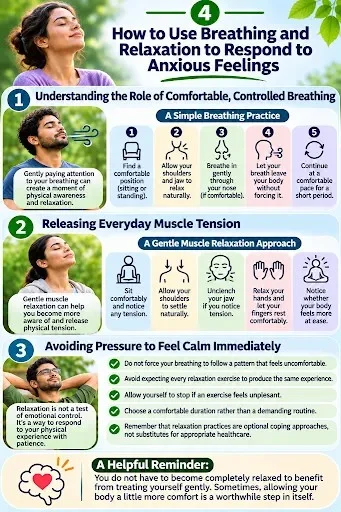
This infographic presents three approaches to responding to anxious feelings. The first illustrates comfortable, controlled breathing through five simple steps, including finding a comfortable position, relaxing the shoulders and jaw, breathing gently, and maintaining a natural pace. The second demonstrates releasing everyday muscle tension by relaxing the shoulders, unclenching the jaw, and allowing the hands to rest comfortably. The third highlights realistic expectations, reminding readers not to force breathing patterns, expect immediate results, or continue exercises that feel uncomfortable. A final reminder emphasizes that treating the body gently can be worthwhile even without complete relaxation.
When anxiety arises, some people notice that their breathing becomes less comfortable or that they are holding tension in different parts of their bodies. These experiences can make an already difficult moment feel more uncomfortable.
Breathing and relaxation practices offer ways to pay attention to these physical responses without demanding immediate emotional relief. They can be incorporated into everyday routines and adjusted to suit individual comfort.
These approaches are not intended to eliminate anxiety or replace professional treatment. Rather, they provide practical options that some people may find helpful when responding to anxious feelings.
UNDERSTANDING THE ROLE OF COMFORTABLE, CONTROLLED BREATHING
Breathing is an automatic bodily function, but it is also something we can consciously influence. During stressful moments, some people notice that their breathing becomes quicker, shallower or less comfortable.
Gently paying attention to breathing may help create a moment of physical awareness and relaxation.
One simple approach is to allow your breathing to become slow and comfortable without forcing deep breaths or holding your breath for extended periods.
You can try the following:
- Find a comfortable position, either sitting or standing.
- Allow your shoulders and jaw to relax naturally.
- Breathe in gently through your nose if comfortable.
- Let your breath leave your body without forcing it.
- Continue at a comfortable pace for a short period.
There is no need to count every breath or achieve a particular breathing pattern. The aim is to practise comfortable breathing rather than turn relaxation into another task that must be performed perfectly.
If you feel dizzy, breathless or uncomfortable, stop the exercise and return to your natural breathing. People experiencing persistent or concerning breathing difficulties should seek appropriate medical advice rather than assume anxiety is the cause.
RELEASING EVERYDAY MUSCLE TENSION
Anxiety and stress can sometimes be accompanied by muscle tension. People may notice that they are holding their shoulders tightly, clenching their jaw or keeping their hands tense without consciously realising it.
Gentle muscle relaxation offers another way to respond to this physical discomfort.
One approach is progressive muscle relaxation, a technique that involves deliberately tensing and then relaxing selected muscle groups. It can help people become more aware of the difference between physical tension and relaxation.
For a gentle introduction, you can:
- Sit comfortably and notice whether your shoulders feel tense.
- Allow your shoulders to settle into a natural position.
- Unclench your jaw if you notice that you are holding it tightly.
- Relax your hands and allow your fingers to rest comfortably.
- Notice whether your body feels more at ease afterwards.
You do not need to tense muscles forcefully. If you experience pain, an injury or another physical limitation, avoid movements that cause discomfort.
Some people prefer a guided progressive muscle relaxation exercise, which can provide instructions for different muscle groups.
The purpose is to develop awareness of physical tension and explore a comfortable way of releasing it.
AVOIDING PRESSURE TO FEEL CALM IMMEDIATELY
One of the most important aspects of relaxation is understanding that it does not always produce an immediate change in how you feel.
You may practise comfortable breathing or relax your shoulders and still experience anxious thoughts. This does not mean that you have done something incorrectly.
Relaxation is not a test of emotional control. It is an opportunity to respond to your physical experience with patience rather than additional pressure.
For example, someone preparing for an important responsibility may try a short breathing exercise but continue to feel nervous afterwards. Instead of becoming frustrated, they can recognise that feeling nervous and taking a useful next step are not mutually exclusive.
Keep these points in mind:
- Do not force your breathing to follow a pattern that feels uncomfortable.
- Avoid expecting every relaxation exercise to produce the same experience.
- Allow yourself to stop if an exercise feels unpleasant.
- Choose a comfortable duration rather than following an unnecessarily demanding routine.
- Remember that relaxation practices are optional coping approaches, not substitutes for appropriate healthcare.
A helpful reminder: You do not have to become completely relaxed to benefit from treating yourself gently. Sometimes, allowing your body a little more comfort is a worthwhile step in itself.
5. How to Respond to Anxious Thoughts Without Fighting Them
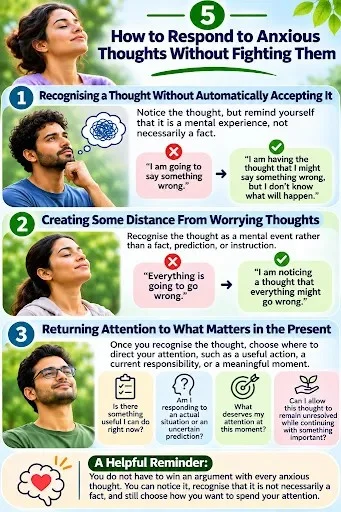
This infographic illustrates three ways to respond to anxious thoughts without fighting or automatically accepting them. The first explains how to recognize a thought without treating it as an established fact, using an example of an uncertain prediction. The second demonstrates cognitive distancing by changing absolute worrying statements into observations about thoughts. The third presents questions that help redirect attention towards practical actions, actual circumstances, and meaningful present-moment activities. A closing reminder emphasizes that people do not need to argue with every anxious thought and can choose where to direct their attention.
Anxious thoughts can sometimes feel convincing, particularly when a situation is uncertain or emotionally difficult. You may notice yourself reacting to a thought as though it were an established fact, even when you do not have enough information to know what will happen.
Learning to respond differently does not mean ignoring your concerns or forcing yourself to think positively. It means recognising that a thought is a mental experience, not necessarily an accurate description of reality.
This distinction can help you approach uncomfortable thoughts with greater perspective and avoid treating every anxious prediction as something that requires an immediate response.
RECOGNISING A THOUGHT WITHOUT AUTOMATICALLY ACCEPTING IT
One useful starting point is learning to notice the difference between having a thought and accepting that thought as true.
For example, imagine that you have an important conversation approaching. An anxious thought might arise: “I am going to say something wrong.”
The thought may feel convincing, but you cannot know in advance exactly how the conversation will unfold.
Instead of immediately believing the prediction, you can acknowledge it:
“I am having the thought that something might go wrong, but I do not know what will happen.”
This simple change in language creates room to consider the thought without treating it as a confirmed outcome.
You can practise this approach by:
- Noticing when a thought appears.
- Identifying whether it describes something that has happened or predicts something that might happen.
- Avoiding the assumption that a strong feeling automatically makes a thought accurate.
- Allowing uncertainty to exist without demanding an immediate answer.
The intention is not to dismiss genuine concerns. If a situation requires practical attention, you can still take appropriate action while recognising that anxious predictions are not established facts.
CREATING SOME DISTANCE FROM WORRYING THOUGHTS
Creating distance from a thought means recognising it without becoming completely absorbed in its message.
In psychological approaches such as cognitive defusion, people learn to observe thoughts as mental events rather than automatically treating them as instructions, facts or predictions.
For instance, compare these two statements:
- “Everything is going to go wrong.”
- “I am noticing a thought that everything might go wrong.”
The second statement does not guarantee a better outcome or make uncertainty disappear. However, it can help you recognise that you are experiencing a thought rather than describing something that has definitely happened.
Another example might involve making a mistake at work. Instead of interpreting one mistake as proof that you are incapable, you could recognise the thought, consider the available information and decide whether anything genuinely needs correcting.
A few gentle ways to practise creating distance include:
- Describe the experience as a thought rather than a fact.
- Notice the words or predictions appearing in your mind without immediately responding to them.
- Avoid spending unnecessary effort trying to prove that every uncomfortable thought is wrong.
- Give yourself permission to leave an unanswered question unanswered when no immediate decision is required.
These approaches are not about suppressing thoughts. They are about changing how you respond to them.
RETURNING ATTENTION TO WHAT MATTERS IN THE PRESENT
Once you recognise that a thought does not necessarily require an immediate response, you can choose where to direct your attention.
This does not mean forcing yourself to stop thinking. It means deciding whether the thought requires practical action now or whether you can return to something meaningful in your present circumstances.
For example, imagine that you are spending time with someone important to you, but an uncertain thought keeps drawing your attention away from the conversation.
You might acknowledge that the thought is present and gently return your attention to the person speaking. You do not have to resolve every uncertainty before participating in an ordinary moment.
You can use a similar approach when working, studying, completing household responsibilities or enjoying an activity.
Consider these questions:
- Is there something useful I can do about this concern right now?
- Am I responding to an actual situation or to an uncertain prediction?
- What deserves my attention at this moment?
- Can I allow this thought to remain unresolved while continuing with something important?
These questions are intended to support awareness, not provide a diagnostic test or require you to challenge every thought.
Sometimes, a concern genuinely deserves attention. At other times, you may find that returning to the present is a more useful response.
A helpful reminder: You do not have to win an argument with every anxious thought. You can notice it, recognise that it is not necessarily a fact, and still choose how you want to spend your attention.
6. How Small Everyday Actions Can Help When Anxiety Feels Difficult to Manage
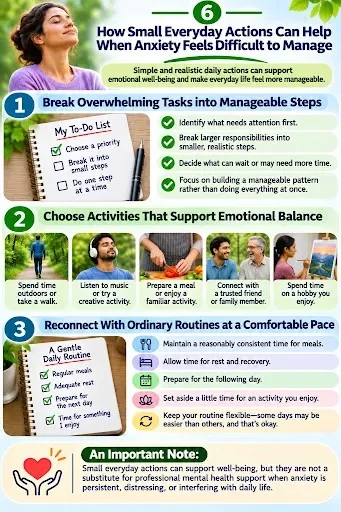
This infographic presents three practical ways small everyday actions may support emotional well-being when anxiety feels difficult to manage. The first illustrates breaking overwhelming responsibilities into manageable steps by identifying priorities, dividing larger tasks, and allowing some activities to wait. The second highlights enjoyable activities such as walking outdoors, listening to music, preparing meals, connecting with trusted people, and pursuing hobbies. The third presents flexible daily routines involving regular meals, adequate rest, preparation for the following day, and time for enjoyable activities. A final note reminds readers that everyday actions can support well-being but do not replace professional mental health care when anxiety is persistent, distressing, or interferes with daily life.
Managing anxiety does not always require major lifestyle changes. Sometimes, small and realistic adjustments to everyday life can make it easier to maintain a sense of structure, stay connected with meaningful activities, and respond to daily demands. These actions are not a cure for anxiety, but they may support emotional well-being over time.
BREAKING OVERWHELMING TASKS INTO MANAGEABLE STEPS
When several responsibilities compete for attention, everyday activities can begin to feel harder to manage. Instead of expecting yourself to complete everything at once, consider creating a realistic order for your priorities. For example, if household responsibilities, work commitments, or personal tasks are accumulating, identify what genuinely needs attention first. You can then decide what can wait and what may need additional time or support. This is not about increasing productivity or putting pressure on yourself. It is about making daily responsibilities feel more approachable. If you have already identified one immediate action during an anxious moment, this approach extends that idea into everyday planning. The aim is to develop a manageable pattern rather than repeatedly pushing yourself to do more.
CHOOSING ACTIVITIES THAT SUPPORT EMOTIONAL BALANCE
Activities that provide enjoyment, connection, or a sense of purpose can contribute to everyday emotional well-being. Their value does not depend on being productive or achieving a particular result. Depending on your interests and circumstances, you might consider:
- Spending time outdoors or taking a comfortable walk.
- Listening to music or engaging in a creative activity.
- Preparing a meal or enjoying another familiar activity.
- Connecting with a trusted friend or family member.
- Spending time on a hobby that gives you a welcome change of focus.
You do not need to follow a fixed list or schedule. Choose activities that feel appropriate for your circumstances, energy, and preferences. If an activity feels like another obligation, it is reasonable to adjust it or choose something else.
RECONNECTING WITH ORDINARY ROUTINES AT A COMFORTABLE PACE
Anxiety can sometimes make everyday routines feel less consistent. Reconnecting with familiar activities may help restore a sense of continuity without requiring a strict schedule. You might begin by maintaining a reasonably consistent time for meals, allowing time for rest, preparing for the following day, or setting aside a little time for an activity you enjoy. These are examples, not rules that everyone must follow. Try to approach routines flexibly. Some days may be easier than others, and changes in circumstances may affect what feels realistic. Missing a planned activity does not mean you have failed. You can return to your routine when it feels manageable. The central idea is to build a daily rhythm that supports your well-being rather than creating another source of pressure. Small actions may contribute to a more balanced routine, but they should not be presented as a substitute for professional mental health support when anxiety is persistent, distressing, or interfering with everyday life.
7. How to Develop a Personal Approach to Managing Anxious Moments
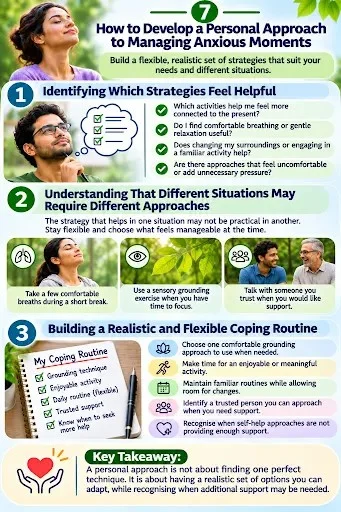
This infographic illustrates three steps for developing a personal approach to managing anxious moments. The first encourages identifying strategies that feel helpful by reflecting on personal experiences with breathing, relaxation, grounding, and familiar activities. The second explains why different situations may require different approaches, showing comfortable breathing, sensory grounding, and conversations with trusted people as examples. The third presents a flexible coping routine that includes grounding techniques, enjoyable activities, familiar daily routines, trusted support, and recognizing when additional help may be needed. A final takeaway emphasizes choosing adaptable strategies rather than searching for one perfect technique.
There is no single anxiety management strategy that works equally well for everyone or in every situation. A grounding exercise may help someone reconnect with the present, while another person may find a quiet activity, gentle relaxation, or a conversation with someone they trust more useful. Developing a personal approach means understanding which options feel appropriate and learning when to use them.
IDENTIFYING WHICH STRATEGIES FEEL HELPFUL
After trying different approaches, take a little time to notice how each one affects your experience. You do not need to measure your progress or expect every technique to produce an immediate change. Consider reflecting on questions such as:
- Which activities help me feel more connected to the present?
- Do I find comfortable breathing or gentle relaxation useful?
- Does changing my surroundings or engaging in a familiar activity help?
- Are there approaches that feel uncomfortable or add unnecessary pressure?
Your observations can help you distinguish between strategies that suit your needs and those that may not be appropriate for you. It is perfectly reasonable to stop using an approach that feels uncomfortable.
UNDERSTANDING THAT DIFFERENT SITUATIONS MAY REQUIRE DIFFERENT APPROACHES
Anxious moments do not always happen under the same circumstances. A strategy that feels useful during a quiet evening may not be practical during a busy workday or an unfamiliar social situation. For example, taking a few comfortable breaths may be convenient during a short break, while a sensory grounding exercise may be more suitable when you have time to focus on your surroundings. Talking with someone you trust may also be helpful when you would prefer support rather than managing the moment alone. The important point is to remain flexible. You do not have to use every technique or follow the same sequence whenever anxiety arises. Consider the situation, your surroundings, and what feels manageable at that time.
BUILDING A REALISTIC AND FLEXIBLE COPING ROUTINE
A personal coping routine does not need to be complicated. It can simply involve keeping a few familiar strategies in mind and making space for activities that support your everyday well-being. For example, your routine might include:
- Choosing one comfortable grounding approach to use when you need to reconnect with the present.
- Making time for an enjoyable or meaningful everyday activity.
- Maintaining familiar routines while allowing room for changes.
- Identifying a trusted person you can approach when you need support.
- Recognising when self-help approaches are not providing enough support.
Think of this routine as a flexible guide rather than a set of rules. Your needs may change over time, and it is reasonable to adjust your approach accordingly. If anxiety continues to cause significant distress or interferes with work, relationships, sleep, or other parts of daily life, consider speaking with a qualified mental health professional. A professional can help you understand your needs and discuss appropriate support options. A personal approach to managing anxious moments is not about finding one perfect technique. It is about developing a realistic set of options that you can adapt to different situations, while recognising when additional support may be needed.
8. What If You Still Feel Anxious After Trying These Strategies?
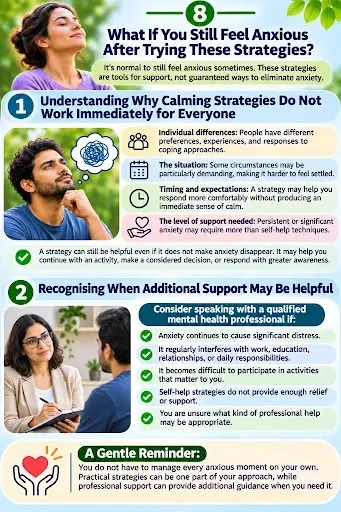
This infographic explains what to consider when anxiety continues despite trying practical coping strategies. The first section highlights four factors that may influence the usefulness of calming techniques: individual differences, the situation, timing and expectations, and the level of support needed. It also explains that a strategy may still be helpful even when anxiety does not disappear. The second section identifies circumstances in which professional support may be appropriate, including persistent distress, interference with everyday responsibilities, difficulty participating in meaningful activities, and insufficient support from self-help approaches. A final reminder emphasizes that practical strategies and professional mental health care can complement one another.
Trying practical anxiety management strategies does not mean anxious feelings will always disappear. You may practise grounding, comfortable breathing, relaxation, or other approaches and still experience anxiety. This does not mean you have failed or that you are doing something wrong. These strategies are tools for responding to difficult moments, not guaranteed ways to eliminate anxiety.
UNDERSTANDING WHY CALMING STRATEGIES DO NOT WORK IMMEDIATELY FOR EVERYONE
People experience anxiety differently, and the same strategy may have different effects depending on the person, situation, and circumstances. A technique that feels useful one day may be less helpful on another. Several factors may influence your experience:
- Individual differences: People have different preferences, experiences, and responses to coping approaches.
- The situation: Some circumstances may be particularly demanding, making it harder to feel settled.
- Timing and expectations: A strategy may help you respond more comfortably without producing an immediate sense of calm.
- The level of support needed: Persistent or significant anxiety may require more than self-help techniques.
It is also important not to judge a strategy only by whether it makes anxiety disappear. Sometimes, its value may lie in helping you continue with an activity, make a considered decision, or respond to a situation with greater awareness. You do not need to keep repeating a technique that feels uncomfortable or unhelpful. It is reasonable to try a different approach or seek guidance.
RECOGNISING WHEN ADDITIONAL SUPPORT MAY BE HELPFUL
Self-help strategies can be useful, but they are not a replacement for professional care when anxiety becomes difficult to manage independently. Consider speaking with a qualified mental health professional if:
- Anxiety continues to cause significant distress.
- It regularly interferes with work, education, relationships, or daily responsibilities.
- It becomes difficult to participate in activities that matter to you.
- Self-help strategies do not provide enough relief or support.
- You are unsure what kind of professional help may be appropriate.
Remember: You do not have to manage every anxious moment on your own. Practical strategies can be one part of your approach, while professional support can provide additional guidance when you need it.
Frequently Asked Questions
CONCLUSION
Learning how to calm an anxious mind is not about controlling every thought or expecting uncomfortable feelings to disappear. It is about developing practical ways to respond to anxious moments, reconnect with the present, and approach everyday situations with greater flexibility.
Grounding, comfortable breathing, gentle relaxation, mindful attention, and supportive daily routines may help you manage difficult moments. However, no single strategy works for everyone, and progress does not always happen immediately. Give yourself room to discover which approaches feel helpful without turning anxiety management into another source of pressure.
If anxiety continues to cause significant distress or affects your relationships, work, sleep, or everyday responsibilities, consider speaking with a qualified mental health professional. You deserve appropriate support, and you do not have to rely on self-help strategies alone.
The important thing to remember is that managing anxiety is a personal process. Small, realistic steps can help you develop an approach that fits your circumstances, while professional guidance can provide additional support when needed.
EXPLORE MORE ON MENTALHEALTHNEST: ANXIETY SERIES
If you would like to understand other aspects of anxiety, explore these related MentalHealthNest articles:
- Anxiety Disorders: Understanding Symptoms, Types, and Treatment Learn about different anxiety disorders, their common symptoms, their effects on everyday life, and available assessment and treatment options.
- Overthinking and Anxiety: Why Your Mind Won’t Slow Down Explore repetitive worrying, anxious thought patterns, and practical approaches that may help.
- Anxiety vs. Stress: What’s the Difference and How Can You Tell? Understand how anxiety and stress differ, where they overlap, and when either may begin affecting everyday life.
- Anxiety vs. Depression: Understanding the Differences and Overlap Explore how anxiety and depression may differ, where symptoms can overlap, and why recognising these differences matters.
- Anxiety and Sleep: Why Anxiety Can Keep You Awake Discover how anxiety may interfere with sleep and how sleep difficulties and anxious thoughts can reinforce each other.
- Anxiety and Physical Symptoms: How Anxiety Can Affect the Body Understand how anxiety may be associated with physical experiences, including muscle tension, a racing heart, and digestive discomfort.
- Panic Attacks vs. Anxiety Attacks: What Is the Difference? Learn about panic attacks, how they differ from general experiences of anxiety, and why “anxiety attack” is not a formal clinical diagnosis.
- Health Anxiety: When Worry About Your Health Becomes Overwhelming Understand how persistent fears about illness can affect daily life and why appropriate medical guidance and mental health support may help.
- Social Anxiety in Adults: Symptoms, Causes, and What May Help Explore how fear of judgment or embarrassment may affect social situations, relationships, work, and everyday activities.
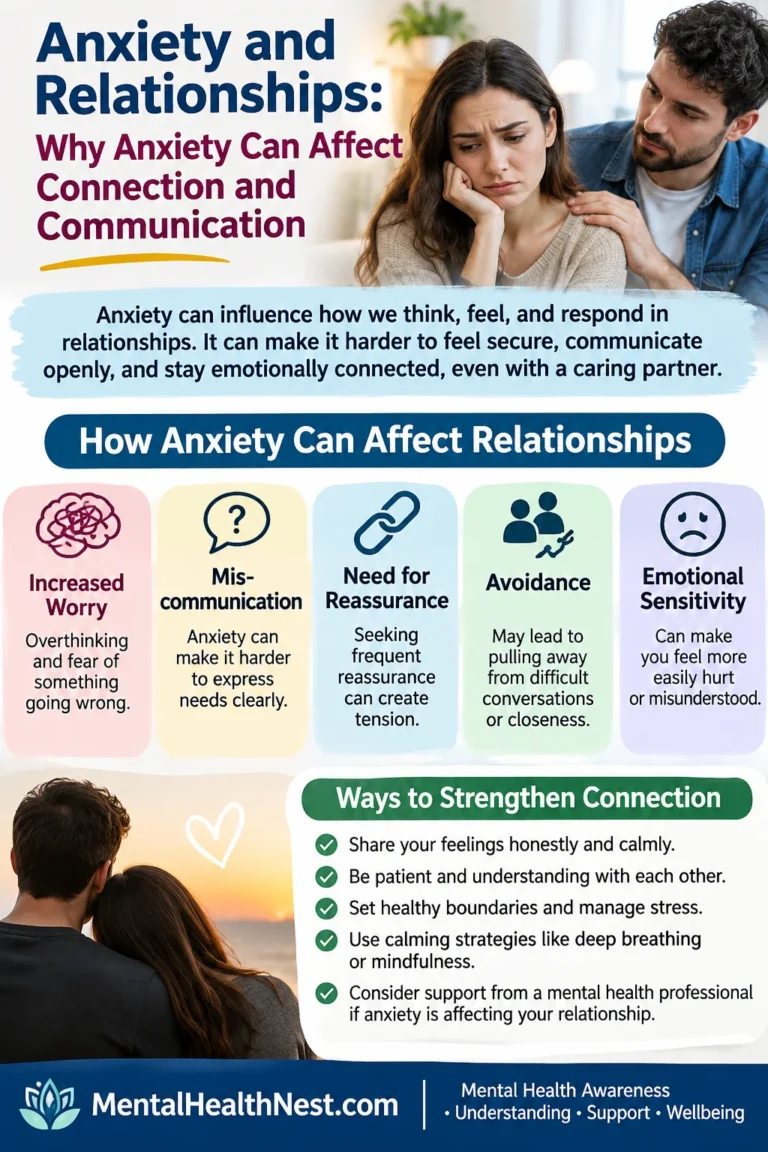
- Anxiety and Relationships: Why Anxiety Can Affect Connection and Communication Discover how anxiety may influence communication, trust, reassurance, and emotional connection.
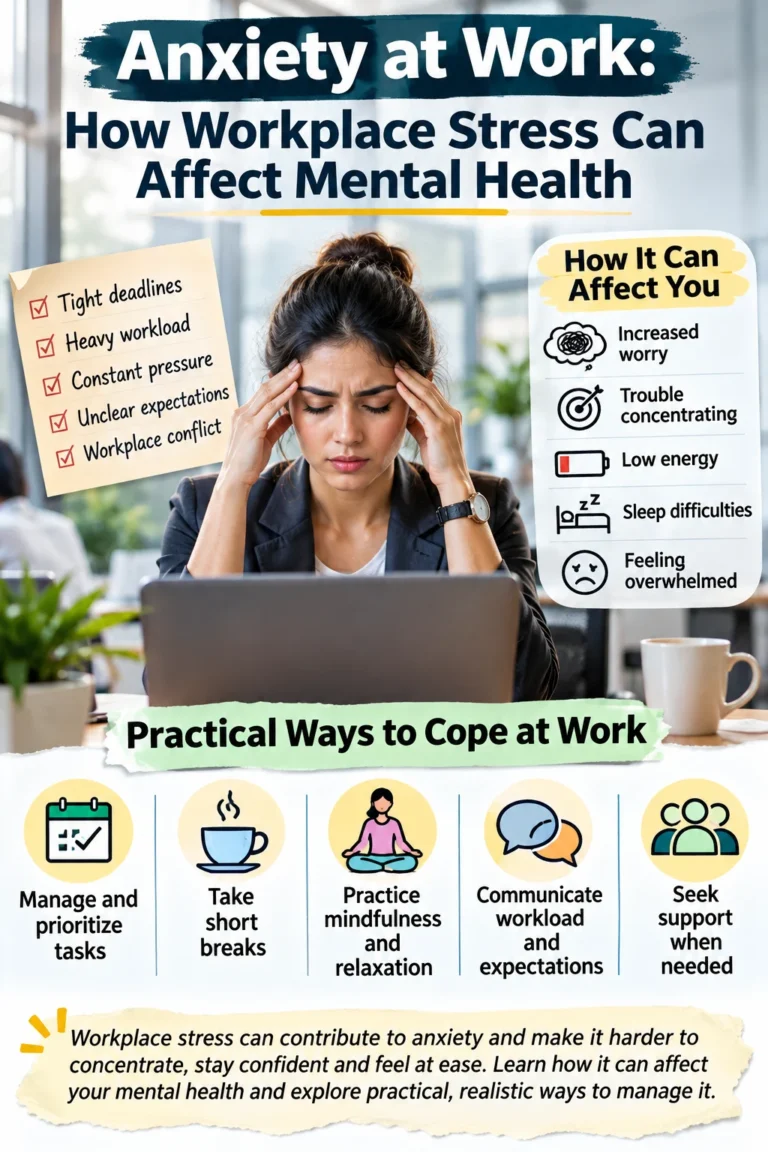
- Anxiety at Work: How Workplace Stress Can Affect Mental HealthLearn how workplace pressures and anxiety may interact and explore practical sources of support.
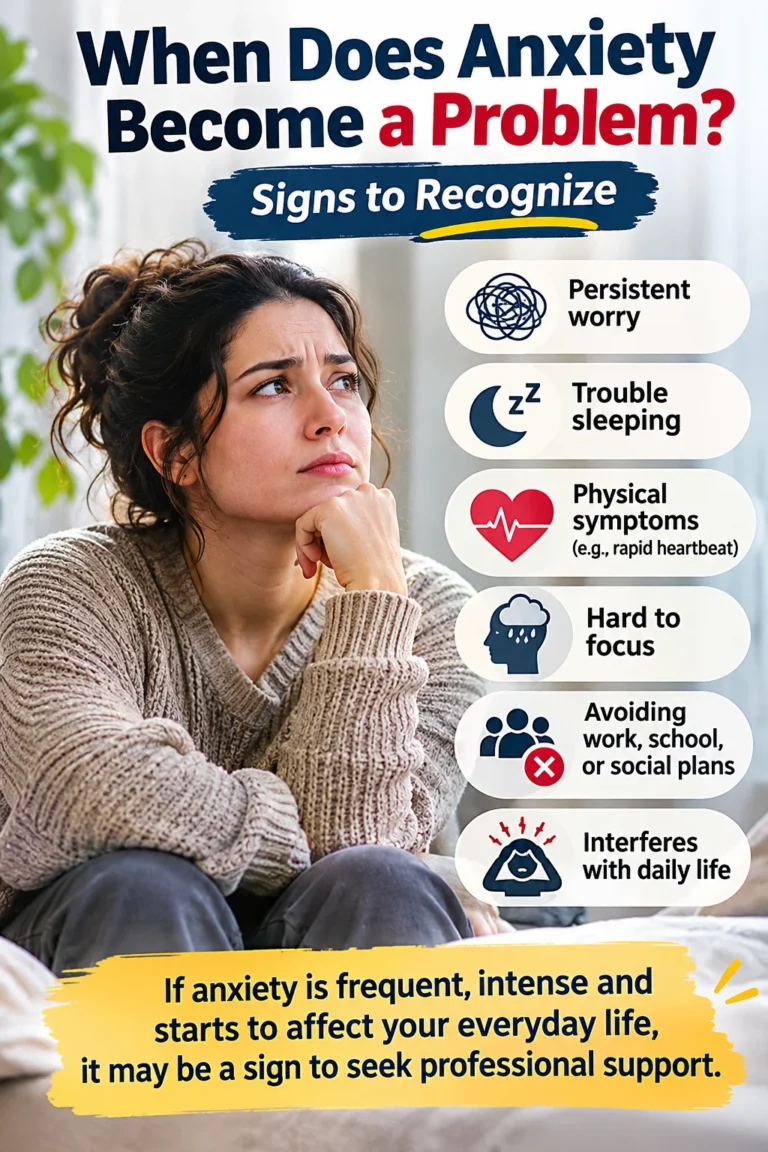
- When Does Anxiety Become a Problem? Understand when anxiety may be more than an occasional response to stress, particularly when it becomes persistent, difficult to manage, or disruptive to everyday activities.
These articles explore different aspects of anxiety, helping readers build a broader understanding of its effects and the support options available.
A NOTE TO OUR RETURNING READERS
If you have been following the MentalHealthNest anxiety series, thank you for continuing to explore these topics with us. Each article is intended to address a different aspect of the anxiety experience, without assuming that every reader has the same needs or circumstances.
We hope this guide has given you practical ideas to consider and a clearer understanding of how to approach anxious moments with patience and flexibility. Our aim is to make reliable mental health information easier to understand and useful in everyday life.
TRUSTED MENTAL HEALTH RESOURCE
Reliable mental health information can help readers make informed decisions about their well-being and understand where to find appropriate support. The following U.S. organizations and resources offer educational information about anxiety, mental health care, and available treatment services.
1. NATIONAL INSTITUTE OF MENTAL HEALTH (NIMH)
The National Institute of Mental Health is part of the National Institutes of Health (NIH). It provides research-based information about anxiety disorders, mental health conditions, psychotherapy, and treatment options.
Explore: NIMH – Anxiety Disorders
2. MEDLINEPLUS – U.S. NATIONAL LIBRARY OF MEDICINE
MedlinePlus provides reliable, easy-to-understand health information from the National Library of Medicine. Its anxiety resources include information about anxiety disorders, diagnosis, treatment, and related health topics.
Explore: MedlinePlus – Anxiety
3. SUBSTANCE ABUSE AND MENTAL HEALTH SERVICES ADMINISTRATION (SAMHSA)
SAMHSA is a U.S. federal agency that provides information about behavioral health services and access to mental health treatment. Its online resources can help individuals and families explore available support and treatment services.
Explore: SAMHSA – Find Help and Support
4. FINDTREATMENT.GOV
FindTreatment.gov is a confidential and anonymous U.S. treatment locator provided by SAMHSA. It helps people search for mental health and substance use treatment services in their area.
Explore: FindTreatment.gov
A note about these resources: These organizations provide educational information and access to support services. They do not replace an individual assessment or guidance from a qualified healthcare professional. Readers should consult an appropriate professional about personal mental health concerns.
REFERENCES
The following authoritative sources informed the mental health information presented in this article. They provide evidence-based guidance on anxiety, psychological approaches, grounding, relaxation techniques, and professional mental health care.
- National Institute of Mental Health (NIMH). Generalized Anxiety Disorder: What You Need to Know. Information about anxiety treatment, psychotherapy, cognitive behavioral therapy (CBT), and acceptance and commitment therapy (ACT).
https://www.nimh.nih.gov/health/publications/generalized-anxiety-disorder-gad - National Institute of Mental Health (NIMH). Psychotherapies. An overview of psychological treatments and approaches, including mindfulness and relaxation techniques.
https://www.nimh.nih.gov/health/topics/psychotherapies - World Health Organization (WHO). Doing What Matters in Times of Stress: An Illustrated Guide (2020). A practical guide covering grounding, awareness, unhooking from difficult thoughts, and values-based action.
https://www.who.int/publications/i/item/9789240003927 - National Center for Complementary and Integrative Health (NCCIH). Relaxation Techniques: What You Need to Know. Information about breathing exercises, progressive muscle relaxation, guided imagery, and the available research on relaxation approaches.
https://www.nccih.nih.gov/health/relaxation-techniques-what-you-need-to-know - National Institute for Health and Care Excellence (NICE). Generalised Anxiety Disorder and Panic Disorder in Adults: Management (CG113). Clinical recommendations concerning psychological interventions, guided self-help, and applied relaxation for adults.
https://www.nice.org.uk/guidance/cg113/chapter/recommendations
Evidence and interpretation note: These sources support the general educational information in this article. The WHO guide addresses stress-management skills, while the NCCIH review discusses relaxation techniques and their evidence limitations. Neither should be interpreted as establishing that an individual grounding or relaxation exercise is a proven treatment for an anxiety disorder. Professional assessment and evidence-based care remain important when anxiety causes significant distress or functional difficulties.
About MentalHealthNest: Editorial Policy and Content Standards
OUR MISSION
MentalHealthNest is a mental health education and awareness platform dedicated to helping readers better understand mental health, emotional well-being, common mental health conditions, and available support options. Our content is designed primarily for readers in the United States and aims to make reliable mental health information accessible, understandable, and useful.
EVIDENCE-INFORMED CONTENT
We aim to develop articles using credible health information, established research, and authoritative sources, including relevant U.S. government health agencies and recognized medical organizations. When discussing symptoms, mental health conditions, or treatment options, we seek to distinguish established information from emerging evidence and general educational guidance.
ACCURACY AND SOURCE TRANSPARENCY
Our editorial approach prioritizes factual accuracy, clear explanations, and appropriate references. Where relevant, articles link to trusted external resources so readers can explore the subject further. We aim to avoid unsupported medical claims, exaggerated promises, misleading headlines, and statements suggesting that one approach works for everyone.
CONTENT CREATION AND EDITORIAL REVIEW
Articles are prepared according to MentalHealthNest’s editorial standards, which emphasize reader needs, clear organization, responsible language, relevant internal linking, and evidence-informed explanations. Content is reviewed for clarity, consistency, factual accuracy, and the suitability of its cited sources before publication. We aim to correct material errors and update articles when important information changes or a review identifies a need for improvement.
MEDICAL REVIEW AND PROFESSIONAL LIMITATIONS
MentalHealthNest provides mental health education and awareness; it does not provide clinical diagnosis, individualized treatment, or emergency medical services. The platform’s founder is a mental health advocate, not a licensed healthcare professional. Unless an article explicitly identifies a qualified professional reviewer, readers should not assume that the content has undergone clinical review. Readers should consult appropriately qualified healthcare professionals for individual concerns, diagnosis, and treatment decisions.
RESPONSIBLE USE OF MENTAL HEALTH INFORMATION
Mental health experiences differ from person to person. Our content aims to communicate respectfully, avoid unnecessary stigma, acknowledge individual differences, and encourage appropriate professional support when needed. Educational information should not be used as a substitute for individualized healthcare advice.
OUR COMMITMENT TO READERS
Our goal is to provide accessible, transparent, and responsible mental health information that helps readers make better-informed decisions about their well-being. We recognize the importance of maintaining reader trust and aim to improve our content and editorial practices over time. For questions, corrections, or editorial feedback, readers can contact MentalHealthNest through the website’s Contact page.
MEDICAL DISCLAIMER
The information provided in this article is intended for general educational and mental health awareness purposes only. It is not a substitute for professional medical advice, psychological assessment, diagnosis, or treatment.
The grounding exercises, breathing techniques, relaxation approaches, and everyday coping strategies discussed in this article are general self-help suggestions. Their effectiveness may vary depending on individual circumstances, and they should not be considered guaranteed treatments for anxiety or anxiety disorders.
If you experience persistent anxiety, significant emotional distress, or difficulties that interfere with your daily activities, consult a qualified healthcare or mental health professional for an appropriate evaluation and individualized guidance.
Do not delay seeking professional care or discontinue prescribed treatment based on information presented on MentalHealthNest.
MentalHealthNest is an educational and awareness platform, not a healthcare provider. Its content does not establish a professional healthcare relationship between readers and the website, its founder, or its contributors.
ABOUT THE AUTHOR
Sujit Shetty is the founder of MentalHealthNest and a mental health advocate and blogger committed to making mental health information more accessible and understandable.
Through MentalHealthNest, he focuses on developing reader-friendly, evidence-informed educational content covering mental health awareness, anxiety, emotional well-being, and common mental health concerns.
His editorial approach emphasizes responsible information, credible sources, compassionate communication, and transparency about the limitations of online mental health education.
Sujit Shetty is not a licensed mental health professional or healthcare provider. MentalHealthNest articles are intended for general educational purposes and do not replace professional medical advice, diagnosis, or treatment.
Learn more: About MentalHealthNest