Introduction
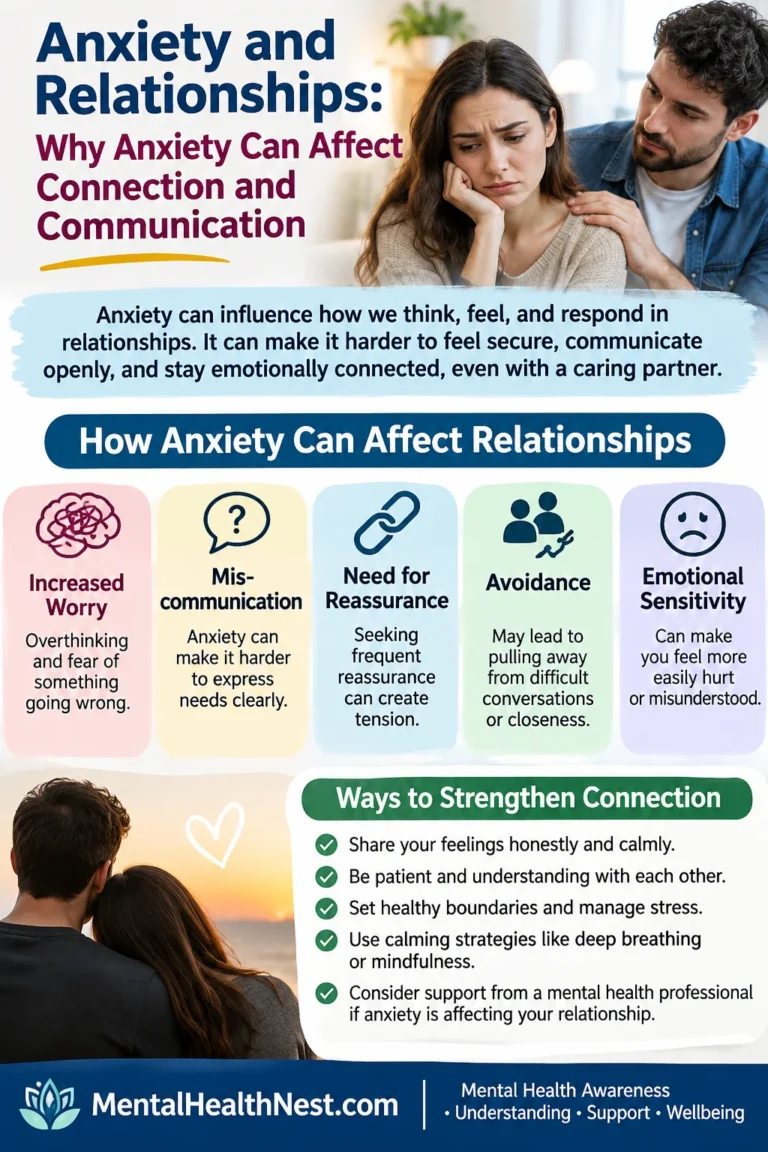
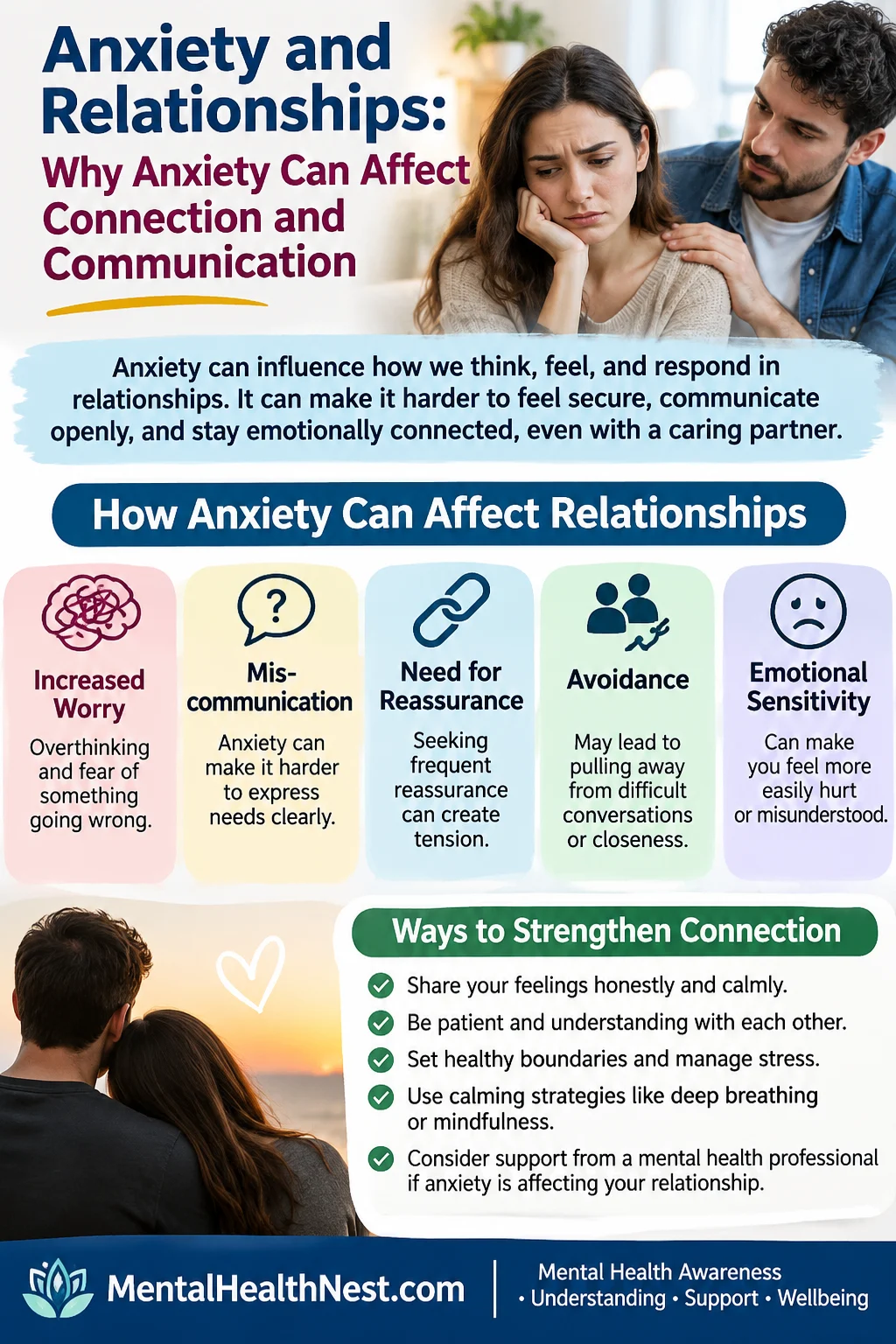
Anxiety and relationships are closely connected because anxiety can influence how people communicate, interpret interactions, express emotions, and experience emotional closeness.
A person experiencing anxiety may worry about being misunderstood, feel uncertain about how someone interprets their words, or find it difficult to express what they genuinely need. A delayed response, an uncomfortable conversation, or an unresolved disagreement may create additional emotional uncertainty.
These experiences do not mean that someone is incapable of maintaining a healthy relationship. They also do not mean that anxiety is responsible for every disagreement or relationship difficulty. However, anxiety can influence how people interpret interactions, communicate their feelings, respond to uncertainty, and experience emotional closeness.
The effects can extend beyond romantic relationships. Friendships, family connections, and other important relationships may also be affected. Each relationship has its own expectations, communication patterns, and emotional needs.
Understanding these interactions can help people recognise misunderstandings, communicate more openly, and develop healthier ways of relating to one another without blame or unrealistic expectations.
Quick Answer
Anxiety can affect relationships by influencing how people communicate, interpret interactions, express emotions, respond to uncertainty, and experience emotional closeness. It may contribute to misunderstandings, withdrawal, repeated requests for reassurance, or difficulty discussing sensitive subjects. However, anxiety does not automatically determine relationship quality. Open communication, mutual understanding, healthy boundaries, and appropriate support can help people navigate these challenges.
KEY TAKEAWAYS
- Anxiety may influence communication, emotional expression, and the interpretation of everyday interactions.
- Relationship difficulties can arise when uncertainty, misunderstandings, or unspoken emotional needs affect conversations.
- Anxiety can influence romantic relationships, friendships, and family connections in different ways.
- Reassurance can provide comfort, but healthy relationships also require mutual understanding and respect for individual boundaries.
- Anxiety does not automatically mean that a relationship is unhealthy or unsuccessful.
- Both people have a role in maintaining respectful communication and addressing relationship difficulties.
- Professional support may be helpful when anxiety or recurring relationship problems significantly affect everyday life.
1. How Anxiety Can Influence Relationships
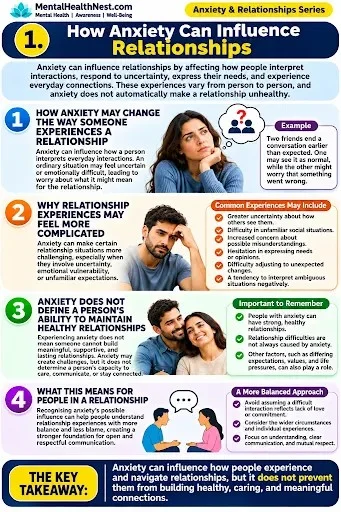
A four-section MentalHealthNest infographic explaining how anxiety can influence relationships. It covers how anxiety changes the way someone experiences relationships, why relationship situations may feel more complicated, why anxiety does not define someone’s ability to maintain healthy relationships, and what a more balanced understanding means for people in relationships. The key takeaway emphasizes that anxiety can influence relationships without preventing people from building healthy, caring, and meaningful connections.
Anxiety can influence relationships by affecting how people interpret interactions, respond to uncertainty, express their needs, and experience everyday connections. It may make certain social situations feel more difficult, increase sensitivity to perceived changes in another person’s behaviour, or create uncertainty about how a relationship is developing. However, these experiences differ from person to person, and anxiety does not automatically make a relationship unhealthy.
Relationships involve more than affection or shared interests. They also depend on how people understand one another, respond to everyday situations, manage differences, and navigate emotional experiences. When someone experiences persistent anxiety, these ordinary parts of a relationship may sometimes require additional effort.
HOW ANXIETY MAY CHANGE THE WAY SOMEONE EXPERIENCES A RELATIONSHIP
Anxiety can influence the way a person interprets situations involving other people. An ordinary interaction that seems straightforward to one person may feel uncertain or emotionally difficult to someone experiencing anxiety.
For example, imagine two friends having a conversation that ends earlier than expected. One person may simply assume that the conversation has finished. The other may wonder whether something was said incorrectly or whether the friendship has changed.
This does not mean that the anxious interpretation is accurate. It illustrates how anxiety can influence the meaning someone attaches to an everyday experience.
Over time, repeated uncertainty may make some interactions feel more demanding. A person might become particularly attentive to changes in social situations or find it difficult to feel comfortable when they do not know what another person is thinking.
These responses are not universal, and they should not be treated as proof of a mental-health condition.
WHY RELATIONSHIP EXPERIENCES MAY FEEL MORE COMPLICATED
Anxiety may make certain relationship situations more challenging, particularly when they involve uncertainty, emotional vulnerability, or unfamiliar expectations.
Some people may experience:
- Greater uncertainty about how others perceive them.
- Difficulty feeling comfortable in unfamiliar social situations.
- Increased concern about possible misunderstandings.
- Hesitation when expressing personal needs or opinions.
- Difficulty adjusting to unexpected changes in plans or interactions.
- A tendency to interpret ambiguous situations negatively.
These experiences may affect how someone participates in a relationship. For example, a person might decline an invitation because a social gathering feels overwhelming, even though they genuinely value the friendship.
Another person may avoid discussing an uncomfortable subject because they are concerned about how the conversation could develop.
Such behaviour should be understood in context rather than automatically interpreted as disinterest, rejection, or a lack of commitment.
ANXIETY DOES NOT DEFINE A PERSON’S ABILITY TO MAINTAIN HEALTHY RELATIONSHIPS
Experiencing anxiety does not mean someone cannot build meaningful, supportive, and lasting relationships.
People with anxiety can develop strong friendships, maintain loving family connections, and participate in healthy romantic relationships. Anxiety may introduce certain challenges, but it does not determine a person’s capacity to care for others, communicate, or experience emotional connection.
It is equally important to recognise that relationship difficulties are not always caused by anxiety. Differences in expectations, incompatible values, poor communication, external pressures, and unresolved disagreements can affect relationships regardless of whether someone experiences anxiety.
Understanding the wider circumstances helps prevent unfairly placing responsibility for every relationship problem on the person experiencing anxiety.
An important distinction: Understanding how anxiety may influence relationships is not the same as excusing hurtful behaviour or overlooking another person’s needs. Both individuals deserve respect, consideration, and appropriate boundaries.
WHAT THIS MEANS FOR PEOPLE IN A RELATIONSHIP
Recognising anxiety’s possible influence can provide a useful starting point for understanding relationship experiences.
Rather than immediately assuming that a difficult interaction reflects a lack of love, care, or commitment, it may help to consider the circumstances, individual experiences, and expectations involved.
The aim is not to remove every uncomfortable feeling or make another person responsible for managing someone’s anxiety. It is to develop a more balanced understanding of how emotional experiences can affect relationships.
With greater awareness, people can begin to approach relationship difficulties with less blame and more thoughtful consideration. This creates a foundation for understanding the role of communication, which is particularly important when anxiety makes it difficult to express thoughts and feelings clearly.
2. How Anxiety Can Affect Communication Between People
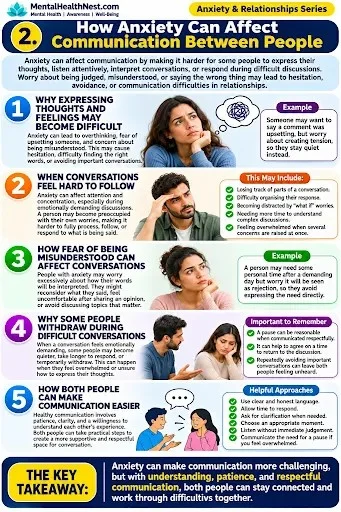
How Anxiety Can Affect Communication Between People. Five numbered sections explain why expressing thoughts and feelings may become difficult, how anxiety can affect attention during conversations, why fear of being misunderstood can influence communication, why some people withdraw during difficult discussions, and how both people can make communication easier. Realistic illustrations, practical examples, and helpful communication tips reinforce the importance of patience, clarity, listening, and mutual respect.
Anxiety can affect communication by making it more difficult for some people to express their thoughts, interpret conversations, listen comfortably, or respond to emotionally challenging situations. Worry about being misunderstood, judged, or saying the wrong thing may influence how someone participates in conversations. These difficulties can sometimes create misunderstandings, even when both people want to communicate and understand each other.
Communication is not limited to the words people use. It also involves listening, asking questions, expressing feelings, understanding different perspectives, and responding to one another. When anxiety enters these interactions, ordinary conversations may sometimes require additional emotional effort.
WHY EXPRESSING THOUGHTS AND FEELINGS MAY BECOME DIFFICULT
Some people experiencing anxiety may spend considerable time thinking about how their words will be received. They might worry that their opinions will upset someone, that their feelings will be misunderstood, or that a conversation will develop into an argument.
Social anxiety can make everyday conversations and social interactions particularly challenging. Read our guide to Social Anxiety in Adults to learn more.
As a result, they may hesitate before speaking, struggle to organise their thoughts, or choose not to express something important.
For example, someone may want to tell a friend that a particular comment was upsetting. However, concern about creating tension could make it difficult to begin the conversation.
Instead of explaining what happened, the person might remain quiet or change the subject.
This does not necessarily mean they have nothing to say. They may simply find the possibility of an uncomfortable conversation difficult to navigate.
WHEN CONVERSATIONS FEEL HARD TO FOLLOW
Anxiety can also affect attention and concentration.
During an emotionally demanding conversation, a person may become preoccupied with their own concerns rather than fully focusing on what the other person is saying.
For example, while discussing a disagreement, someone might become so concerned about giving the wrong response that they find it difficult to process the other person’s explanation.
They may:
- Lose track of parts of a conversation.
- Find it difficult to organise their responses.
- Become distracted by worries about what might happen next.
- Need additional time to understand emotionally complicated discussions.
- Struggle to respond when several concerns are raised at once.
These experiences can make conversations feel frustrating for both people. However, they do not necessarily indicate a lack of interest, care, or respect.
HOW FEAR OF BEING MISUNDERSTOOD CAN AFFECT CONVERSATIONS
Some people with anxiety may worry excessively about how their words will be interpreted.
They might repeatedly reconsider what they said, feel uncomfortable after expressing an opinion, or hesitate to discuss subjects that matter to them.
Consider a person who wants to explain that they need some personal time after a demanding day. They may worry that asking for space will be interpreted as rejection.
Consequently, they might avoid expressing the need directly.
The other person may then struggle to understand what is happening because the actual concern has never been explained.
Clear and respectful communication can help reduce these avoidable misunderstandings. It is important to remember that another person cannot always understand an unexpressed need, even when they genuinely care.
WHY SOME PEOPLE WITHDRAW DURING DIFFICULT CONVERSATIONS
When conversations become emotionally demanding, some people may become quieter, take longer to respond, or temporarily withdraw.
This can happen when someone feels overwhelmed or uncertain about how to express their thoughts.
For example, during a disagreement, one person may need time to collect their thoughts before continuing the discussion. The other person might interpret the silence as indifference or unwillingness to resolve the issue.
Neither interpretation necessarily reflects the full situation.
Taking a break from a difficult conversation can be reasonable when it is communicated respectfully and followed by an effort to return to the discussion. However, repeatedly avoiding important conversations without addressing the underlying issue may leave both people feeling unheard.
HOW BOTH PEOPLE CAN MAKE COMMUNICATION EASIER
Healthy communication does not require perfect words or the absence of uncomfortable emotions. It requires a willingness to listen, clarify misunderstandings, and respect each other’s experiences.
Some practical approaches may help:
- Use clear language: Explain what you are feeling or what you need without expecting another person to guess.
- Allow time to respond: Not everyone can immediately express their thoughts during an emotionally difficult conversation.
- Ask for clarification: If something sounds confusing, ask what the other person meant rather than relying entirely on assumptions.
- Choose an appropriate moment: Important conversations may be easier when both people have enough time and are able to pay attention.
- Listen without immediately judging: Try to understand the other person’s perspective before preparing a response.
- Communicate the need for a pause: If a conversation becomes overwhelming, explain that you need some time and, where possible, agree when to continue.
These approaches are not guaranteed to resolve every disagreement. They can, however, help create more respectful opportunities for understanding.
Communication is a shared responsibility. A person experiencing anxiety can work towards expressing their needs, while the other person can contribute through patience, listening, and respectful responses. Neither individual should be expected to manage every difficulty alone.
Understanding these communication patterns also helps explain why emotional closeness may sometimes become difficult to maintain, even when both people value the relationship.
3. Anxiety, Emotional Closeness, and Vulnerability
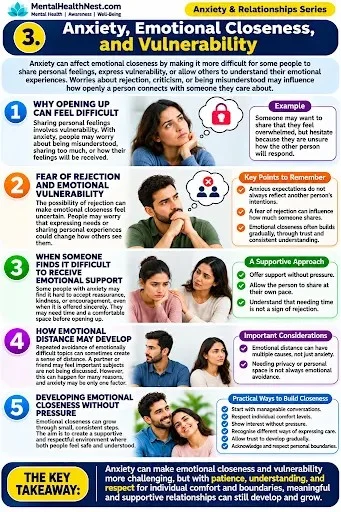
A five-section MentalHealthNest infographic explaining how anxiety may influence emotional closeness and vulnerability. It covers why opening up can feel difficult, fear of rejection and emotional vulnerability, difficulty receiving emotional support, how emotional distance may develop, and practical ways to develop emotional closeness without pressure. The key takeaway emphasizes patience, understanding, respect for individual comfort, and healthy personal boundaries.
Anxiety can affect emotional closeness by making it more difficult for some people to feel comfortable sharing personal feelings, expressing vulnerability, or allowing others to understand their emotional experiences. Worries about rejection, criticism, disappointment, or being misunderstood may sometimes influence how openly a person connects with someone they care about.
Emotional closeness develops when people gradually build trust, share experiences, understand one another, and feel accepted. It does not require two people to agree about everything or disclose every personal thought. Rather, it involves developing a sense of mutual understanding and emotional connection.
For someone experiencing anxiety, however, becoming emotionally open may sometimes feel uncomfortable, particularly when sharing personal experiences involves uncertainty about how another person might respond.
WHY OPENING UP CAN FEEL DIFFICULT
Sharing personal feelings requires a degree of vulnerability. It involves allowing another person to understand experiences, concerns, hopes, and emotions that may not be easy to discuss.
Some people experiencing anxiety may worry about how their feelings will be received. They might question whether they are sharing too much, whether their concerns will be taken seriously, or whether being emotionally open could change the relationship.
For example, someone may want to explain that they have been feeling emotionally overwhelmed but hesitate because they do not want their partner or friend to misunderstand their experience.
Instead of discussing what is happening, they may keep their feelings private.
This does not necessarily mean that they do not trust the other person. Sometimes, the difficulty lies in feeling uncertain about how to become emotionally open.
FEAR OF REJECTION AND EMOTIONAL VULNERABILITY
For some individuals, the possibility of rejection can make emotional closeness feel uncertain.
They may worry that expressing their needs, sharing personal experiences, or showing difficult emotions could change how another person sees them.
These concerns may influence how much they reveal about themselves.
For instance, someone developing a new friendship might genuinely want to become closer but hesitate to discuss personal matters because they are unsure whether the other person will respond with understanding.
It is important to distinguish between a person’s fear of rejection and evidence that rejection is actually occurring. An anxious expectation does not necessarily reflect another person’s intentions.
Building emotional closeness often involves allowing trust to develop gradually rather than expecting immediate certainty.
WHEN SOMEONE FINDS IT DIFFICULT TO RECEIVE EMOTIONAL SUPPORT
Emotional connection involves both offering and receiving support.
However, some people experiencing anxiety may find it difficult to accept reassurance, kindness, or encouragement, even when these are offered sincerely.
They might struggle to believe that someone genuinely understands their feelings or feel uncomfortable discussing something personal.
For example, a friend may offer support during a difficult period, but the person receiving it may find themselves unsure about how to respond or whether it is appropriate to share more.
This does not mean that the support is unwanted. The person may simply need time and a comfortable environment before discussing their experiences.
Support should be offered without pressure. Emotional openness cannot be forced, and people should be allowed to decide what they feel comfortable sharing.
HOW EMOTIONAL DISTANCE MAY DEVELOP
When someone repeatedly avoids emotionally difficult situations, other people may sometimes experience a sense of distance.
A partner might feel that important subjects are not being discussed. A friend may notice that personal conversations have become less frequent. A family member might find it difficult to understand why someone seems reluctant to share their feelings.
However, emotional distance can develop for many reasons. Anxiety may be one contributing factor, but it should not automatically be assumed to explain every change in a relationship.
It is also important to recognise that needing privacy or personal space is not necessarily emotional avoidance. Healthy relationships allow individuals to maintain personal boundaries while remaining connected.
DEVELOPING EMOTIONAL CLOSENESS WITHOUT PRESSURE
Emotional closeness does not have to develop through dramatic conversations or immediate disclosure of deeply personal experiences.
Small, consistent interactions can help people become more comfortable with one another.
Some helpful approaches include:
- Start with manageable conversations: Share everyday experiences before discussing subjects that feel especially personal.
- Respect individual comfort levels: Allow each person to decide what they are ready to discuss.
- Show interest without pressure: Ask thoughtful questions and listen without demanding immediate explanations.
- Recognise different ways of expressing affection: People may communicate care through words, shared activities, practical help, or simply spending time together.
- Allow trust to develop gradually: Emotional connection generally benefits from consistency, mutual respect, and understanding.
- Acknowledge personal boundaries: Being emotionally close does not mean giving up privacy or independence.
These approaches are not a treatment for anxiety. They are practical ways of creating more supportive conditions for relationships.
Emotional closeness also does not mean one person must become responsible for managing the other’s feelings. Both individuals deserve care, consideration, and room to express their own needs.
A useful reminder: Being emotionally vulnerable is not a requirement for proving love, friendship, or commitment. Meaningful relationships can develop at different paces, and healthy connection includes respect for individual differences.
Understanding emotional closeness also raises another important relationship question: what happens when someone repeatedly seeks reassurance because uncertainty feels difficult to manage? This is a separate dynamic worth exploring.
4. Reassurance, Uncertainty, and Relationship Expectations
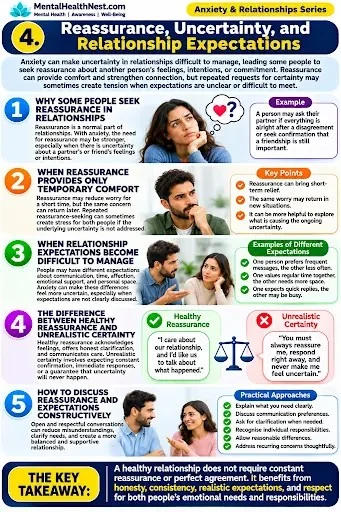
A five-section MentalHealthNest infographic explaining how anxiety can influence reassurance, uncertainty, and relationship expectations. It covers why people seek reassurance, why reassurance may provide only temporary comfort, how differing relationship expectations can become difficult to manage, the difference between healthy reassurance and unrealistic certainty, and practical ways to discuss reassurance and expectations constructively. The key takeaway emphasizes honesty, consistency, realistic expectations, mutual respect, and shared emotional responsibility.
Anxiety can make uncertainty in relationships difficult to manage, leading some people to seek reassurance about another person’s feelings, intentions, or commitment. Although reassurance can provide comfort and strengthen connection, repeated requests for certainty may sometimes create tension when expectations are unclear or difficult to meet.
Every relationship involves some degree of uncertainty. People have different schedules, responsibilities, communication habits, and ways of expressing affection. Even in supportive relationships, it is not always possible to know exactly what another person is thinking or feeling.
For someone experiencing anxiety, however, these ordinary uncertainties may sometimes become emotionally difficult, particularly when they involve an important relationship.
WHY SOME PEOPLE SEEK REASSURANCE IN RELATIONSHIPS
Reassurance is a normal part of many relationships. People often want to know that they are valued, understood, respected, and appreciated.
However, anxiety may sometimes increase the need for reassurance, particularly when someone feels uncertain about another person’s feelings or intentions.
For example, a person may ask their partner whether everything is alright after a disagreement. Another person may repeatedly seek confirmation that a friendship remains important to both individuals.
These questions may reflect a genuine desire for emotional security rather than an intention to create difficulty.
It is important not to assume that every request for reassurance is anxiety-driven. People may reasonably seek clarification when something has changed, when expectations are unclear, or when a relationship has experienced a difficult situation
WHEN REASSURANCE PROVIDES ONLY TEMPORARY COMFORT
For some people, reassurance may reduce uncertainty temporarily, but the same concern can return later.
Repeatedly revisiting the same concern may also involve overthinking. Read our guide to Overthinking and Anxiety to understand how recurring worries can affect everyday life.
For example, someone may feel comforted after their partner explains that a disagreement has not changed their feelings. However, when another ambiguous situation occurs, the person may begin questioning the relationship again.
This pattern can sometimes develop into repeated reassurance-seeking.
Repeated reassurance may become tiring for both people if the same concern is discussed frequently without addressing the underlying uncertainty.
However, this should not be interpreted as a reason to dismiss someone’s feelings. It is more helpful to understand what is causing the concern and whether the relationship itself contains unresolved issues that need attention.
WHEN RELATIONSHIP EXPECTATIONS BECOME DIFFICULT TO MANAGE
People enter relationships with different expectations about time, attention, affection, communication, independence, and emotional support.
Difficulties may arise when these expectations are not clearly discussed.
For example:
- One person may prefer frequent messages, while the other communicates less often.
- One partner may value spending regular time together, while the other needs more individual space.
- A person may expect immediate responses, while the other may be occupied with work or family responsibilities.
- One individual may feel comfortable discussing emotions frequently, while the other prefers time to process personal experiences.
These differences do not automatically indicate a lack of care or commitment.
Anxiety may make certain differences feel more uncertain, but the expectations themselves also deserve attention. A relationship becomes more manageable when both people can discuss what they need and what they can realistically offer.
THE DIFFERENCE BETWEEN HEALTHY REASSURANCE AND UNREALISTIC CERTAINTY
Healthy reassurance involves acknowledging another person’s feelings, offering honest clarification, and communicating care without making promises that cannot reasonably be maintained.
For example, saying, “I care about our relationship, and I would like us to talk about what happened,” communicates interest and willingness to work through a disagreement.
By contrast, expecting another person to provide constant confirmation, respond immediately every time, or prevent all uncomfortable feelings may create unrealistic expectations.
No individual can guarantee that another person will never feel uncertain, disappointed, or worried.
This does not mean reassurance should be withheld. It means reassurance works best when accompanied by honesty, mutual understanding, and respect for individual responsibilities.
HOW TO DISCUSS REASSURANCE AND EXPECTATIONS CONSTRUCTIVELY
Talking openly about reassurance and relationship expectations can help prevent misunderstandings.
Some useful approaches include:
- Explain what you need: Instead of expecting someone to recognise an unspoken concern, describe what would help you feel understood.
- Discuss communication preferences: Talk about realistic expectations regarding messages, calls, personal time, and availability.
- Ask for clarification when necessary: Avoid treating assumptions about another person’s intentions as established facts.
- Recognise individual responsibilities: Each person can contribute to a supportive relationship without becoming responsible for managing every emotion the other experiences.
- Allow reasonable differences: Partners and friends do not have to communicate or express affection in exactly the same way.
- Address recurring concerns thoughtfully: If the same disagreement repeatedly returns, consider whether an unresolved expectation or relationship issue needs attention.
These approaches do not guarantee that uncertainty will disappear. Their purpose is to make relationship expectations clearer and create opportunities for more balanced interactions.
A healthy relationship does not require constant reassurance or perfect agreement. It benefits from honesty, consistency, realistic expectations, and the understanding that both people have emotional needs and individual responsibilities.
Understanding reassurance and expectations also helps explain another important aspect of relationships: how anxiety may influence a person’s experience of trust and relationship security.
5. How Anxiety Can Influence Trust and Relationship Security
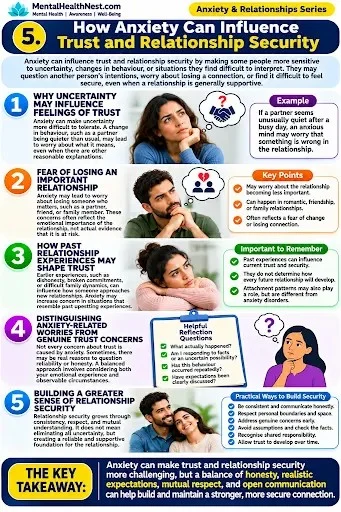
A five-section MentalHealthNest infographic explaining how anxiety can influence trust and relationship security. It covers why uncertainty may influence feelings of trust, fear of losing important relationships, how past relationship experiences may shape trust, distinguishing anxiety-related worries from genuine trust concerns, and building greater relationship security through consistency, honesty, boundaries, and mutual respect. The key takeaway emphasizes realistic expectations, open communication, and shared responsibility in maintaining secure relationships.
Anxiety can influence trust and relationship security by making some people more sensitive to uncertainty, changes in behaviour, or situations they find difficult to interpret. They may question another person’s intentions, worry about losing an important connection, or find it difficult to feel secure even when a relationship is generally supportive. However, anxiety does not necessarily indicate a lack of trust, and genuine relationship concerns should never be dismissed as anxiety.
Trust develops through honesty, reliability, mutual respect, and consistent behaviour. It allows people to feel reasonably confident that they can depend on one another while recognising that no relationship offers complete certainty.
For someone experiencing anxiety, maintaining this sense of security may sometimes feel challenging, particularly when situations are ambiguous or emotionally important.
WHY UNCERTAINTY MAY INFLUENCE FEELINGS OF TRUST
Trust involves accepting that another person has their own thoughts, responsibilities, experiences, and decisions. It does not require knowing everything about their activities or receiving constant confirmation of their intentions.
However, anxiety may sometimes make uncertainty more difficult to tolerate.
For example, if a partner becomes unusually quiet after a demanding day, someone experiencing anxiety might wonder whether something is wrong in the relationship.
There may be several possible explanations, including tiredness, personal stress, or simply needing some time alone. Yet uncertainty about the situation may make it difficult to settle on a balanced interpretation.
This illustrates an important distinction: a concern can feel emotionally convincing without necessarily representing what is actually happening.
Taking time to understand the circumstances rather than immediately accepting the most worrying interpretation may help people approach such situations more thoughtfully.
FEAR OF LOSING AN IMPORTANT RELATIONSHIP
Some people experiencing anxiety may worry about losing relationships that matter deeply to them.
These concerns can arise in romantic relationships, friendships, and family connections.
For example, someone may become concerned when a close friend starts spending more time with other people. They might wonder whether the friendship is becoming less important, even when there is no clear evidence of rejection.
Similarly, a person in a romantic relationship may feel uncertain during periods of change, such as a new job, relocation, or increased family responsibilities.
Such concerns do not establish that a relationship is in danger. They may reflect the emotional importance of the connection and the difficulty of navigating uncertainty.
At the same time, genuine changes in a relationship deserve honest attention rather than automatic dismissal.
HOW PAST RELATIONSHIP EXPERIENCES MAY SHAPE TRUST
Previous relationship experiences can influence how people approach new connections.
Experiences involving dishonesty, repeated disappointment, broken commitments, or difficult family dynamics may affect what someone expects from future relationships.
Anxiety may also contribute to heightened concern in situations that resemble earlier upsetting experiences.
For instance, someone who previously experienced a significant breach of trust may find it difficult to feel comfortable when a new partner becomes less communicative.
However, past experiences do not determine how every future relationship will develop. People and circumstances differ, and it is important to evaluate present situations on their own evidence.
Attachment-related patterns may also influence how people experience closeness and security. However, attachment styles and anxiety disorders are different concepts and should not be treated as interchangeable clinical diagnoses.
DISTINGUISHING ANXIETY-RELATED WORRIES FROM GENUINE TRUST CONCERNS
Not every concern about trust is caused by anxiety.
Sometimes, there may be actual reasons to question the reliability or honesty of another person. Repeated dishonesty, broken commitments, controlling behaviour, or disrespect for boundaries should not be dismissed as an anxious interpretation.
A balanced approach involves considering both emotional experiences and observable circumstances.
Helpful questions may include:
- What actually happened?
- Am I responding to something observable or mainly to an uncertain possibility?
- Has this behaviour occurred repeatedly?
- Have expectations or agreements been clearly discussed?
- Is there a genuine pattern that needs to be addressed?
These questions are intended to encourage thoughtful reflection, not to diagnose anxiety or invalidate someone’s concerns.
Trust should develop through behaviour and mutual accountability, not through pressure to ignore uncomfortable experiences.
BUILDING A GREATER SENSE OF RELATIONSHIP SECURITY
Relationship security does not mean that people never experience uncertainty or disagreement. It means having a reasonable foundation of trust, respect, reliability, and mutual understanding.
Some approaches that may support this foundation include:
- Be consistent: Follow through on reasonable commitments and communicate honestly when circumstances change.
- Respect personal boundaries: Allow each person appropriate independence, privacy, and personal space.
- Address genuine concerns: Discuss repeated behaviour or broken agreements rather than allowing unresolved issues to accumulate.
- Avoid assumptions: Consider the available information before deciding what another person’s behaviour means.
- Recognise mutual responsibility: Both individuals contribute to the quality and reliability of a relationship.
- Allow trust to develop over time: Trust is strengthened through repeated experiences rather than a single conversation or promise.
These practices cannot guarantee that every relationship will remain secure. They can, however, support a more respectful and balanced relationship environment.
An important reminder: Trust does not mean accepting everything without question. Healthy relationship security includes both emotional understanding and the ability to recognise when someone’s behaviour genuinely needs to be addressed.
Understanding trust also requires recognising that anxiety may be experienced differently depending on the type of relationship. Romantic partners, friends, and family members may encounter different challenges, which we will explore next.
6. How Anxiety May Affect Romantic Relationships, Friendships, and Family Connections
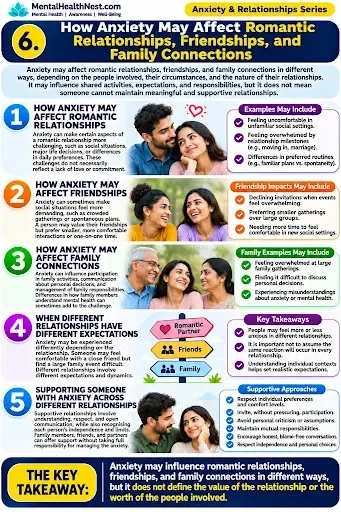
A five-section MentalHealthNest infographic explaining how anxiety may affect romantic relationships, friendships, and family connections. It covers how anxiety may influence romantic relationships, how it may affect friendships, how it may influence family connections, why different relationships have different expectations, and how to support someone with anxiety across different relationships. The key takeaway emphasizes that anxiety may influence relationships in different ways but does not define their value or the worth of the people involved.
The connection between anxiety and relationships can look different across romantic partnerships, friendships, and family connections, depending on the people involved, their circumstances, and the nature of their relationships. It may influence shared activities, social participation, personal expectations, and the ability to navigate everyday responsibilities together. However, experiencing anxiety does not mean someone cannot maintain meaningful and supportive relationships.
Every relationship has its own emotional needs and expectations. A romantic partner may share decisions and responsibilities, a friendship may depend on mutual companionship, and family relationships may involve long-standing roles and responsibilities. Understanding these differences helps explain why anxiety may appear differently across relationships.
HOW ANXIETY MAY AFFECT ROMANTIC RELATIONSHIPS
Romantic relationships often involve shared experiences, emotional commitment, personal expectations, and decisions about the future. Anxiety may sometimes make these experiences more difficult to navigate.
For example, someone experiencing anxiety may find unfamiliar social situations with a partner’s friends or relatives uncomfortable. Another person may feel overwhelmed when a relationship reaches an important milestone, such as moving in together, discussing marriage, or making significant financial decisions.
These experiences do not necessarily reflect a lack of affection or commitment.
Anxiety may also affect how couples manage everyday activities. One partner might prefer familiar plans and environments, while the other enjoys spontaneity and trying new experiences. Such differences can create practical challenges if neither person understands the other’s preferences.
A supportive relationship allows both individuals to discuss their needs without making one person feel responsible for every difficulty.
It is also important to recognise that romantic relationships involve two people. Both partners deserve consideration, personal independence, and the opportunity to express their own concerns.
HOW ANXIETY MAY AFFECT FRIENDSHIPS
Friendships often develop through shared interests, social activities, regular interaction, and mutual support.
However, anxiety may sometimes make certain social experiences more difficult.
A person may genuinely value their friendships but feel uncomfortable attending crowded gatherings, meeting unfamiliar people, or participating in spontaneous activities.
For example, someone may decline several invitations because social events feel demanding. Their friends might interpret this as a lack of interest, even though the person still values the friendship.
Another person may prefer meeting one friend at a time rather than participating in larger group activities.
These preferences do not automatically indicate a problem with the friendship. People have different social needs and comfort levels.
Friendships can remain meaningful through different forms of connection, including smaller gatherings, shared hobbies, individual conversations, and activities that suit both people’s preferences.
However, maintaining a friendship also involves mutual effort. Understanding someone’s anxiety does not mean one person must continually cancel their own plans or carry the entire responsibility for maintaining the connection.
HOW ANXIETY MAY AFFECT FAMILY CONNECTIONS
Family relationships can involve a complex combination of affection, responsibilities, shared history, expectations, and differences between generations.
Anxiety may sometimes influence how family members participate in everyday activities or manage family responsibilities.
For example, a person experiencing anxiety may find large family gatherings overwhelming or feel uncomfortable discussing personal decisions with relatives.
Parents may also find certain family responsibilities emotionally demanding when they are experiencing anxiety. Similarly, adult children may feel uncertain about discussing their personal needs with parents or other family members.
In some families, differences in how people understand mental health may create additional challenges. A relative may interpret anxiety as excessive worry or a lack of confidence without understanding the person’s actual experience.
Providing accurate information and approaching these conversations with patience may help family members develop a better understanding.
However, family relationships are not always supportive. If relatives repeatedly dismiss someone’s experiences, violate personal boundaries, or behave disrespectfully, those concerns deserve attention in their own right.
Family connection does not require accepting every behaviour or sacrificing personal wellbeing.
WHEN DIFFERENT RELATIONSHIPS HAVE DIFFERENT EXPECTATIONS
A person may experience anxiety differently depending on whom they are interacting with.
For example, someone may feel comfortable spending time with a close friend but find a large family gathering difficult. Another person may feel at ease with their partner but become uncomfortable when meeting unfamiliar colleagues or social groups.
These differences are understandable because relationships involve different expectations, histories, and social circumstances.
It is therefore important not to assume that someone who experiences anxiety in one relationship will experience the same difficulties in every other relationship.
Recognising individual differences can help people avoid unnecessary comparisons and develop more realistic expectations of one another.
SUPPORTING SOMEONE WITH ANXIETY ACROSS DIFFERENT RELATIONSHIPS
Whether the relationship involves a partner, friend, parent, sibling, or adult child, supportive behaviour begins with understanding the individual’s experience without making assumptions.
Some useful approaches include:
- Respect individual preferences: Understand that social comfort and personal needs can differ from one person to another.
- Offer inclusion without pressure: Invite someone to participate while respecting their decision if they decline.
- Avoid personal criticism: Do not automatically interpret social withdrawal or discomfort as rejection.
- Maintain mutual responsibilities: Support should not become a one-sided expectation in which one person carries every relationship responsibility.
- Encourage honest conversations: Make space for people to discuss what they find difficult without embarrassment or blame.
- Respect independence: Having anxiety does not mean someone needs others to make every decision for them.
Supportive relationships can make difficult experiences easier to discuss, but family members, friends, and partners are not substitutes for qualified mental-health professionals when professional care is needed.
An important reminder: Anxiety may influence different relationships, but it does not define the value of those relationships or the worth of the people involved. Understanding individual circumstances is more helpful than placing labels on someone’s behaviour.
Even when people understand one another’s experiences, disagreements and misunderstandings can still occur. The next section examines how anxiety may contribute to relationship conflict and how these situations can develop.
7. When Anxiety Contributes to Misunderstandings and Relationship Conflict
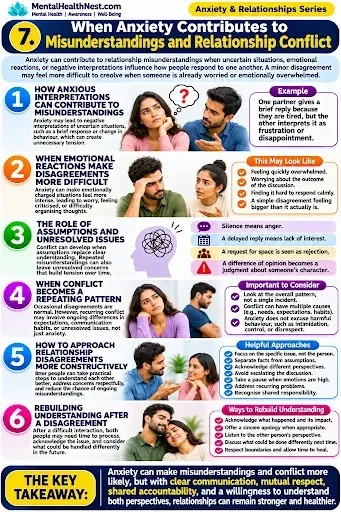
A six-section MentalHealthNest infographic explaining how anxiety may contribute to misunderstandings and relationship conflict. It covers anxious interpretations, emotional reactions during disagreements, assumptions and unresolved issues, recurring conflict patterns, constructive approaches to disagreements, and rebuilding understanding after a disagreement. The key takeaway emphasizes clear communication, mutual respect, shared accountability, sincere apologies, and understanding both perspectives.
Anxiety can contribute to relationship misunderstandings when uncertain situations, emotional reactions, or negative interpretations influence how people respond to one another. A minor disagreement may sometimes feel more difficult to resolve when someone is already worried or emotionally overwhelmed. However, anxiety is only one possible influence on relationship conflict, and disagreements should be understood in the context of both people’s experiences and behaviour.
Disagreements are a normal part of human relationships. People have different opinions, priorities, emotional needs, and ways of responding to difficult situations. Healthy relationships do not require the absence of conflict. They require a willingness to address differences respectfully and work towards understanding.
When anxiety is involved, however, certain disagreements may become more emotionally demanding.
HOW ANXIOUS INTERPRETATIONS CAN CONTRIBUTE TO MISUNDERSTANDINGS
Anxiety may influence how someone interprets an uncertain interaction. A person’s words, facial expression, or reaction may be understood negatively even when their actual intention is different.
For example, imagine two partners discussing weekend plans. One partner responds briefly because they are tired after work. The other may interpret the response as frustration or disappointment.
If neither person clarifies the situation, an unnecessary misunderstanding may develop.
This does not mean that every negative interpretation is caused by anxiety. Sometimes, people communicate unclearly or behave in ways that genuinely cause concern.
The important distinction is between what actually happened and the meaning each person attached to it.
WHEN EMOTIONAL REACTIONS MAKE DISAGREEMENTS MORE DIFFICULT
Some people experiencing anxiety may find emotionally intense situations particularly challenging.
During a disagreement, they might become worried about the possible consequences, struggle to organise their thoughts, or feel uncertain about how to respond.
For example, a discussion about household responsibilities may gradually become more stressful if one person feels criticised and the other feels that their concerns are being ignored.
The original disagreement may be relatively straightforward, but the emotional responses surrounding it can make resolution more difficult.
Taking time to understand the actual issue can help both individuals avoid allowing an everyday disagreement to become a wider judgment about the relationship.
THE ROLE OF ASSUMPTIONS AND UNRESOLVED ISSUES
Relationship conflict can develop when assumptions replace clear understanding.
For example:
- One person assumes that silence means anger.
- Another assumes that a delayed response indicates a lack of interest.
- A disagreement about plans is interpreted as a lack of commitment.
- A request for personal space is understood as rejection.
- A difference of opinion becomes a judgment about someone’s character.
These interpretations may increase tension, particularly when neither person feels understood.
Repeated misunderstandings can also leave unresolved concerns. If the same issue continues without meaningful discussion, frustration may gradually accumulate.
However, responsibility for resolving misunderstandings should not automatically fall on the person experiencing anxiety. Both individuals have a role in examining their assumptions, explaining their perspectives, and addressing genuine concerns.
WHEN CONFLICT BECOMES A REPEATING PATTERN
Occasional disagreements are different from recurring conflict that repeatedly affects the relationship.
For example, a couple may repeatedly argue about cancelled plans, household responsibilities, or time spent together. A friendship may experience tension whenever one person declines an invitation. Family disagreements may continue because different generations have conflicting expectations.
Anxiety may contribute to how some of these situations are experienced, but recurring conflict can also involve incompatible expectations, poor communication habits, unresolved disagreements, or unequal responsibilities.
It is important to examine the broader pattern rather than automatically attributing every problem to anxiety.
If disagreements regularly involve intimidation, humiliation, controlling behaviour, or disregard for personal boundaries, these concerns should be taken seriously. Anxiety does not excuse harmful behaviour.
HOW TO APPROACH RELATIONSHIP DISAGREEMENTS MORE CONSTRUCTIVELY
A disagreement does not have to become a lasting source of distance. Both people can take steps towards a more respectful discussion.
Some useful approaches include:
- Focus on the specific issue: Discuss what happened rather than making broad judgments about the other person’s personality.
- Separate facts from assumptions: Consider what was actually said or done before deciding what it means.
- Acknowledge different perspectives: Two people may experience the same situation differently.
- Avoid escalating the discussion: Personal criticism, blame, and generalisations can make resolution more difficult.
- Take a reasonable pause when needed: If emotions become overwhelming, agree to return to the conversation when both people can participate more comfortably.
- Address recurring problems: If the same disagreement continues, identify the underlying issue rather than repeatedly arguing about individual incidents.
- Recognise shared responsibility: Each person should be able to express concerns and take responsibility for their own behaviour.
These approaches cannot prevent every disagreement, but they can support more constructive ways of addressing differences.
REBUILDING UNDERSTANDING AFTER A DISAGREEMENT
After a difficult interaction, both people may need time to process what happened.
Rebuilding understanding does not mean pretending that the disagreement never occurred. It involves acknowledging the issue, recognising its impact, and considering what could be handled differently in the future.
A sincere apology, a clearer explanation, or a willingness to listen may help restore a sense of cooperation.
However, reconciliation should not be forced. If a disagreement involves serious disrespect or harmful behaviour, appropriate boundaries and personal safety must remain priorities.
A useful reminder: Experiencing anxiety does not make someone responsible for every relationship disagreement. Healthy relationships require mutual respect, accountability, and a willingness to understand both perspectives.
Once people recognise how misunderstandings and conflict can develop, the next step is to explore practical ways of strengthening communication and emotional connection.
8. Building Healthier Communication and Emotional Connection
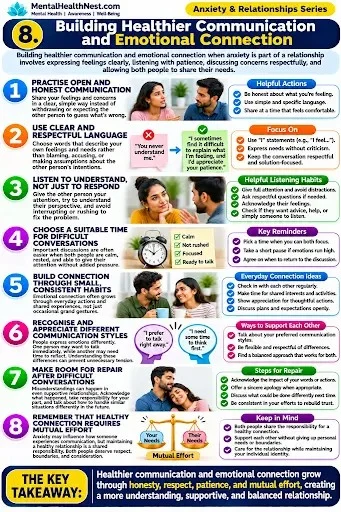
An eight-section MentalHealthNest infographic explaining how to build healthier communication and emotional connection when anxiety affects relationships. It covers practising open and honest communication, using clear and respectful language, listening to understand, choosing suitable times for difficult conversations, building connection through small consistent habits, appreciating different communication styles, repairing relationships after difficult conversations, and recognising that healthy connection requires mutual effort. The key takeaway emphasizes honesty, respect, patience, and shared responsibility.
Building healthier communication and emotional connection when anxiety is part of a relationship involves expressing feelings clearly, listening with patience, discussing concerns respectfully, and allowing both people to share their needs. Small, consistent communication habits can help reduce misunderstandings and strengthen mutual understanding without expecting either person to manage every emotional difficulty perfectly.
PRACTISE OPEN AND HONEST COMMUNICATION
Open communication gives people an opportunity to explain what they are experiencing without assuming that the other person will automatically understand. When anxiety makes conversations difficult, it may help to describe feelings and concerns in simple, specific language.
For example, instead of withdrawing or expecting someone to recognise that something is wrong, a person might say, “I have been feeling anxious today, and I may need a little time to organise my thoughts.”
Honest communication does not require sharing everything immediately. Each person can choose an appropriate time and level of detail that feels comfortable.
USE CLEAR AND RESPECTFUL LANGUAGE
The way people express concerns can influence how a conversation develops. Statements that describe personal feelings and experiences may be more constructive than accusations or assumptions about another person’s intentions.
For example:
- Instead of saying, “You never understand me,” try, “I sometimes find it difficult to explain what I am feeling, and I would appreciate your patience.”
- Instead of saying, “You do not care,” try, “I have been feeling disconnected lately, and I would like us to spend some time together.”
- Instead of saying, “You are making me anxious,” try, “I am feeling anxious about this situation, and I would like to talk about it.”
These examples are not scripts that everyone must follow. They illustrate how specific language can make room for discussion without assigning blame.
LISTEN TO UNDERSTAND, NOT JUST TO RESPOND
Healthy communication involves listening as well as speaking. When someone shares a concern, the other person can try to understand what they mean before offering advice, defending themselves, or suggesting solutions.
Helpful listening habits include:
- Giving the conversation appropriate attention.
- Avoiding interruptions when possible.
- Asking respectful questions when something is unclear.
- Acknowledging the other person’s feelings without necessarily agreeing with every interpretation.
- Checking whether the person wants advice, practical help, or simply someone to listen.
Listening should be mutual. Both people deserve the opportunity to express their experiences and feel heard.
CHOOSE A SUITABLE TIME FOR DIFFICULT CONVERSATIONS
Important discussions may become harder when either person is tired, distracted, upset, or under pressure. If a conversation feels overwhelming, it may help to agree on a short pause and return to the subject at a suitable time.
A pause should not become a way to avoid every difficult conversation. Where possible, communicate when you expect to continue the discussion so that neither person is left uncertain about whether the concern will be addressed.
BUILD CONNECTION THROUGH SMALL, CONSISTENT HABITS
Emotional connection is often supported by ordinary interactions rather than occasional major gestures. Small habits can help people maintain a sense of involvement and mutual care.
These may include:
- Checking in with one another without turning every conversation into a discussion about problems.
- Making time for shared interests and everyday activities.
- Expressing appreciation for thoughtful actions.
- Discussing plans and expectations openly.
- Respecting individual time, privacy, and personal interests.
- Showing interest in each other’s experiences.
These habits should feel mutually supportive rather than like another set of responsibilities that one person must perform perfectly.
RECOGNISE AND APPRECIATE DIFFERENT COMMUNICATION STYLES
People do not always express emotions in the same way. One person may prefer to discuss concerns immediately, while another may need time to reflect before speaking. Differences in communication styles do not automatically indicate a lack of care or commitment.
Discussing these differences can help both people understand what makes conversations easier. The goal is not to make one person communicate exactly like the other, but to develop a respectful approach that considers both people’s needs.
MAKE ROOM FOR REPAIR AFTER DIFFICULT CONVERSATIONS
Even in supportive relationships, people sometimes misunderstand one another or communicate in ways they later regret. Acknowledging what happened, taking responsibility for one’s own words or actions, and discussing how to approach similar situations differently can help restore understanding.
An apology can be meaningful when it recognises the impact of an action rather than dismissing the other person’s feelings. At the same time, rebuilding trust and connection may require consistent changes in behaviour, not words alone.
REMEMBER THAT HEALTHY CONNECTION REQUIRES MUTUAL EFFORT
Anxiety may influence how someone experiences communication, but maintaining a healthy relationship is not the sole responsibility of the person experiencing anxiety. Both people have a role in communicating respectfully, recognising boundaries, and addressing concerns.
Support should not mean accepting repeated disrespect, giving up personal needs, or becoming responsible for another person’s entire emotional wellbeing. A healthy connection allows both people to offer care while maintaining their individual identities and boundaries.
As communication becomes more open and consistent, it is also important to recognise where support ends and personal responsibility begins. This leads to the role of healthy boundaries and shared emotional responsibility in relationships.
9. Healthy Boundaries and Shared Emotional Responsibility
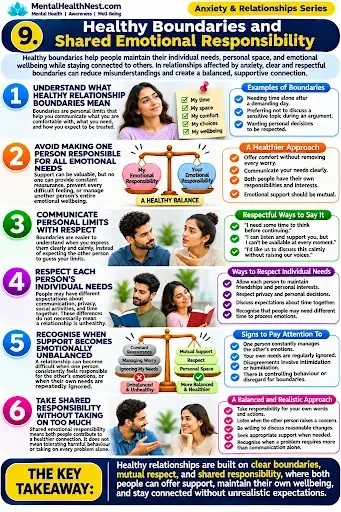
A six-section MentalHealthNest infographic explaining healthy boundaries and shared emotional responsibility in relationships affected by anxiety. It covers understanding healthy relationship boundaries, avoiding making one person responsible for all emotional needs, communicating personal limits respectfully, respecting individual needs, recognising emotionally unbalanced support, and taking shared responsibility without taking on too much. The key takeaway emphasizes clear boundaries, mutual respect, individual wellbeing, and balanced emotional support.
Healthy boundaries help people maintain their individual needs, personal space, and emotional wellbeing while staying connected to others. In relationships affected by anxiety, clear and respectful boundaries can help prevent misunderstandings, reduce unrealistic expectations, and establish a healthier balance between offering support and taking responsibility for one’s own actions.
UNDERSTAND WHAT HEALTHY RELATIONSHIP BOUNDARIES MEAN
Boundaries are personal limits that help people communicate what they are comfortable with, what they need, and how they expect to be treated. They can involve emotional, physical, social, and practical aspects of a relationship.
For example, someone may need time alone after a demanding day, prefer not to discuss a sensitive subject during an argument, or want their personal decisions to be respected.
Having boundaries does not mean rejecting someone or withdrawing affection. It means recognising that both people have individual needs and deserve respect.
AVOID MAKING ONE PERSON RESPONSIBLE FOR ALL EMOTIONAL NEEDS
Support from a partner, friend, or family member can be valuable when someone is experiencing anxiety. However, one person cannot reasonably be expected to provide constant reassurance, prevent every difficult feeling, or manage another person’s entire emotional wellbeing.
A healthier approach recognises that:
- People can offer comfort without being responsible for removing every worry.
- Someone experiencing anxiety can communicate their needs while also developing appropriate ways to manage their difficulties.
- Both people deserve time for their own responsibilities, interests, and relationships.
- Emotional support should be mutual rather than consistently one-sided.
This balance can help relationships remain supportive without creating unrealistic expectations.
COMMUNICATE PERSONAL LIMITS WITH RESPECT
Boundaries are easier to understand when they are communicated clearly and calmly. Instead of expecting another person to recognise an unspoken limit, explain what is needed and, where possible, why it matters.
For example:
- “I care about this conversation, but I need some time to think before continuing.”
- “I can listen and support you, but I cannot be available for a conversation at every moment.”
- “I would like us to discuss this without raising our voices.”
- “I need some personal time, and that does not mean I care about you any less.”
A boundary is not a demand that another person must agree with every preference. It communicates what someone needs and what they can reasonably accept or participate in.
RESPECT EACH PERSON’S INDIVIDUAL NEEDS
People in close relationships may have different expectations about communication, privacy, social activities, and time together. These differences do not necessarily mean that a relationship is unhealthy.
Respecting individual needs may involve:
- Allowing each person to maintain friendships and personal interests.
- Respecting privacy and personal decisions.
- Discussing expectations about time together.
- Recognising that people may need different amounts of time to process emotions.
- Avoiding pressure to respond immediately to every message or concern.
Mutual respect allows people to remain connected without losing their sense of individuality.
RECOGNISE WHEN SUPPORT BECOMES EMOTIONALLY UNBALANCED
Relationships can become difficult when one person consistently feels responsible for managing the other’s emotions, or when their own needs are repeatedly ignored. Anxiety may be one part of this experience, but an imbalance should not automatically be attributed to a mental health condition.
It may be useful to reflect on whether:
- Both people have opportunities to express their concerns.
- Emotional support is reasonably reciprocal.
- Personal limits are acknowledged.
- Disagreements can be discussed without intimidation or humiliation.
- Each person can maintain appropriate independence.
If a relationship repeatedly involves controlling behaviour, threats, humiliation, or disregard for personal boundaries, these concerns deserve attention in their own right. They should not be dismissed as ordinary anxiety or communication difficulties.
TAKE SHARED RESPONSIBILITY WITHOUT TAKING ON TOO MUCH
Shared emotional responsibility means recognising that both people contribute to the quality of their interactions. It does not mean that both people are equally responsible for every problem, or that someone must tolerate harmful behaviour to preserve a relationship.
A balanced approach may include:
- Taking responsibility for one’s own words and actions.
- Listening when the other person raises a concern.
- Being willing to discuss reasonable changes.
- Seeking appropriate support when relationship difficulties become difficult to manage.
- Recognising when a problem requires more than communication alone.
Healthy relationships make room for care, accountability, independence, and mutual respect.
Boundaries and shared responsibility can support healthier relationships, but some difficulties may continue despite sincere efforts. When anxiety or relationship concerns significantly affect everyday life, professional support may be worth considering.
10. When to Consider Professional Support for Anxiety and Relationship Difficulties
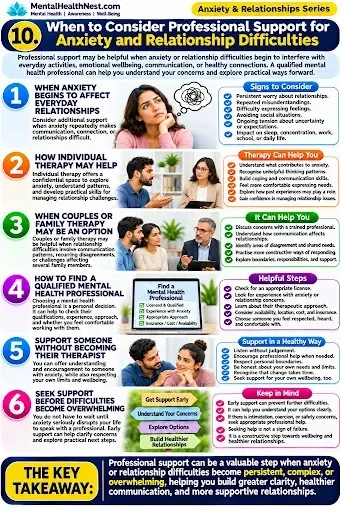
A six-section MentalHealthNest infographic explaining when to consider professional support for anxiety and relationship difficulties. It covers signs that anxiety is affecting everyday relationships, how individual therapy may help, when couples or family therapy may be an option, how to find a qualified mental health professional, supporting someone without becoming their therapist, and seeking support before difficulties become overwhelming. The key takeaway emphasizes that professional support can help people understand persistent difficulties, improve communication, and develop healthier relationships.
Professional support may be helpful when anxiety or relationship difficulties begin to interfere with everyday activities, emotional wellbeing, communication, or the ability to maintain healthy connections. A qualified mental health professional can help someone understand their concerns, explore practical ways to manage anxiety, and work through relationship challenges without placing the responsibility for change entirely on one person.
Anxiety can involve different conditions, symptoms, and levels of difficulty. Read our guide to Anxiety Disorders: Understanding Symptoms, Types, and Treatment to learn more about the different anxiety disorders and available treatment options.
WHEN ANXIETY BEGINS TO AFFECT EVERYDAY RELATIONSHIPS
Occasional worry, misunderstandings, and disagreements can occur in any relationship. However, additional support may be worth considering when anxiety repeatedly makes communication or emotional connection difficult.
Some signs that professional guidance may be useful include:
- Persistent worry about relationships that is difficult to manage.
- Repeated misunderstandings that affect important relationships.
- Difficulty expressing feelings or discussing concerns.
- Avoiding social situations or meaningful interactions because of anxiety.
- Ongoing tension related to uncertainty, reassurance, or relationship expectations.
- Relationship difficulties that affect sleep, concentration, work, school, or everyday responsibilities.
These experiences do not automatically indicate an anxiety disorder. They are reasons to consider whether additional support could be beneficial.
HOW INDIVIDUAL THERAPY MAY HELP
Individual therapy can provide a confidential setting to discuss anxiety, emotional concerns, and patterns that may be affecting relationships.
Depending on a person’s needs and the therapist’s approach, sessions may help someone:
- Understand situations that contribute to anxiety.
- Recognise unhelpful patterns of thinking and responding.
- Develop practical coping and communication skills.
- Become more comfortable expressing personal needs.
- Explore how previous experiences may influence present concerns.
- Work towards greater confidence in managing relationship challenges.
Different forms of therapy may be appropriate for different concerns. A licensed mental health professional can discuss available approaches and help determine what may be suitable.
WHEN COUPLES OR FAMILY THERAPY MAY BE AN OPTION
When relationship difficulties involve communication patterns, recurring disagreements, or challenges affecting several family members, couples or family therapy may be worth exploring.
These approaches can provide a structured setting in which participants can:
- Discuss concerns with guidance from a trained professional.
- Understand how communication patterns affect relationships.
- Identify areas of disagreement and shared expectations.
- Practise more constructive ways of responding to one another.
- Explore boundaries, responsibilities, and mutual support.
Couples or family therapy is not appropriate in every situation. Where there is intimidation, coercion, violence, or concern about personal safety, individual support and safety-focused guidance may be more appropriate than joint sessions.
HOW TO FIND A QUALIFIED MENTAL HEALTH PROFESSIONAL
Choosing a mental health professional is an individual decision. It may help to consider:
- Whether the professional holds an appropriate license for the services they provide.
- Their experience working with anxiety or relationship-related concerns.
- Their therapeutic approach and whether it suits the person’s needs.
- Practical factors such as availability, location, cost, and insurance coverage.
- Whether the person feels respected, heard, and comfortable asking questions.
In the United States, people can begin by contacting their health insurance provider, primary care professional, or a recognised mental health referral service. It is reasonable to ask about qualifications, fees, confidentiality, and treatment options before beginning care.
SUPPORT SOMEONE WITHOUT BECOMING THEIR THERAPIST
If someone close to you experiences anxiety, offering understanding and encouragement can make a difference. However, being a supportive partner, friend, or family member does not mean becoming responsible for their treatment or emotional wellbeing.
You can offer support by:
- Listening without judgement.
- Encouraging professional help when difficulties persist.
- Respecting personal boundaries.
- Being honest about your own needs and limitations.
- Recognising that meaningful change may take time.
- Seeking support for your own wellbeing when necessary.
Both people deserve care and respect. Supporting someone should not require neglecting your own emotional needs or accepting harmful behaviour.
SEEK SUPPORT BEFORE DIFFICULTIES BECOME OVERWHELMING
People do not have to wait until anxiety seriously disrupts their lives before speaking with a qualified professional. Early conversations can help clarify concerns, identify available support, and explore practical next steps.
If relationship difficulties involve threats, intimidation, coercion, or concerns about safety, consider reaching out to a trusted person or an appropriate professional who can help assess the situation and discuss safer options.
Seeking help is not a sign of personal failure. It can be a constructive step towards understanding anxiety, improving communication, and making informed decisions about relationships.
Healthy relationships do not require perfect communication or the absence of anxiety. They are supported by mutual respect, honest conversations, appropriate boundaries, and a willingness to seek help when it is needed.
Frequently Asked Questions
CONCLUSION: Building Healthier Relationships While Living With Anxiety
Anxiety can influence how people communicate, experience emotional closeness, interpret uncertainty, and respond to relationship challenges. It may sometimes make everyday interactions feel more complicated, but it does not determine someone’s ability to build meaningful, supportive, and lasting relationships.
Understanding the connection between anxiety and relationships can help people recognise their emotional needs, communicate more openly, and approach misunderstandings with greater patience. Small steps, such as expressing concerns clearly, listening without judgement, respecting personal boundaries, and making time for meaningful connection, can support healthier interactions.
It is equally important to recognise that a healthy relationship requires mutual respect and shared responsibility. One person should not have to manage every emotional difficulty, provide constant reassurance, or sacrifice personal wellbeing to maintain a connection. Both people deserve to feel heard, respected, and valued.
If anxiety or relationship difficulties begin affecting everyday life, speaking with a qualified mental health professional may help clarify concerns and identify appropriate support. Seeking help does not mean a person has failed in a relationship. It can be a constructive step towards understanding personal experiences and making informed decisions.
Remember: You do not need to have perfect communication or eliminate every feeling of anxiety to build a healthy relationship. Progress can begin with honest conversations, reasonable expectations, mutual understanding, and respect for each person’s needs.
Explore More on MentalHealthNest Anxiety Series
Anxiety can affect different aspects of everyday life, from sleep and physical wellbeing to work, social interactions, and close relationships. If you would like to explore these topics further, the following MentalHealthNest articles offer additional information and practical guidance.
- Anxiety Disorders: Understanding Symptoms, Types, and Treatment
Learn about different anxiety disorders, their common symptoms, their effects on everyday life, and available assessment and treatment options. - Overthinking and Anxiety: Why Your Mind Won’t Slow Down
Explore repetitive worrying, anxious thought patterns, and practical approaches that may help. - Anxiety vs. Stress: What’s the Difference and How Can You Tell?
Understand how anxiety and stress differ, where they overlap, and when either may begin affecting everyday life. - Anxiety vs. Depression: Understanding the Differences and Overlap
Explore how anxiety and depression may differ, where symptoms can overlap, and why recognising these differences matters. - Anxiety and Sleep: Why Anxiety Can Keep You Awake
Discover how anxiety may interfere with sleep and how sleep difficulties and anxious thoughts can reinforce each other. - Anxiety and Physical Symptoms: How Anxiety Can Affect the Body
Understand how anxiety may be associated with physical experiences, including muscle tension, a racing heart, and digestive discomfort. - Panic Attacks vs. Anxiety Attacks: What Is the Difference?
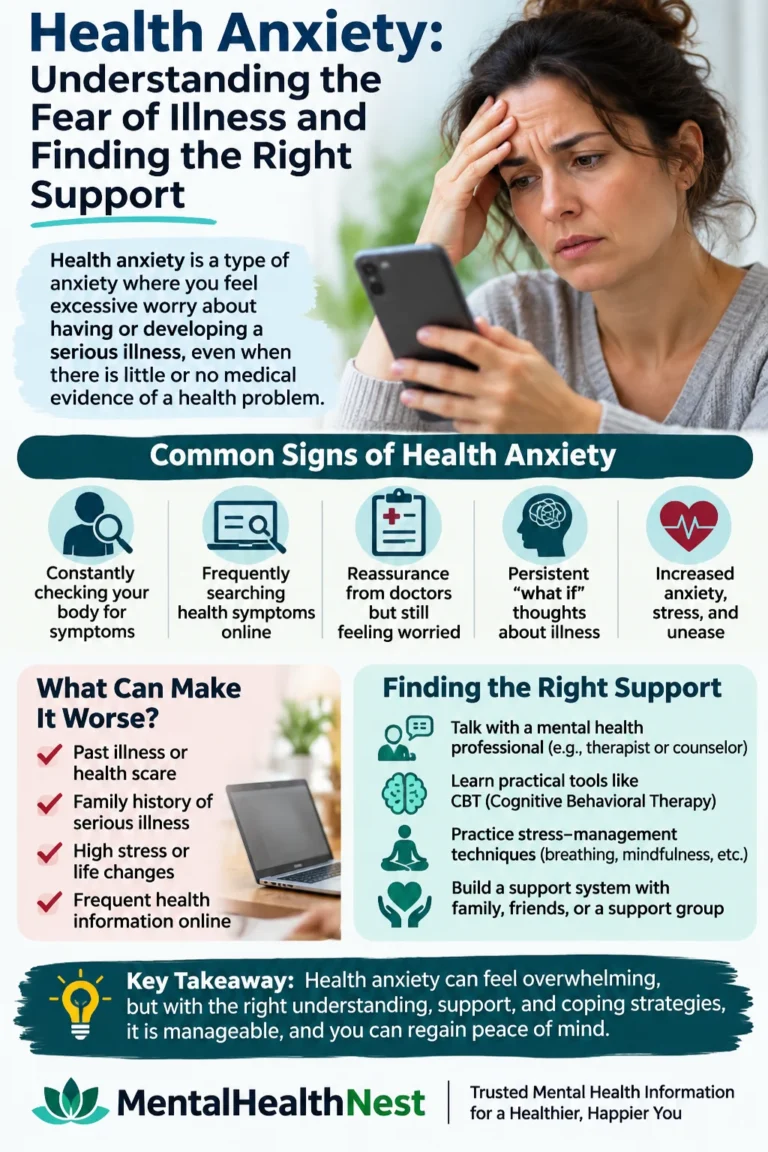
Learn about panic attacks, how they differ from general experiences of anxiety, and why “anxiety attack” is not a formal clinical diagnosis. - Health Anxiety: When Worry About Your Health Becomes Overwhelming
Understand how persistent fears about illness can affect daily life and why appropriate medical guidance and mental health support may help. - Social Anxiety in Adults: Symptoms, Causes, and What May Help
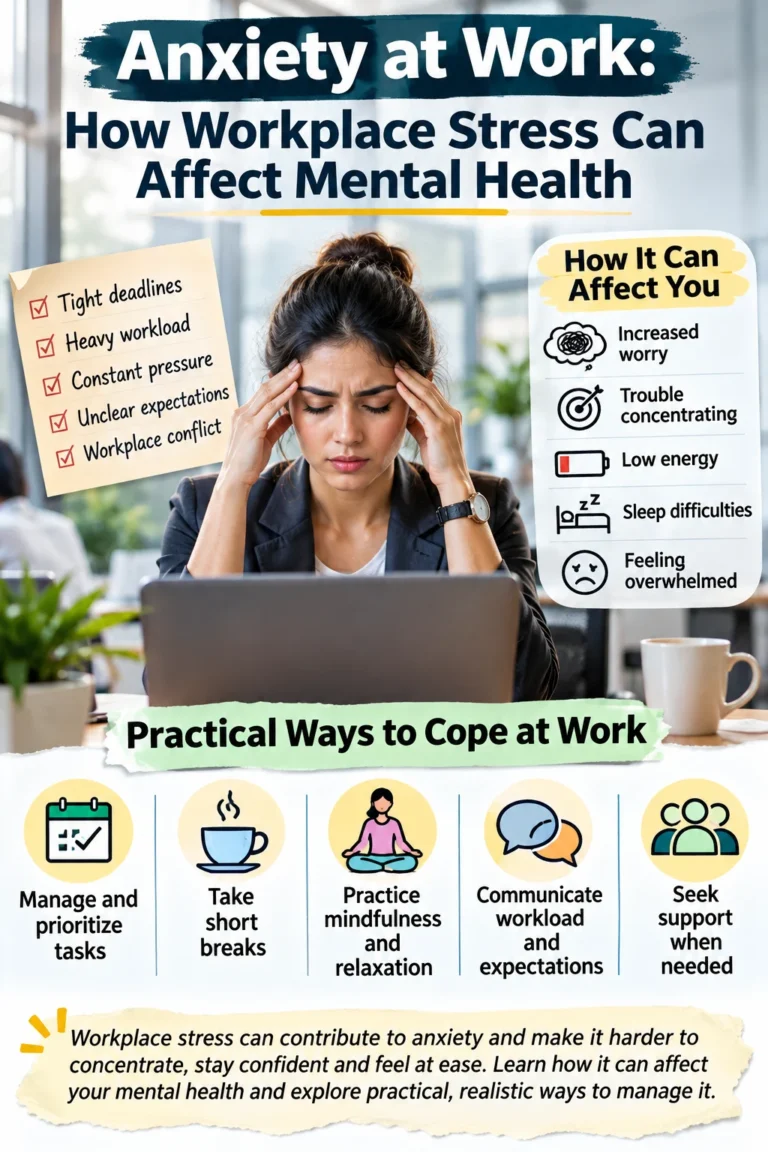
Explore how fear of judgment or embarrassment may affect social situations, relationships, work, and everyday activities. - Anxiety at Work: How Workplace Stress Can Affect Mental Health
Learn how workplace pressures and anxiety may interact and explore practical sources of support. - How to Calm an Anxious Mind: Practical Strategies for Managing Anxiety
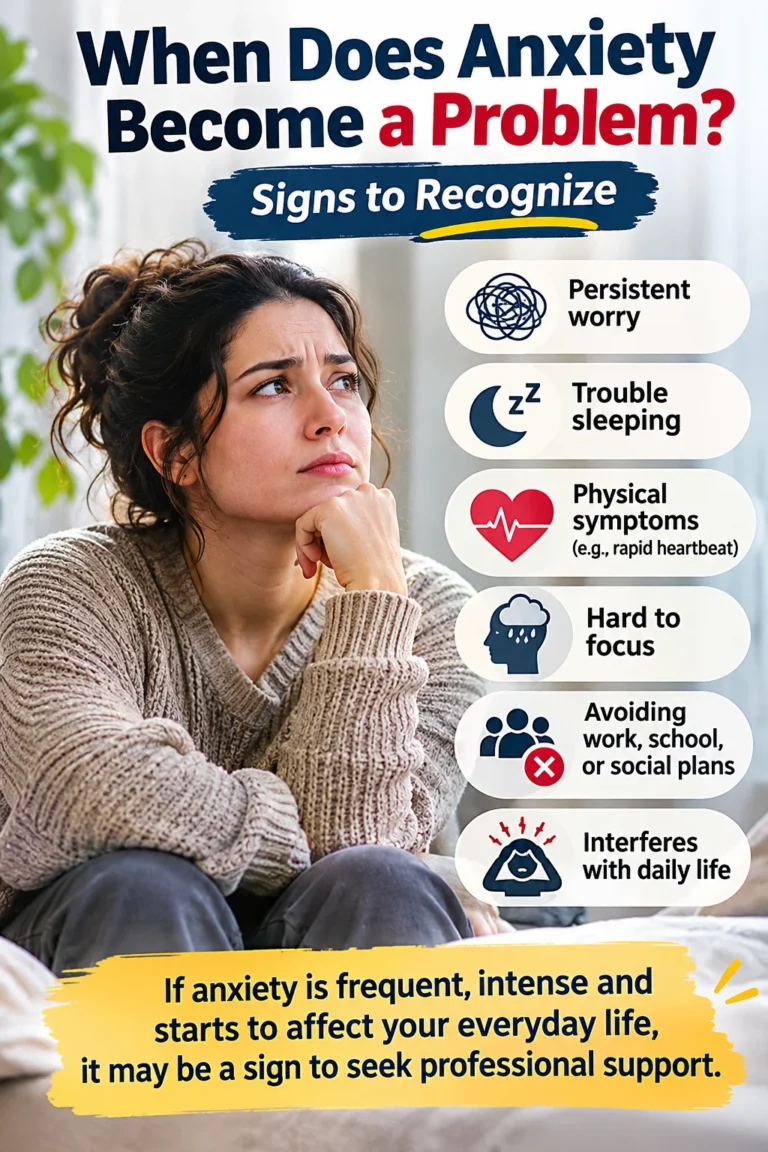
Explore practical approaches to responding to anxious thoughts and feelings, managing everyday worries, and recognising when additional support may be appropriate. - When Does Anxiety Become a Problem?
Understand when anxiety may be more than an occasional response to stress, particularly when it becomes persistent, difficult to manage, or disruptive to everyday activities.
A Note to Our Returning Readers
If you have been following the MentalHealthNest Anxiety Series, you have already explored several important aspects of anxiety, including its effects on thoughts, everyday experiences, sleep, physical wellbeing, and daily responsibilities.
This final article brings the series into another important part of everyday life: our relationships with other people. Understanding anxiety is not only about recognising what happens within an individual. It is also about understanding how emotional experiences can influence conversations, closeness, trust, and the way people connect with those they care about. Whether you are personally experiencing anxiety, supporting someone you care about, or simply trying to understand these relationship dynamics, we hope this article offers a thoughtful and practical perspective.
TRUSTED MENTAL HEALTH RESOURCE
The following organisations provide reliable mental health information, guidance, and support resources for individuals and families in the United States.
1. National Institute of Mental Health (NIMH)
A federal research institute providing evidence-based information about anxiety disorders, mental health conditions, symptoms, treatment, and mental health research.
Website: https://www.nimh.nih.gov/
Find Help: https://www.nimh.nih.gov/health/find-help
2. Substance Abuse and Mental Health Services Administration (SAMHSA)
A U.S. government agency offering information about mental health services, treatment options, and ways to locate support across the United States.
Website: https://www.samhsa.gov/
Find Help and Support: https://www.samhsa.gov/find-help
3. Centers for Disease Control and Prevention (CDC) – Mental Health
Provides public health information and resources about mental health, emotional wellbeing, and ways to find appropriate support.
Website: https://www.cdc.gov/mental-health/
4. American Psychological Association (APA)
A professional organisation offering educational information about psychology, anxiety, relationships, emotional wellbeing, and psychological research.
Website: https://www.apa.org/
Topics: https://www.apa.org/topics
5. National Alliance on Mental Illness (NAMI)
A nationwide mental health organisation providing educational resources, peer support, and information for individuals and families affected by mental health conditions.
Website: https://www.nami.org/
Find Support: https://www.nami.org/support-education/
6. Mental Health America (MHA)
A nonprofit organisation offering mental health education, screening information, wellness resources, and guidance on finding support.
Website: https://mhanational.org/
Find Support: https://mhanational.org/finding-help/
REFERENCES
- American Psychological Association. (2020, January 1). Happy couples: How to keep your relationship healthy.
https://www.apa.org/topics/marriage-relationships/healthy-relationships - Abrams, Z. (2023, September 18). Conversations are powerful. Here are ways to embrace the awkward and deepen relationships. American Psychological Association.
https://www.apa.org/topics/marriage-relationships/better-conversations - Areas, M., Flückiger, C., & Gómez Penedo, J. M. (2026). The association of interpersonal distress with negative mental health outcomes in people with a diagnosed anxiety disorder: A meta-analytic review. Research in Psychotherapy: Psychopathology, Process and Outcome, 29(2), 894.
https://doi.org/10.4081/ripppo.2026.894 - Casey, K., King, R., Banner, J., & Fuller-Tyszkiewicz, M. (2023). Romantic relationship quality and functioning for individuals with clinical and sub-clinical social anxiety: A scoping review. Journal of Mental Health, 32(3), 670–698.
https://doi.org/10.1080/09638237.2022.2091755 - Chen, B., Sun, X., Huang, X., & Yao, L. (2024). Examining the reciprocal link between social anxiety and social relationships spanning from childhood to adulthood: A meta-analysis of longitudinal studies. Developmental Psychology, 60(1), 170–186.
https://doi.org/10.1037/dev0001666 - National Institute of Mental Health. (2024). Anxiety disorders.
https://www.nimh.nih.gov/health/topics/anxiety-disorders - National Institute of Mental Health. (n.d.). Psychotherapies.
https://www.nimh.nih.gov/health/topics/psychotherapies - Priest, J. B. (2013). Anxiety disorders and the quality of relationships with friends, relatives, and romantic partners. Journal of Clinical Psychology, 69(1), 78–88.
https://doi.org/10.1002/jclp.21925
About MentalHealthNest: Editorial Policy and Content Standards
MentalHealthNest is an independent mental health education platform committed to providing readers, particularly in the United States, with accessible, responsible, and evidence-informed information about mental health, emotional wellbeing, and mental health conditions.
Our goal is to help individuals and families better understand mental health topics, explore reliable information, recognise when additional support may be appropriate, and make informed decisions about their wellbeing.
OUR COMMITMENT TO ACCURATE AND RESPONSIBLE INFORMATION
We aim to develop content that is:
- Evidence-informed: We prioritise credible research, peer-reviewed publications, and information from recognised government agencies, medical organisations, and established mental health institutions.
- Accurate and transparent: We strive to present information carefully, distinguish established evidence from developing research, and avoid unsupported medical or psychological claims.
- Reader-focused: We explain mental health topics in clear, accessible language without unnecessary jargon, sensationalism, or misleading promises.
- Respectful and compassionate: We recognise that mental health experiences differ between individuals and avoid language that promotes stigma, shame, or discrimination.
- Practical and responsible: We aim to provide useful educational information while recognising that individual circumstances may require professional assessment and care.
EDITORIAL REVIEW AND CONTENT QUALITY
Our editorial approach focuses on the accuracy, relevance, clarity, originality, and usefulness of published content. We aim to review important factual claims and references, correct identified errors, and update articles when significant information changes or more relevant evidence becomes available.
We do not present information as medically reviewed or professionally endorsed unless an appropriate qualified professional has actually completed that review.
AUTHOR TRANSPARENCY AND PROFESSIONAL LIMITATIONS
MentalHealthNest was founded by Sujit Shetty, a mental health advocate and blogger. He is not a licensed mental health professional, psychologist, psychiatrist, therapist, or medical practitioner.
The platform provides mental health education and awareness. It does not represent its founder as a clinical expert or substitute personal experience and general research for professional qualifications.
RESPONSIBLE MENTAL HEALTH COMMUNICATION
Mental health information must be communicated with care. We avoid diagnosing readers, prescribing treatment, guaranteeing recovery, or suggesting that one approach works for everyone.
Our articles are intended to support understanding and awareness, not to replace individual assessment, diagnosis, treatment, or advice from qualified healthcare professionals.
When appropriate, we encourage readers to consult licensed mental health professionals or other qualified healthcare providers for guidance suited to their individual circumstances.
A COMMITMENT TO ORIGINALITY AND READER TRUST
We aim to publish original, useful, and clearly presented educational content. We do not intentionally copy another publisher’s work, fabricate research findings, invent expert quotations, or use misleading claims to attract readers.
Our editorial standards reflect our commitment to accuracy, transparency, responsible health communication, and the trust of our readers. We continuously strive to provide original, evidence-informed, accessible, and genuinely useful mental health education.
MENTALHEALTHNEST AS A CONNECTED MENTAL HEALTH EDUCATION ECOSYSTEM
MentalHealthNest aims to bring together educational articles, practical mental health resources, awareness initiatives, and information that can help readers explore appropriate professional support.
Our broader vision is to create a connected educational platform where individuals, families, caregivers, and mental health professionals can find relevant information and resources. The purpose is to make mental health knowledge more accessible while respecting the importance of qualified professional care.
Our promise to readers: MentalHealthNest will continue striving to communicate mental health information with accuracy, compassion, transparency, and respect for the people who rely on it.
MEDICAL DISCLAIMER
The information provided in this article is intended for general educational and mental health awareness purposes only. It is not intended to replace professional medical advice, psychological assessment, diagnosis, treatment, or individualised healthcare guidance.
Anxiety and relationship experiences can vary considerably from person to person. The information discussed in this article should not be used to diagnose yourself or another person, determine whether someone has an anxiety disorder, or make assumptions about the health or quality of a relationship.
MentalHealthNest is an independent mental health education platform founded by Sujit Shetty, a mental health advocate and blogger. The platform does not provide clinical services, medical diagnoses, psychotherapy, or treatment.
If anxiety or relationship difficulties are affecting your emotional wellbeing or everyday life, consider speaking with a licensed mental health professional or another qualified healthcare provider. They can help assess your circumstances and discuss appropriate support options.
Emergency Support: If you or someone else is in immediate danger or experiencing a mental health emergency in the United States, call 911 or go to the nearest emergency department. For emotional distress or a mental health crisis, call or text 988 to connect with the 988 suicide & crisis life line.
By using MentalHealthNest, you acknowledge that its content is provided for general educational purposes and does not establish a professional healthcare relationship.
Every article is designed to help you make informed decisions, strengthen your mental wellbeing, and connect with trusted professional support when needed.
ABOUT THE AUTHOR
Sujit Shetty – Founder of MentalHealthNest | Mental Health Advocate and Blogger
Sujit Shetty is the founder of MentalHealthNest, an independent mental health education platform dedicated to making mental health information more accessible, understandable, and useful.
As a mental health advocate and blogger, he is committed to raising awareness about anxiety, emotional wellbeing, mental health conditions, and the importance of compassionate, informed conversations about mental health.
Through MentalHealthNest, Sujit aims to help readers better understand mental health topics through accessible, evidence-informed educational articles, practical information, and references to trusted mental health organisations.
His editorial approach emphasises accuracy, originality, transparency, reader wellbeing, and respect for the different experiences of individuals and families.
Professional Transparency: Sujit Shetty is a mental health advocate and blogger, not a licensed psychologist, psychiatrist, therapist, or medical professional. His work focuses on mental health education and awareness rather than clinical assessment, diagnosis, or treatment.
Explore MentalHealthNest: https://mentalhealthnest.com/